
GHK-Cu: Sourcing, Purity, and Verification Standards
Why GHK-Cu quality control turns on the copper-coordination step: peptide synthesis, 1:1 stoichiometry confirmation, spectroscopic identity, and batch documentation. Educational reference.
For research use only. Not for human consumption. This article is educational reference material. It is not medical advice and is not a recommendation to use any substance.
Why GHK-Cu Is a Metallopeptide, Not Just a Peptide
Most quality discussions of research peptides concern a single molecule: a defined amino-acid sequence, synthesized, purified, and confirmed by mass. GHK-Cu is a more demanding case because the characterized species is a coordination complex. The tripeptide glycyl-L-histidyl-L-lysine (GHK) is one component; the copper(II) ion it chelates is the other, and the two together form the metallopeptide that the research literature describes.
This distinction drives everything downstream in sourcing. A batch can contain sequence-correct, high-purity GHK peptide and still be the wrong material if copper is absent, present in the wrong ratio, or bound to a different site than intended. Quality control for GHK-Cu therefore carries two verification burdens: characterize the peptide, and separately characterize the copper complex. This article describes how the material Sparta Labs supplies for research is manufactured and verified against both. A broader treatment of the compound's identity and classification appears in the GHK-Cu research overview.
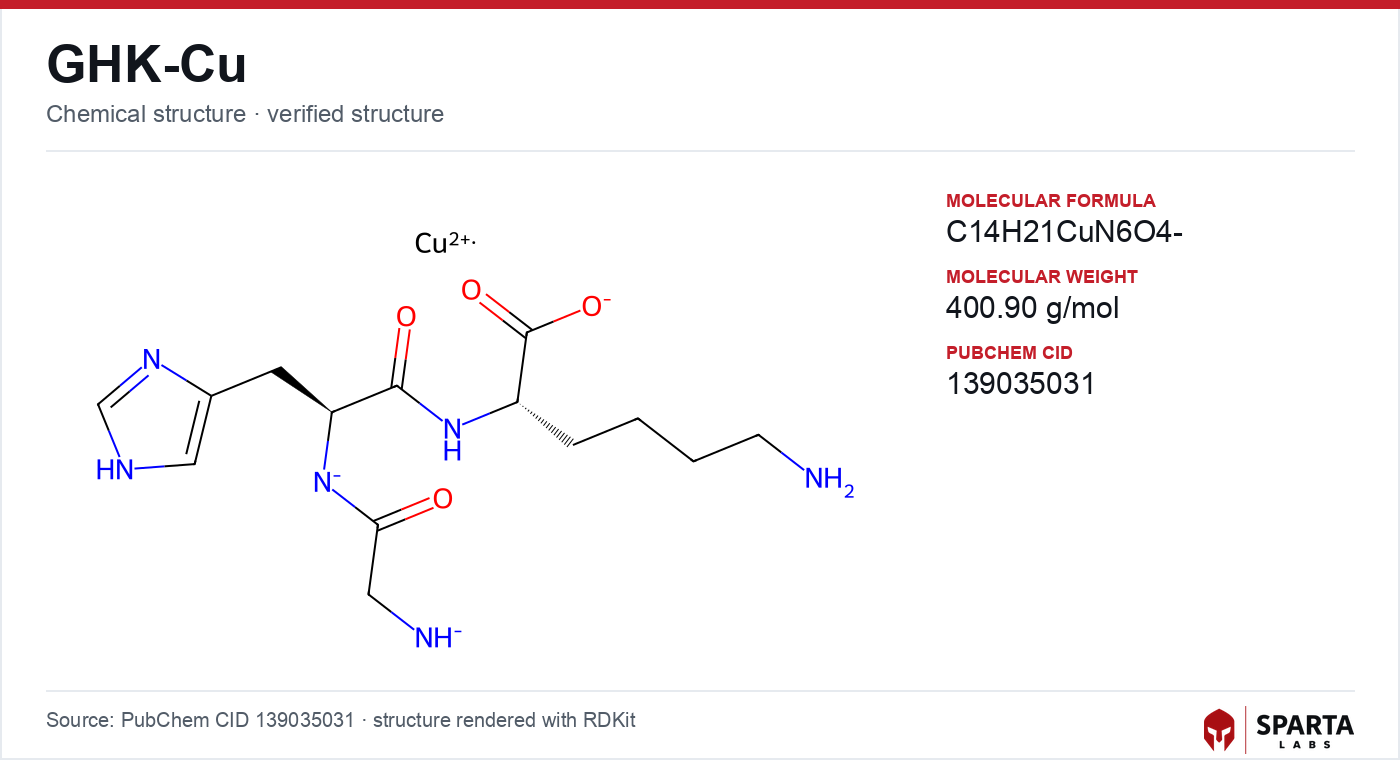
Figure: chemical structure of GHK-Cu.
The Copper-Coordination Chemistry That Governs Identity
GHK was first isolated from human plasma by Loriann Pickart and colleagues, who reported that the tripeptide's activity in early liver-cell studies depended on the presence of copper [1]. That observation established the central fact of the material: GHK and copper(II) associate to form a defined complex with a characteristic geometry, and the geometry is what makes the copper stoichiometry reproducible.
In the GHK-copper(II) complex, the metal ion sits in a coordination environment supplied by the peptide itself. The imidazole nitrogen of the central histidine residue, the terminal amino group of the glycine, and a deprotonated backbone amide nitrogen contribute to the copper-binding site, producing a stable chelate at physiological pH. Findings from research models do not establish safety or efficacy in humans. Sparta Labs makes no claims about the use of this compound.
Two practical consequences follow for sourcing. First, because the binding site is defined by specific residues, an intact and correctly folded GHK sequence is a prerequisite for correct copper coordination; a deletion or racemization defect can perturb the metal site. Second, the complex has spectroscopic signatures the metal-free peptide lacks, which gives analysts an independent handle on identity beyond peptide mass alone. The reported binding behavior of GHK toward copper has been characterized in coordination-chemistry studies of amino-terminal Cu(II)-binding motifs, of which the histidine-containing GHK sequence is a well-studied example [2].
Manufacturing: Building the Peptide, Then Forming the Complex
Production proceeds in two conceptually separate stages. The GHK tripeptide (molecular weight of the free peptide approximately 340 daltons) is assembled first; the copper complex is formed afterward.
The peptide stage uses solid-phase peptide synthesis (SPPS), the method introduced by Merrifield in 1963 [3] and now standard for short-to-medium peptides. In SPPS the chain is built one residue at a time on an insoluble resin through repeated coupling and deprotection cycles, giving precise control over sequence, chain length, and stereochemistry. Because GHK contains L-histidine and L-lysine, chirality control during synthesis is directly relevant to whether the finished peptide can form the intended copper site. The scalability and reproducibility of SPPS for peptides of this size are documented in the large-scale synthesis literature [4].
After cleavage from the resin, the crude peptide is purified by preparative reversed-phase HPLC. Only then is copper introduced: the purified GHK peptide is combined with a copper(II) salt under controlled conditions to form the complex in a target 1:1 metal-to-peptide ratio, after which the material is lyophilized to a dry solid. Separating the copper-incorporation step from synthesis is deliberate, because it is the step whose outcome the identity assays must confirm. The same two-stage logic and the analytical checkpoints it demands are discussed for other metal-sensitive research peptides in the TB-500 sourcing and quality reference.
Verifying the Peptide: HPLC Purity and Mass Identity
Peptide-level quality is assessed by analytical HPLC and mass spectrometry, the same core methods used across the research-peptide sector.
Reversed-phase HPLC with ultraviolet detection quantifies the target peptide as a percentage of total UV-absorbing material. A result of 98 percent means the target accounts for 98 percent of the detected peak area, with the balance comprising related impurities, deletion sequences, and other absorbing species. The prevailing standard for research-use synthetic peptides is HPLC purity of at least 98 percent, and Sparta Labs applies that threshold to the GHK component. Reversed-phase methods and their application to peptide purity are treated in standard analytical references [5].
Mass spectrometry then confirms molecular identity. HPLC establishes chromatographic behavior but cannot by itself distinguish isomers or verify molecular formula; mass spectrometry supplies the orthogonal confirmation that the observed species matches the calculated mass. For GHK-Cu this measurement does double duty, because the intact copper complex has a distinct mass and a recognizable copper isotope envelope, so the same technique that confirms peptide identity also reports on copper incorporation.
Verifying the Copper Complex: Stoichiometry and Spectroscopy
The verification unique to GHK-Cu is confirmation that copper is present in the correct amount and correctly bound. Three lines of evidence address this.
- Mass spectrometry of the intact complex. The copper-tripeptide species resolves at its expected mass with copper's characteristic two-isotope pattern, distinguishing the formed complex from free GHK.
- Ultraviolet-visible spectroscopy. The Cu(II) complex exhibits a d-d absorption band in the visible region that the metal-free peptide does not, providing a rapid qualitative check that a copper complex has formed and an indication of its coordination environment [2].
- Elemental copper quantitation. Measuring copper content against peptide content establishes the metal-to-peptide ratio and flags material that is copper-deficient or contains excess free copper.
These are not interchangeable with peptide purity. A batch of sequence-perfect GHK with no copper would pass an HPLC purity test yet fail to be GHK-Cu. Treating copper-complex identity as its own checkpoint is what prevents that failure mode, and it is the reason mass spectrometry confirmation is required on every batch rather than treated as optional.
Certificates of Analysis and Batch Traceability
Every batch of GHK-Cu supplied by Sparta Labs is accompanied by a Certificate of Analysis (COA) that records the peptide-level and complex-level results together:
- HPLC purity result with chromatogram for the GHK peptide component
- Mass spectrometry confirmation — observed versus expected mass of the copper-tripeptide complex
- Batch number traceable to synthesis and complexation records
- Manufacturing date
- Expiry date based on stability data for the lyophilized solid
The COA for each batch is accessible from the product page, allowing a researcher to record the specific batch identifier in experimental documentation and cite it for peer review. Batch-specific documentation and current availability are listed on the GHK-Cu product page. Researchers examining why the intact complex rather than the peptide alone is the species of interest may also consult the GHK-Cu mechanism of action reference, which describes the copper-dependent behavior reported in the primary literature.
Storage and Stability of the Copper Complex
GHK-Cu is supplied lyophilized. Freeze-drying removes water under vacuum to produce a dry solid that is generally more stable in storage than a peptide held in solution, a principle established in the solid-state peptide and protein stability literature [6].
Handling considerations specific to a histidyl copper complex follow from its chemistry rather than from any use recommendation:
- Temperature. Long-term storage of the lyophilized solid is appropriate at −20 °C or below; short-term storage at 4 °C is acceptable for dry, sealed material in active handling.
- Light. The histidine imidazole that coordinates copper is also a site sensitive to oxidation, so protection from direct light is consistent with established handling of copper-binding histidyl peptides.
- Moisture. Lyophilized peptides are hygroscopic; containers are best equilibrated to room temperature before opening to avoid condensation on the solid, then resealed promptly.
- Solution stability. Once reconstituted in an appropriate research solvent, copper complexes can be sensitive to buffer composition and pH; single-use aliquoting and low-temperature storage limit degradation from repeated freeze-thaw handling.
Stability beyond the stated expiry has not been evaluated, and material past expiry is not appropriate for research use without independent re-analysis.
Why Copper-Complex Verification Matters for Reproducibility
The reproducibility of GHK-Cu research depends on consistency of the actual species used across experiments and groups. For a metallopeptide, that consistency is not captured by peptide purity alone: identical GHK peptide can yield materially different complexes if copper stoichiometry or coordination differs between batches. Confirmation of the intact copper complex by mass spectrometry, supported where appropriate by spectroscopic and elemental methods, is what ties an experimental result to a defined molecular species.
Sparta Labs's sourcing posture for GHK-Cu — SPPS of the tripeptide, HPLC purity of at least 98 percent on the peptide component, mass spectrometry confirmation of the intact copper complex, and a batch COA accessible per product — is structured around that two-level verification. Researchers are encouraged to review the batch COA before experimental use and to retain the batch number in laboratory records for citation in any resulting publications.
References
-
Pickart L, Thaler MM. Tripeptide in human serum which prolongs survival of normal liver cells and stimulates growth in neoplastic liver. Nat New Biol. 1973;243(124):85–87. PMID: 4349963. View on PubMed
-
Sóvágó I, Ősz K. Metal ion selectivity of oligopeptides. Dalton Trans. 2006;(32):3841–3854. PMID: 16896447. View on PubMed
-
Merrifield RB. Solid phase peptide synthesis. I. The synthesis of a tetrapeptide. J Am Chem Soc. 1963;85(14):2149–2154. DOI: 10.1021/ja00897a025. Full text via DOI
-
Andersson L, Blomberg L, Flegel M, Lepsa L, Nilsson B, Verlander M. Large-scale synthesis of peptides. Biopolymers. 2000;55(3):227–250. PMID: 10803528. View on PubMed
-
Aguilar MI. HPLC of Peptides and Proteins: Methods and Protocols. Methods in Molecular Biology, vol. 251. Totowa (NJ): Humana Press; 2004. Source: link.springer.com
-
Chang LL, Pikal MJ. Mechanisms of protein stabilization in the solid state. J Pharm Sci. 2009;98(9):2886–2908. PMID: 19089989. View on PubMed
Disclaimer. Statements in this article have not been evaluated by the Food and Drug Administration. This compound is not intended to diagnose, treat, cure, or prevent any disease. Sparta Labs sells research-use-only materials. Content is provided for educational and informational purposes only and does not constitute medical advice. Consult a qualified medical professional for any health concerns.
Frequently asked questions
What makes GHK-Cu quality control different from a plain tripeptide?
GHK-Cu is a metallopeptide: the biologically characterized species is a copper(II) complex of the tripeptide glycyl-L-histidyl-L-lysine, not the free peptide alone. Manufacturing therefore has two verification burdens rather than one: confirming the peptide sequence and purity, and confirming that copper has been incorporated in the correct 1:1 stoichiometry. Analysis that stops at peptide purity does not characterize the metal complex, so identity confirmation of the copper species is treated as a separate quality checkpoint.
How is the copper content of GHK-Cu confirmed?
Copper incorporation is assessed through mass spectrometry, which resolves the intact copper-tripeptide species at its expected mass and characteristic copper isotope pattern, and can be complemented by ultraviolet-visible spectroscopy, since the Cu(II) complex shows a distinctive absorption band absent in the metal-free peptide. Elemental copper quantitation methods can further establish the copper-to-peptide ratio. Together these methods distinguish correctly formed GHK-Cu from free GHK or a mixture with an incorrect metal ratio.
What purity standard applies to GHK-Cu research material?
The prevailing standard for research-use synthetic peptides is reversed-phase HPLC purity of at least 98 percent, and Sparta Labs applies that threshold to the GHK peptide component of GHK-Cu. HPLC quantifies the target relative to related impurities and deletion sequences, while mass spectrometry confirms molecular identity. Because HPLC of the copper complex is influenced by copper coordination, peptide purity and copper-complex identity are reported as complementary measurements rather than a single number.
What information appears on a GHK-Cu Certificate of Analysis?
A Sparta Labs Certificate of Analysis for GHK-Cu records the HPLC purity result with chromatogram, mass spectrometry confirmation comparing observed and expected mass of the copper-tripeptide complex, the unique batch number, the manufacturing date, and an expiry date based on stability data for the lyophilized solid. The COA for each batch is accessible from the product page and supports traceability in laboratory records and publications.
Why is GHK-Cu supplied as a lyophilized solid?
Lyophilization removes water under vacuum to yield a dry solid that is generally more stable in storage than a peptide in solution. General peptide-chemistry literature indicates that the solid state slows hydrolytic and oxidative degradation pathways. For GHK-Cu the histidine imidazole that coordinates copper is also a site sensitive to oxidation, so storing the dry material cold and protected from light is consistent with established handling of copper-binding histidyl peptides.