
Mazdutide: Sourcing, Purity, and Verification Standards
Mazdutide is an oxyntomodulin-derived GLP-1R/GCGR peptide carrying a lipidated side chain. This reference examines the analytical demands that structure places on synthesis, purity verification, and batch documentation. Educational reference.

For research use only. Not for human consumption. This article is educational reference material. It is not medical advice and is not a recommendation to use any substance.
Introduction
Mazdutide is a synthetic 39-amino-acid peptide classified as a dual agonist at the glucagon-like peptide-1 receptor (GLP-1R) and the glucagon receptor (GCGR). Its sequence is derived from oxyntomodulin, a naturally occurring gut peptide that engages both receptors, and it carries a covalently attached lipophilic side chain that is characteristic of long-acting acylated peptides. That combination of a moderately long sequence and a site-specific chemical modification is what shapes every sourcing and quality question that follows. For a broader treatment of the compound's classification and development, see the mazdutide research overview; the receptor pharmacology is discussed in the mazdutide mechanism of action article. This article focuses on the manufacturing, analytical, and documentation practices that determine whether a given lot of mazdutide is what its label says it is.
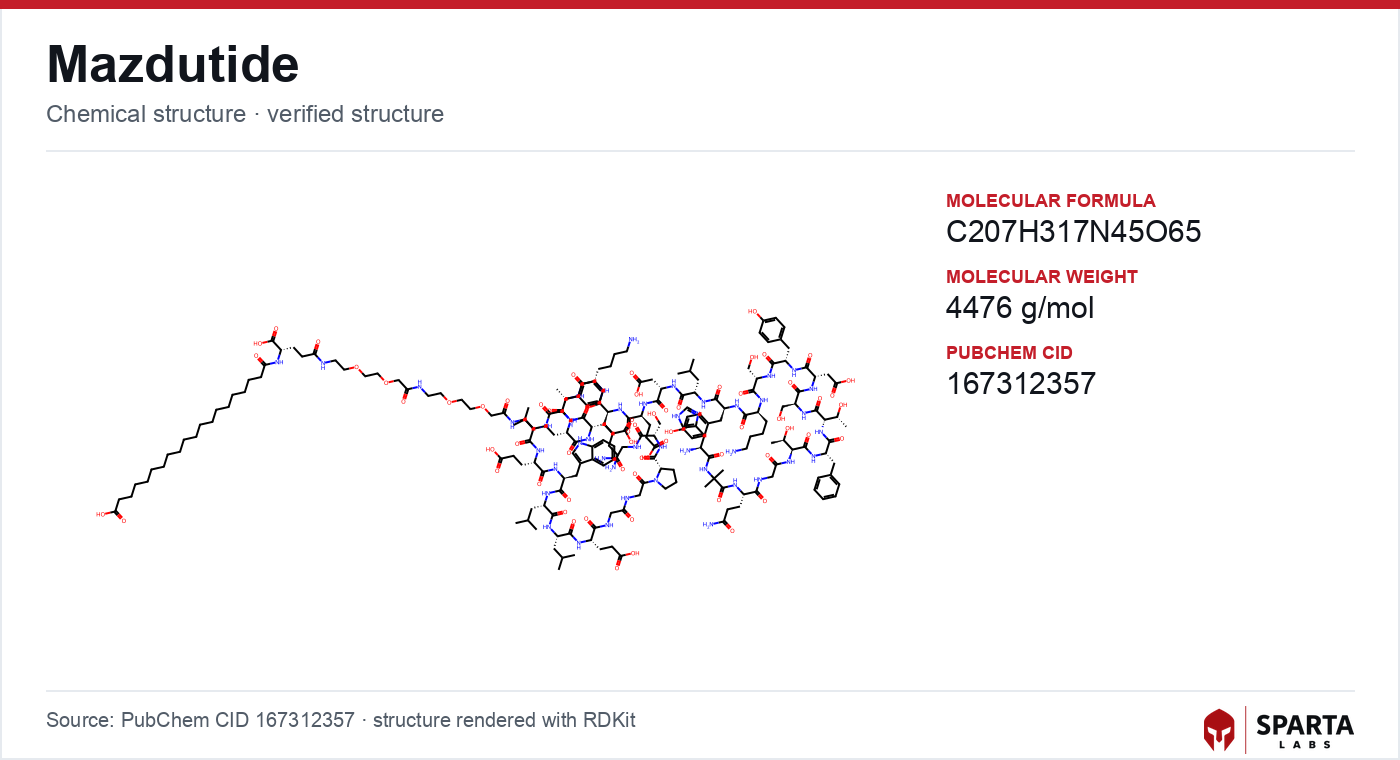
Figure: chemical structure of Mazdutide.
The Molecule That Has to Be Verified
Quality control for mazdutide begins with understanding exactly what has to be confirmed. Three attributes define the target species. First, the 39-residue peptide backbone based on the oxyntomodulin scaffold must be assembled in the correct sequence, without truncations or amino-acid deletions. Second, a fatty-diacid side chain must be attached at a defined position, generally through a spacer, giving the molecule the amphiphilic character associated with albumin binding in acylated peptides. Third, the material must be free of the reagents and byproducts introduced during synthesis and purification.
Each of these is a separate analytical question, and a lot can pass one while failing another. A sample can be chromatographically pure yet carry an acylation on the wrong residue; it can have the right total mass yet contain a deletion sequence that a low-resolution method does not resolve. This is why identity confirmation for a conjugated peptide is treated as a multi-attribute exercise rather than a single pass/fail number.
Solid-Phase Synthesis and the Acylation Step
The dominant route to research-grade peptides of this size is solid-phase peptide synthesis (SPPS), the method introduced by Robert Bruce Merrifield in 1963, for which he received the Nobel Prize in Chemistry in 1984 [1]. In SPPS the chain is built one residue at a time on an insoluble resin support, with protection and deprotection cycles controlling which reactive group participates at each coupling. For a 39-residue target, the cumulative efficiency of those cycles governs how much full-length product survives relative to deletion and truncation sequences, and it is a central reason longer peptides are more demanding to make cleanly.
Large-scale and research-grade production of complex peptides depends as much on downstream processing as on the coupling chemistry itself. Andersson and colleagues surveyed the practical challenges of scaling peptide synthesis, including the purification and analytical burden that grows with sequence length and chemical modification [2]. For mazdutide, the acylation that installs the fatty-diacid side chain is an additional controlled reaction that must be driven to completion and confirmed to be site-specific. The chemistry of that lipidation strategy is well documented in the acylated GLP-1 literature; the discovery report for semaglutide describes the design logic of a fatty-diacid albumin-binding motif attached through a linker, a strategy that underlies this structural class [3]. A separate treatment of an acylated GLP-1 compound's sourcing appears in the semaglutide sourcing and quality reference.
Findings from research models do not establish safety or efficacy in humans. Sparta Labs makes no claims about the use of this compound.
Purity and Identity: Two Different Measurements
The reference measure of peptide purity is reverse-phase HPLC purity, expressed as the target species as a percentage of total UV-absorbing material in the chromatogram. A working convention for research-grade synthetic peptides is a purity specification at or above 98 percent, and that is the threshold applied to mazdutide as a research material. Chromatographic purity, however, describes how much of one thing is present relative to everything else the detector sees; it does not establish what that thing is.
Molecular identity is confirmed by mass spectrometry, typically electrospray ionization mass spectrometry (ESI-MS) or matrix-assisted laser desorption/ionization time-of-flight (MALDI-TOF). The observed molecular weight is compared with the theoretical value calculated for the complete acylated 39-residue sequence. For a conjugate, this comparison does double duty: it confirms the peptide backbone and, through the mass contributed by the side chain, provides evidence that the fatty-diacid acylation was incorporated. A discrepancy at this stage flags a sequence error, an incomplete conjugation, or a contaminant, and it is the reason mass-spectrometry data sits alongside the chromatographic number rather than in place of it.
Residual Reagents and Endotoxin
Beyond identity and purity, a research-grade peptide must account for the materials that touch it during synthesis and purification. Trifluoroacetic acid (TFA) is commonly used as a counterion and mobile-phase additive in SPPS and reverse-phase purification, and residual TFA is assessed because it can interfere with sensitive cell-based assays. Residual organic solvents from processing, such as acetonitrile and dimethylformamide, are evaluated by standard analytical methods.
For material intended for in vivo research, endotoxin content is a further consideration. The bacterial endotoxins test, standardized as United States Pharmacopeia general chapter <85>, uses limulus amebocyte lysate (LAL) methodology to quantify endotoxin against defined limits [4]. Endotoxin contamination can confound immunological and inflammatory readouts independently of the peptide itself, which is why this attribute is assessed separately from chemical purity.
Batch Documentation and the Certificate of Analysis
The analytical work described above becomes usable only when it is tied to a specific production lot. A Certificate of Analysis (COA) is the batch-specific record that carries that information. For mazdutide, a COA typically reports reverse-phase HPLC purity with reference to the chromatographic trace, observed versus theoretical mass from mass spectrometry, a unique batch number, manufacturing and expiry dates, and identification of the laboratory that performed the analysis. Because it is lot-specific, a COA is not a general product claim but a documented result for the exact material a researcher receives.
Batch documentation and purity specifications for mazdutide from Sparta Labs are referenced on the product page, and the batch-specific COA can be associated with an order. Independent third-party analysis provides a verification layer separate from the manufacturing facility, which addresses the general risk that in-house quality control can miss systematic errors in synthesis, purification, or record-keeping. Lots that do not meet the stated analytical specifications are not released.
Storage and Stability Considerations
Mazdutide is supplied as a lyophilized (freeze-dried) powder. Lyophilization lowers water activity, which slows hydrolytic degradation, oxidation of susceptible residues, and other non-enzymatic modifications relative to storage in solution. General handling principles for lyophilized peptides apply: cold storage, protection from light and moisture, and a sealed container until use.
The amphiphilic character conferred by the fatty-diacid side chain is the same feature that supports albumin association in acylated peptides, and it is a reason aggregation behavior on reconstitution receives attention for this structural class. No peer-reviewed stability study specific to lyophilized mazdutide powder was identified at the time of writing, so stability expectations are informed by the general behavior of acylated peptides rather than by compound-specific data. The expiry date on a COA reflects the conditions under which the analytical specifications were verified; storage outside those conditions can shorten the interval over which the specifications hold.
Why Material Quality Governs Reproducibility
The interpretability of a peptide experiment cannot exceed the certainty about the material used to run it. A compound of uncertain identity or purity tested in a receptor-binding assay or an animal model yields data of correspondingly uncertain validity, and no downstream statistical rigor recovers that. A broad survey of researchers by Baker, published in Nature, documented widespread difficulty reproducing published biomedical results and identified inadequately characterized reagents and materials among the contributing factors [5]. The principle transfers directly to synthetic peptides: characterized starting material is a precondition for reproducible work, not an optional add-on.
For a conjugated peptide such as mazdutide, that characterization means the joint use of chromatographic purity to bound the impurity content and mass spectrometry to confirm both the sequence and the acylation, supported by residual-reagent and, where relevant, endotoxin testing, and recorded in a batch-specific COA. Documented, verifiable identity and purity are what allow a researcher to attribute an observed result to the intended compound rather than to an uncontrolled variable in the starting material.
References
-
Merrifield RB. Solid phase peptide synthesis. I. The synthesis of a tetrapeptide. J Am Chem Soc. 1963;85(14):2149-2154. DOI: 10.1021/ja00897a025. Full text via DOI
-
Andersson L, Blomberg L, Flegel M, Lepsa L, Nilsson B, Verlander M. Large-scale synthesis of peptides. Biopolymers. 2000;55(3):227-250. PMID: 11074421. DOI: 10.1002/1097-0282(2000)55:3<227::AID-BIP30>3.0.CO;2-7. View on PubMed
-
Lau J, Bloch P, Schäffer L, Pettersson I, Spetzler J, Kofoed J, et al. Discovery of the once-weekly glucagon-like peptide-1 (GLP-1) analogue semaglutide. J Med Chem. 2015;58(18):7370-7380. PMID: 26308095. DOI: 10.1021/acs.jmedchem.5b00726. View on PubMed
-
United States Pharmacopeia. General Chapter <85> Bacterial Endotoxins Test. USP-NF. Source: usp.org
-
Baker M. 1,500 scientists lift the lid on reproducibility. Nature. 2016;533(7604):452-454. PMID: 27225100. DOI: 10.1038/533452a. View on PubMed
Disclaimer. Statements in this article have not been evaluated by the Food and Drug Administration. This compound is not intended to diagnose, treat, cure, or prevent any disease. Sparta Labs sells research-use-only materials. Content is provided for educational and informational purposes only and does not constitute medical advice. Consult a qualified medical professional for any health concerns.
Frequently asked questions
What structural features of mazdutide make its analytical verification demanding?
Mazdutide is a 39-residue peptide built on the oxyntomodulin scaffold and carrying a lipophilic fatty-diacid side chain attached through a glutamate-based linker. Both the length of the sequence and the site-specific conjugation must be confirmed, which requires mass-spectrometry data in addition to chromatographic purity. A peptide of the correct mass could still carry an incomplete or misplaced acylation, so identity testing looks at more than one attribute.
Why is mass spectrometry used alongside HPLC for a conjugated peptide like mazdutide?
Reverse-phase HPLC reports how much of the sample is the target species relative to other UV-absorbing material, but it does not by itself prove the molecular identity. Mass spectrometry, typically ESI-MS or MALDI-TOF, supplies the observed molecular weight that is compared against the theoretical value for the full acylated sequence. For an albumin-binding conjugate, this comparison is the step that confirms the fatty-diacid moiety was installed as intended.
What does a Certificate of Analysis for mazdutide document?
A Certificate of Analysis is a batch-specific record. For mazdutide it typically reports reverse-phase HPLC purity with a referenced chromatographic trace, observed versus theoretical mass from mass spectrometry, a unique batch number, manufacturing and expiry dates, and identification of the analytical laboratory. The document is the evidentiary basis for the stated identity and purity of a given production lot.
How does the lipidated side chain affect handling of lyophilized mazdutide?
The fatty-diacid side chain gives mazdutide an amphiphilic character, which is the same feature that supports albumin binding in the broader acylated-peptide literature. Lyophilized powder is generally stored cold, sealed, and protected from light and moisture. The amphiphilic nature is a reason aggregation behavior on reconstitution receives attention for peptides in this structural class.