
Cagrilintide: Published Research
A literature-anchored walk through cagrilintide's published record, from the acylated amylin-analog design that solved fibrillation, to the Phase 1b and Phase 2 combination trials, the Phase 3 REDEFINE readouts, and cryo-EM receptor structures. Educational reference.

For research use only. Not for human consumption. This article is educational reference material. It is not medical advice and is not a recommendation to use any substance.
Introduction
Cagrilintide is a long-acting, acylated analog of human amylin developed by Novo Nordisk and investigated as an amylin- and calcitonin-receptor agonist. Its published record is unusually coherent for a research-stage peptide: a single medicinal-chemistry design paper, a short chain of combination clinical trials, and a set of recent structural studies together explain why the molecule exists in the form it does. This article summarizes that literature in chronological and thematic order, attributing each finding to its original authors and study design. The receptor pharmacology that underlies these studies is treated separately in the cagrilintide mechanism of action article, and the broader chemistry and classification are covered in the cagrilintide research overview.
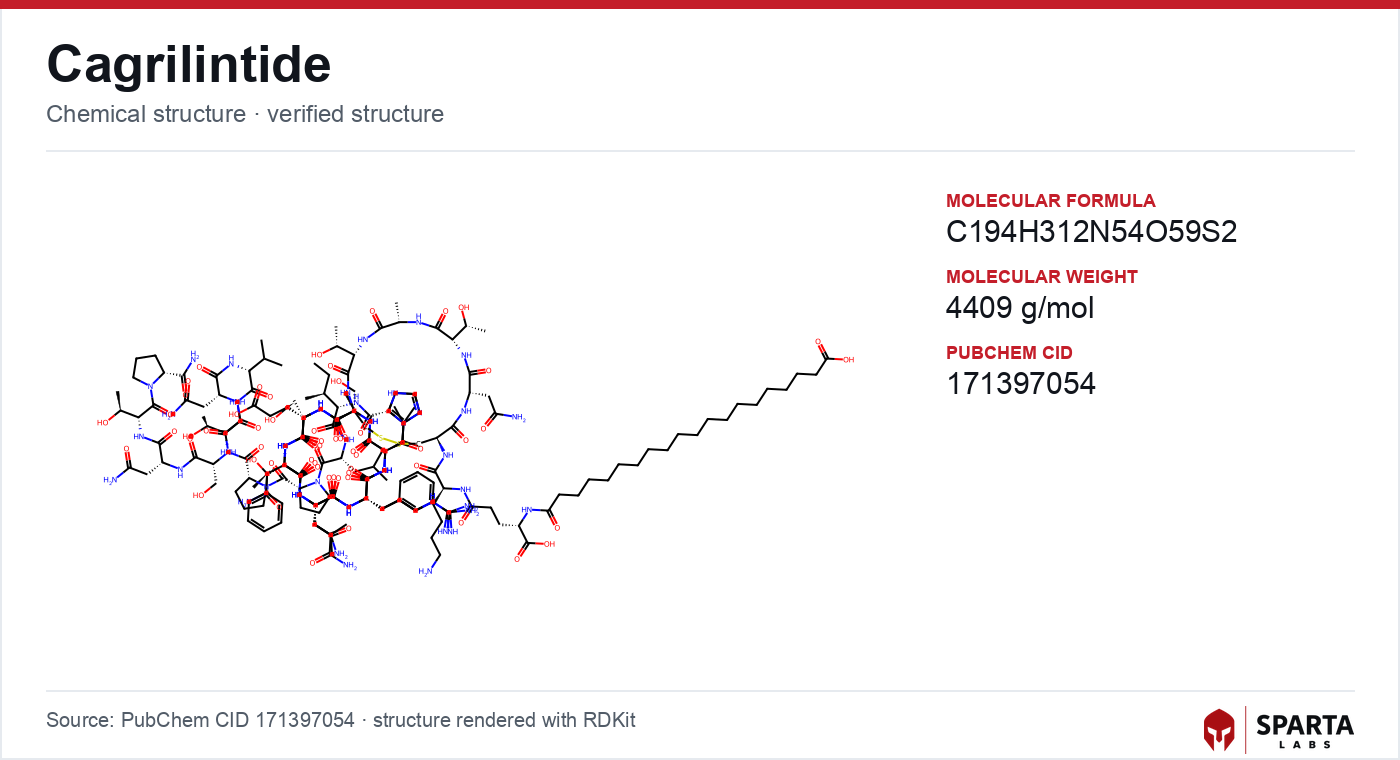
Figure: chemical structure of cagrilintide.
The Design Problem: Amylin's Fibrillation and Short Half-Life
Human amylin, also called islet amyloid polypeptide (IAPP), is co-secreted with insulin from pancreatic beta cells. Two properties of the native peptide make it impractical as a durable pharmacological agent. First, human amylin is aggregation-prone: at pharmaceutical concentrations it readily forms amyloid fibrils, the same class of deposits studied in the context of pancreatic islet pathology. Second, the native peptide is cleared quickly from circulation. The earlier marketed amylin-class agent, pramlintide, is a triple-proline-substituted analog engineered specifically to reduce fibrillation, but it retains a short duration of action.
Cagrilintide's published rationale begins from these two constraints. Any analog intended for infrequent administration had to suppress fibril formation across storage and circulation while simultaneously acquiring a mechanism for prolonged plasma residence. These are, in effect, competing engineering goals, because the hydrophobic modifications that extend half-life can also promote aggregation.
The Medicinal-Chemistry Disclosure (2021)
The primary design paper describing cagrilintide was published by Andreassen and colleagues in the Journal of Medicinal Chemistry in 2021 [1]. The authors reported a structure-activity relationship campaign over a library of acylated amylin analogs derived from the human amylin sequence. Two features are central to the reported design.
The first is sequence stabilization against fibrillation. Substitutions in the amyloidogenic core region were used to disrupt the beta-sheet propensity that drives fibril nucleation, allowing the analog to remain soluble and monomeric at formulation-relevant concentrations. The second is albumin-mediated half-life extension. The authors attached a fatty-acid (lipid) moiety through a hydrophilic linker; the lipid reversibly binds serum albumin, slowing renal clearance and proteolysis in a manner conceptually parallel to the acylation strategy used for several long-acting incretin analogs.
The reported outcome of this campaign was a candidate that retained agonist activity at amylin/calcitonin-family receptors while displaying a markedly extended pharmacokinetic profile in the authors' preclinical models, and reduced food intake in rodent models following administration.
Findings from research models do not establish safety or efficacy in humans. Sparta Labs makes no claims about the use of this compound.
A useful comparison point is the acylation chemistry described for semaglutide by Lau and colleagues in the Journal of Medicinal Chemistry in 2015 [2], which introduced a C18 diacid linked through a spacer to achieve albumin binding on a GLP-1 scaffold. Cagrilintide applies an analogous half-life-extension logic to a different peptide family, which is part of why the two molecules were later studied together.
The Combination-Development Path
A distinctive feature of cagrilintide's clinical literature is that its pivotal trials studied it alongside semaglutide rather than in isolation. The published pharmacological rationale is that amylin-receptor agonism and GLP-1-receptor agonism engage separate signaling systems in the central and peripheral control of energy balance. The GLP-1 side of that pairing is summarized in the semaglutide published research article.
Phase 1b (2021)
Enebo and colleagues published a randomized, placebo-controlled, multiple-ascending-dose Phase 1b trial in The Lancet in 2021 [3]. The trial evaluated escalating levels of cagrilintide administered together with semaglutide in adults with overweight or obesity without diabetes. The authors reported that the combination was generally tolerated across the tested levels, with adverse events predominantly gastrointestinal and graded mild to moderate, and that the pharmacokinetic profile was consistent with once-weekly administration in the trial design. The authors described the profile as supporting further clinical development.
Phase 2 in Type 2 Diabetes (2023)
Frias and colleagues published a randomized, double-blind, active-controlled Phase 2 trial in The Lancet in 2023 [4]. The trial enrolled adults with type 2 diabetes and compared the cagrilintide-plus-semaglutide combination (the investigational combination designated CagriSema) against the individual components. The authors reported greater reductions in body weight and in glycated hemoglobin in the combination arm relative to either monotherapy arm within the trial, with gastrointestinal events again the most frequently reported category. The authors concluded that the data supported advancement to Phase 3.
The REDEFINE Phase 3 Program (2025)
The Phase 3 evidence for the cagrilintide-semaglutide combination was reported under the REDEFINE program in the New England Journal of Medicine in 2025.
REDEFINE 1 evaluated the combination in adults with overweight or obesity without type 2 diabetes over a 68-week design, comparing the combination against the individual components and placebo [5]. The publication reported the estimated mean percent change in body weight from baseline to week 68 for each arm, with the combination arm showing a substantially larger estimated reduction than placebo, and the cagrilintide-alone arm showing an intermediate reduction. Cardiometabolic secondary endpoints, including measures such as waist circumference and blood pressure, were reported directionally in favor of the combination arm.
REDEFINE 2 evaluated the combination in adults with overweight or obesity who also had type 2 diabetes over a comparable 68-week design [6]. The publication reported body-weight and glycemic endpoints that were qualitatively consistent with REDEFINE 1, with the combination arm favored over placebo on the reported measures. Across both trials, the reported safety profile was described as consistent with prior experience for the compound class, with gastrointestinal adverse events predominating.
Readers evaluating these outcomes should note that the REDEFINE readouts describe the combination product; disentangling the amylin-specific contribution from the GLP-1 contribution is one of the interpretive challenges these trials leave open.
The Structural Studies
Alongside the clinical program, structural biology has begun to explain how amylin-class peptides engage their receptor targets. Cryo-electron microscopy work published in 2025 resolved calcitonin- and amylin-family peptides bound to active-state, Gs-coupled receptor complexes and compared their binding modes [7]. This class of work reports that amylin-mimetic peptides adopt characteristic binding poses while inducing receptor-specific conformational dynamics, providing a molecular framework for interpreting the pharmacological differences between newer acylated analogs such as cagrilintide and older peptides in the family. Structural datasets of this kind are typically deposited in public repositories, enabling independent reanalysis.
Knowledge Gaps and Open Questions
Several questions remain underdetermined in the peer-reviewed record. The relative contribution of individual amylin-receptor subtypes to cagrilintide's in vivo profile continues to be an area of active receptor-biology inquiry. Because the pivotal trials studied the combination product, the isolated long-term profile of cagrilintide monotherapy in large populations is less fully characterized than the combination. Head-to-head structural and pharmacological comparisons with other emerging long-acting amylin analogs are an anticipated direction as additional compounds in the class advance. Finally, receptor-occupancy characterization in human tissue at clinically relevant exposures remains an open frontier that will likely be addressed in future publications.
Research-grade cagrilintide from Sparta Labs is supplied with batch-level certificates of analysis for laboratory investigation.
References
-
Andreassen KV, Feigh M, Hjuler ST, Christoffersen BØ, Damgaard M, Rolin B, et al. Development of cagrilintide, a long-acting amylin analogue. J Med Chem. 2021;64(15):11183-11194. DOI: 10.1021/acs.jmedchem.1c00565
-
Lau J, Bloch P, Schäffer L, Pettersson I, Spetzler J, Kofoed J, et al. Discovery of the once-weekly glucagon-like peptide-1 (GLP-1) analogue semaglutide. J Med Chem. 2015;58(18):7370-7380. DOI: 10.1021/acs.jmedchem.5b00726
-
Enebo LB, Berthelsen KK, Kankam M, Lund MT, Rubino DM, Satylganova A, et al. Safety, tolerability, pharmacokinetics, and pharmacodynamics of concomitant administration of multiple doses of cagrilintide with semaglutide 2.4 mg for weight management: a randomised, controlled, phase 1b trial. Lancet. 2021;397(10286):1736-1748. PMID: 33894838. DOI: 10.1016/S0140-6736(21)00845-X
-
Frias JP, Deenadayalan S, Erichsen L, Knop FK, Lingvay I, Macura S, et al. Efficacy and safety of co-administered once-weekly cagrilintide 2.4 mg with once-weekly semaglutide 2.4 mg in type 2 diabetes: a multicentre, randomised, double-blind, active-controlled, phase 2 trial. Lancet. 2023;402(10403):720-730. PMID: 37364590. DOI: 10.1016/S0140-6736(23)01163-7
-
Garvey WT, Blüher M, Kandler K, Kroese M, Rubino DM, Kushner RF, et al. Coadministered cagrilintide and semaglutide in adults with overweight or obesity (REDEFINE 1). N Engl J Med. 2025. DOI: 10.1056/NEJMoa2502081
-
Davies MJ, Bajaj HS, Broholm C, Christiansen E, Fink LN, Hussein Z, et al. Cagrilintide-semaglutide in adults with overweight or obesity and type 2 diabetes (REDEFINE 2). N Engl J Med. 2025. DOI: 10.1056/NEJMoa2502082
-
Cao J, Belousoff MJ, Danev R, Christopoulos A, Wootten D, Sexton PM, et al. Structural insights into peptide recognition by the calcitonin and amylin receptor family. Nat Commun. 2025. DOI: 10.1038/s41467-025-58680-y
Disclaimer. Statements in this article have not been evaluated by the Food and Drug Administration. This compound is not intended to diagnose, treat, cure, or prevent any disease. Sparta Labs sells research-use-only materials. Content is provided for educational and informational purposes only and does not constitute medical advice. Consult a qualified medical professional for any health concerns.
Frequently asked questions
Why was cagrilintide engineered as an acylated amylin analog rather than using native human amylin?
Native human amylin (islet amyloid polypeptide) aggregates into amyloid fibrils and has a very short circulating half-life, which makes it unsuitable as a long-acting agent. Andreassen and colleagues (J Med Chem, 2021) reported a design campaign that combined sequence substitutions to suppress fibrillation with a fatty-acid acylation that promotes albumin binding, yielding a molecule with a much longer reported plasma half-life in their preclinical models.
What clinical trials have been published for cagrilintide?
Published clinical evidence includes a Phase 1b multiple-ascending-dose trial reported by Enebo and colleagues (Lancet, 2021) and a Phase 2 trial in type 2 diabetes reported by Frias and colleagues (Lancet, 2023), both studying cagrilintide together with semaglutide. The Phase 3 REDEFINE program in adults with overweight or obesity was subsequently reported in the New England Journal of Medicine in 2025.
What is CagriSema in the published literature?
CagriSema is the investigational fixed-combination of cagrilintide with the GLP-1 receptor agonist semaglutide studied across the Phase 2 and Phase 3 REDEFINE trials. The published rationale is that an amylin-receptor agonist and a GLP-1 receptor agonist engage distinct but complementary signaling systems. The GLP-1 side of that combination is summarized in the semaglutide research article.
What have structural studies reported about how cagrilintide engages its receptors?
Cryo-electron microscopy work published in 2025 resolved cagrilintide and related peptides bound to active-state calcitonin and amylin receptor complexes and compared their binding modes. The authors reported that cagrilintide adopts an amylin-like pose while inducing receptor-specific conformational dynamics, offering a structural framework for interpreting its pharmacology.