
Cagrilintide Mechanism of Action
A chemistry-first account of cagrilintide's reported pharmacology: how its lipidation, backbone substitutions, and pH-neutral design map onto the calcitonin/amylin (RAMP) receptor family described in peer-reviewed literature. Educational reference.

For research use only. Not for human consumption. This article is educational reference material. It is not medical advice and is not a recommendation to use any substance.
Introduction
Cagrilintide is a long-acting, lipidated analog of the pancreatic hormone amylin (islet amyloid polypeptide, IAPP). Its reported pharmacology is best understood not as a single receptor interaction but as engagement with an entire receptor family: the calcitonin receptor (CTR) and the amylin receptors, which are assembled from CTR together with accessory subunits called receptor activity-modifying proteins (RAMPs). This article approaches the compound from its chemistry, tracing how specific structural modifications relate to the receptor biology described in peer-reviewed literature. A parallel account of the compound's classification and history is available in the cagrilintide research overview.
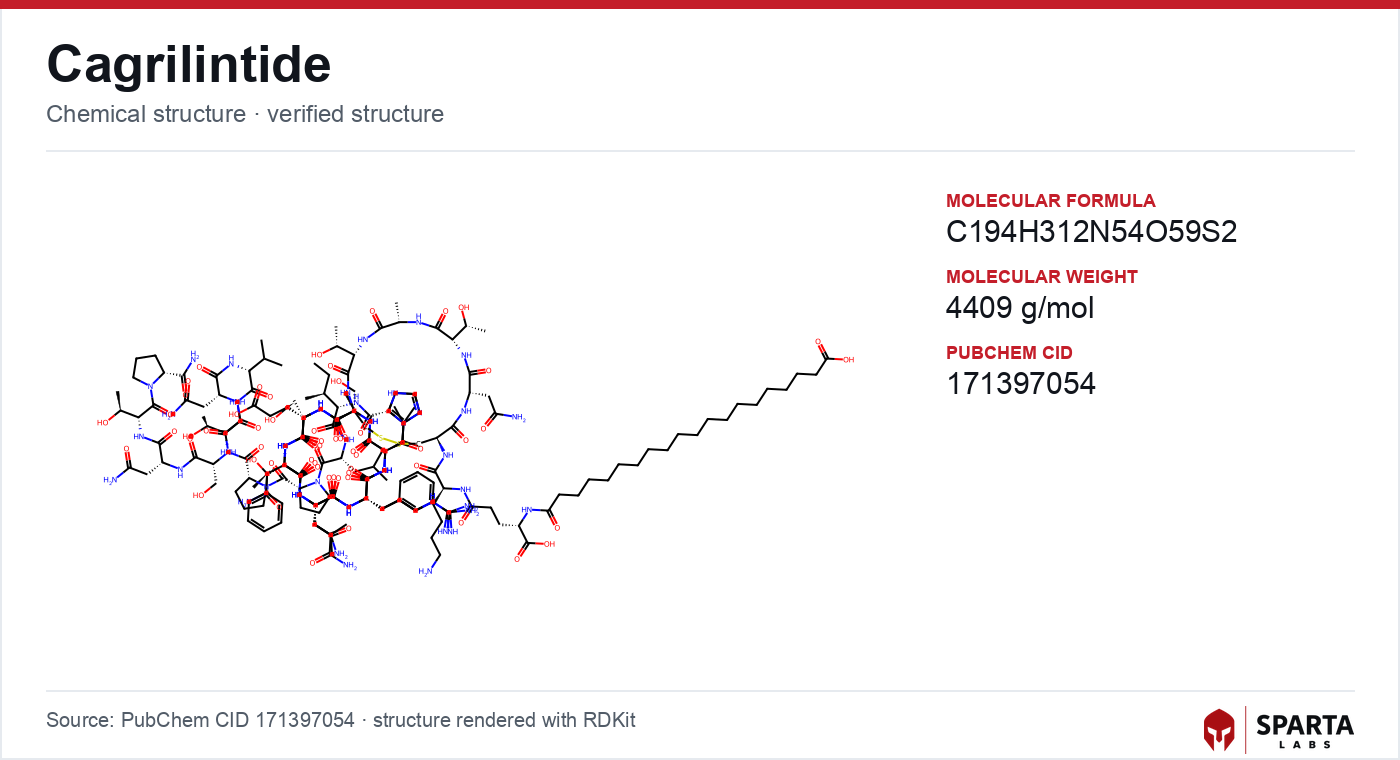
Figure: chemical structure of Cagrilintide.
The amylin receptor is a heterodimer, not a single protein
A defining feature of amylin pharmacology is that no dedicated "amylin receptor" gene exists. Instead, the amylin receptors are generated when the calcitonin receptor, a class B (secretin-family) G protein-coupled receptor, associates with a RAMP. This modular architecture was first uncovered for the closely related calcitonin gene-related peptide (CGRP) receptor: McLatchie and colleagues reported in 1998 that RAMP1 is required to transport the calcitonin-receptor-like receptor to the cell surface and to present it as a functional CGRP receptor, establishing RAMPs as accessory proteins that determine the pharmacology of this receptor class.[1]
The same principle governs the amylin receptors. The three RAMP subunits combine with CTR to form three complexes:
- AMY1R — CTR + RAMP1
- AMY2R — CTR + RAMP2
- AMY3R — CTR + RAMP3
Hay and colleagues reviewed the molecular composition and pharmacology of these complexes and reported that incorporation of a RAMP into the CTR complex is required for the characteristic high-affinity amylin binding phenotype, whereas the calcitonin receptor expressed alone shows substantially lower amylin potency.[2] The RAMP contributes part of the extracellular ligand-binding surface, which is why the identity of the RAMP subunit shapes the pharmacology of the resulting receptor.
Findings from research models do not establish safety or efficacy in humans. Sparta Labs makes no claims about the use of this compound.
Downstream signaling: Gs coupling and cyclic AMP
At the intracellular level, the calcitonin receptor and the amylin receptor complexes couple primarily to the stimulatory G protein Gs. Agonist binding activates adenylyl cyclase, raising intracellular cyclic AMP (cAMP), the canonical second messenger for this receptor family, and can additionally engage other pathways depending on cellular context.[3] Because the RAMP subunit modifies both ligand affinity and the conformation of the receptor complex, the three amylin receptor subtypes are not pharmacologically interchangeable even when presented with the same ligand. This subtype heterogeneity is a recurring theme in the calcitonin-receptor-family literature and is one reason amylin-class agonists are characterized against a panel of receptors rather than a single target.
From native amylin to an engineered peptide
Human amylin is a 37-residue peptide co-secreted with insulin from pancreatic beta cells. Two properties of the native molecule limit its usefulness as a research tool: it is highly prone to self-aggregation into amyloid fibrils, and it has a short circulating half-life. Structure-based engineering has therefore aimed to preserve amylin's receptor-binding character while removing its liabilities.
The medicinal-chemistry account of cagrilintide by Kruse and colleagues described the molecule as a long-acting amylin analog designed for improved solubility and stability at neutral pH and for an extended duration of action.[4] Two categories of modification are central to its design:
Sequence substitutions for stability
The native amylin backbone was modified with amino-acid substitutions that reduce the aggregation tendency of the parent peptide and improve its behavior in solution at physiological pH. These changes address the amyloidogenic character of human amylin while retaining the residues important for engaging the CTR/RAMP complexes, so that the analog is reported to behave as an amylin-like agonist across the receptor family rather than switching selectivity toward the calcitonin receptor.[4]
Lipidation for albumin binding
Cagrilintide carries a fatty-acid (lipid) side chain attached through a linker to the peptide. Acylation of this kind is a well-established half-life-extension strategy in peptide chemistry: the lipid moiety binds reversibly to serum albumin, forming a circulating depot that slows renal filtration and prolongs exposure. Kruse and colleagues attributed cagrilintide's markedly longer duration of action, relative to unmodified amylin and to the earlier non-acylated analog pramlintide, largely to this albumin-mediated pharmacokinetic effect rather than to a fundamentally different receptor mechanism.[4] The same lipidation logic underlies several long-acting incretin analogs, providing a useful chemical parallel discussed in the tirzepatide mechanism of action article.
Structure–activity relationships across the receptor family
Because cagrilintide engages CTR and all three amylin receptor subtypes, its structure–activity profile is inherently multidimensional. In the calcitonin-receptor family, agonist peptides are understood through the "two-domain" model: the peptide's C-terminal region docks into the extracellular domain of the receptor complex, contributing affinity and selectivity, while the N-terminal region inserts into the transmembrane bundle to trigger activation and G protein coupling. RAMP subunits sit at the extracellular domain interface, which is why different RAMPs alter the affinity of the same peptide.[2] Cagrilintide's substitutions and lipid attachment site were selected to remain compatible with this binding geometry, so that the analog is reported to retain amylin-like engagement while gaining extended pharmacokinetics.[4]
An important consequence of this pharmacology is that cagrilintide is not a single-target agonist. Its profile reflects the summed contributions of CTR and the three RAMP-defined complexes, and the relative weighting of those contributions is a subject of ongoing receptor-pharmacology research. The broader classification of amylin analogs within incretin-adjacent pharmacology is discussed in the mazdutide mechanism of action article, which covers a distinct but comparable multi-receptor design strategy.
Limits of current understanding
Several aspects of cagrilintide's mechanism remain incompletely characterized. The precise contribution of each amylin receptor subtype to the compound's overall pharmacology, and how peripheral versus central receptor populations weight that contribution, are active questions in receptor biology. The extent to which RAMP identity biases signaling between the cAMP pathway and other downstream effectors for this ligand is also an emerging area of structural and biophysical study. As with all research-model findings, results obtained in cell systems and animal models do not translate directly to human physiology, and the neutral academic reading of the current literature is that cagrilintide's mechanism is understood in outline but not in full molecular detail.
Batch-level analytical characterization is a prerequisite for reproducible receptor-pharmacology work; the cagrilintide sourcing and quality article outlines the identity and purity documentation relevant to laboratory use. Research-grade cagrilintide from Sparta Labs is supplied with batch-specific analytical data for investigational use.
References
-
McLatchie LM, Fraser NJ, Main MJ, Wise A, Brown J, Thompson N, et al. RAMPs regulate the transport and ligand specificity of the calcitonin-receptor-like receptor. Nature. 1998;393(6683):333–339. PMID: 9620797. DOI: 10.1038/30666. View on PubMed
-
Hay DL, Christopoulos G, Christopoulos A, Sexton PM. Amylin receptors: molecular composition and pharmacology. Biochem Soc Trans. 2004;32(Pt 5):865–867. PMID: 15494035. DOI: 10.1042/BST0320865. View on PubMed
-
Hay DL, Garelja ML, Poyner DR, Walker CS. Update on the pharmacology of calcitonin/CGRP family of peptides: IUPHAR Review 25. Br J Pharmacol. 2018;175(1):3–17. PMID: 29059473. DOI: 10.1111/bph.14075. View on PubMed
-
Kruse T, Hansen JL, Dahl K, Schäffer L, Sensfuss U, Poulsen C, et al. Development of cagrilintide, a long-acting amylin analogue. J Med Chem. 2021;64(15):11183–11194. PMID: 34288673. DOI: 10.1021/acs.jmedchem.1c00565. View on PubMed
Disclaimer. Statements in this article have not been evaluated by the Food and Drug Administration. This compound is not intended to diagnose, treat, cure, or prevent any disease. Sparta Labs sells research-use-only materials. Content is provided for educational and informational purposes only and does not constitute medical advice. Consult a qualified medical professional for any health concerns.
Frequently asked questions
What receptors does cagrilintide act on?
Published pharmacology describes cagrilintide as a non-selective agonist at the calcitonin receptor (CTR) and at the three amylin receptor complexes, AMY1R, AMY2R and AMY3R. Each amylin receptor is a heterodimer of the CTR core with one of the receptor activity-modifying proteins (RAMP1, RAMP2 or RAMP3). These are class B G protein-coupled receptors.
Why is cagrilintide described as long-acting?
Cagrilintide carries a fatty-acid (lipid) chain attached to the peptide backbone. In the amylin-analog literature, this type of acylation promotes reversible binding to serum albumin, which slows renal clearance and extends the circulating half-life relative to unmodified amylin and to first-generation analogs such as pramlintide, as reported in the medicinal-chemistry account of the molecule.
How does the amylin receptor generate an intracellular signal?
The calcitonin receptor and the amylin receptor complexes couple primarily to the stimulatory G protein Gs. Agonist binding activates adenylyl cyclase and raises intracellular cyclic AMP (cAMP), the classic second messenger for this receptor family. RAMP identity influences ligand affinity and receptor pharmacology, a principle first established for the related CGRP receptor.
How is cagrilintide different from native human amylin at the molecular level?
Native human amylin is prone to aggregation and has a short circulating life. Cagrilintide's sequence was engineered with substitutions that improve solubility and stability at neutral pH, together with a lipid side chain for albumin binding. These modifications are reported to preserve amylin-like receptor engagement while extending pharmacokinetics, according to the peer-reviewed discovery literature.