
Glutathione: Sourcing, Purity, and Verification Standards
A sourcing reference for glutathione (GSH): biotechnological fermentation and synthetic routes, the redox-active thiol, GSH/GSSG state, and the analytical methods that verify identity, purity, and oxidation. Educational reference.
For research use only. Not for human consumption. This article is educational reference material. It is not medical advice and is not a recommendation to use any substance.
Why Glutathione Is an Atypical Sourcing Problem
Most compounds in a research-peptide catalog are conventional α-linked peptides assembled residue-by-residue on a synthesizer. Glutathione (GSH; γ-L-glutamyl-L-cysteinyl-glycine, CAS 70-18-8) is the exception that makes the sourcing discussion worth writing separately. It is a small tripeptide of roughly 307.3 daltons, but two structural features set it apart for anyone concerned with material quality: an unusual γ-glutamyl (isopeptide) bond, and a redox-active free thiol on its central cysteine. Both features shape how the compound is manufactured, which analytical methods are diagnostic, and what a Certificate of Analysis should actually report.
This article describes the production routes documented for glutathione, the analytical methods that confirm its identity and characterize its oxidation state, how independent verification fits into batch release, and what a Sparta Labs Certificate of Analysis contains for this compound.
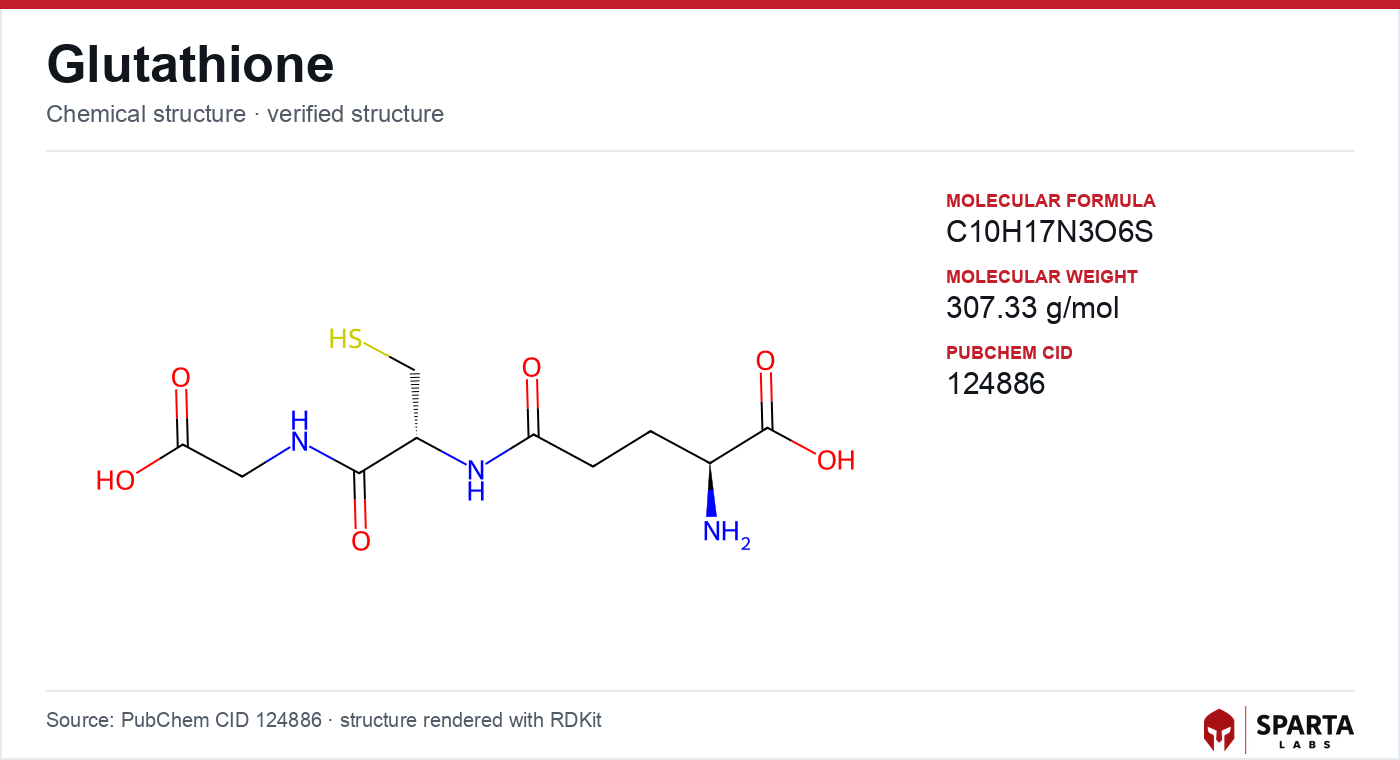
Figure: chemical structure of Glutathione.
The γ-Glutamyl Bond and What It Dictates
In an ordinary peptide, each amide bond joins the α-carboxyl of one residue to the α-amino group of the next. Glutathione breaks that pattern at its first linkage: glutamate is joined to cysteine through the side-chain γ-carboxyl, not the α-carboxyl. This isopeptide bond is the defining structural feature of glutathione and the reason the molecule resists most cellular peptidases, which recognize only α-peptide bonds. Meister and Anderson's foundational review of glutathione biochemistry describes this γ-glutamyl linkage and the dedicated enzymatic machinery that forms it [1].
The practical consequence for sourcing is that glutathione cannot simply be assembled by the standard automated α-amide coupling chemistry used for most research peptides without specific attention to forming the γ-linkage. In living systems the bond is installed by γ-glutamylcysteine synthetase (glutamate-cysteine ligase) followed by glutathione synthetase, both ATP-dependent enzymes [1]. That biosynthetic reality is precisely why the dominant industrial route to glutathione differs from the solid-phase route familiar from other compounds in the mitochondrial and metabolic cluster, such as the material described in the SS-31 sourcing and quality reference.
Production Routes: Fermentation, Enzymatic, and Chemical
Three broad routes to glutathione appear in the manufacturing and biochemical literature.
Microbial fermentation. The most widely documented large-scale route uses microbial cells, particularly yeasts such as Saccharomyces cerevisiae and Candida species, which biosynthesize glutathione through their native ligase enzymes. Li, Wei and Chen's review of glutathione production surveys fermentation strain selection, precursor amino-acid feeding, and the downstream separation needed to recover intracellular glutathione at high purity [2]. Because the producing organism installs the γ-glutamyl bond enzymatically, fermentation yields the correctly linked tripeptide directly.
Enzymatic and whole-cell biocatalysis. Related approaches use isolated or recombinantly expressed glutathione-biosynthetic enzymes, sometimes with ATP-regeneration systems, to convert the three constituent amino acids into glutathione outside a growing culture. Li, Wei and Chen review these enzymatic strategies alongside fermentation and note the trade-offs in cofactor cost and productivity [2].
Chemical synthesis. Glutathione can also be assembled by directed chemical synthesis in which the γ-glutamyl bond is formed with appropriate side-chain protection and activation. Solid-phase peptide synthesis, the resin-based method introduced by Robert Merrifield and recognized with the 1984 Nobel Prize in Chemistry, remains the reference technology for controlled stepwise assembly of peptides generally [3]; for glutathione the chemistry must be adapted to build the isopeptide linkage rather than a standard α-amide.
Regardless of route, the isolated bulk is purified — typically by preparative reversed-phase chromatography for synthetic material, or by a fermentation-appropriate separation train for biosynthetic material — and characterized before release. The route chosen changes the impurity profile that analytical testing must screen for: fermentation material must be assessed for cell-derived and process residues, whereas synthetic material is screened for deletion sequences, coupling by-products, and reagent residues.
Purity, Identity, and the Redox-State Problem
For glutathione, chromatographic purity is necessary but not sufficient. The compound's free thiol makes its oxidation state an independent quality dimension that a single HPLC purity number does not capture.
Chromatographic purity. Reversed-phase HPLC with UV detection separates glutathione from related impurities and reports the area percent of the principal peak as purity. Sparta Labs applies an internal HPLC-purity target of ≥99% for glutathione, above the common ≥98% research-grade minimum.
Identity by mass. HPLC purity does not confirm molecular identity. Electrospray-ionization mass spectrometry (ESI-MS) verifies the molecular weight against the theoretical value for γ-L-glutamyl-L-cysteinyl-glycine (monoisotopic mass ≈ 307.08 Da), distinguishing genuine glutathione from same-length peptides of different composition.
Redox state and free-thiol content. The reduced monomer (GSH) carries a free cysteine sulfhydryl; the oxidized dimer (GSSG) links two glutathione molecules through a disulfide bond. The two species are chemically distinct, and the balance between them is a legitimate release parameter. Free-thiol content can be quantified colorimetrically using the Ellman reaction with 5,5′-dithiobis(2-nitrobenzoic acid) (DTNB), the classical sulfhydryl assay that Ellman introduced for tissue thiol groups [4]. Chromatographic methods can resolve GSH from GSSG directly, allowing the reduced-to-oxidized ratio to be reported rather than inferred.
Because oxidation to GSSG can occur if the material is exposed to air, redox-aware handling during manufacture and packaging is part of quality control for a thiol-containing tripeptide in a way it is not for thiol-free peptides.
Independent Verification and Batch Release
Sparta Labs submits each batch of glutathione for independent third-party analytical testing before release. External verification matters because internal-only quality control is subject to systematic bias; an accredited outside laboratory provides confirmation that does not share the manufacturer's instrumentation or assumptions.
Third-party testing for a glutathione batch typically encompasses:
- RP-HPLC purity analysis — confirming chromatographic purity from the same bulk submitted as the batch.
- ESI-MS identity confirmation — observed versus theoretical mass for γ-L-glutamyl-L-cysteinyl-glycine.
- Free-thiol / redox characterization — where specified, quantifying reduced-form content and resolving GSH from GSSG.
- Residual and process analysis — screening for solvent or process residues appropriate to the production route.
These results are compiled into the batch Certificate of Analysis rather than kept as internal records. The same verification philosophy is applied across the catalog, including compounds discussed in the glutathione research overview and adjacent references such as the NAD+ sourcing and quality article, both of which describe redox-relevant materials.
What a Sparta Labs Certificate of Analysis Contains
A Sparta Labs Certificate of Analysis (COA) for glutathione is a lot-specific document, not a generic specification sheet, and is linked from the product page for the corresponding inventory lot. A glutathione COA records:
- Compound name and CAS number (70-18-8) — confirming the identity of the material described.
- Batch number and manufacturing date — enabling full lot traceability.
- Expiry date — based on stability data for the lyophilized material under the labeled storage conditions.
- HPLC purity result — with chromatogram available on request.
- MS confirmation — observed versus theoretical mass with the acceptable deviation range.
- Redox / thiol data — where determined for the lot.
- Testing laboratory name — the independent third-party laboratory that performed the analysis.
Researchers who require COA documentation for institutional compliance, grant reporting, or the methods section of a manuscript can retrieve the batch COA directly from the Sparta Labs product page for the relevant lot. The mechanistic context for why the reduced form is the reference species is discussed in the glutathione mechanism of action reference.
Storage and Stability Considerations for a Thiol Peptide
Glutathione supplied by Sparta Labs is provided in lyophilized (freeze-dried) form. Removing water to a low residual level substantially slows chemical degradation and extends shelf life relative to solution, a general principle for solid peptide and protein preparations reviewed by Wang [5].
The free thiol introduces a stability consideration absent from thiol-free peptides: exposure to atmospheric oxygen can drive oxidation of GSH to the disulfide-linked GSSG dimer. Standard laboratory practice for thiol-containing compounds is therefore to limit repeated air exposure of the primary container — for example by partitioning bulk material into single-use aliquots at receipt rather than reopening the primary container repeatedly. Each Sparta Labs batch carries an expiry date assigned from stability data under the labeled storage conditions.
References
-
Meister A, Anderson ME. Glutathione. Annu Rev Biochem. 1983;52:711-760. PMID: 6137189. DOI: 10.1146/annurev.bi.52.070183.003431
-
Li Y, Wei G, Chen J. Glutathione: a review on biotechnological production. Appl Microbiol Biotechnol. 2004;66(3):233-242. PMID: 15558286. DOI: 10.1007/s00253-004-1751-y
-
Merrifield RB. Solid phase peptide synthesis. I. The synthesis of a tetrapeptide. J Am Chem Soc. 1963;85(14):2149-2154. DOI: 10.1021/ja00897a025
-
Ellman GL. Tissue sulfhydryl groups. Arch Biochem Biophys. 1959;82(1):70-77. PMID: 13650640. DOI: 10.1016/0003-9861(59)90090-6
-
Wang W. Lyophilization and development of solid protein pharmaceuticals. Int J Pharm. 2000;203(1-2):1-60. PMID: 10967427. DOI: 10.1016/s0378-5173(00)00423-3
Disclaimer. Statements in this article have not been evaluated by the Food and Drug Administration. This compound is not intended to diagnose, treat, cure, or prevent any disease. Sparta Labs sells research-use-only materials. Content is provided for educational and informational purposes only and does not constitute medical advice. Consult a qualified medical professional for any health concerns.
Frequently asked questions
How is research-grade glutathione produced?
Unlike most catalog peptides, glutathione is commonly manufactured at scale by microbial fermentation or enzymatic synthesis rather than solid-phase peptide synthesis, because the γ-glutamyl linkage that joins glutamate to cysteine is formed by the native γ-glutamylcysteine synthetase and glutathione synthetase enzymes rather than by standard α-amide coupling. Chemical synthesis is also documented in the literature. The bulk material is then purified and isolated as the reduced tripeptide.
Why does the γ-glutamyl bond in glutathione matter for sourcing?
Glutathione is not a conventional peptide: its glutamate residue is joined to cysteine through the side-chain γ-carboxyl rather than the α-carboxyl. This isopeptide bond makes glutathione resistant to standard peptidases and is the reason biosynthetic routes rely on dedicated ligase enzymes. It also distinguishes glutathione analytically from α-linked tripeptides of the same mass.
What is the difference between GSH and GSSG in a glutathione batch?
GSH is the reduced monomeric tripeptide with a free cysteine thiol; GSSG is the oxidized dimer in which two glutathione molecules are joined by a disulfide bond. The two forms are chemically distinct and behave differently in redox chemistry, so the reduced-to-oxidized ratio is a meaningful quality parameter. Thiol-specific assays and chromatography are used to characterize the balance between the two forms.
How is the identity and purity of glutathione confirmed analytically?
Reversed-phase HPLC reports chromatographic purity as the area percent of the principal peak, while mass spectrometry confirms the molecular weight against the theoretical value for γ-L-glutamyl-L-cysteinyl-glycine. Free-thiol content can be quantified with the Ellman (DTNB) reaction, a classical colorimetric method for sulfhydryl groups. Together these establish identity, purity, and redox state.
What does a Sparta Labs Certificate of Analysis for glutathione include?
The batch Certificate of Analysis records the compound name and CAS number, batch and manufacturing date, expiry, HPLC purity result, mass-spectrometry confirmation, and the independent laboratory that performed testing. It is a lot-specific document rather than a generic specification sheet and is linked from the product page. Chromatograms are available on request.