
SS-31 (Elamipretide): Sourcing, Purity, and Verification Standards
An analytical sourcing reference for SS-31 (elamipretide): why its D-amino-acid and dimethyltyrosine residues drive the mass-spectrometry, counter-ion, and stability tests that verify each batch. Educational reference.

For research use only. Not for human consumption. This article is educational reference material. It is not medical advice and is not a recommendation to use any substance.
Why SS-31's Structure Dictates Its Analytical Panel
SS-31 (elamipretide) is a synthetic tetrapeptide with the sequence D-Arg–Dmt–Lys–Phe–NH2 and a molecular mass near 640 daltons. Unlike a peptide built entirely from standard L-amino acids, SS-31 is defined by three deliberate structural choices: a D-stereoisomer at the N-terminus, a doubly methylated aromatic residue at position two, and a C-terminal amide. In the foundational pharmacology, this alternating aromatic-cationic arrangement is described as the basis for the compound's association with the inner mitochondrial membrane and with cardiolipin [1][2].
Findings from research models do not establish safety or efficacy in humans. Sparta Labs makes no claims about the use of this compound.
Because each of those features carries analytical consequences, the verification panel Sparta Labs applies to SS-31 is not a generic peptide checklist. It is shaped by the specific ways this sequence can go wrong during synthesis: a racemized N-terminus, an under- or over-methylated tyrosine, a missing amide, or an oxidized aromatic ring. The pharmacological classification and reported membrane-targeting behavior are treated in the SS-31 research overview, and the receptor-independent, structure-driven mechanism is discussed in the SS-31 mechanism of action article; the present reference focuses on how that structure is confirmed in supplied material.
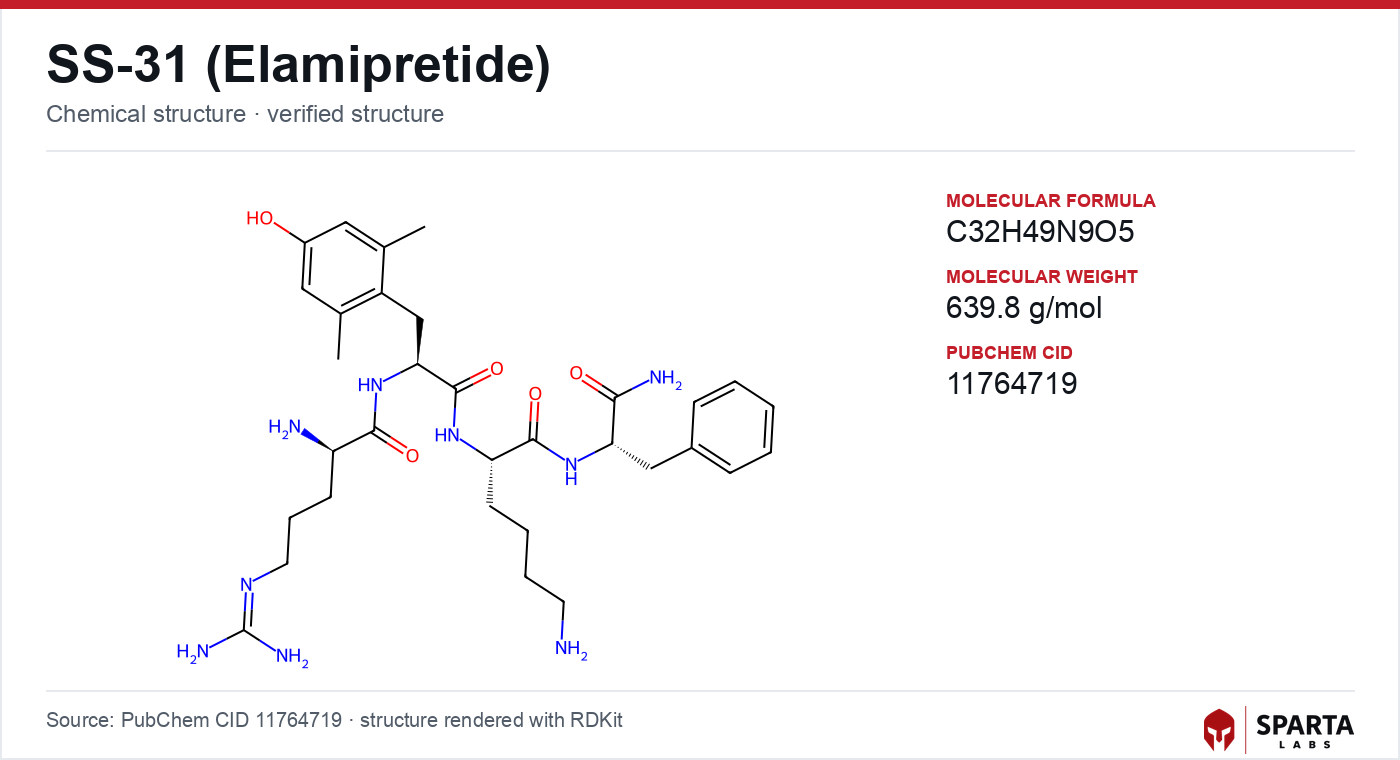
Figure: chemical structure of SS-31.
The Two Non-Standard Building Blocks
Short peptides of this length and complexity are assembled by solid-phase peptide synthesis (SPPS), the resin-based method R. Bruce Merrifield introduced in 1963 and for which he received the 1984 Nobel Prize in Chemistry [3]. Each SPPS cycle deprotects the resin-bound chain, couples the next protected amino acid, and washes away excess reagent; after assembly the peptide is cleaved from the resin and globally deprotected to yield a crude mixture.
For SS-31, two of the four coupling steps use non-standard, individually protected building blocks. D-arginine must be introduced as the D-enantiomer, and any contamination of the reagent with L-arginine, or any base-mediated racemization during coupling, produces a diastereomer that differs from SS-31 in three-dimensional shape. The second residue, 2',6'-dimethyltyrosine (Dmt), is a tyrosine bearing two ring methyl groups; incomplete methylation of the reagent or coupling of ordinary tyrosine yields a mass-shifted analogue that HPLC may not fully resolve.
These building blocks add cost and synthetic complexity relative to all-L, all-natural-residue peptides, and they are the reason identity confirmation for SS-31 leans heavily on mass spectrometry rather than chromatography alone.
Chromatographic Purity and Stereochemical Fidelity
Purity assessment uses reversed-phase HPLC on a C18 column with a gradient mobile phase, integrating the target peak against total UV absorbance at 214 or 220 nm. A single sharp peak at the expected retention time, with impurity peaks held to low defined limits, is the chromatographic condition for release. Sparta Labs applies an internal HPLC-purity standard of ≥98% for SS-31.
Chromatography alone, however, cannot fully characterize a stereochemically defined tetrapeptide. A diastereomer arising from N-terminal racemization can co-elute or elute close to the target under a given gradient, and a Dmt-versus-Tyr substitution changes mass by a small, potentially unresolved amount. Confirmation therefore pairs HPLC with high-resolution mass spectrometry: the intact [M+H]+ ion is matched to the theoretical monoisotopic mass, and diagnostic fragment ions are used to place the D-Arg, Dmt, Lys and Phe residues in the correct order and to confirm the C-terminal amide. This two-method approach is standard practice for peptides carrying non-natural residues in scaled synthesis [4].
Counter-Ion and Salt-Form Characterization
SS-31 is polycationic at neutral pH: the D-Arg guanidinium and the Lys side chain both carry positive charge. Purified peptide is consequently isolated not as a free base but as a salt paired with a counter-ion contributed by the synthesis and purification chemistry, most commonly trifluoroacetate (from trifluoroacetic acid used in cleavage and in acidic HPLC mobile phases) or acetate (where ammonium-acetate buffers are used).
The counter-ion is analytically consequential for two reasons. First, it contributes to the net weighed mass of a lyophilized lot, so the salt form is part of describing what the material actually is. Second, residual trifluoroacetate is an identifiable species that peptide-characterization workflows quantify and, where required, exchange to a defined salt form. Documenting the salt form and residual-solvent profile on the Certificate of Analysis lets a researcher interpret analytical data with the counter-ion accounted for rather than assumed away.
Oxidation-Focused Stability of the Dmt Aromatic
Peptide stability is governed by moisture, temperature, oxygen and light, and the general principles established in the protein- and peptide-stability literature apply to SS-31 as a short aromatic-cationic tetrapeptide [5]. What distinguishes SS-31 from a purely aliphatic peptide is the electron-rich Dmt ring. In the SS-31 pharmacology literature this dimethylated aromatic is described as contributing to the compound's antioxidant character and to cardiolipin association [2] — the same electron density that makes it chemically distinctive also makes it a plausible site for oxidative modification.
Analytical stability programs for SS-31 therefore watch specifically for oxidation products of the aromatic residues alongside the general markers of peptide degradation such as aggregation and hydrolysis. Lyophilized material stored cold, dry, sealed against moisture and protected from light retains analytical purity across the shelf life stated on its Certificate of Analysis. Because oxidative and freeze-thaw stress are the degradation modes most relevant to an aromatic-cationic peptide, stability documentation for SS-31 emphasizes those pathways when defining the tested shelf life. This article addresses only analytical stability of the supplied material and does not describe preparation or use.
What the Certificate of Analysis Records
Every batch of SS-31 supplied by Sparta Labs carries a Certificate of Analysis (COA) that documents the data supporting release. For SS-31 the COA reports:
- HPLC purity — percentage peak area, chromatogram trace, and column and gradient conditions.
- Mass spectrometry — observed versus theoretical mass for the intact [M+H]+ ion, confirming sequence identity and the correct incorporation of D-Arg and Dmt.
- Salt form and residual-solvent profile — the counter-ion identity relevant to a polycationic peptide.
- Batch number — a unique identifier traceable to the specific synthesis lot.
- Manufacturing and expiry dates — the storage timeline for the lot.
- Independent laboratory identity — the third-party analytical laboratory and its accreditation status.
An independent contract laboratory, operating under its own quality system, performs confirmatory HPLC and mass spectrometry on the released batch, and endotoxin testing by limulus amebocyte lysate (LAL) assay is available where the research application requires it, consistent with the compendial bacterial-endotoxins method [6]. Independent analysis removes in-house confirmation bias and gives the researcher an externally verifiable data source. COAs are accessible from the product page: SS-31 from Sparta Labs is released against these standards for every batch.
Why This Matters for Reproducible SS-31 Research
The reproducibility of published SS-31 work depends on the material in each experiment matching the compound characterized in the mechanistic literature — the correct sequence, the correct stereochemistry, the correct salt form, and an intact Dmt ring. A lot that is chromatographically clean but carries a racemized N-terminus, a Tyr-for-Dmt substitution, or oxidized aromatic residues is a different molecule from the SS-31 described in the primary sources, even when it looks similar on a single HPLC trace. Pairing chromatography with mass-spectrometry identity confirmation, counter-ion characterization, and oxidation-aware stability testing is how supplied material is tied back to the published record.
Researchers working across the mitochondrial and bioenergetic cluster may find the analogous analytical treatment in the MOTS-c sourcing and quality reference useful for comparison, since both compounds are characterized by their behavior at the mitochondrion rather than at a canonical cell-surface receptor.
References
-
Zhao K, Zhao G-M, Wu D, Soong Y, Birk AV, Schiller PW, Szeto HH. Cell-permeable peptide antioxidants targeted to inner mitochondrial membrane inhibit mitochondrial swelling, oxidative cell death, and reperfusion injury. J Biol Chem. 2004;279(33):34682-34690. PMID: 15178689. DOI: 10.1074/jbc.M402999200. Full text via DOI
-
Szeto HH. First-in-class cardiolipin-protective compound as a therapeutic agent to restore mitochondrial bioenergetics. Br J Pharmacol. 2014;171(8):2029-2050. PMID: 24117165. DOI: 10.1111/bph.12461. Full text via DOI
-
Merrifield RB. Solid phase peptide synthesis. I. The synthesis of a tetrapeptide. J Am Chem Soc. 1963;85(14):2149-2154. DOI: 10.1021/ja00897a025. Full text via DOI
-
Andersson L, Blomberg L, Flegel M, Lepsa L, Nilsson B, Verlander M. Large-scale synthesis of peptides. Biopolymers. 2000;55(3):227-250. PMID: 10880865. DOI: 10.1002/1097-0282(2000)55:3<227::AID-BIP50>3.0.CO;2-7. Full text via DOI
-
Manning MC, Chou DK, Murphy BM, Payne RW, Katayama DS. Stability of protein pharmaceuticals: an update. Pharm Res. 2010;27(4):544-575. PMID: 20143256. DOI: 10.1007/s11095-009-0045-6. Full text via DOI
-
United States Pharmacopeia. General Chapter <85> Bacterial Endotoxins Test. USP-NF. Rockville, MD: United States Pharmacopeial Convention. Source: usp.org
Disclaimer. Statements in this article have not been evaluated by the Food and Drug Administration. This compound is not intended to diagnose, treat, cure, or prevent any disease. Sparta Labs sells research-use-only materials. Content is provided for educational and informational purposes only and does not constitute medical advice. Consult a qualified medical professional for any health concerns.
Frequently asked questions
Why does SS-31 require mass spectrometry and not just HPLC purity testing?
SS-31 contains two non-standard residues: D-arginine (a D-stereoisomer of the natural L-form) and 2',6'-dimethyltyrosine (Dmt). HPLC reports the percentage of material eluting as a single peak, but it does not by itself confirm that the correct residues were incorporated in the correct order. High-resolution mass spectrometry confirms the intact molecular ion and fragmentation pattern, verifying sequence identity and correct incorporation of the D-Arg and Dmt building blocks.
What is 2',6'-dimethyltyrosine (Dmt) and why does it matter for SS-31 quality?
Dmt is a modified tyrosine carrying two methyl groups on its aromatic ring. In the published SS-31 literature it is described as central to the peptide's aromatic-cationic character and its reported cardiolipin binding. Its aromatic electron density is also the residue most susceptible to oxidation, which is why analytical release and stability testing for SS-31 give particular attention to oxidative degradation products.
Why is counter-ion analysis relevant for a peptide like SS-31?
SS-31 carries multiple positive charges, so purified peptide is isolated as a salt paired with a counter-ion such as trifluoroacetate or acetate from the synthesis and chromatography steps. The counter-ion contributes to the net weighed mass, so quantifying the salt form is part of characterizing what a given lot actually contains. Documenting the salt form on the Certificate of Analysis lets a researcher account for it when interpreting analytical data.
What does a Sparta Labs Certificate of Analysis for SS-31 document?
A Sparta Labs COA for SS-31 reports HPLC purity as percentage peak area with the chromatogram and method conditions, mass-spectrometry confirmation of the observed versus theoretical molecular weight for the intact ion, the salt form, a batch number traceable to the synthesis lot, manufacturing and expiry dates, and the identity of the independent third-party laboratory. COAs are accessible from the product page.