
IGF-1 LR3: Published Research
A structured bibliographic review of the peer-reviewed IGF-1 LR3 literature, organized by the analog's distinguishing pharmacology: reduced IGFBP binding, its use in rodent potency comparisons, and its adoption as a serum-free cell-culture supplement. Educational reference.

For research use only. Not for human consumption. This article is educational reference material. It is not medical advice and is not a recommendation to use any substance.
Why the IGF-1 LR3 Literature Reads Differently From Native IGF-1
IGF-1 LR3 (Long Arginine-3 Insulin-like Growth Factor-1) is an engineered analog of human insulin-like growth factor-1, the 70-residue polypeptide whose amino acid sequence was first reported by Rinderknecht and Humbel in 1978 [1]. Two modifications separate the analog from that parent sequence: a 13-amino-acid N-terminal extension and a substitution of arginine for glutamate at position 3. In the published literature these changes are consistently associated with markedly reduced affinity for the insulin-like growth factor binding proteins (IGFBPs), the carrier proteins that ordinarily govern how much free IGF-1 is available to engage the type-1 IGF receptor (IGF-1R) [2].
That single pharmacological property, low IGFBP affinity, explains why the body of research citing IGF-1 LR3 does not cluster the way a typical hormone's literature does. Rather than a single therapeutic thread, the analog appears across three loosely connected domains: comparative potency pharmacology in rodents, whole-animal organ-growth physiology, and, most distinctively, as a chemically defined supplement in cell-culture and recombinant-protein manufacturing. The sections below summarize peer-reviewed primary research in which IGF-1 LR3 (also written LR3IGF-I or Long R3IGF-I) served as a principal experimental agent, grouped by that literature structure rather than by a generic study list. The IGF-1 LR3 mechanism of action article provides the receptor-pharmacology background that underlies these study designs.
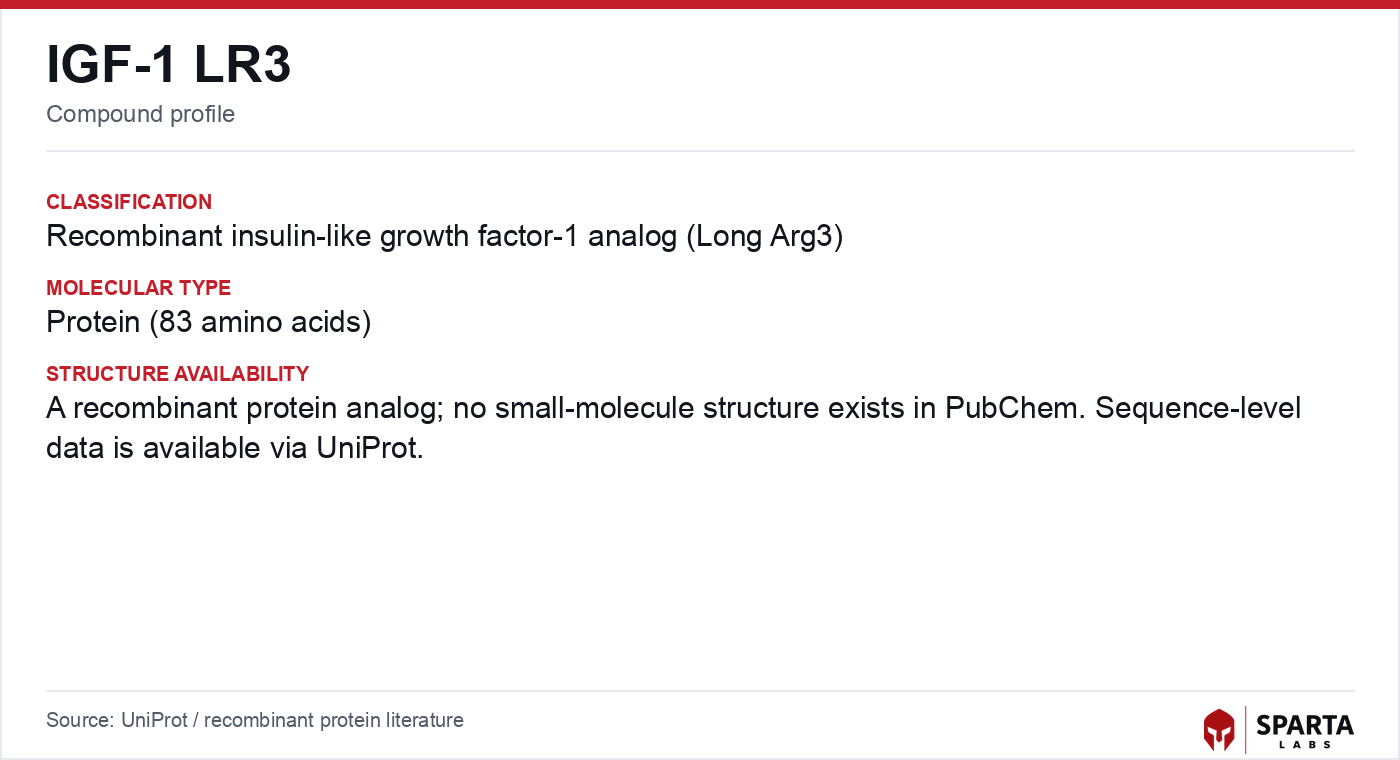
Figure: chemical structure of IGF-1 LR3.
Domain One: Comparative Potency in Rodent Models
The earliest and most cited use of IGF-1 LR3 was as a pharmacological tool for separating receptor-mediated signaling from the confounding influence of endogenous binding proteins. Tomas and colleagues (1996), publishing in the Journal of Endocrinology, compared IGF-I analogs that bind poorly to IGF-binding proteins against native IGF-I in rats, evaluating growth-related and anti-catabolic outcomes under both continuous infusion and once-per-injection administration [3]. The authors reported that the poorly binding analogs retained a potency advantage across outcome measures and, notably, that this advantage was maintained when the compounds were delivered by injection rather than continuous infusion.
Findings from research models do not establish safety or efficacy in humans. Sparta Labs makes no claims about the use of this compound.
This result is frequently referenced because it isolated the contribution of IGFBP binding to observed potency: an analog that escapes sequestration engages the receptor more efficiently on a molar basis than the native ligand under the same experimental conditions. The rodent comparison thus functions as the empirical anchor for the mechanistic rationale that recurs throughout the rest of the literature.
Domain Two: Whole-Animal Organ-Growth Physiology
A second cluster of studies moved from isolated potency measurement to the consequences of sustained IGF-1R engagement in intact animals, where feedback regulation of the endogenous IGF axis becomes visible. Conlon and colleagues (1995), also in the Journal of Endocrinology, reported on continuous Long R3 IGF-I infusion in female guinea pigs [4]. The study documented increased fractional weights of several organs, including the gut, kidneys, spleen, and adrenals, relative to control animals.
Just as informative was the accompanying observation that circulating IGF-I, IGF-II, and IGFBP-3 concentrations fell during infusion. The authors interpreted this as feedback down-regulation of the endogenous axis in response to elevated exogenous receptor signaling. This dual finding, tissue-level growth alongside suppression of native ligand and its principal carrier protein, is why intact-animal IGF-1 LR3 data are interpreted more cautiously than isolated-cell data: the whole-organism response reflects both direct receptor engagement and a compensatory endocrine adjustment. The role of IGFBP-3 in this feedback loop connects back to the carrier-protein biology reviewed in the foundational IGFBP literature [2].
Domain Three: IGF-1 LR3 as a Serum-Free Culture Supplement
The most distinctive and arguably the most practically consequential branch of the literature has little to do with pharmacology and much to do with the same low-IGFBP-affinity property viewed from the opposite direction. In cell culture, binding proteins present in serum or secreted by cells sequester added growth factors; a ligand that resists this sequestration remains bioavailable at lower nominal concentrations.
Andersen and colleagues (2007), writing in Molecular Biotechnology, examined Long R3IGF-I as a substitute for insulin in serum-free culture of HEK293 cells, a line widely used in recombinant-protein production [5]. The study reported that Long R3IGF-I sustained cell growth and viability at concentrations substantially below those of insulin required for comparable effects in that system, and it attributed receptor engagement to both IGF-1R and the insulin receptor, consistent with hybrid-receptor participation. This positioned the analog as a defined-medium supplement of interest in biologics manufacturing, an application domain that continues to reference the compound.
The reproductive-biology literature provides a parallel in-vitro example. Sirisathien and colleagues (2001), in Domestic Animal Endocrinology, compared native IGF-I and Long R3 IGF-I effects on in-vitro-produced bovine embryos, examining developmental readouts alongside transcript abundance for IGF-binding proteins and the type-1 IGF receptor [6]. The two agonists were associated with distinct patterns of receptor and binding-protein transcript regulation, which the authors read as evidence that structurally different IGF-1R agonists can engage downstream gene-regulatory programs differently. For experimental designers, this is a reminder that native IGF-1 and its low-IGFBP-affinity analog are not interchangeable even when both act through the same receptor.
What the Published Record Does and Does Not Establish
Read together, the peer-reviewed record establishes a consistent chemical-to-functional narrative: the N-terminal extension and E3R substitution reduce IGFBP affinity [1][2], reduced sequestration translates into greater apparent molar potency in controlled rodent comparisons [3], sustained exposure in intact animals produces both organ-level growth and feedback suppression of the native axis [4], and the same reduced-binding property makes the analog a low-concentration bioavailable supplement in defined culture media [5][6].
Several structural questions remain open in this literature. The independent contribution of the 13-residue N-terminal extension to receptor-binding geometry, as distinct from the E3R substitution, has not been fully resolved and is relevant to future analog design within the IGF-1R research toolkit. Context-dependence is a second recurring theme: the same feedback dynamics that Conlon and colleagues observed in guinea pigs imply that results measured in one physiological state may not transfer cleanly to another. For researchers examining upstream approaches to the growth-hormone axis, the ipamorelin research overview documents a ghrelin-mimetic secretagogue that acts on endogenous GH release, a complementary contrast to the downstream, receptor-level pharmacology represented here; the CJC-1295 without DAC published research article covers a GHRH analog in the same upstream category. Research-grade IGF-1 LR3 from Sparta Labs is documented with batch-specific certificate-of-analysis records.
References
-
Rinderknecht E, Humbel RE. The amino acid sequence of human insulin-like growth factor I and its structural homology with proinsulin. J Biol Chem. 1978;253(8):2769-76. PMID: 632300.
-
Firth SM, Baxter RC. Cellular actions of the insulin-like growth factor binding proteins. Endocr Rev. 2002;23(6):824-54. PMID: 12466191. DOI: 10.1210/er.2001-0033
-
Tomas FM, Lemmey AB, Read LC, Ballard FJ. Superior potency of infused IGF-I analogues which bind poorly to IGF-binding proteins is maintained when administered by injection. J Endocrinol. 1996;150(1):77-84. PMID: 8708565. DOI: 10.1677/joe.0.1500077
-
Conlon MA, Tomas FM, Owens PC, Wallace JC, Howarth GS, Ballard FJ. Long R3 insulin-like growth factor-I (IGF-I) infusion stimulates organ growth but reduces plasma IGF-I, IGF-II and IGF binding protein concentrations in the guinea pig. J Endocrinol. 1995;146(2):247-53. PMID: 7561636. DOI: 10.1677/joe.0.1460247
-
Andersen DC, Storling J, Lindberg AM, et al. LONG R3IGF-I as a more potent alternative to insulin in serum-free culture of HEK293 cells. Mol Biotechnol. 2007;34(2):201-12. PMID: 17172665. DOI: 10.1385/MB:34:2:201
-
Sirisathien S, Hernandez-Fonseca HJ, Bosch P, et al. Insulin-like growth factor I (IGF-I) and long R(3)IGF-I differently affect development and messenger ribonucleic acid abundance for IGF-binding proteins and type I IGF receptors in in vitro produced bovine embryos. Domest Anim Endocrinol. 2001;20(1):57-72. PMID: 11181549. DOI: 10.1016/s0739-7240(00)00096-x
Disclaimer. Statements in this article have not been evaluated by the Food and Drug Administration. This compound is not intended to diagnose, treat, cure, or prevent any disease. Sparta Labs sells research-use-only materials. Content is provided for educational and informational purposes only and does not constitute medical advice. Consult a qualified medical professional for any health concerns.
Frequently asked questions
Why does IGF-1 LR3 appear in cell-culture bioproduction research rather than only pharmacology studies?
The reduced affinity of IGF-1 LR3 for IGF-binding proteins means less of the added peptide is sequestered in serum-free or low-serum media. Andersen and colleagues (2007) reported that Long R3IGF-I supported growth of HEK293 cells at concentrations far below those of insulin used for comparable effects in that system. This property is why the analog is discussed in recombinant-protein manufacturing literature, not only in receptor pharmacology.
What did the Tomas 1996 study report about IGF-1 LR3 relative to native IGF-1?
Tomas and colleagues (1996), publishing in the Journal of Endocrinology, compared infused IGF-I analogs that bind poorly to IGF-binding proteins against native IGF-I in rats. They reported that the poorly binding analogs retained a potency advantage across outcome measures and that this advantage was maintained when the compounds were administered by injection. The study is a frequently cited reference point for the pharmacological rationale behind reduced-IGFBP-affinity analogs.
What structural features distinguish IGF-1 LR3 from native IGF-1 in the literature?
IGF-1 LR3 (Long Arg-3 IGF-I) carries a 13-amino-acid N-terminal extension and a substitution of arginine for glutamate at position 3 relative to the human IGF-I sequence first reported by Rinderknecht and Humbel (1978). Published work attributes the analog's characteristically low IGF-binding-protein affinity to these modifications. The IGF-1 LR3 mechanism article discusses how binding-protein interactions shape the molecule's behavior.
What did the guinea pig organ-growth study report?
Conlon and colleagues (1995), in the Journal of Endocrinology, reported that continuous infusion of Long R3 IGF-I in guinea pigs was associated with increased fractional weights of several organs together with reductions in circulating IGF-I, IGF-II, and IGFBP-3. The authors discussed these changes in the context of feedback regulation within the endogenous IGF axis. These findings inform interpretation of IGF-1 LR3 studies conducted in intact animals.