
CJC-1295 Without DAC: Published Research
A research-library map of how the fragmented GHRH-analog literature — the tetrasubstituted GRF(1-29) backbone, sermorelin, and the DAC-bearing variant — applies to CJC-1295 without DAC, with each study's scope flagged. Educational reference.

For research use only. Not for human consumption. This article is educational reference material. It is not medical advice and is not a recommendation to use any substance.
CJC-1295 Without DAC: Published Research
CJC-1295 without DAC — commonly labeled Modified GRF (1-29), or Mod GRF (1-29) — is a tetrasubstituted analog of the 29-amino-acid N-terminal fragment of human growth-hormone-releasing hormone (GHRH). Understanding its research base requires a specific analytical discipline that most peptide summaries skip: the published literature almost never studies "CJC-1295 without DAC" by that trade name. Instead, the evidence is distributed across studies of the shared tetrasubstituted GRF(1-29) backbone, the albumin-conjugated (with-DAC) variant, the unmodified predecessor sermorelin, and foundational GHRH degradation biochemistry. This article maps that fragmented literature onto the without-DAC molecule, flagging for each study exactly what it does and does not establish about this specific compound.
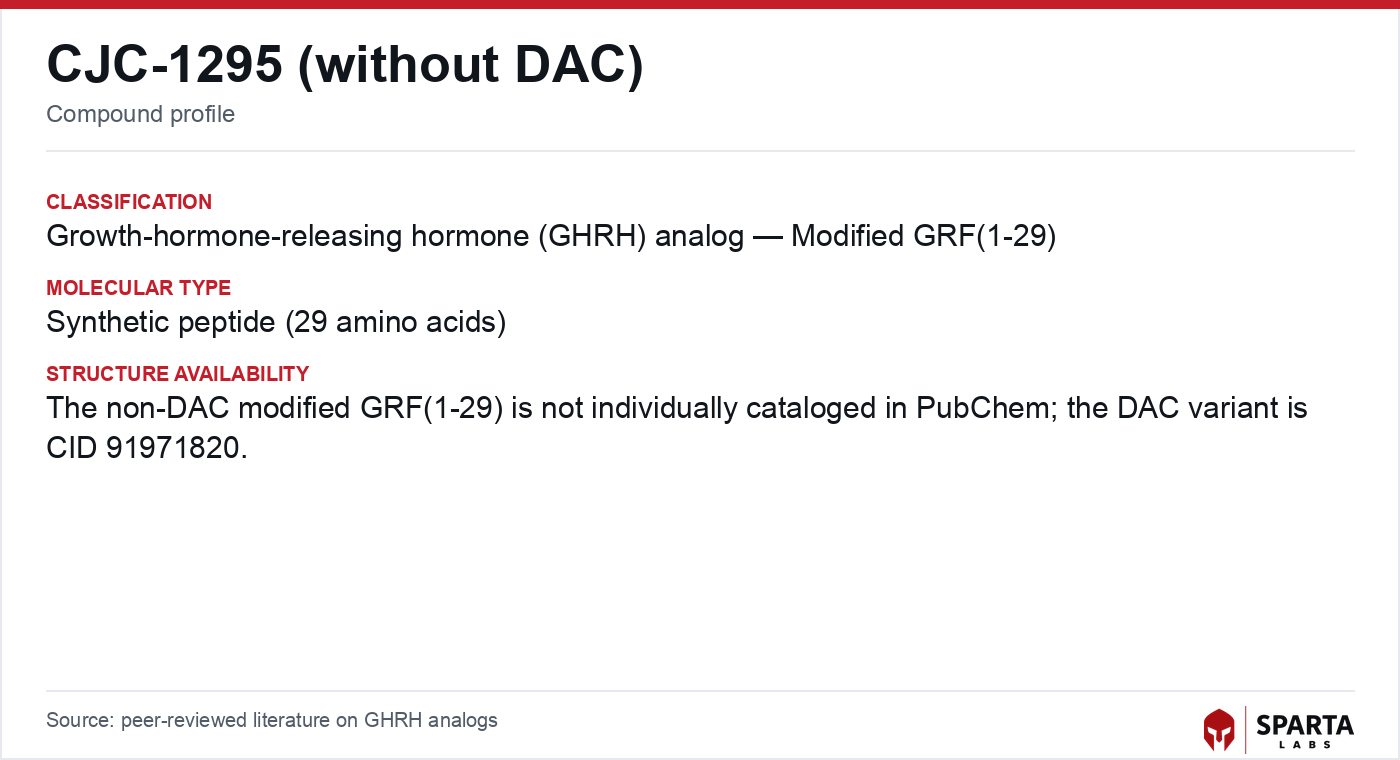
Figure: chemical structure of CJC-1295 (without DAC).
Why the "without DAC" distinction reorganizes the evidence
The four amino-acid substitutions that define this scaffold — D-Ala at position 2, Gln at 8, Ala at 15, and Nle at 27 — were engineered onto GRF(1-29) for one primary purpose: metabolic stabilization against enzymatic clearance. The Drug Affinity Complex (DAC) is a separate, optional maleimidopropionyl linker that covalently binds circulating albumin and extends plasma residence into a multi-day range. Removing the DAC does not touch the four backbone substitutions; it removes only the albumin-tethering pharmacokinetic extender.
This has a direct consequence for reading the literature. Any finding that depends on the tetrasubstituted backbone's receptor activity or enzymatic resistance is, in principle, relevant to the without-DAC molecule. Any finding that depends on prolonged albumin-bound half-life belongs to the with-DAC variant and cannot be transferred. Throughout this summary, the two are kept separate. For a structural walkthrough of the substitutions themselves, the CJC-1295 without DAC research overview and the CJC-1295 without DAC mechanism of action articles provide the chemistry context this research summary assumes.
Methodological categories in the literature
The evidence divides into four methodological tiers, each carrying different interpretive weight for the without-DAC compound:
- Foundational biochemistry characterizing native GHRH degradation, which motivated the backbone design.
- In vitro receptor and stability assays on the tetrasubstituted scaffold itself, including non-conjugated (DAC-free) forms.
- Preclinical in vivo studies, principally in rodent models of GHRH deficiency, largely using the DAC-bearing variant.
- Human pharmacokinetic and pharmacodynamic trials, which in the published record examine CJC-1295 with DAC rather than the without-DAC molecule as an isolated agent.
No published randomized controlled trial characterizes CJC-1295 without DAC as a distinct investigational agent in humans. That absence is the single most important framing fact for this compound's research profile.
The degradation biochemistry that motivated the design
Frohman and colleagues characterized the plasma enzymatic degradation pathways of native human GHRH in a 1989 Journal of Clinical Investigation study [1]. Using radiolabeled peptide substrates and specific enzymatic inhibitors, the authors identified dipeptidyl peptidase-4 (DPP-4) as the dominant protease cleaving the N-terminus of GHRH, generating the biologically inactive GRF(3-29) fragment, with a trypsin-like activity as a secondary route. This established the mechanistic rationale for the position-2 substitution strategy: replacing the L-Ala at residue 2 with D-Ala blocks the DPP-4 recognition site. That single design principle is the reason the tetrasubstituted backbone — and therefore CJC-1295 without DAC — exists.
Findings from research models do not establish safety or efficacy in humans. Sparta Labs makes no claims about the use of this compound.
In vitro evidence that the backbone is active without DAC
The foundational publication defining the CJC-1295 series came from Jetté and colleagues in Endocrinology in 2005 [2]. The authors synthesized a series of maleimidopropionyl derivatives of hGRF(1-29) carrying the four defining substitutions (D-Ala², Gln⁸, Ala¹⁵, Nle²⁷) and reported enhanced resistance to plasma degradation relative to native hGRF(1-29). The result most directly relevant to the without-DAC molecule is a specific in vitro observation: the non-bioconjugated (DAC-free) forms of the tetrasubstituted scaffold retained GHRH-receptor agonist activity in a rat anterior-pituitary cell GH-secretion assay. This supports the interpretation that the tetrasubstituted backbone is biologically active at the GHRH receptor independent of any albumin-binding contribution — the central in vitro basis for treating CJC-1295 without DAC as a functional GHRH-R agonist. The study used rat pituitary cells and human-serum-albumin conjugates and does not establish human pharmacokinetics or pharmacodynamics.
What the human with-DAC trials do and do not transfer
Teichman and colleagues published the first human data on the CJC-1295 series in the Journal of Clinical Endocrinology & Metabolism in 2006 [3]. Two randomized, placebo-controlled, double-blind, ascending-dose trials in healthy adults examined the DAC-bearing variant. Following single subcutaneous administration, investigators reported dose-dependent elevations in mean plasma GH concentrations described as two- to ten-fold above baseline sustained for six or more days, and mean plasma IGF-1 concentrations reported at roughly 1.5- to three-fold above baseline lasting nine to eleven days.
The multi-day duration is the critical non-transferable element. It is attributable to the albumin-binding DAC moiety and is not representative of the pharmacodynamic profile expected from the without-DAC compound, whose behavior is instead anchored to the short intrinsic half-life of the GRF(1-29) backbone. What the trial does establish for the broader scaffold is that the tetrasubstituted GRF(1-29) core is a functional GH secretagogue in humans under controlled conditions. Readers comparing the two variants may find the CJC-1295 with DAC published research summary useful for holding the pharmacokinetic contrast in view.
The pulsatility question
A recurring scientific question for any sustained GHRH-receptor agonist is whether it flattens the normally pulsatile architecture of GH secretion into a tonic signal. Ionescu and Frohman addressed this in a 2006 Journal of Clinical Endocrinology & Metabolism study, sampling GH frequently over twelve hours during sustained GHRH-R stimulation by CJC-1295 with DAC in healthy men [4]. The authors reported that discrete GH pulses persisted during elevated agonist exposure, with changes in pulse amplitude rather than replacement of the pulsatile pattern by tonic release, and attributed the preserved pulsatility to intact somatostatinergic counter-regulation.
This finding is often cited in discussions of the without-DAC compound because its shorter intrinsic action approximates a discrete stimulus more closely than the multi-day with-DAC exposure studied here. The connection is inferential: the study characterizes the DAC-bearing variant, and no equivalent frequent-sampling human study of the without-DAC molecule appears in the published record.
Preclinical growth data in a GHRH-deficient model
Alba and colleagues examined CJC-1295 in GHRH-knockout (GHRHKO) mice — animals lacking endogenous hypothalamic GHRH and exhibiting growth retardation — in a 2006 study in the American Journal of Physiology — Endocrinology and Metabolism [5]. Mice receiving once-daily CJC-1295 over a five-week course showed body-weight and linear-length measurements within the wild-type range, while less-frequent administration produced progressively less complete normalization. The authors interpreted the frequency of GHRH-R stimulation as an important determinant of outcome in this deficiency model. These preclinical findings are cited as evidence of the biological relevance of GHRH-R agonism in a system with no endogenous GHRH background, though the agent studied carried the DAC moiety.
The predecessor benchmark: sermorelin
Prakash and Goa reviewed sermorelin — unmodified hGRF(1-29)-NH₂ and the direct structural predecessor to the tetrasubstituted scaffold — in BioDrugs in 1999 [6]. The review documented a plasma half-life of approximately eleven to twelve minutes following subcutaneous administration in the diagnostic and pediatric GH-deficiency literature. This short half-life is the reference point against which the metabolic stabilization from the four-position substitutions is understood: the D-Ala² substitution's DPP-4 resistance is precisely the modification intended to extend residence beyond the sermorelin baseline while retaining the short-acting, non-albumin-bound character that distinguishes the without-DAC molecule from its DAC-bearing counterpart.
Class-level pharmacology context
Ishida and colleagues published a review of growth-hormone-secretagogue history and mechanism in JCSM Rapid Communications in 2020 [7]. The review classified GHRH-receptor agonists as a category distinct from ghrelin-receptor (GHS-R) agonists and described GHRH-R signaling through the pituitary cAMP-PKA cascade to drive GH synthesis and secretion, in contrast to the intracellular-calcium-mediated mechanism engaged by ghrelin mimetics. This distinction frames why the combinatorial pharmacology of GHRH-R agonists alongside GHS-R agonists — such as GHRP-2 or GHRP-6 — is a recurring topic in the secretagogue literature, since the two act through separate, potentially complementary signaling routes.
Knowledge gaps specific to the without-DAC molecule
The most consequential gaps in this compound's evidence base are not gaps in GHRH-R pharmacology generally but in direct characterization of the without-DAC molecule itself:
- No published human pharmacokinetic profile of CJC-1295 without DAC's specific plasma half-life, bioavailability, or GH-secretory pharmacodynamics. These are currently inferred from the D-Ala²-conferred DPP-4 resistance and the absence of albumin binding, not measured directly.
- No head-to-head comparison under equivalent experimental conditions between the without-DAC molecule, the with-DAC variant, and sermorelin — the design that would isolate the incremental contribution of each structural element.
- No controlled characterization of the without-DAC compound's interaction with GHS-R agonists, despite a well-documented mechanistic rationale for dual-pathway stimulation in the class literature.
These are boundaries of active investigation rather than fundamental gaps in the scaffold's biochemical foundation. Research-grade CJC-1295 without DAC from Sparta Labs is independently tested and available for research applications.
References
-
Frohman LA, Downs TR, Heimer EP, Felix AM. Dipeptidylpeptidase IV and trypsin-like enzymatic degradation of human growth hormone-releasing hormone in plasma. J Clin Invest. 1989;83(5):1533-1540. PMID: 2651468. DOI: 10.1172/JCI114049. PubMed
-
Jetté L, Léger R, Thibaudeau K, Benquet C, Robitaille M, Pellerin I, et al. Human growth hormone-releasing factor (hGRF)1-29-albumin bioconjugates activate the GRF receptor on the anterior pituitary in rats: identification of CJC-1295 as a long-lasting GRF analog. Endocrinology. 2005;146(7):3052-3058. PMID: 15817669. DOI: 10.1210/en.2004-1286. PubMed
-
Teichman SL, Neale A, Lawrence B, Gagnon C, Castaigne JP, Frohman LA. Prolonged stimulation of growth hormone (GH) and insulin-like growth factor I secretion by CJC-1295, a long-acting analog of GH-releasing hormone, in healthy adults. J Clin Endocrinol Metab. 2006;91(3):799-805. PMID: 16352683. DOI: 10.1210/jc.2005-1536. PubMed
-
Ionescu M, Frohman LA. Pulsatile secretion of growth hormone (GH) persists during continuous stimulation by CJC-1295, a long-acting GH-releasing hormone analog. J Clin Endocrinol Metab. 2006;91(12):4792-4797. PMID: 17018654. DOI: 10.1210/jc.2006-1702. PubMed
-
Alba M, Fintini D, Sagazio A, Lawrence B, Castaigne JP, Frohman LA, et al. Once-daily administration of CJC-1295, a long-acting growth hormone-releasing hormone (GHRH) analog, normalizes growth in the GHRH knockout mouse. Am J Physiol Endocrinol Metab. 2006;291(6):E1290-E1294. PMID: 16822960. DOI: 10.1152/ajpendo.00201.2006. PubMed
-
Prakash A, Goa KL. Sermorelin: a review of its use in the diagnosis and treatment of children with idiopathic growth hormone deficiency. BioDrugs. 1999;12(2):139-157. PMID: 18031173. DOI: 10.2165/00063030-199912020-00007. PubMed
-
Ishida J, Saitoh M, Doehner W, von Haehling S, Anker SD, Springer J. Growth hormone secretagogues: history, mechanism of action, and clinical development. JCSM Rapid Commun. 2020;3(1):25-37. DOI: 10.1002/rco2.9. Journal
Disclaimer. Statements in this article have not been evaluated by the Food and Drug Administration. This compound is not intended to diagnose, treat, cure, or prevent any disease. Sparta Labs sells research-use-only materials. Content is provided for educational and informational purposes only and does not constitute medical advice. Consult a qualified medical professional for any health concerns.
Frequently asked questions
Are there human clinical trials on CJC-1295 without DAC specifically?
No published randomized controlled trial characterizes CJC-1295 without DAC as a distinct investigational agent in humans. The published human trials in this compound series — Teichman et al. (2006) and Ionescu and Frohman (2006) — examined the DAC-bearing variant. The without-DAC molecule's human pharmacokinetics are inferred from backbone chemistry rather than measured directly.
What is the difference between CJC-1295 with and without DAC in the research?
The four amino-acid substitutions that define the tetrasubstituted GRF(1-29) backbone are shared by both. The Drug Affinity Complex (DAC) is a separate albumin-binding linker present only in the with-DAC variant, which extends plasma residence into a multi-day range. Findings that depend on that prolonged albumin-bound half-life belong to the with-DAC variant and do not transfer to the without-DAC molecule.
Why was the D-Ala substitution added to the GRF(1-29) backbone?
Frohman and colleagues (1989) identified DPP-4 as the dominant protease cleaving native GHRH at its N-terminus, generating the inactive GRF(3-29) fragment. Substituting D-Ala at position 2 blocks the DPP-4 recognition site, which is the design rationale documented in the peer-reviewed literature for the position-2 modification in this scaffold.
Is CJC-1295 without DAC active at the GHRH receptor without the DAC moiety?
Jetté and colleagues (2005) reported that non-bioconjugated (DAC-free) forms of the tetrasubstituted GRF(1-29) scaffold retained GHRH-receptor agonist activity in a rat anterior-pituitary cell GH-secretion assay. This in vitro finding supports treating the tetrasubstituted backbone as biologically active at the GHRH receptor independent of albumin binding, though it does not establish human pharmacodynamics.