
IGF-1 LR3: Sourcing, Purity, and Verification Standards
Why IGF-1 LR3's 83-residue sequence, three disulfide bonds, and ~9,111 Da mass shape its recombinant manufacturing, refolding, and analytical verification. Educational reference.

For research use only. Not for human consumption. This article is educational reference material. It is not medical advice and is not a recommendation to use any substance.
Why an IGF-1 Analog Is Harder to Verify Than a Short Peptide
IGF-1 LR3 (Long Arginine-3 Insulin-like Growth Factor-1) is an 83-residue recombinant analog of human insulin-like growth factor-1. Its quality profile is governed by three structural facts that a short synthetic peptide does not share: a defined 83-amino-acid primary sequence, three intramolecular disulfide bonds that must adopt their native pairing, and an engineered set of substitutions that change how the molecule interacts with its carrier proteins. Each of these raises the analytical bar for confirming that a supplied batch is genuinely the intended compound.
For researchers using IGF-1 LR3 as a pharmacological probe of the IGF-1 receptor (IGF-1R), identity and integrity of the material are inseparable from data quality. A batch that is chromatographically clean but misfolded, or full-length but of the wrong isoform, can produce cellular responses that resemble genuine receptor biology. This article describes how IGF-1 LR3's specific chemistry drives its recombinant manufacturing route, its refolding-dependent purity, and the analytical tests that confirm identity rather than purity alone.
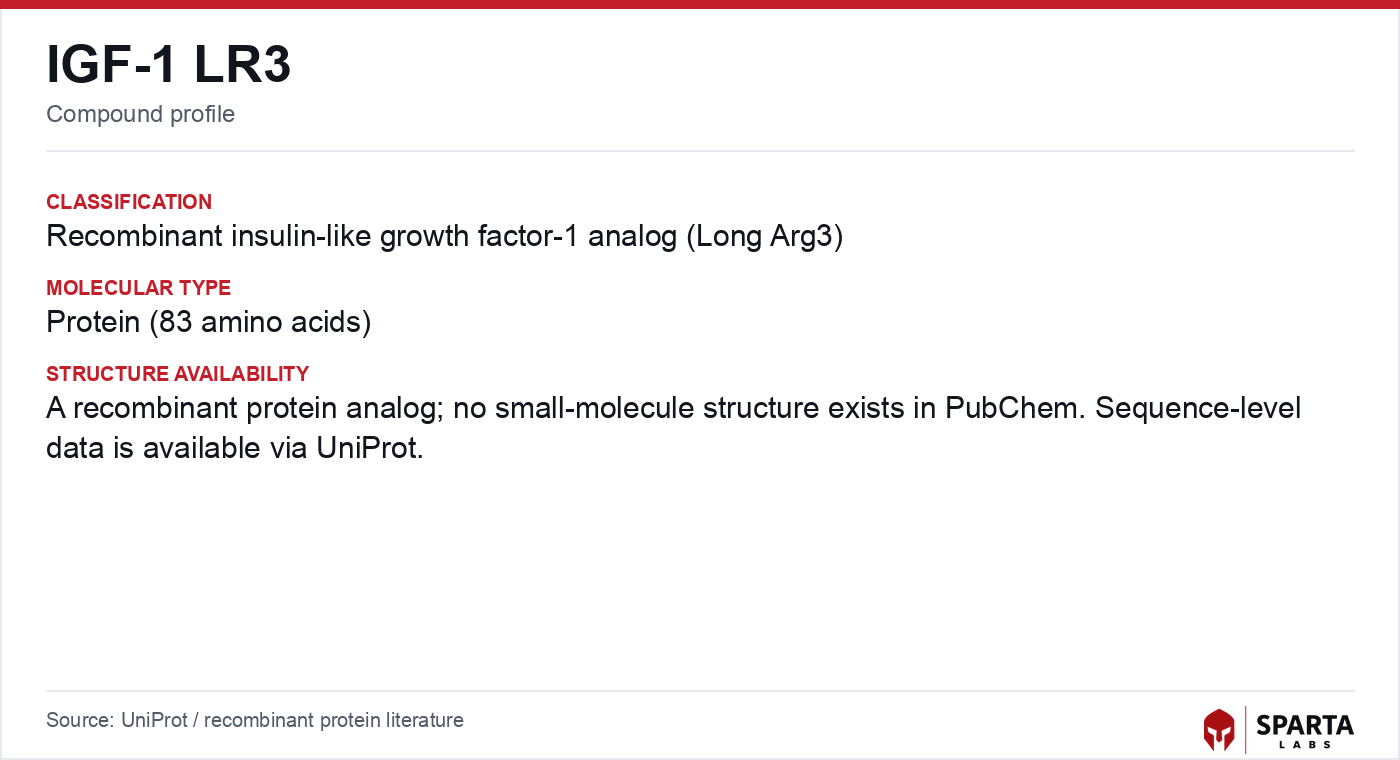
Figure: chemical structure of IGF-1 LR3.
The Two Engineered Modifications That Define the Molecule
Native human IGF-1 is a 70-residue single-chain polypeptide whose sequence was determined by Rinderknecht and Humbel in 1978 [1]. IGF-1 LR3 is derived from that scaffold by two deliberate changes. First, the glutamate residue at position 3 of the native sequence is replaced with arginine (the "R3" in the name). Second, a 13-residue N-terminal extension is appended (the "Long" in the name), giving a total length of 83 residues and a molecular mass of approximately 9,111 daltons.
These modifications are not cosmetic. Francis and colleagues reported that the analog carrying the position-3 substitution and N-terminal extension was associated with substantially reduced binding to the insulin-like growth factor binding proteins (IGFBPs) in vitro relative to native IGF-1 [2].
Findings from research models do not establish safety or efficacy in humans. Sparta Labs makes no claims about the use of this compound.
Because IGFBP affinity is one of the properties the analog was engineered to alter, sequence fidelity is not a bookkeeping detail. A batch in which the extension is truncated, or in which the position-3 substitution is absent, is a different molecule with different reported binding behavior. This is why, for IGF-1 LR3, verifying identity carries at least as much analytical weight as verifying purity. The pharmacological consequences of these modifications are discussed in the IGF-1 LR3 mechanism of action article.
Why the Manufacturing Route Is Recombinant, Not Synthetic
Solid-phase peptide synthesis (SPPS), the dominant route for research-grade peptides since Merrifield's 1963 demonstration of the method [3], becomes progressively inefficient as chain length grows: small yield losses at each coupling step compound across many residues, and full-length recovery falls. At 83 residues, IGF-1 LR3 sits well beyond the length at which SPPS delivers reliable full-length material, and the molecule's three disulfide bonds add a folding problem that linear synthesis does not solve on its own.
For these reasons the reported research route for LONG R3IGF-I is recombinant expression, commonly in Escherichia coli, followed by controlled refolding to allow the three disulfides to form their correct native pairing. This methodology is consistent with the expressed material used in the published cell-culture literature on the analog [4]. General reviews of peptide manufacturing describe the same tradeoff between synthetic and recombinant routes as molecular size increases [5].
After expression and refolding, the crude preparation undergoes preparative reverse-phase high-performance liquid chromatography (RP-HPLC) to separate correctly folded, full-length peptide from truncated sequences, misfolded disulfide isomers, and process-derived impurities. The purified material is then lyophilized to a stable dry powder. The refolding step is the critical control point: a preparation can be full-length and still be a scrambled-disulfide isomer, which is why downstream analytics must resolve folding state, not just molecular weight.
Purity Establishes Cleanliness; Mass Confirms Identity
Research-grade purity is conventionally established by analytical RP-HPLC, which resolves the target from co-eluting impurities by hydrophobicity. The purity figure on a Certificate of Analysis (COA) is the percentage of total UV absorbance at 220 nm attributable to the main peptide peak. General guidance for pharmacological tool compounds intended for receptor-binding and cell-signaling work favors high chromatographic purity so that observed effects can be attributed to the target rather than to co-eluting species [5]. Sparta Labs applies an HPLC purity specification of ≥98% for IGF-1 LR3, tested on each manufactured batch before release.
Chromatographic purity alone, however, cannot confirm that the dominant peak is the intended sequence. For an 83-residue engineered analog this distinction matters, because a truncated or substituted variant can co-elute closely with the target. Mass spectrometry by electrospray ionization (ESI) or matrix-assisted laser desorption/ionization (MALDI) compares the observed molecular mass of the main species against the theoretical value near 9,111 daltons. A match against that target, interpreted together with the HPLC profile, supports the conclusion that the material is full-length IGF-1 LR3 rather than a truncation or a scrambled refolding product of similar retention time.
Endotoxin: The Contaminant That Mimics Biology
Residual analysis for a bacterially expressed peptide extends past chromatography. The species of concern include bacterial endotoxin (lipopolysaccharide), residual host-cell proteins, and process solvents. Endotoxin is particularly consequential for IGF-1 LR3 because much of the analog's documented use is in cell culture, including the HEK293 serum-free culture applications reported in the literature [4]. Endotoxin can activate innate-immune signaling that produces proliferation or apoptosis responses independent of IGF-1R engagement, which would confound any attempt to attribute a cellular readout to the compound.
Sparta Labs tests each batch of IGF-1 LR3 for endotoxin by the Limulus amebocyte lysate (LAL) method, with release specifications appropriate for a research-grade recombinant peptide. Quantifying endotoxin at the batch level allows a research team to reason about whether an observed cellular response reflects receptor pharmacology or a contaminant-driven artifact.
Independent Confirmation and the Batch COA
Manufacturer-only testing has a structural limitation: the purchasing researcher cannot verify it. To address that single point of failure, each batch of IGF-1 LR3 is submitted for independent analytical testing at an accredited third-party laboratory. Independent RP-HPLC purity analysis, run on the laboratory's own instrumentation and method, confirms that the reported purity is reproducible under separate analytical conditions. Independent mass-spectrometric analysis confirms the molecular mass of the dominant species against the theoretical mass of IGF-1 LR3.
These results are consolidated into a batch-specific Certificate of Analysis issued at the time of purchase. For IGF-1 LR3 the COA documents:
- HPLC purity — numerical purity percentage from analytical RP-HPLC with the chromatogram trace, confirming the ≥98% specification.
- Mass-spectrometry identity — observed molecular mass versus the theoretical mass near 9,111 daltons.
- Endotoxin result — LAL-method value and applicable specification.
- Batch number and manufacturing date — traceable to the specific production run.
- Expiry date — based on stability of the lyophilized material under specified storage conditions.
- Third-party laboratory identification — the independent laboratory that performed confirmatory testing.
COAs are accessible from the product page, and a batch-specific COA can be requested by referencing the batch number printed on a shipment.
Stability of the Lyophilized Powder
Lyophilized IGF-1 LR3 is supplied and stored as a dry powder. General peptide-stability principles indicate that freeze-dried peptides held at low temperature in a low-humidity environment can retain integrity over extended periods [5]. Moisture uptake is the primary degradation pathway for lyophilized material: absorption of ambient humidity initiates hydrolytic breakdown that HPLC purity will eventually register as impurity growth. Keeping the powder dry and cold, and minimizing exposure to ambient air during handling, is therefore the central stability consideration for the material as shipped. Batch-specific stability data are documented on the COA.
Why Verified Sourcing Underpins Reproducibility
The reproducibility of experiments using IGF-1 LR3 depends on batch-to-batch consistency of a molecule whose engineered identity is the very property under study. When a receptor-binding assay, a cell-culture proliferation study, or a bioproduction optimization experiment uses material of uncertain identity or folding state, the research team cannot cleanly separate biological signal from compound artifact. Because IGF-1 LR3's altered IGFBP affinity is a designed-in feature, an incorrect isoform does not simply add noise; it can shift the observed pharmacology.
Sparta Labs's quality posture for IGF-1 LR3 combines a ≥98% HPLC purity release specification, mass-spectrometric identity confirmation against the theoretical ~9,111 Da mass, endotoxin testing by LAL, and independent third-party confirmation, all consolidated in a batch-specific COA. The pharmacological background for the compound, including its receptor target and downstream signaling, is covered in the IGF-1 LR3 research overview. Comparable analytical reasoning for another mitochondrially active research peptide is described in the MOTS-c sourcing and quality article, and the corresponding standards for a growth-hormone-axis research peptide are outlined in the Tesamorelin sourcing and quality article.
References
-
Rinderknecht E, Humbel RE. The amino acid sequence of human insulin-like growth factor I and its structural homology with proinsulin. J Biol Chem. 1978;253(8):2769-76. PMID: 632300.
-
Francis GL, Ross M, Ballard FJ, et al. Novel recombinant fusion protein analogues of insulin-like growth factor (IGF)-I indicate the relative importance of IGF-binding protein and receptor binding for enhanced biological potency. J Mol Endocrinol. 1992;8(3):213-23. PMID: 1376087. DOI: 10.1677/jme.0.0080213
-
Merrifield RB. Solid phase peptide synthesis. I. The synthesis of a tetrapeptide. J Am Chem Soc. 1963;85(14):2149-54. DOI: 10.1021/ja00897a025
-
Andersen DC, Storling J, Lindberg AM, et al. LONG R3IGF-I as a more potent alternative to insulin in serum-free culture of HEK293 cells. Mol Biotechnol. 2007;34(2):201-12. PMID: 17172665. DOI: 10.1385/MB:34:2:201
-
Kaspar AA, Reichert JM. Future directions for peptide therapeutics development. Drug Discov Today. 2013;18(17-18):807-17. PMID: 23726889. DOI: 10.1016/j.drudis.2013.05.011
Disclaimer. Statements in this article have not been evaluated by the Food and Drug Administration. This compound is not intended to diagnose, treat, cure, or prevent any disease. Sparta Labs sells research-use-only materials. Content is provided for educational and informational purposes only and does not constitute medical advice. Consult a qualified medical professional for any health concerns.
Frequently asked questions
Why is IGF-1 LR3 produced by recombinant expression rather than solid-phase synthesis?
At 83 amino acids with three intramolecular disulfide bonds, IGF-1 LR3 sits at the upper boundary of what solid-phase peptide synthesis reliably delivers, because cumulative coupling losses across many residues reduce full-length recovery. The reported research route for LONG R3IGF-I is recombinant expression, commonly in Escherichia coli, followed by controlled refolding so the three disulfides pair in their native arrangement. Reverse-phase HPLC then separates correctly folded full-length material from truncated and misfolded species.
What makes IGF-1 LR3 structurally different from native IGF-1?
IGF-1 LR3 is an analog of the 70-residue human IGF-1 sequence described by Rinderknecht and Humbel. It carries two modifications: a substitution of arginine for the glutamate at position 3, and a 13-residue N-terminal extension, giving an 83-residue chain of approximately 9,111 daltons. Francis and colleagues reported that these changes were associated with reduced binding to insulin-like growth factor binding proteins in vitro relative to native IGF-1.
Why is exact-mass confirmation central to IGF-1 LR3 identity testing?
HPLC establishes chromatographic purity but does not by itself confirm that the main peak is the intended sequence. Mass spectrometry by electrospray ionization or MALDI compares the observed molecular mass against the theoretical value near 9,111 daltons for IGF-1 LR3. A match against that target, combined with purity data, helps distinguish full-length correctly folded material from truncated sequences or scrambled refolding products of similar retention time.
Why is endotoxin testing relevant for a recombinant peptide used in cell culture?
IGF-1 LR3 produced in bacterial systems can carry residual endotoxin (lipopolysaccharide). In cell-culture work, endotoxin can activate innate-immune signaling that produces proliferation or apoptosis responses independent of the IGF-1 receptor, confounding interpretation. Batch testing by the Limulus amebocyte lysate (LAL) method quantifies endotoxin so that observed cellular responses can be attributed to the compound rather than to a contaminant.
How is lyophilized IGF-1 LR3 stored for stability?
General peptide-stability principles indicate that lyophilized peptides held at low temperature in a low-humidity environment can retain integrity for extended periods. Moisture uptake is the primary degradation pathway for freeze-dried material, initiating hydrolytic breakdown that HPLC purity eventually reflects as impurity growth. Sparta Labs supplies IGF-1 LR3 as a lyophilized powder with batch-specific stability documented on the Certificate of Analysis.