
Tesamorelin: Sourcing, Purity, and Verification Standards
A sourcing reference for tesamorelin: how a 44-residue GHRH analogue is assembled by SPPS, why its N-terminal acyl modification demands mass-spectrometric confirmation, and how HPLC and stability data appear on a certificate of analysis. Educational reference.

For research use only. Not for human consumption. This article is educational reference material. It is not medical advice and is not a recommendation to use any substance.
Introduction
Tesamorelin is a 44-amino-acid analogue of human growth-hormone-releasing hormone, GHRH(1-44), distinguished from the endogenous sequence by a single N-terminal modification: a trans-3-hexenoic acid group acylated onto the alpha-amine of the N-terminal tyrosine. That one structural detail governs both the compound's pharmacology and its analytical burden. A verification workflow that is adequate for an unmodified peptide is not automatically adequate here, because the modification adds only a small mass to a large molecule and can be incomplete without producing an obvious chromatographic signature. This article describes the sourcing and analytical-verification considerations specific to research-grade tesamorelin: how a peptide of this length is assembled, why identity confirmation rests on mass spectrometry rather than purity chromatography alone, and how those data are recorded on a certificate of analysis. The tesamorelin research overview covers the compound's pharmacological classification and regulatory context that sit alongside this sourcing discussion.
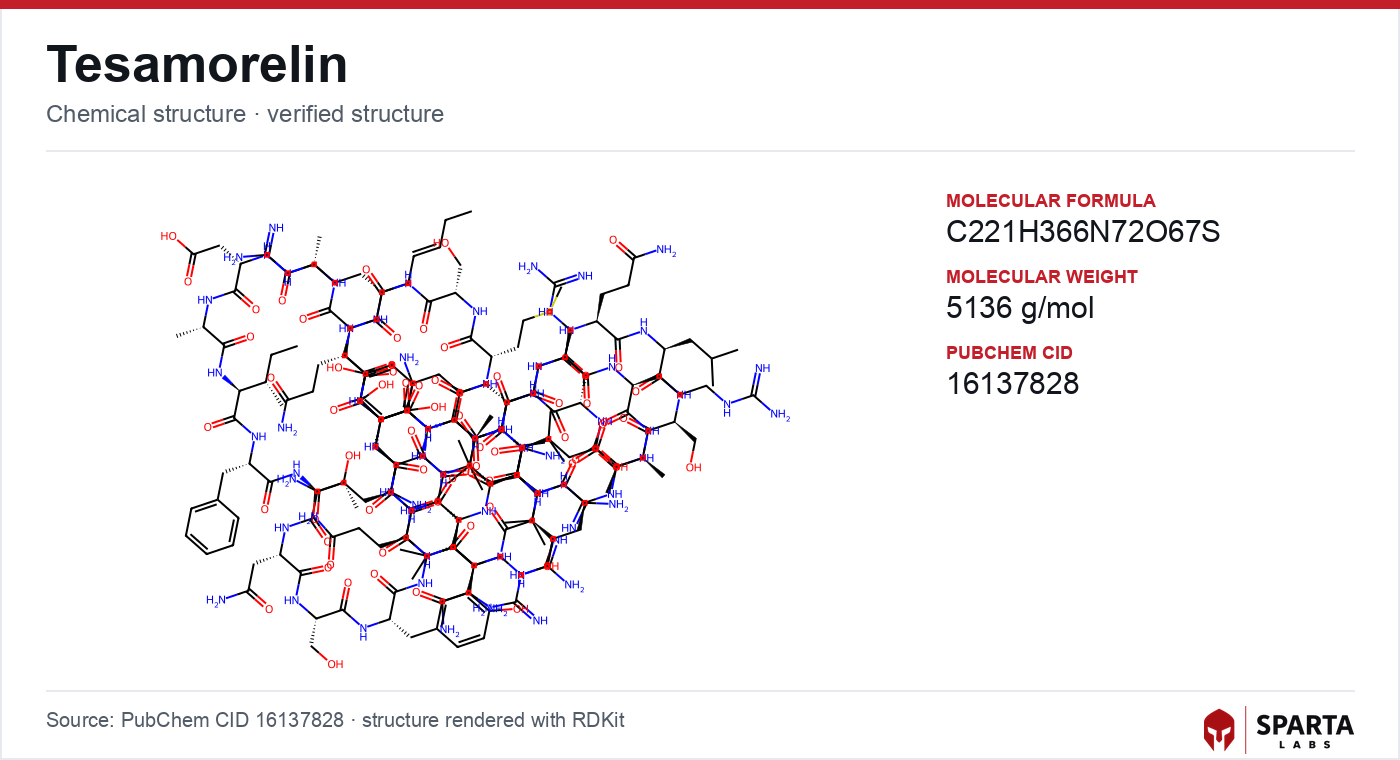
Figure: chemical structure of Tesamorelin.
The Molecule That Sets the Specification
Any sourcing standard is a response to a specific molecule, and tesamorelin's specification is dictated by three features of its structure. First, it is a 44-residue linear peptide with a theoretical average mass near 5,135 daltons, placing it at the larger end of peptides routinely produced by linear chemical synthesis. Second, its sequence carries no methionine, which removes one of the more common oxidative degradation liabilities that complicate the stability profile of many other research peptides. Third, and most consequential for verification, the pharmacophore includes the N-terminal trans-3-hexenoic acid group, which contributes roughly 96 daltons to the finished molecule.
The functional purpose of that acyl group is well documented in the GHRH-analogue literature: native GHRH(1-44) is a substrate for dipeptidyl peptidase-IV (DPP-IV), which cleaves the N-terminal dipeptide and inactivates the hormone, whereas N-terminal modification is associated with resistance to that cleavage. The tesamorelin mechanism of action article discusses the receptor-level consequences of that modification. For sourcing, the relevant point is narrower: the difference between correctly finished tesamorelin and an unacylated by-product is a small, defined mass shift on a large backbone, and the analytical program has to be built to detect it.
Chain Assembly by Solid-Phase Synthesis
Peptides in tesamorelin's size class are produced by solid-phase peptide synthesis (SPPS), the method introduced by Merrifield in 1963 and recognized with the 1984 Nobel Prize in Chemistry [1]. SPPS builds the chain sequentially on an insoluble resin support: each residue is coupled to the growing chain, the temporary N-terminal protecting group is removed, and the cycle repeats, with a final cleavage step releasing the peptide from the resin and removing side-chain protecting groups.
Modern operations for peptides of this length generally use Fmoc (9-fluorenylmethoxycarbonyl) chemistry, which relies on base-labile Nalpha protection and acid-labile side-chain protection, an orthogonal scheme reviewed in detail by Isidro-Llobet and colleagues [2]. At 44 residues, tesamorelin sits near the practical ceiling of routine linear SPPS. As chain length grows, small per-cycle inefficiencies accumulate into deletion and truncation sequences, and secondary-structure formation on the resin can lower coupling yields at difficult positions. Behrendt, White and Offer surveyed the coupling reagents, resins, and aggregation-suppression strategies that make longer Fmoc syntheses tractable [3]. Andersson and colleagues documented the coupling efficiencies and purification approaches relevant to producing peptides in this range at scale [4]. The consequence for sourcing is that the achievable purity of a 44-mer is a function of both synthesis quality and downstream purification, not synthesis alone.
Findings from research models do not establish safety or efficacy in humans. Sparta Labs makes no claims about the use of this compound.
Acylation as a Discrete, Verifiable Step
The N-terminal acylation is not part of standard chain elongation; it is a distinct coupling that attaches the trans-3-hexenoic acid moiety to the alpha-amine of the terminal tyrosine after the 44-residue backbone is assembled. Because it is a separate reaction, it can proceed to completion or leave a fraction of chains unmodified, and an incompletely acylated preparation would be a mixture of tesamorelin and a GHRH-like species with a different degradation profile.
This is where purity chromatography alone is insufficient as an identity check. An acyl group of roughly 96 daltons on a molecule of roughly 5,135 daltons is a small relative mass change, and depending on the chromatographic method the acylated and unacylated forms may not resolve into cleanly distinct, well-separated peaks. Mass spectrometry provides the orthogonal measurement: the observed, deconvoluted mass either matches the theoretical mass of the acylated 44-mer or it does not. For tesamorelin specifically, mass-spectrometric confirmation of the N-terminal modification is therefore treated as a mandatory identity criterion rather than a supplementary formality.
Purity by HPLC and Identity by Mass Spectrometry
Two complementary analyses characterize a research-grade peptide, and they answer different questions. Reversed-phase high-performance liquid chromatography (RP-HPLC) addresses purity: it separates the main peptide from truncated, deletion, and oxidized variants and from residual synthesis by-products by exploiting differences in hydrophobicity, and the reported purity percentage is the fraction of total UV-absorbance area attributable to the main peak. A commonly applied threshold for research-use peptides is HPLC purity at or above 98 percent, a benchmark consistent with the survey of modern synthesis and analysis practice by Jaradat [5].
Electrospray-ionization mass spectrometry (ESI-MS) addresses identity. A peptide of tesamorelin's size ionizes into a characteristic envelope of multiply-charged states; deconvoluting that envelope yields a single average mass that is compared against the theoretical value for the acylated sequence. The two methods are not interchangeable. HPLC can report a high main-peak percentage for material whose main peak is the wrong molecule, and MS can confirm the correct mass for a sample that also contains substantial impurity. Purity and identity are established together, which is why a defensible certificate of analysis reports both. Residual-solvent and counter-ion considerations, such as trifluoroacetic acid carried over from Fmoc cleavage and deprotection, are additional parameters that a testing protocol may address depending on the intended application.
Independent Testing and Certificate Contents
Independent third-party analysis provides a separation between the party that manufactures material and the party that reports whether it meets specification, which matters most for borderline results. Sparta Labs submits each production batch of tesamorelin to an independent analytical laboratory for HPLC purity measurement and ESI-MS mass confirmation, and the laboratory's reports are the basis for the data published on each batch's certificate of analysis.
A certificate of analysis for a tesamorelin batch documents the following:
- HPLC purity — the main-peak purity percentage from reversed-phase analysis, with the chromatographic method identified.
- Mass-spectrometric identity — the observed deconvoluted mass from ESI-MS against the theoretical mass near 5,135 daltons, confirming the acylated 44-residue structure.
- Batch number — a unique identifier linking the vial to the analytical records for that lot.
- Manufacturing and expiry dates — defining shelf life under the specified storage conditions.
- Analytical laboratory identity — naming the independent laboratory that performed the HPLC and MS work.
The certificate for a given batch is accessible from the product page, and the documentation link there allows the record to be reviewed before ordering.
Lyophilized-State Stability and Storage
Tesamorelin is supplied and stored as a lyophilized (freeze-dried) powder because the dry state is substantially more stable than a peptide in solution. Manning and colleagues, reviewing protein-pharmaceutical stability, describe why: lyophilization removes water, the principal medium for hydrolytic degradation and the mobility that permits chemical rearrangement, and low-temperature storage further suppresses residual degradation pathways [6]. In the lyophilized state, tesamorelin is stored at minus 20 degrees Celsius or below, protected from light and moisture, and kept sealed until required, with chemical stability maintained through the expiry date on the certificate.
The compound's own sequence shapes its degradation profile. Because tesamorelin contains no methionine, it lacks the readily oxidized thioether side chain that is a frequent source of oxidative variants in other peptides, though asparagine deamidation and general hydrolytic pathways remain relevant considerations that dry, cold storage is intended to slow. Peptide solutions are inherently less stable than the dry powder and, per the reviewed stability literature, are more susceptible to aggregation and chemical change, which is why documentation specifies handling conditions and cautions against repeated freeze-thaw cycling of prepared solutions [6].
Why Verification Matters for Reproducible Research
The reproducibility of pharmacology research depends on the chemical consistency of the materials under study, and for a modified peptide that dependency is concentrated in a single analytical result. If the N-terminal acyl group is incompletely installed, the material is no longer a defined single entity but a mixture whose pharmacodynamics differ from those of the pure compound, and no amount of downstream care recovers a well-controlled experiment from an ambiguous starting material. Mass-spectrometric confirmation of the acylated mass is the step that resolves that ambiguity, and pairing it with an HPLC purity value and batch traceability is what allows a result obtained on one lot to be interpreted against another.
Sparta Labs publishes a certificate of analysis with every batch, confirms purity and identity through an independent laboratory, and maintains traceability from that certificate to the vial. Comparable verification logic for growth-hormone-secretagogue-class peptides is described in the ipamorelin sourcing and quality reference for researchers working across this compound group. Research-grade tesamorelin from Sparta Labs is listed with its certificate-of-analysis documentation on the product page.
References
-
Merrifield RB. Solid phase peptide synthesis. I. The synthesis of a tetrapeptide. J Am Chem Soc. 1963;85(14):2149-54. DOI: 10.1021/ja00897a025
-
Isidro-Llobet A, Alvarez M, Albericio F. Amino acid-protecting groups. Chem Rev. 2009;109(6):2455-504. PMID: 19364121. DOI: 10.1021/cr800323s
-
Behrendt R, White P, Offer J. Advances in Fmoc solid-phase peptide synthesis. J Pept Sci. 2016;22(1):4-27. PMID: 26785684. DOI: 10.1002/psc.2836
-
Andersson L, Blomberg L, Flegel M, Lepsa L, Nilsson B, Verlander M. Large-scale synthesis of peptides. Biopolymers. 2000;55(3):227-50. PMID: 10880966. DOI: 10.1002/1097-0282(2000)55:3<227::AID-BIP50>3.0.CO;2-7
-
Jaradat DMM. Thirteen decades of peptide synthesis: key developments in solid phase peptide synthesis and amide bond formation utilized in peptide ligation. Amino Acids. 2018;50(1):39-68. PMID: 29063202. DOI: 10.1007/s00726-017-2516-0
-
Manning MC, Chou DK, Murphy BM, Payne RW, Katayama DS. Stability of protein pharmaceuticals: an update. Pharm Res. 2010;27(4):544-75. PMID: 20143256. DOI: 10.1007/s11095-009-0045-6
Disclaimer. Statements in this article have not been evaluated by the Food and Drug Administration. This compound is not intended to diagnose, treat, cure, or prevent any disease. Sparta Labs sells research-use-only materials. Content is provided for educational and informational purposes only and does not constitute medical advice. Consult a qualified medical professional for any health concerns.
Frequently asked questions
Why does the N-terminal acyl group make tesamorelin harder to verify than a standard peptide?
Tesamorelin is a 44-residue analogue of human GHRH(1-44) carrying a trans-3-hexenoic acid group on the N-terminal tyrosine. Because that single acylation adds only about 96 daltons to a roughly 5,135-dalton molecule, a purity chromatogram alone can look clean even if a fraction of the chains were never acylated. Independent mass-spectrometric confirmation of the deconvoluted mass is therefore the step that distinguishes finished tesamorelin from an unmodified GHRH-like impurity.
What analytical methods are typically used to characterize research-grade tesamorelin?
The two conventional methods are reversed-phase high-performance liquid chromatography (RP-HPLC) for purity and electrospray-ionization mass spectrometry (ESI-MS) for identity. HPLC separates the main peptide from truncated, deletion, and oxidized sequences and reports the main-peak area as a purity percentage. ESI-MS produces a multiply-charged envelope that is deconvoluted to a single mass and compared against the theoretical value for the acylated 44-mer.
How does solid-phase peptide synthesis apply to a 44-residue peptide like tesamorelin?
Solid-phase peptide synthesis (SPPS), introduced by Merrifield in 1963, builds the chain one residue at a time on an insoluble resin, and modern operations for peptides in this length range generally use Fmoc chemistry. At 44 residues, tesamorelin sits near the upper end of routine linear SPPS, where accumulated deletion and truncation sequences make coupling efficiency and purification strategy central to the achievable purity.
How is lyophilized tesamorelin's stability documented on a certificate of analysis?
A certificate of analysis records the HPLC purity value, the ESI-MS observed mass against the theoretical mass, the batch identifier, and the manufacturing and expiry dates tied to defined storage conditions. Lyophilization removes the water that drives hydrolytic degradation, and the reviewed protein-stability literature attributes the greater shelf life of dry powders to this reduced mobility and moisture. Tesamorelin's sequence contains no methionine, removing one common oxidative liability.