
N-Acetyl Selank Amidate: Sourcing, Purity, and Verification Standards
A sourcing reference for N-Acetyl Selank Amidate: SPPS of its tuftsin-derived heptapeptide sequence, the analytical challenges of a proline- and arginine-rich chain, terminal-modification verification, and COA documentation. Educational reference.

For research use only. Not for human consumption. This article is educational reference material. It is not medical advice and is not a recommendation to use any substance.
The Compound Behind the Quality Question
N-Acetyl Selank Amidate is a synthetic modification of Selank, itself a synthetic heptapeptide developed at the Institute of Molecular Genetics of the Russian Academy of Sciences. The molecule belongs to a small structural family that traces back to tuftsin, an endogenous immunoactive tetrapeptide (Thr-Lys-Pro-Arg) first characterized in the immunoglobulin heavy chain. Selank extends the tuftsin motif with a proline-glycine-proline stabilizing tail; N-Acetyl Selank Amidate adds two further terminal modifications on top of that sequence.
For a research program working with this compound, sourcing quality is not a peripheral logistics concern. The published pharmacology of this structural class was generated overwhelmingly with the parent peptide Selank, so a researcher handling the acetyl-amidated analog is working with a defined variant whose identity must be confirmed against the intended structure. Terminal modifications that are only partially incorporated, or a backbone that has undergone a deletion during synthesis, produce a sample that no longer corresponds to the compound named on the label. This article documents how N-Acetyl Selank Amidate is synthesized and verified, framed around the specific chemistry of this sequence rather than a generic peptide-quality checklist. The material discussed here is the same offered through the N-Acetyl Selank Amidate product page.
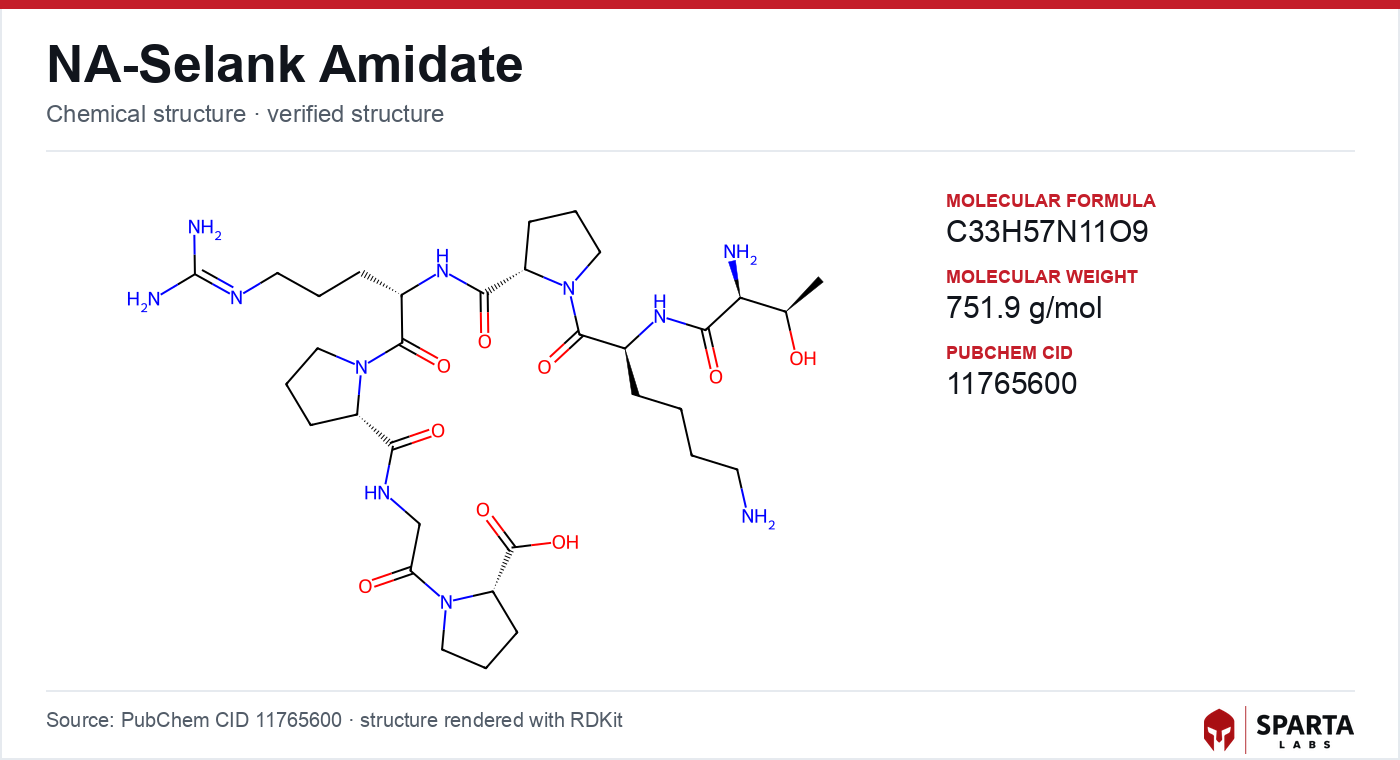
Figure: chemical structure of NA-Selank Amidate.
Building a Tuftsin-Derived Heptapeptide
N-Acetyl Selank Amidate is a heptapeptide (seven amino acid residues) and is assembled by solid-phase peptide synthesis (SPPS), the method introduced by R. Bruce Merrifield in the Journal of the American Chemical Society in 1963, work recognized with the 1984 Nobel Prize in Chemistry [1]. SPPS anchors the growing chain to an insoluble resin and adds amino acids one at a time, each coupling followed by a deprotection step. This stepwise, resin-bound approach gives the synthetic control needed to reproduce a defined sequence across batches, which is the foundation on which every downstream quality claim rests.
The sequence itself shapes the synthesis. The tuftsin-derived portion is arginine- and lysine-bearing and therefore basic, while the proline-glycine-proline extension makes the chain proline-rich. Multiple proline residues and sterically demanding couplings are recognized in the synthesis literature as points where side reactions such as racemization and aspartimide-related rearrangements can arise if coupling and deprotection conditions are not controlled; Palasek and colleagues characterized these failure modes and the conditions that limit them in Fmoc-based SPPS [2]. Sequences of this composition consequently benefit from carefully chosen coupling reagents and deprotection cycles rather than default bulk conditions.
Andersson and colleagues reviewed the transition from bench-scale to large-scale peptide manufacture, documenting the resin loading, coupling efficiency, cleavage, and purification parameters that separate research-grade production from lower-quality bulk preparation [3]. After chain assembly, the peptide is cleaved from the resin, globally deprotected, precipitated, and taken through preparative reverse-phase HPLC as the final purity-determining step.
The Two Terminal Modifications, and How They Are Confirmed
What distinguishes N-Acetyl Selank Amidate from Selank is a pair of terminal modifications, and each is introduced at a defined point in the synthesis. The N-terminal acetyl cap is installed after the final residue is coupled, converting the free amino terminus to an acetamide. The C-terminal amide is not a post-synthesis step at all; it is designed in through the choice of an amide-generating resin, so that cleavage releases the chain already terminating in a carboxamide rather than a free carboxylic acid. Both modifications are standard, well-characterized operations in contemporary peptide manufacturing [3].
These caps are also the reason identity verification for this compound is more demanding than for an unmodified peptide. An acetyl group and a C-terminal amide each change the exact molecular mass by a defined increment relative to the free-terminus sequence. Mass spectrometry is therefore doing double duty: it confirms the backbone is correct and confirms that both terminal modifications are present and complete. A batch in which acetylation was incomplete, or in which some chains retain the free acid terminus, will present a mass-spectral signature that differs from the theoretical value for the fully modified molecule. Confirming measured mass against the theoretical mass is how a batch is distinguished from partially modified material or from co-eluting Selank itself.
Purity Standards for a Proline-Rich Sequence
HPLC purity analysis is the primary quantitative standard for research-grade synthetic peptides. In reverse-phase HPLC, a sample is resolved against a stationary phase and the area of the target compound's peak relative to total peak area is reported as a purity percentage. Sparta Labs applies an internal HPLC standard of at least 98 percent purity for N-Acetyl Selank Amidate, with batch data recorded in each Certificate of Analysis.
Interpreting those chromatograms for this particular sequence carries a caveat worth stating explicitly. Proline residues can adopt both cis and trans configurations about the preceding peptide bond, and interconversion between them is slow enough that a single proline-rich peptide can present as more than one conformer under chromatographic conditions. That behavior can broaden or split a peak in ways that a naive read might mistake for an impurity, or that could mask a genuine one. Analytical practice for proline-containing peptides accounts for this so that a conformational artifact is not counted as a contaminant and an actual contaminant is not dismissed as a conformer. This is one reason mass spectrometry is run alongside HPLC rather than in place of it: HPLC quantifies how much of the sample is the target, and mass spectrometry confirms the resolved peak corresponds to the intended molecule.
Residual analysis covers the remaining quality dimensions. Trifluoroacetic acid used in cleavage and mobile phases, residual organic solvents, and, for cell-culture or in vivo work, endotoxin are the standard residual considerations for peptides purified by this route [4]. The same analytical logic that governs N-Acetyl Selank Amidate applies to its parent compound, and readers comparing the two can consult Selank sourcing and quality for the unmodified sequence.
Independent Verification and the Certificate of Analysis
Independent laboratory verification is the structural safeguard against an in-house quality-control failure going unnoticed. Sparta Labs submits batches of N-Acetyl Selank Amidate to an independent third-party analytical laboratory for HPLC purity analysis and mass-spectrometry molecular-weight confirmation. The purpose of independent testing is to check the manufacturing quality report against findings produced by a laboratory with no financial interest in the outcome. Each independently verified batch generates a test report that Sparta Labs retains as part of the batch record.
Every batch is issued with a Certificate of Analysis (COA) that documents:
- HPLC purity — expressed as percentage peak area for the target compound, with chromatogram reference
- Mass spectrometry confirmation — measured versus theoretical molecular weight, confirming both the sequence and the terminal modifications
- Batch number — a unique identifier linking the COA to the specific manufacturing and testing record
- Manufacturing date — the date of final purification
- Expiry date — the recommended shelf-life endpoint under specified storage conditions
COAs are accessible from the product listing, so that batch-specific documentation is available for institutional purchasing records, ethics submissions, or laboratory notebooks.
Stability of a Terminally Protected Peptide
Lyophilized (freeze-dried) synthetic peptides, the form in which N-Acetyl Selank Amidate is supplied, are generally stable over extended periods under appropriate storage. The published peptide literature describes storage of lyophilized peptides at low temperature, away from light and moisture, in sealed containers, with well-behaved sequences retaining chemical integrity over long timeframes [5]. Assigned expiry dates reflect stability characterization consistent with this literature.
The terminal modifications that define this compound are directly relevant to its stability profile. Free peptide termini are among the sites most exposed to hydrolytic and enzymatic degradation; capping the N-terminus with an acetyl group and converting the C-terminus to an amide removes those free termini. This terminal protection is the same structural feature that motivates the modification pharmacologically, and readers interested in that dimension can consult the N-Acetyl Selank Amidate mechanism of action discussion. The analogous acetyl-amidated modification of a related regulatory peptide is documented in N-Acetyl Semax Amidate sourcing and quality, which shares the same design logic.
Once reconstituted in aqueous solution, peptide stability is substantially reduced relative to the lyophilized state, and stability in solution is sequence-dependent. Published stability data for the relevant structural class is the appropriate reference when characterizing reconstituted material.
Why Identity Confirmation Matters for This Compound
The integrity of a research finding depends on the integrity of the material used to generate it, and for N-Acetyl Selank Amidate the identity question is unusually pointed. Because the bulk of the published pharmacology in this family was produced with Selank, a sample that has undergone partial deacetylation or deamidation, or that carries unmodified Selank as a co-contaminant, is not the compound the researcher intended to study, even if it looks structurally adjacent. HPLC purity quantifies the proportion of the sample represented by the target, and mass-spectrometry identity confirmation establishes that the target peak carries the correct mass, including both terminal caps. Together they separate the acetyl-amidated analog from the parent peptide and from partially modified intermediates.
Sparta Labs's quality posture for this compound, an internal HPLC standard, mass-spectrometry confirmation of the full modified structure, and independent third-party verification documented on a per-batch COA, is designed to give researchers confidence that the material received corresponds to the material described. For the broader research context of this compound, see the N-Acetyl Selank Amidate research overview.
Findings from research models do not establish safety or efficacy in humans. Sparta Labs makes no claims about the use of this compound.
References
-
Merrifield RB. Solid phase peptide synthesis. I. The synthesis of a tetrapeptide. J Am Chem Soc. 1963;85(14):2149-2154. DOI: 10.1021/ja00897a025.
-
Palasek SA, Cox ZJ, Collins JM. Limiting racemization and aspartimide formation in microwave-enhanced Fmoc solid phase peptide synthesis. J Pept Sci. 2007;13(3):143-8. PMID: 17121420. DOI: 10.1002/psc.806.
-
Andersson L, Blomberg L, Flegel M, Lepsa L, Nilsson B, Verlander M. Large-scale synthesis of peptides. Biopolymers. 2000;55(3):227-50. PMID: 10891640. DOI: 10.1002/1097-0282(2000)55:3<227::AID-BIP50>3.0.CO;2-7.
-
Vlieghe P, Lisowski V, Martinez J, Khrestchatisky M. Synthetic therapeutic peptides: science and market. Drug Discov Today. 2010;15(1-2):40-56. PMID: 19879969. DOI: 10.1016/j.drudis.2009.10.009.
-
Guzman F, Barberis S, Illanes A. Peptide synthesis: chemical or enzymatic. Electron J Biotechnol. 2007;10(2):279-314. DOI: 10.2225/vol10-issue2-fulltext-13.
Disclaimer. Statements in this article have not been evaluated by the Food and Drug Administration. This compound is not intended to diagnose, treat, cure, or prevent any disease. Sparta Labs sells research-use-only materials. Content is provided for educational and informational purposes only and does not constitute medical advice. Consult a qualified medical professional for any health concerns.
Frequently asked questions
What distinguishes N-Acetyl Selank Amidate from Selank at the analytical level?
N-Acetyl Selank Amidate carries two terminal modifications the parent Selank sequence lacks: an acetyl cap on the N-terminus and a C-terminal amide in place of the free carboxyl. Analytical verification therefore has to confirm not only the correct backbone sequence but that both terminal modifications are present and complete. Mass spectrometry is central here, because incomplete acetylation or partial C-terminal amidation shifts the molecular mass by defined increments that identity testing is designed to detect.
Why is the tuftsin-derived sequence relevant to sourcing quality?
Selank and its acetyl-amidated analog descend from tuftsin (Thr-Lys-Pro-Arg), an endogenous immunoactive tetrapeptide, extended with a proline-glycine-proline stabilizing motif. That lineage produces a proline- and arginine-rich chain whose synthesis and purification carry sequence-specific considerations. Documenting the intended sequence against measured mass is how a batch is confirmed to correspond to the tuftsin-derived structure rather than a deletion or scrambled variant.
How is purity of a research-grade peptide like this quantified?
Reverse-phase high-performance liquid chromatography (HPLC) resolves a sample and reports the target peak's area as a percentage of total peak area, giving a purity figure. Mass spectrometry is run alongside it to confirm the resolved peak corresponds to the correct molecular mass. HPLC quantifies how much of the sample is the target; mass spectrometry confirms the target is the intended molecule.
What appears on a Certificate of Analysis for this compound?
A Certificate of Analysis documents batch-specific HPLC purity as percentage peak area, mass-spectrometry confirmation of measured versus theoretical molecular weight, a unique batch number, the manufacturing date, and a recommended expiry date under specified storage conditions. Sparta Labs issues a COA with every batch, accessible from the product listing.
Why do proline-rich peptides warrant particular analytical attention?
Proline residues introduce cis-trans isomerization about the peptide bond, which can produce multiple conformers of the same molecule that resolve as separate or broadened peaks under chromatographic conditions. Recognizing this behavior matters when interpreting HPLC chromatograms of a proline-rich sequence, so that a conformational feature is not mistaken for an impurity or a genuine impurity overlooked.