
N-Acetyl Selank Amidate: A Research Overview
N-Acetyl Selank Amidate is a terminally blocked analog of the tuftsin-derived heptapeptide Selank. This overview examines its sequence lineage, N-acetyl and C-amide modifications, and pharmacological classification from the primary literature. Educational reference.

For research use only. Not for human consumption. This article is educational reference material. It is not medical advice and is not a recommendation to use any substance.
Introduction
N-Acetyl Selank Amidate is a terminally modified analog of the synthetic heptapeptide Selank (Thr-Lys-Pro-Arg-Pro-Gly-Pro), a regulatory neuropeptide developed at the Institute of Molecular Genetics of the Russian Academy of Sciences as a structural extension of tuftsin [1]. Its defining feature is a pair of terminal-blocking modifications, an acetyl group at the N-terminus and an amide group at the C-terminus, applied to the intact Selank backbone. This overview situates the compound within its sequence lineage, examines the chemical rationale for the terminal modifications, and summarizes how the primary literature classifies the parent scaffold pharmacologically. It is written as an educational reference and makes no claims about the compound's use.
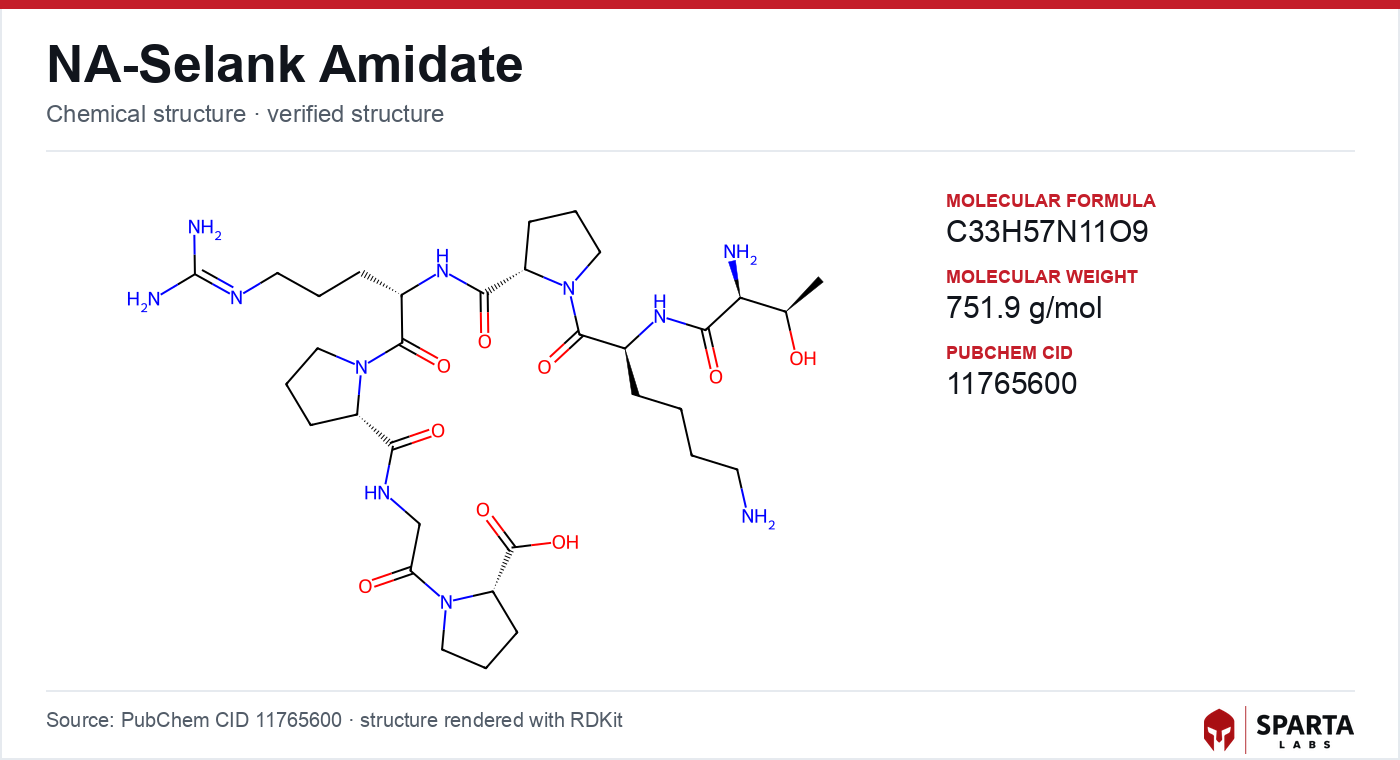
Figure: chemical structure of N-Acetyl Selank Amidate.
From tuftsin to Selank: the sequence lineage
The Selank scaffold traces directly to tuftsin, the tetrapeptide Thr-Lys-Pro-Arg. Tuftsin was isolated and characterized by Najjar and Nishioka at Tufts University in 1970 and described in Nature as a phagocytosis-stimulating factor derived from the heavy-chain (Fc) region of immunoglobulin G [2]. That short endogenous sequence became a recurring template for peptide-extension chemistry, in part because native tuftsin is hydrolyzed rapidly by serum and tissue peptidases, which complicates the study of any biological activity attributable to it.
Researchers associated with Nikolay Myasoedov, Lyudmila Andreeva, and colleagues in Moscow produced Selank by appending the tripeptide Pro-Gly-Pro to the C-terminus of the tuftsin sequence, yielding the heptapeptide Thr-Lys-Pro-Arg-Pro-Gly-Pro [1,3]. The added proline-rich tail was reported to lengthen the peptide's residence time relative to tuftsin, because proline residues near a cleavage site are poor substrates for many peptidases. N-Acetyl Selank Amidate carries this design logic one step further: rather than extending the chain again, it caps both ends of the existing Selank backbone.
Selank has the molecular formula C₃₃H₅₇N₁₁O₉ and a molecular weight of approximately 751.9 Da, and is registered in the NIH PubChem database under CID 11765600. Cross-references to the closely related Semax-family analog show a parallel design pattern, in which the same terminal-blocking chemistry is applied to a different melanocortin-derived scaffold.
Why block the termini: the acetyl and amide modifications
Linear peptides are degraded at both ends by exopeptidases. Aminopeptidases cleave residues from the free alpha-amino terminus, and carboxypeptidases cleave from the free carboxyl terminus. N-Acetyl Selank Amidate introduces two chemical changes that remove the substrate features these enzymes recognize.
- N-terminal acetylation attaches an acetyl group (CH₃CO–) to the alpha-amino group at the threonine N-terminus, eliminating the free primary amine that serves as a preferred aminopeptidase substrate.
- C-terminal amidation converts the carboxyl group at the C-terminal proline to an amide (–CONH₂), removing the free carboxylate that carboxypeptidases recognize.
A widely cited review of synthetic therapeutic peptides describes N-terminal acetylation and C-terminal amidation as established strategies for improving the metabolic stability and plasma half-life of peptide scaffolds, alongside cyclization, D-amino-acid substitution, and backbone modification [4]. In the context of a research compound, the practical significance is that a more stable analog reduces enzymatic breakdown as a confounding variable when experimental preparations are studied. The terminal groups flank, but do not replace, the interior residues that constitute the pharmacophore.
The seven-residue pharmacophore and its receptor targets
Because the acetyl and amide caps sit outside the seven-residue core, the interior sequence responsible for Selank's reported activity is preserved. The primary literature characterizes that activity along two complementary lines.
First, Semenova and colleagues reported in 2001 that Selank inhibits enkephalin-degrading enzymes in serum, and framed this enzyme inhibition as a candidate contributor to the peptide's observed behavioral profile in rodent models [5].
Findings from research models do not establish safety or efficacy in humans. Sparta Labs makes no claims about the use of this compound.
Second, Filatova and colleagues reported in a 2016 Frontiers in Pharmacology study that Selank administration in a rodent model was associated with altered expression of several genes involved in GABAergic neurotransmission [6]. Together, these two strands, modulation of the enkephalin system and interaction with GABAergic signaling, define how the literature places the Selank family within the class of regulatory neuropeptides.
Direct receptor-binding or pharmacokinetic studies characterizing the acetylated and amidated variant specifically are limited in the published record. The reasonable inference from the chemistry is that the terminal modifications alter degradation kinetics rather than receptor recognition, since the pharmacophore is unchanged; this remains a stated inference rather than a demonstrated equivalence. Readers examining these pathways in more depth may consult the companion N-Acetyl Selank Amidate mechanism of action article.
Distinguishing Selank from benzodiazepine compounds
A recurring point in the review literature is that the Selank family is pharmacologically distinct from benzodiazepine anxiolytics despite some overlap in the neurotransmitter systems involved. Kolomin and colleagues, in a review of Selank and related regulatory peptides, described the peptide class as acting through a different set of molecular interactions than classical benzodiazepines, which are direct positive allosteric modulators at a defined GABA-A receptor site [7]. The distinction matters for classification: a peptide that influences GABAergic gene expression and enkephalin metabolism is categorized differently from a small-molecule receptor ligand, even where both are studied in the context of the GABAergic system. For a broader survey of the underlying study record, see the Selank published research summary.
Regulatory footprint and research-use status
Selank was registered in the Russian Federation as a pharmaceutical product in a nasal formulation, a milestone documented by the Institute of Molecular Genetics group and noted in the peer-reviewed peptide-biopharmaceuticals literature [1]. That registration is specific to the parent heptapeptide and its approved formulation; it does not extend to the terminally modified analog.
N-Acetyl Selank Amidate, as a distinct chemical entity incorporating the dual terminal modification, has not been the subject of independent regulatory submissions to the United States Food and Drug Administration, the European Medicines Agency, or equivalent authorities as of the date of this article, and no clinical-trial registrations for the acetylated and amidated variant have been identified in public registries. The compound is offered as a research-use-only material; batch documentation for verified research-grade material is provided on the N-Acetyl Selank Amidate product page. The regulatory history of the parent Selank program represents the closest institutional precedent for this compound class, and a fuller account appears in the companion N-Acetyl Selank Amidate discovery and research history article.
References
-
Deigin VI, Poluektova EA, Beniashvili AG, Kozin SA, Poluektov YM. Development of Peptide Biopharmaceuticals in Russia. Pharmaceutics. 2022;14(4):716. PMID: 35456550. DOI: 10.3390/pharmaceutics14040716.
-
Najjar VA, Nishioka K. "Tuftsin": a natural phagocytosis stimulating peptide. Nature. 1970;228(5272):672-3. PMID: 4116440. DOI: 10.1038/228672a0.
-
Kolomin T, Shadrina M, Slominsky P, Limborska S, Myasoedov N. A new generation of drugs: synthetic peptides based on natural regulatory peptides. Neuroscience and Medicine. 2013;4(4):223-252. DOI: 10.4236/nm.2013.44035.
-
Vlieghe P, Lisowski V, Martinez J, Khrestchatisky M. Synthetic therapeutic peptides: science and market. Drug Discov Today. 2010;15(1-2):40-56. PMID: 19879969. DOI: 10.1016/j.drudis.2009.10.009.
-
Semenova TP, Kozlovskaya MM, Zuikov AV, Kozlovskiy II, Zuikov PV, Lygalov AV. The inhibitory effect of Selank on enkephalin-degrading enzymes as a possible mechanism of its anxiolytic activity. Eksperimentalnaya i Klinicheskaya Farmakologiya. 2001;64(4):15-7. PMID: 11550013.
-
Filatova E, Kasian A, Kolomin T, Rybalkina E, Alieva A, Andreeva L, et al. GABA, Selank, and Olanzapine Affect the Expression of Genes Involved in GABAergic Neurotransmission in IMR-32 Cells. Front Pharmacol. 2017;8:89. PMID: 28289387. DOI: 10.3389/fphar.2017.00089.
-
Zozulya AA, Neznamov GG, Siuniakov TS, Kost NV, Gar'kavaia ER, Siuniakov SA, et al. Peptide-based Anxiolytics: The Molecular Aspects of Heptapeptide Selank Biological Activity. Protein Pept Lett. 2018;25(10):914-923. PMID: 30255741. DOI: 10.2174/0929866525666180925143003.
Disclaimer. Statements in this article have not been evaluated by the Food and Drug Administration. This compound is not intended to diagnose, treat, cure, or prevent any disease. Sparta Labs sells research-use-only materials. Content is provided for educational and informational purposes only and does not constitute medical advice. Consult a qualified medical professional for any health concerns.
Frequently asked questions
What is N-Acetyl Selank Amidate?
N-Acetyl Selank Amidate is a synthetic heptapeptide derived from Selank, itself a tuftsin analog first characterized at the Institute of Molecular Genetics of the Russian Academy of Sciences. It carries an acetyl group at the N-terminus and an amide group at the C-terminus, terminal modifications documented in the peptide chemistry literature to reduce susceptibility to exopeptidase-mediated degradation relative to the unmodified parent sequence.
How does N-Acetyl Selank Amidate differ from Selank?
Selank has the sequence Thr-Lys-Pro-Arg-Pro-Gly-Pro. N-Acetyl Selank Amidate adds two terminal-blocking modifications to that same seven-residue backbone: N-terminal acetylation, which caps the free alpha-amino group targeted by aminopeptidases, and C-terminal amidation, which converts the terminal carboxylate recognized by carboxypeptidases into an amide. The interior pharmacophore is left unchanged.
What pharmacological class does N-Acetyl Selank Amidate belong to?
It is classified in the literature as a synthetic tuftsin-derived regulatory neuropeptide. Research on the parent compound Selank has reported interaction with the GABAergic neurotransmission system and inhibition of enkephalin-degrading serum enzymes, placing this structural family in the GABAergic and enkephalinergic neuropeptide category rather than among classical benzodiazepine compounds.
Is N-Acetyl Selank Amidate FDA approved?
No. N-Acetyl Selank Amidate has not been the subject of regulatory submissions to the United States Food and Drug Administration, the European Medicines Agency, or equivalent authorities. The parent compound Selank was registered in the Russian Federation as a pharmaceutical nasal formulation, which represents the closest institutional precedent for this compound class. The material is offered for research use only.
Where does the Selank sequence originate?
The Selank sequence extends tuftsin, the tetrapeptide Thr-Lys-Pro-Arg first isolated and described by Najjar and Nishioka at Tufts University in 1970 as a fragment of the immunoglobulin G heavy chain. Researchers at the Institute of Molecular Genetics in Moscow appended the tripeptide Pro-Gly-Pro to the tuftsin C-terminus to produce Selank, and terminal-blocking chemistry was later applied to that scaffold.