
Semax: Sourcing, Purity, and Verification Standards
A sourcing reference for Semax: SPPS of the ACTH(4-10) analog, the two analytical control points that define its purity picture, and what a batch COA documents. Educational reference.
For research use only. Not for human consumption. This article is educational reference material. It is not medical advice and is not a recommendation to use any substance.
Introduction
This article documents the synthesis and analytical verification considerations that shape research-grade Semax (Met-Glu-His-Phe-Pro-Gly-Pro). Semax is a synthetic heptapeptide classified as a noncorticotropic analog of the ACTH(4-10) fragment of adrenocorticotropic hormone. Unlike many library entries, Semax has two chemistry-specific features that dominate its purity picture: an oxidation-prone N-terminal methionine and a C-terminal Pro-Gly-Pro motif that corresponds to a separately described peptide entity. Both features determine which analytical methods are meaningful for the compound, and both are the organizing themes of this sourcing reference. For the compound's classification and pharmacological background, see the Semax research overview; batch documentation and material are listed on the Semax product page.
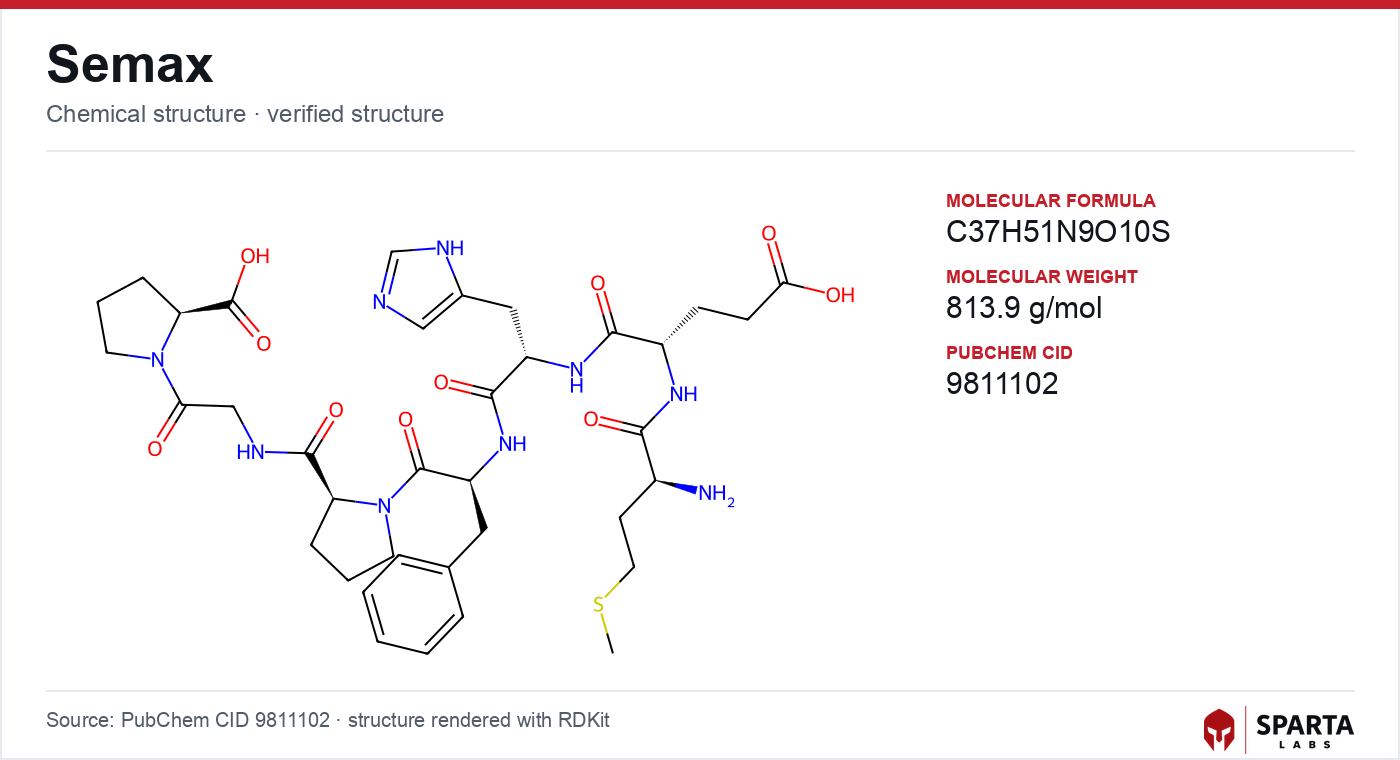
Figure: chemical structure of Semax.
The Semax Sequence as a Synthetic Target
Semax comprises seven natural amino acid residues (Met, Glu, His, Phe, Pro, Gly, Pro) with a molecular weight of approximately 812 daltons. It contains no disulfide bridges, no cyclization, and no non-proteinogenic residues, which places it among the more tractable targets for solid-phase peptide synthesis (SPPS). SPPS was introduced by Merrifield in 1963 and later recognized with the 1984 Nobel Prize in Chemistry [1]. The method builds the chain stepwise on an insoluble resin support, coupling one protected residue at a time before final cleavage and side-chain deprotection.
Two features of the Semax sequence are worth flagging at the synthesis stage. First, the peptide contains two proline residues within a short chain, and the Pro-Gly-Pro arrangement at the C-terminus imposes conformational constraints that synthetic and analytical chemists account for during chain assembly and chromatographic separation. Second, the single histidine and the N-terminal methionine are the residues most sensitive to side reactions during synthesis and handling. Reviews of large-scale peptide manufacturing describe how coupling chemistry, protecting-group strategy, and purification are optimized for short peptides so that sequence fidelity is maintained across production scales [2].
After chain assembly and resin cleavage, crude Semax is purified by preparative reverse-phase HPLC to remove truncated sequences, deletion sequences, and deprotection byproducts. Final purity is quantified by analytical HPLC and identity is confirmed by mass spectrometry, the two release assays discussed below.
Purity Quantification by HPLC
Analytical reverse-phase HPLC is the primary quantitative purity measure for research-grade peptides. In a UV chromatogram, purity is reported as the area fraction of the target peptide peak relative to all detected peaks. A threshold of ≥98% by HPLC is commonly cited in the peptide-therapeutics literature as a working benchmark for research-use material, reflecting the level at which minor synthesis-related species are limited [3]. Material below that threshold may carry truncated sequences or modified variants that introduce uncontrolled variables into preclinical work.
Sparta Labs holds Semax to a ≥98% HPLC purity standard, with each production batch tested by analytical RP-HPLC prior to release. The chromatographic trace and peak-area calculation are recorded on the batch certificate of analysis. For Semax specifically, the value of the chromatogram is not only the numeric purity but its ability to resolve the two compound-specific impurity classes described next, both of which are separable from the intact heptapeptide under reverse-phase conditions.
The Methionine Oxidation Control Point
Semax carries an N-terminal methionine, and methionine is among the most oxidation-susceptible residues in peptide chemistry. Oxidation converts the thioether side chain to a sulfoxide, a well-characterized degradation pathway for methionine-containing peptides and proteins and a recognized contributor to loss of intact material during storage and handling [4]. The oxidized species differs from intact Semax by roughly 16 daltons.
This +16 Da difference is analytically convenient. Methionine sulfoxide Semax elutes as a resolvable peak in reverse-phase HPLC and appears as a distinct mass in the mass spectrum, so a single-batch analysis captures oxidation both quantitatively (as a chromatographic peak fraction) and by mass identity. Sparta Labs analytical QC treats methionine oxidation as part of the standard purity assessment rather than a separate specialty test, because for a Met-terminal peptide it is one of the most probable ways for otherwise correct material to drift off specification.
The Pro-Gly-Pro Fragment as a Characterizable Impurity
The second Semax-specific consideration sits at the opposite end of the molecule. The C-terminal Pro-Gly-Pro (PGP) tripeptide is not merely an inert sequence fragment: PGP is described in the literature as a distinct small peptide with its own biological interest, and the Semax molecule can be regarded as an ACTH(4-7) segment joined to a PGP motif. From a sourcing standpoint, this means that free PGP generated during synthesis or through subsequent degradation should be treated as a defined, characterizable impurity rather than generic noise.
Reverse-phase HPLC separates low-molecular-weight fragments such as free PGP from the intact heptapeptide, and mass spectrometry confirms that the released material carries the full-length molecular weight near 812 daltons rather than a truncated mass. The combination is why both assays appear on the Semax COA. Researchers investigating structurally modified derivatives of this scaffold may also find the corresponding standards for N-Acetyl Semax Amidate relevant, since N-terminal acetylation of that analog changes both the methionine-oxidation profile and the terminal chemistry that reverse-phase separation must resolve.
Identity Confirmation and the Certificate of Analysis
HPLC quantifies how much of the sample is the target peak, but it does not by itself prove that the peak is Semax. Mass spectrometry provides orthogonal identity confirmation by matching the observed molecular ion against the theoretical molecular weight of the heptapeptide. Together, purity by HPLC and identity by mass spectrometry are the paired evidence that a batch is both clean and correct.
A Sparta Labs Certificate of Analysis for a Semax batch records:
- HPLC purity percentage: the area-fraction purity from analytical reverse-phase HPLC.
- Mass spectrometry confirmation: the observed molecular ion(s) compared against the theoretical molecular weight (approximately 812 daltons), which also flags the +16 Da oxidation species and any low-mass PGP-related fragment.
- Batch number: a unique identifier linking the document to a specific manufacturing lot.
- Manufacturing and expiry dates: the production timeline and recommended use window for the lyophilized material.
COAs are accessible from the product page, and because purity and mass-spectrometry values are batch-specific rather than a single global specification, researchers are encouraged to review the COA for the exact lot received.
Storage, Stability, and the Oxidation Link
Lyophilization (freeze-drying) is the standard presentation for short research peptides such as Semax. Removing water from the peptide matrix under vacuum slows hydrolytic degradation and extends shelf life relative to solution formats, consistent with established principles governing the physical and chemical stability of peptide and protein pharmaceuticals [4]. Lyophilized Semax is stored frozen, protected from moisture and light.
Storage strategy for Semax connects directly to the methionine chemistry discussed earlier. Because oxidation is a probable degradation route for a Met-terminal peptide, minimizing exposure to air and moisture is not merely generic advice but a control aimed at the specific liability of this molecule. Repeated freeze-thaw cycling of reconstituted solutions is generally associated with accelerated degradation of sensitive peptide analytes, so single-use aliquoting from a lyophilized stock is standard laboratory practice.
Why Analytical Sourcing Standards Matter for Semax
The interpretability of Semax research depends on the researcher knowing what is actually in the vial. For this compound, two questions dominate: has any of the N-terminal methionine oxidized, and does the material contain the intact heptapeptide rather than fragments related to its Pro-Gly-Pro terminus. Both questions are answered by the same paired assays: reverse-phase HPLC for quantitative purity and separation, and mass spectrometry for identity. Related nootropic-class scaffolds documented in the library, such as Selank, share the general reliance on this analytical pairing while presenting their own sequence-specific control points.
Sparta Labs's quality posture for Semax, ≥98% HPLC purity plus mass-spectrometry identity confirmation with a published batch COA, is designed to give researchers a defined analytical basis for their experimental variables. Documented, batch-specific characterization is what allows a result to be attributed to the labeled compound rather than to an uncharacterized mixture.
References
-
Merrifield RB. Solid phase peptide synthesis. I. The synthesis of a tetrapeptide. J Am Chem Soc. 1963;85(14):2149–2154. DOI: 10.1021/ja00897a025. Full text via DOI
-
Andersson L, Blomberg L, Flegel M, Lepsa L, Nilsson B, Verlander M. Large-scale synthesis of peptides. Biopolymers. 2000;55(3):227–250. PMID: 10880877. DOI: 10.1002/1097-0282(2000)55:3<227::AID-BIP30>3.0.CO;2-7. View on PubMed
-
Kaspar AA, Reichert JM. Future directions for peptide therapeutics development. Drug Discov Today. 2013;18(17–18):807–817. PMID: 23624315. DOI: 10.1016/j.drudis.2013.05.011. View on PubMed
-
Manning MC, Chou DK, Murphy BM, Payne RW, Katayama DS. Stability of protein pharmaceuticals: an update. Pharm Res. 2010;27(4):544–575. PMID: 20143256. DOI: 10.1007/s11095-009-0045-6. View on PubMed
Disclaimer. Statements in this article have not been evaluated by the Food and Drug Administration. This compound is not intended to diagnose, treat, cure, or prevent any disease. Sparta Labs sells research-use-only materials. Content is provided for educational and informational purposes only and does not constitute medical advice. Consult a qualified medical professional for any health concerns.
Frequently asked questions
How is Semax manufactured?
Semax is a seven-residue heptapeptide (Met-Glu-His-Phe-Pro-Gly-Pro) with a molecular weight near 812 daltons, a length well suited to solid-phase peptide synthesis (SPPS). SPPS assembles the chain one protected residue at a time on a resin support, then cleaves and deprotects the completed peptide. Crude material is purified by reverse-phase HPLC to remove truncated and deletion sequences before analytical release testing.
Why is the methionine residue in Semax analytically significant?
Semax begins with an N-terminal methionine, and methionine is one of the most oxidation-prone residues in peptide chemistry. Oxidation converts the side-chain thioether to a sulfoxide, adding roughly 16 daltons to the molecular mass. This species is resolvable from intact Semax by reverse-phase HPLC and detectable as a +16 Da shift by mass spectrometry, which is why both methods appear in Semax quality control.
Why does Pro-Gly-Pro matter for Semax purity?
Semax terminates in a Pro-Gly-Pro (PGP) motif, and PGP is described in the literature as a distinct small peptide entity rather than an inert fragment. For sourcing purposes, elevated free PGP arising from synthesis or degradation is treated as a characterizable impurity. Reverse-phase HPLC separates it from the intact heptapeptide and mass spectrometry confirms the full-length molecular weight.
What does a Certificate of Analysis for Semax document?
A Sparta Labs Certificate of Analysis for a Semax batch reports the analytical HPLC purity percentage, mass spectrometry confirmation against the theoretical molecular weight near 812 daltons, the unique batch number, and manufacturing and expiry dates. Values are batch-specific rather than a single global specification, so researchers are encouraged to review the COA for the exact lot received.
How should lyophilized Semax be stored for research use?
Lyophilized Semax is stored frozen, protected from moisture and light, following the general principle that lower temperature and reduced water activity slow peptide degradation reactions. Freeze-dried presentation limits hydrolysis relative to solutions. Because the N-terminal methionine is oxidation-sensitive, minimizing repeated exposure to air and moisture is consistent with standard laboratory handling of oxidation-prone peptides.