
Semax: A Research Overview
An overview of Semax as an engineered ACTH(4-10) heptapeptide: how the Pro-Gly-Pro tail and N-terminal copper-binding motif define its chemistry, its melanocortin classification, and its documented Russian registration pathway.
For research use only. Not for human consumption. This article is educational reference material. It is not medical advice and is not a recommendation to use any substance.
Introduction
Semax (Met-Glu-His-Phe-Pro-Gly-Pro; MEHFPGP) is a synthetic heptapeptide engineered from a fragment of adrenocorticotropic hormone (ACTH). Rather than copying the full 39-residue hormone, its designers isolated the short melanocortin core of the ACTH(4-10) region and rebuilt it into a proteolytically stabilized molecule. The result is pharmacologically classified as a noncorticotropic melanocortin analog: it carries the ACTH-fragment framework without the adrenal endocrine signaling of the parent hormone. This overview examines the three features that make Semax distinct from other short peptides in the research literature: the logic of its truncated ACTH design, the N-terminal copper-binding motif embedded in its sequence, and its unusual two-track regulatory status.
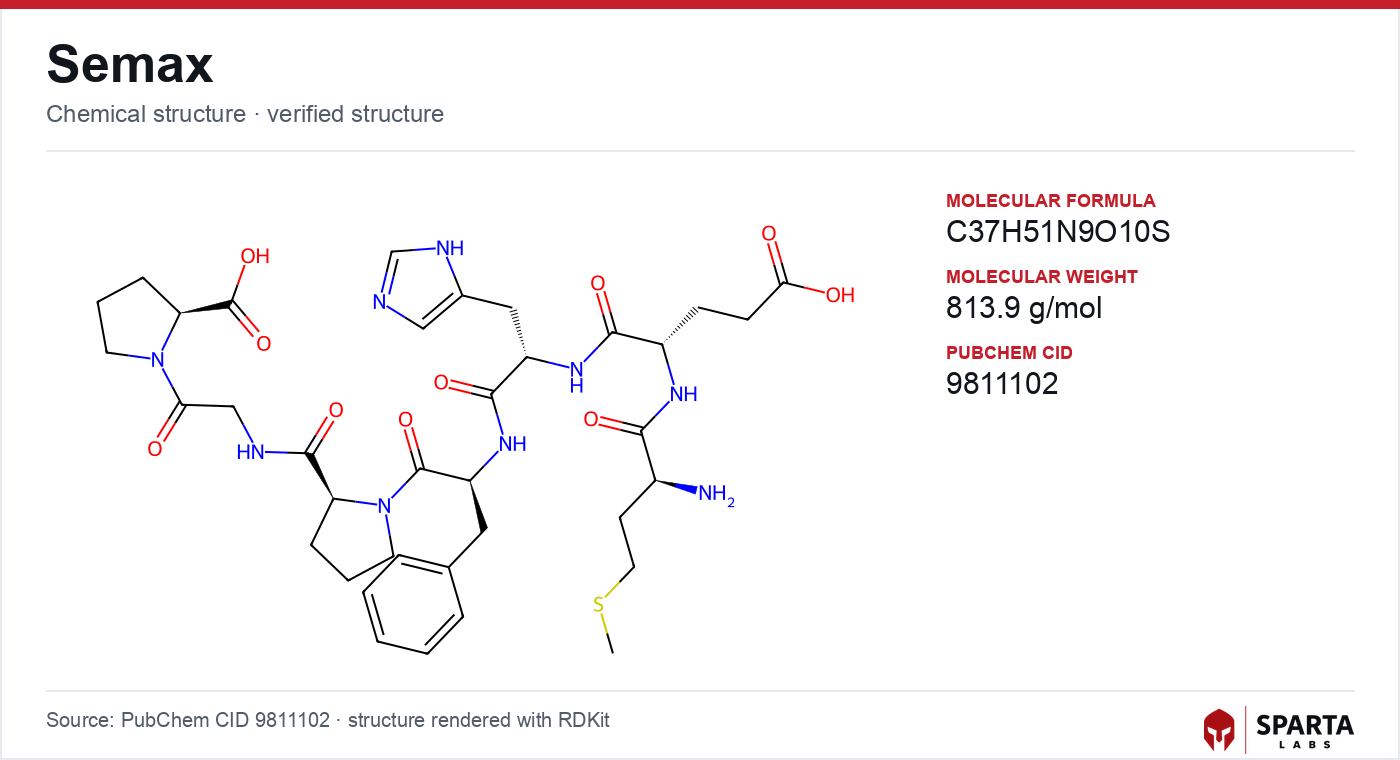
Figure: chemical structure of Semax.
From a 39-residue hormone to a 7-residue analog
The scientific starting point for Semax was a body of behavioral neuropharmacology from the 1970s and 1980s establishing that short peptides drawn from the ACTH sequence retained neuromodulatory activity that could be separated from the hormone's adrenal functions. Work summarized in a later review by Kolomin and colleagues traced how the melanocortin core within the ACTH(4-10) span became the target of deliberate analog design at the Institute of Molecular Genetics of the Russian Academy of Sciences [1].
Findings from research models do not establish safety or efficacy in humans. Sparta Labs makes no claims about the use of this compound.
The design chosen by the group led by Igor Ashmarin and Nikolai Myasoedov kept the minimal active tetrapeptide (ACTH(4-7): Met-Glu-His-Phe) and appended a Pro-Gly-Pro tripeptide at the C-terminus [1]. This is the key architectural decision: the first four residues preserve the melanocortin recognition element inherited from ACTH, while the added tail exists only to solve a stability problem. That two-part logic distinguishes Semax from naturally occurring neuropeptides and places it in the same Russian engineered-peptide lineage as Selank, which was developed at overlapping institutions during the same era.
Chemistry and structure
Semax has the amino acid sequence Met-Glu-His-Phe-Pro-Gly-Pro (one-letter code MEHFPGP) and a molecular weight of approximately 812 daltons. The N-terminal methionine corresponds to position 4 of the native ACTH sequence, anchoring the analog to its melanocortin origin.
The stabilizing C-terminal tail
The Pro-Gly-Pro segment is the appended, non-native portion of the molecule. Its function was characterized in a 1993 study by Inozemtseva and colleagues, who examined the breakdown of the ACTH/MSH(4-10) fragment and its Semax analog by rat serum enzymes [2]. The report described attenuated carboxypeptidase-mediated cleavage on the Semax sequence relative to the unmodified fragment, consistent with the design intent of the proline-rich terminus. This stability characteristic is one reason the analog became a practical tool for extended in vivo study where the parent fragment degrades quickly.
An embedded copper-binding motif
A second, less obvious structural feature sits at the opposite end of the molecule. Because Semax presents a free N-terminal amine three residues upstream of its histidine, it forms an amino-terminal copper- and nickel-binding (ATCUN) motif. A 2015 study by Tabbì and colleagues characterized this feature, reporting that Semax coordinates copper(II) ions with high affinity in vitro and describing an associated protective effect against copper-induced toxicity in a neuroblastoma cell model [3]. This coordination chemistry links Semax to the broader research interest in copper-binding neuropeptides, a theme it shares with the histidine- and copper-associated tripeptide covered in the GHK-Cu research overview.
Acetylated derivatives
N-terminal acetylation produces a distinct research variant. Capping the methionine alpha-amine removes the free N-terminus required for the ATCUN motif and alters the molecule's coordination behavior, which is why the acetylated and amidated derivatives are studied as separate entities rather than interchangeable forms. That variant is discussed in the N-Acetyl Semax Amidate research overview.
Pharmacological classification
Semax is classified as a noncorticotropic melanocortin analog. The melanocortin receptor family comprises five G-protein-coupled receptor subtypes (MC1R through MC5R); the central nervous system principally expresses MC3R and MC4R. The defining property of ACTH(4-10)-derived analogs is that they engage this receptor system in the central nervous system without the corticotropic (adrenal cortisol-releasing) activity of full-length ACTH.
Beyond direct receptor classification, much of the published binding and expression literature has centered on a neurotrophin axis. A 2006 study by Dolotov and colleagues in the Journal of Neurochemistry reported specific binding of Semax in rat basal forebrain tissue alongside measured changes in brain-derived neurotrophic factor (BDNF) protein [4]. A companion report from the same group in Brain Research described associated changes in BDNF and trkB receptor expression in hippocampal tissue [5]. The receptor-level and signaling detail behind these observations is treated separately in the Semax mechanism of action article, and a fuller catalog of the individual studies appears in the Semax published research summary.
Regulatory status: two divergent tracks
Semax occupies an unusual position because its regulatory history split along national lines. In the Russian Federation, the compound received registration from the Russian Ministry of Health in 1994 as a nasal-spray formulation, following a clinical development program conducted in the early-to-mid 1990s, and it appears on the Russian List of Vital and Essential Drugs [1]. A 2022 review by Deigin and colleagues in Pharmaceutics situated Semax within the broader development history of Russian peptide biopharmaceuticals [6].
Outside the Russian Federation, no comparable authorization exists. The FDA has not reviewed Semax for any indication, and it is not listed in the European Medicines Agency's centralized database of authorized medicines. In the United States, European Union, Canada, and Australia, the compound is handled as a research material. Research-grade Semax available from Sparta Labs is supplied with batch-specific certificates of analysis for laboratory research applications.
Discovery lineage
The intellectual lineage of Semax runs from the ACTH-fragment behavioral pharmacology of the 1970s through the formalized analog-design program at the Institute of Molecular Genetics in the late 1970s and 1980s [1]. English-language peer-reviewed coverage of the molecule expanded substantially from 2001 onward, with the melanocortin-receptor and neurotrophin frameworks becoming the dominant mechanistic lenses. The complete timeline, from initial fragment studies through Russian registration, is set out in the Semax discovery and regulatory history article.
References
-
Kolomin T, Shadrina M, Slominsky P, Limborska S, Myasoedov N. A new generation of drugs: synthetic peptides based on natural regulatory peptides. Neuroscience & Medicine. 2013;4(4):223–252. DOI: 10.4236/nm.2013.44035
-
Inozemtseva LS, Dolotov OV, Zolotarev YA, Dolotova OS, Andreeva LA, Myasoedov NF. Degradation of ACTH/MSH(4-10) and its synthetic analog semax by rat serum enzymes: an inhibitor study. Peptides. 1993;14(4):745–750. PMID: 8392718. DOI: 10.1016/0196-9781(93)90104-U
-
Tabbì G, Magrì A, Giuffrida A, Lanza V, Pappalardo G, Naletova I, Nicoletti VG, Attanasio F, Rizzarelli E. Semax, an ACTH4-10 peptide analog with high affinity for copper(II) ion and protective ability against metal induced cell toxicity. J Inorg Biochem. 2015;142:39–46. PMID: 25310602. DOI: 10.1016/j.jinorgbio.2014.09.014
-
Dolotov OV, Karpenko EA, Inozemtseva LS, Seredenina TS, Levitskaya NG, Zolotarev YA, Kamensky AA, Grivennikov IA, Engele J, Myasoedov NF. Semax, an analogue of adrenocorticotropin (4–10), binds specifically and increases levels of brain-derived neurotrophic factor protein in rat basal forebrain. J Neurochem. 2006;97 Suppl 1:82–86. PMID: 16635254. DOI: 10.1111/j.1471-4159.2006.03658.x
-
Dolotov OV, Karpenko EA, Seredenina TS, Inozemtseva LS, Levitskaya NG, Zolotarev YA, Kamensky AA, Grivennikov IA, Engele J, Myasoedov NF. Semax, an analog of ACTH(4-10) with cognitive effects, regulates BDNF and trkB expression in the rat hippocampus. Brain Res. 2006;1117(1):54–60. PMID: 16996037. DOI: 10.1016/j.brainres.2006.07.108
-
Deigin VI, Poluektova EA, Beniashvili AG, Kozin SA, Poluektov YM. Development of peptide biopharmaceuticals in Russia. Pharmaceutics. 2022;14(4):716. PMCID: PMC9030433. DOI: 10.3390/pharmaceutics14040716
Disclaimer. Statements in this article have not been evaluated by the Food and Drug Administration. This compound is not intended to diagnose, treat, cure, or prevent any disease. Sparta Labs sells research-use-only materials. Content is provided for educational and informational purposes only and does not constitute medical advice. Consult a qualified medical professional for any health concerns.
Frequently asked questions
What is Semax and what is it derived from?
Semax is a synthetic heptapeptide with the sequence Met-Glu-His-Phe-Pro-Gly-Pro (MEHFPGP). It was constructed from the ACTH(4-7) melanocortin core fragment of adrenocorticotropic hormone, with a Pro-Gly-Pro tripeptide appended to the C-terminus. It is classified as a noncorticotropic melanocortin analog, meaning it retains the ACTH-fragment framework without the adrenal endocrine activity of the full-length hormone.
Why was a Pro-Gly-Pro tail added to the Semax sequence?
The Pro-Gly-Pro tripeptide does not correspond to any part of the native ACTH sequence; it was added by design. A 1993 study by Inozemtseva and colleagues reported that the terminal proline residues attenuate carboxypeptidase-mediated cleavage of the peptide relative to the unmodified fragment, which extends the molecule's stability in serum-enzyme assays.
What is the ATCUN motif in Semax?
ATCUN stands for amino-terminal copper- and nickel-binding motif, a structural feature formed when a free N-terminal amine sits three residues away from a histidine. Semax carries a histidine at its third position, and a 2015 study by Tabbi and colleagues reported that this arrangement lets Semax coordinate copper(II) ions with high affinity in vitro.
Is Semax approved by the FDA?
No. Semax has not been reviewed or approved by the FDA for any indication, and it is classified as a research-use-only material in the United States, European Union, Canada, and Australia. It holds a separate regulatory history in the Russian Federation, where the Ministry of Health registered a nasal-spray formulation in 1994.
Who developed Semax?
Semax was synthesized in the early 1980s by a group led by Academicians Igor Ashmarin and Nikolai Myasoedov at the Institute of Molecular Genetics of the Russian Academy of Sciences. It belongs to the same Russian regulatory-peptide research program that produced Selank, and its design goal was a proteolytically stabilized analog of the behaviorally active ACTH(4-10) fragment.