
Tirzepatide: Published Research Summary
A trial-by-trial reading of the tirzepatide literature, organized as three research waves: bench pharmacology and cryo-EM structure, the SURPASS diabetes program, and the SURMOUNT weight-management program. Educational reference.

For research use only. Not for human consumption. This article is educational reference material. It is not medical advice and is not a recommendation to use any substance.
Reading the Tirzepatide Literature as Three Research Waves
Tirzepatide (development code LY3298176) accumulated a research record with an unusually legible shape. Rather than a scatter of unrelated papers, the published literature falls into three overlapping waves, each answering a different kind of question. This article uses that structure as its organizing principle. It is a bibliographic map, not a meta-analysis; it reports what investigators reported, with attribution and methodology context, and draws no independent conclusions.
The first wave is bench work: receptor pharmacology and structural biology that characterized how a single peptide engages two distinct incretin receptors. The second wave is the SURPASS program, a set of phase 3 trials in adults with type 2 diabetes. The third wave is the SURMOUNT program, phase 3 trials in adults with obesity or overweight. A researcher approaching the literature cold can navigate it by asking which wave a given paper belongs to.
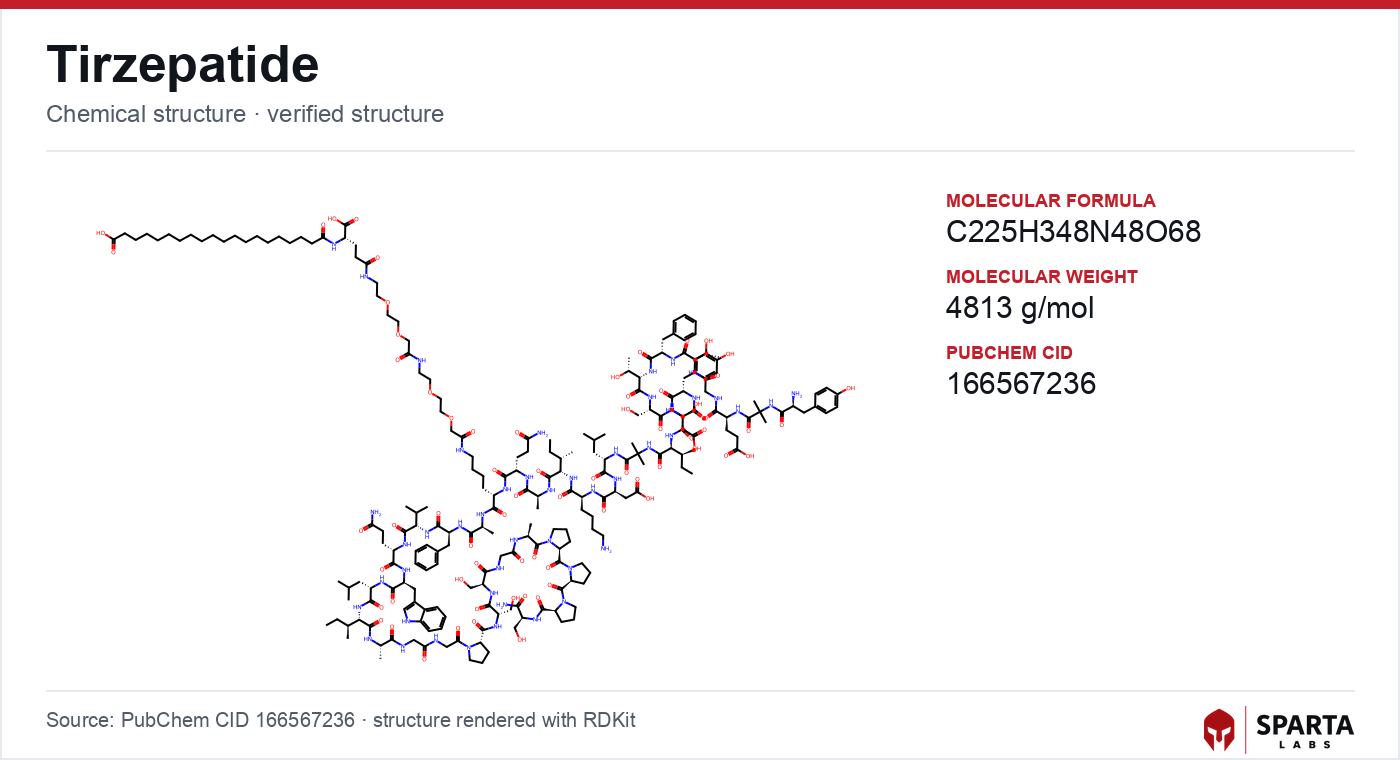
Figure: chemical structure of Tirzepatide.
For the chemistry and classification that sit underneath this literature, the tirzepatide research overview provides context, and the tirzepatide discovery and regulatory history situates these papers on a timeline.
How to Read the Study Types
Interpreting any single reference below depends on knowing what kind of evidence it represents. Four methodological registers recur across the tirzepatide record.
Cell-based receptor pharmacology measures binding affinity, receptor selectivity, second-messenger generation (such as cAMP), and beta-arrestin recruitment in engineered assay systems. These studies describe molecular behavior, not organism-level outcomes.
Structural biology, principally cryo-electron microscopy here, resolves the physical geometry of the peptide bound to its receptor, down to individual residue contacts.
Preclinical in vivo work in rodent and non-human primate models generated pharmacokinetic and metabolic data. Findings from these models informed the scientific rationale for clinical development and are reported for methodological context only; they do not extrapolate directly to human populations.
Phase 1 through phase 3 clinical trials progress from pharmacokinetics and tolerability in small human cohorts to large, multicenter randomized controlled trials with prespecified endpoints. The distinction between an open-label active-controlled design and a double-blind placebo-controlled design matters when weighing any individual result.
Wave One: Molecular Pharmacology and Structure
Coskun et al., 2018 — The Discovery Paper
Coskun and colleagues reported the discovery and initial characterization of LY3298176 in Molecular Metabolism in 2018 [1]. The paper laid out the design rationale for a single molecule intended to engage both the glucose-dependent insulinotropic polypeptide (GIP) receptor and the glucagon-like peptide-1 (GLP-1) receptor, presented in vitro receptor pharmacology across both assay systems, and reported preclinical in vivo metabolic data alongside early phase 1 clinical pharmacokinetic and pharmacodynamic observations. The authors reported that co-stimulation of both incretin receptors in preclinical models was associated with metabolic observations that differed from those attributed to selective GLP-1 receptor agonists.
Findings from research models do not establish safety or efficacy in humans. Sparta Labs makes no claims about the use of this compound.
The phase 1 data described in the same paper indicated that the molecule reached steady-state concentrations consistent with an extended dosing interval and was associated with dose-dependent changes in pharmacodynamic markers of incretin receptor engagement.
Willard et al., 2020 — Biased and Imbalanced Agonism
Willard and colleagues published a detailed pharmacological characterization in JCI Insight in 2020 [2]. In receptor-based assays, the authors reported that the molecule behaved as a full agonist at the GIP receptor while showing biased agonism at the GLP-1 receptor, with preferential cAMP generation over beta-arrestin recruitment at the latter. The study further reported that beta-arrestin 1 limited GLP-1-stimulated but not tirzepatide-stimulated insulin secretion in isolated islet preparations, a finding the authors framed as a proposed mechanistic distinction between this dual agonist and selective GLP-1 receptor agonists. The downstream signaling implications of this "imbalanced" profile are treated in depth in the tirzepatide mechanism of action article.
Sun et al., 2022 — Cryo-EM Structural Determinants
Sun and colleagues reported cryo-electron microscopy structures of tirzepatide in complex with both the GIP receptor and the GLP-1 receptor in the Proceedings of the National Academy of Sciences in 2022 [3]. The structural data identified the molecular contact points governing engagement of each receptor and reported that the peptide adopted distinct binding poses at the two receptor complexes. The authors characterized specific residue interactions associated with the differential potency observed at each receptor subtype, giving the pharmacological findings from the earlier assay work an atomic-resolution structural anchor.
Wave Two: The SURPASS Diabetes Program
The SURPASS trials evaluated tirzepatide in adults with type 2 diabetes, using glycemic control (change in HbA1c) as the primary endpoint and body-weight change among secondary endpoints. The three trials summarized below illustrate the program's range of comparators: placebo, an active injectable comparator, and a basal insulin analogue.
Rosenstock et al., 2021 — SURPASS-1 (Placebo-Controlled)
Rosenstock and colleagues reported SURPASS-1 in The Lancet in 2021 [4]. It was a 40-week, double-blind, randomized, placebo-controlled phase 3 trial conducted at 52 sites across India, Japan, Mexico, and the United States in 478 adults with type 2 diabetes managed by diet and exercise alone. The authors reported statistically significant reductions in HbA1c and body weight from baseline in all three tirzepatide dose groups relative to placebo at 40 weeks. The incidence of hypoglycemia was reported as low across treatment groups, consistent with the glucose-dependent insulin secretory mechanism attributed to incretin receptor agonism.
Frias et al., 2021 — SURPASS-2 (Versus Semaglutide)
Frias and colleagues reported SURPASS-2 in the New England Journal of Medicine in 2021 [5]. This 40-week, randomized, open-label, active-controlled phase 3 trial enrolled 1,879 adults with type 2 diabetes inadequately controlled on metformin, and compared three tirzepatide doses against injectable semaglutide at its study-specified comparator dose. The authors reported that all three tirzepatide doses met prespecified noninferiority and superiority criteria for mean reductions in HbA1c and body weight from baseline at 40 weeks. Gastrointestinal adverse events were reported in both treatment groups; nausea, diarrhea, and vomiting were among the most frequently reported events with tirzepatide. Because this is the trial most often cited in head-to-head discussions, readers comparing the two incretin agents may find the parallel semaglutide published research summary a useful companion.
Del Prato et al., 2021 — SURPASS-4 (Versus Insulin Glargine)
Del Prato and colleagues reported SURPASS-4 in The Lancet in 2021 [6]. This open-label, randomized, active-controlled phase 3 trial enrolled 2,002 adults with type 2 diabetes and elevated cardiovascular risk, comparing tirzepatide with titrated insulin glargine over a 52-week treatment period. The authors reported that tirzepatide at all doses produced greater reductions in HbA1c and body weight from baseline than insulin glargine, while the incidence of hypoglycemia was reported as lower in the tirzepatide groups. Cardiovascular safety data from the trial were characterized as consistent with no increased risk relative to the comparator. The higher-cardiovascular-risk population makes SURPASS-4 the SURPASS trial most frequently referenced in discussions of the forthcoming dedicated outcomes trial.
Wave Three: The SURMOUNT Weight-Management Program
The SURMOUNT trials shifted population and endpoint. They enrolled adults with obesity or overweight, ran for 72 weeks, and used change in body weight as the primary endpoint. This program generated the dataset that contributed to the FDA's November 2023 assessment for chronic weight management.
Jastreboff et al., 2022 — SURMOUNT-1 (Without Diabetes)
Jastreboff and colleagues reported SURMOUNT-1 in the New England Journal of Medicine in 2022 [7]. It was a 72-week, double-blind, randomized, placebo-controlled phase 3 trial enrolling 2,539 adults with obesity, or with overweight and at least one weight-related comorbidity, and excluding those with type 2 diabetes. The authors reported statistically significant mean reductions in body weight from baseline across all three tirzepatide dose groups compared with placebo at 72 weeks. Gastrointestinal adverse events were among the most frequently reported events. This trial formed part of the regulatory submission underpinning the 2023 weight-management assessment.
Garvey et al., 2023 — SURMOUNT-2 (With Type 2 Diabetes)
Garvey and colleagues reported SURMOUNT-2 in The Lancet in 2023 [8]. This 72-week, double-blind, randomized, placebo-controlled phase 3 trial enrolled 938 adults with obesity or overweight who also had type 2 diabetes. The authors reported statistically significant mean reductions in body weight from baseline across tirzepatide dose groups compared with placebo, extending the SURMOUNT-1 observations to participants with concurrent type 2 diabetes. Read alongside SURMOUNT-1, the two trials bracket the weight-management population by the presence or absence of diabetes.
Where the Literature Is Still Open
The tirzepatide record remains an active area of investigation, and several questions posed by the primary trial program are still being answered.
A dedicated cardiovascular outcomes trial (SURPASS-CVOT) was enrolling at the time this article was prepared, intended to further characterize the long-term outcomes profile. Pediatric data were generated in the SURPASS-PEDS trial, published in The Lancet in 2025, extending the investigational dataset to younger populations. At the basic-pharmacology level, the specific contribution of GIP receptor agonism to the observations in the SURPASS and SURMOUNT trials, including the role of GIP receptor signaling in adipose tissue and the central nervous system, remains under study. The durability of effects observed across the 72-week trial windows, and their trajectory over longer periods, are also subjects of ongoing work. Investigational programs examining tirzepatide in additional cardiometabolic conditions, including metabolic dysfunction-associated steatohepatitis (MASH) and heart failure with preserved ejection fraction, have reported early-phase data and remain active.
This literature also sits within a broader research direction toward multireceptor incretin pharmacology. Programs on the triple GIP/GLP-1/glucagon receptor agonist retatrutide and on the amylin analogue cagrilintide represent adjacent lines of investigation in the same pharmacological family, and researchers tracing the field often read them together.
For laboratories evaluating reference material against this published record, analytically characterized tirzepatide from Sparta Labs is available for non-clinical study, and the tirzepatide sourcing and quality article documents the associated verification standards.
References
-
Coskun T, Sloop KW, Loghin C, Alsina-Fernandez J, Urva S, Bokvist KB, et al. LY3298176, a novel dual GIP and GLP-1 receptor agonist for the treatment of type 2 diabetes mellitus: from discovery to clinical proof of concept. Mol Metab. 2018;18:3-14. DOI: 10.1016/j.molmet.2018.09.009
-
Willard FS, Douros JD, Gabe MBN, Showalter AD, Wainscott DB, Suter TM, et al. Tirzepatide is an imbalanced and biased dual GIP and GLP-1 receptor agonist. JCI Insight. 2020;5(17):e140532. PMID: 32730231. DOI: 10.1172/jci.insight.140532
-
Sun B, Willard FS, Feng D, Alsina-Fernandez J, Chen Q, Vieth M, et al. Structural determinants of dual incretin receptor agonism by tirzepatide. Proc Natl Acad Sci USA. 2022;119(13):e2116506119. PMID: 35333651. DOI: 10.1073/pnas.2116506119
-
Rosenstock J, Wysham C, Frias JP, Kaneko S, Lee CJ, Fernandez Lando L, et al. Efficacy and safety of a novel dual GIP and GLP-1 receptor agonist tirzepatide in patients with type 2 diabetes (SURPASS-1): a double-blind, randomised, phase 3 trial. Lancet. 2021;398(10295):143-155. DOI: 10.1016/S0140-6736(21)01324-6
-
Frias JP, Davies MJ, Rosenstock J, Perez Manghi FC, Fernandez Lando L, Bergman BK, et al. Tirzepatide versus semaglutide once weekly in patients with type 2 diabetes. N Engl J Med. 2021;385(6):503-515. PMID: 34170647. DOI: 10.1056/NEJMoa2107519
-
Del Prato S, Kahn SE, Pavo I, Wander PL, Chen Y, Lando LF, et al. Tirzepatide versus insulin glargine in type 2 diabetes and increased cardiovascular risk (SURPASS-4): a randomised, open-label, parallel-group, multicentre, phase 3 trial. Lancet. 2021;398(10313):1811-1824. DOI: 10.1016/S0140-6736(21)02188-7
-
Jastreboff AM, Aronne LJ, Ahmad NN, Wharton S, Connery L, Alves B, et al. Tirzepatide once weekly for the treatment of obesity. N Engl J Med. 2022;387(3):205-216. PMID: 35658024. DOI: 10.1056/NEJMoa2206038
-
Garvey WT, Frias JP, Jastreboff AM, le Roux CW, Sattar N, Li T, et al. Tirzepatide once weekly for the treatment of obesity in people with type 2 diabetes (SURMOUNT-2): a double-blind, randomised, multicentre, placebo-controlled, phase 3 trial. Lancet. 2023;402(10402):613-626. DOI: 10.1016/S0140-6736(23)01200-X
Disclaimer. Statements in this article have not been evaluated by the Food and Drug Administration. This compound is not intended to diagnose, treat, cure, or prevent any disease. Sparta Labs sells research-use-only materials. Content is provided for educational and informational purposes only and does not constitute medical advice. Consult a qualified medical professional for any health concerns.
Frequently asked questions
How is the tirzepatide research literature organized?
The published record can be read as three overlapping waves. The first is bench pharmacology and structural biology characterizing how the molecule engages the GIP and GLP-1 receptors. The second is the SURPASS phase 3 program in adults with type 2 diabetes. The third is the SURMOUNT phase 3 program in adults with obesity or overweight. This article summarizes representative studies from each wave with attribution and methodology context.
What did the cryo-EM structural studies of tirzepatide report?
Sun and colleagues reported cryo-electron microscopy structures of tirzepatide bound to both the GIP receptor and the GLP-1 receptor in the Proceedings of the National Academy of Sciences in 2022. The authors described distinct binding poses at the two receptor complexes and identified specific residue interactions associated with the differential potency at each receptor. The work provided an atomic-resolution reference point for interpreting the dual-agonist pharmacology.
How did the SURPASS-2 trial compare tirzepatide with semaglutide?
Frias and colleagues reported SURPASS-2 in the New England Journal of Medicine in 2021. It was a 40-week, randomized, open-label, active-controlled phase 3 trial in 1,879 adults with type 2 diabetes inadequately controlled on metformin, comparing three tirzepatide doses with a comparator dose of injectable semaglutide. The authors reported that all three tirzepatide doses met prespecified noninferiority and superiority criteria for change in HbA1c and body weight at 40 weeks.
What distinguishes the SURPASS program from the SURMOUNT program?
The SURPASS trials enrolled adults with type 2 diabetes and used glycemic endpoints, comparing tirzepatide against placebo, injectable semaglutide, and insulin analogues over 40- to 52-week periods. The SURMOUNT trials enrolled adults with obesity or overweight and ran for 72 weeks, generating the body-weight dataset that contributed to the FDA's 2023 chronic weight management assessment. The two programs share a molecule but differ in population, endpoints, and duration.
What questions remain open in the tirzepatide literature?
Investigators have flagged several active areas. A dedicated cardiovascular outcomes trial (SURPASS-CVOT) was enrolling when this article was prepared, and the specific contribution of GIP receptor signaling in adipose tissue and the central nervous system remains under basic-pharmacology investigation. The durability of effects beyond the 72-week trial windows, and programs in conditions such as MASH and heart failure with preserved ejection fraction, are ongoing.