
Tirzepatide: Mechanism of Action
A mechanism-focused reading of tirzepatide's peer-reviewed pharmacology: why a single synthetic peptide engages two incretin receptors, how its GLP-1R signaling bias was measured, and what cryo-EM revealed about its binding poses. Educational reference.

Tirzepatide: How Dual GIP and GLP-1 Receptor Agonism Is Reported to Work
For research use only. Not for human consumption. This article is educational reference material. It is not medical advice and is not a recommendation to use any substance.
Introduction
Tirzepatide (development code LY3298176) is a synthetic 39-amino-acid peptide notable in the pharmacological literature for a design choice that was unusual when it entered clinical development: a single molecule intended to engage two separate incretin receptors. Those receptors, the glucose-dependent insulinotropic polypeptide receptor (GIPR) and the glucagon-like peptide-1 receptor (GLP-1R), are ordinarily activated by two different endogenous hormones. This article reads the published mechanism-of-action literature through the specific question that makes tirzepatide distinct from earlier incretin peptides: how one engineered ligand distributes its activity across two receptors, and what that distribution has been reported to mean at the molecular level. A broader catalogue of the compound's trials is collected in the tirzepatide published research summary, and its classification and history are covered in the tirzepatide research overview.
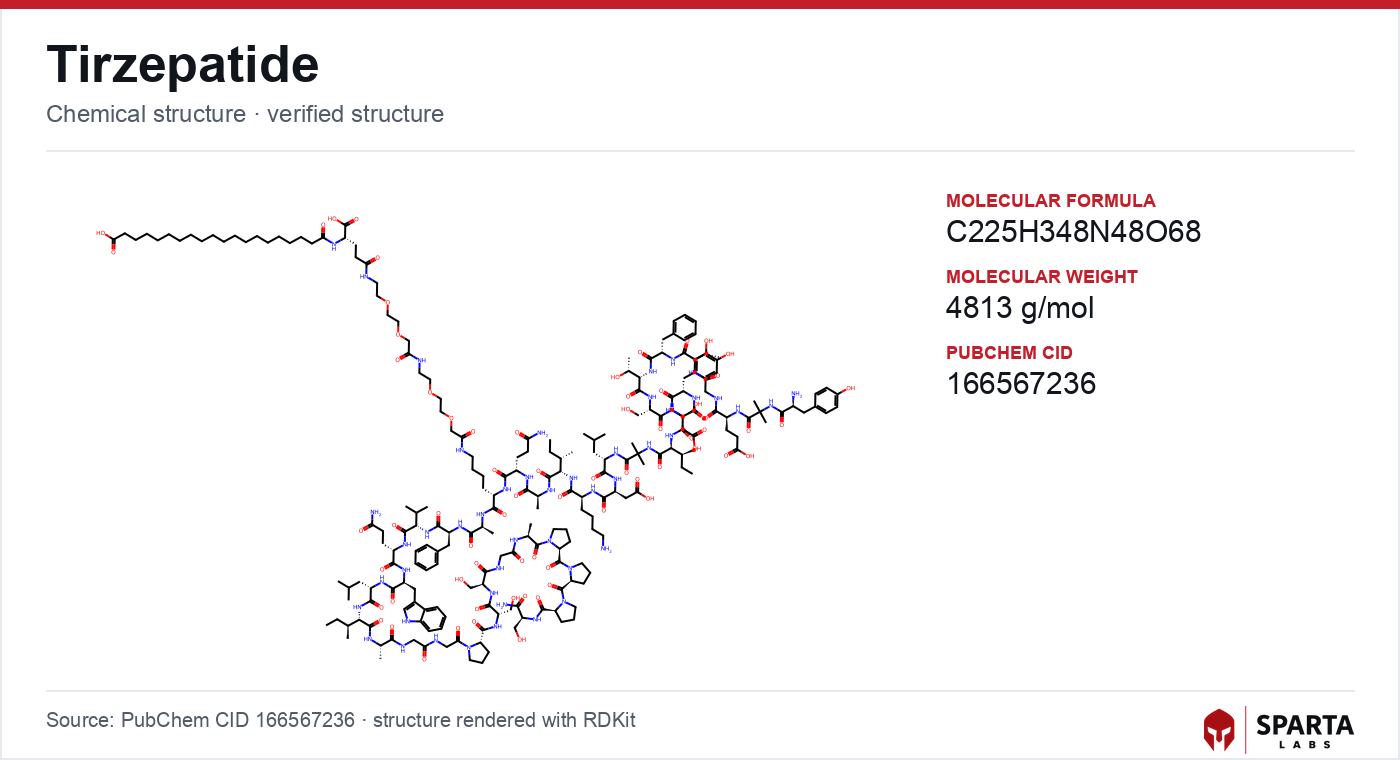
Figure: chemical structure of Tirzepatide.
Why One Peptide Was Built for Two Receptors
The incretin system relies on two gut-derived hormones, GIP and GLP-1, each acting through its own class B G protein-coupled receptor. Selective GLP-1 receptor agonists engage only one of those two arms. The mechanistic premise behind tirzepatide, described in the discovery paper by Coskun and colleagues (2018), was that a peptide reaching both receptors could recruit incretin signaling from both hormone systems at once rather than one alone [3].
To build such a molecule, the peptide backbone was based on the GIP sequence and modified so that it would also recognize the GLP-1R, with a C20 fatty diacid moiety attached to extend its plasma residence. Coskun and colleagues reported that, in preclinical models, this dual-receptor engagement was associated with glucose-dependent insulin secretion and changes in food intake and body weight, and they characterized certain effects on body composition as more pronounced than those seen with selective GLP-1R agonists in the same models, attributing the difference to the added GIPR component [3].
Findings from research models do not establish safety or efficacy in humans. Sparta Labs makes no claims about the use of this compound.
This design premise is what places tirzepatide in a different mechanistic category from single-receptor incretin peptides such as semaglutide, and it anticipates a further generation of multi-receptor peptides discussed in the retatrutide mechanism of action article.
An Imbalanced Dual Agonist
A recurring theme in the reported pharmacology is that tirzepatide's two receptor arms are not matched in strength. The characterization by Willard and colleagues (2020) in JCI Insight is the reference point for this idea [1]. Using in vitro assays of receptor binding and cyclic adenosine monophosphate (cAMP) signaling, the authors reported that at the GIPR, tirzepatide behaved as a full agonist that closely mimicked native GIP. At the GLP-1R, by contrast, it bound with roughly fivefold weaker affinity than native GLP-1 and generated cAMP less potently than the endogenous ligand.
The authors described this profile as "imbalanced," with the GIPR component dominant in the in vitro measurements [1]. That framing matters mechanistically: it means the two receptor arms cannot be assumed to contribute symmetrically, and any interpretation of tirzepatide's pharmacology has to account for a strong GIPR signal paired with an attenuated GLP-1R signal rather than two equal halves. Both receptors couple primarily through stimulatory G proteins (Gs) to activate adenylyl cyclase and raise intracellular cAMP, which is the common second-messenger endpoint the study measured.
Signaling Bias at the GLP-1 Receptor
Beyond the imbalance in affinity, Willard and colleagues (2020) documented a second, qualitatively different property at the GLP-1R: biased agonism [1]. Biased agonism refers to a ligand's capacity to selectively stabilize receptor conformations that preferentially activate one intracellular pathway over another, rather than engaging all pathways in the proportions the native hormone does.
At the GLP-1R specifically, the study reported that tirzepatide preferentially stimulated cAMP accumulation over recruitment of beta-arrestin 1, relative to native GLP-1 [1]. Beta-arrestins are adaptor proteins that can dampen receptor signaling and drive receptor internalization, so a ligand that recruits less beta-arrestin while still driving cAMP represents a distinct signaling mode.
The authors examined the functional consequence of this bias in the same work. They reported that beta-arrestin 1 limited the insulin secretory response to native GLP-1 stimulation, but did not limit the response to GIP or to tirzepatide, and interpreted tirzepatide's reduced beta-arrestin recruitment at the GLP-1R as consistent with a relatively sustained insulin secretory response in their assay system [1]. This mechanistic distinction from selective GLP-1R agonists has remained a subject of active scientific interest and is one reason the compound is analyzed separately from single-receptor agonists such as mazdutide.
Structural Basis: Two Poses, One Molecule
If tirzepatide binds two receptors with different strengths, a natural question is what those interactions look like at atomic resolution. Sun and colleagues (2022) addressed this with cryo-electron microscopy, resolving tirzepatide bound to both the GIPR and GLP-1R signaling complexes and publishing the work in the Proceedings of the National Academy of Sciences [2].
The study identified the molecular contact points that govern tirzepatide's interaction with each receptor and reported that the peptide adopted structurally distinct binding poses at the two receptors rather than a single conserved conformation [2]. In mechanistic terms, this provides a structural correlate for the imbalanced binding affinities characterized earlier by Willard and colleagues: a molecule that sits differently in each receptor pocket would be expected to engage each with different strength and to stabilize different conformational states, which is consistent with both the affinity asymmetry and the signaling bias reported in the functional assays [1,2]. The cryo-EM framework does not by itself establish physiological outcomes, but it grounds the pharmacological observations in defined atomic contacts.
From Molecular Pharmacology to Clinical Observation
The reported clinical literature is where the molecular pharmacology has been examined in human populations, always in the context of controlled trials rather than general-use claims.
In the SURPASS-1 phase 3 trial, a 40-week, double-blind, placebo-controlled study in adults with type 2 diabetes managed by diet and exercise alone, Rosenstock and colleagues (2021) reported statistically significant reductions in glycated hemoglobin (HbA1c) and in body weight across the tirzepatide dose groups compared with placebo at 40 weeks [4]. The authors noted a low incidence of hypoglycemia across treatment groups, which they described as consistent with the glucose-dependent insulin secretory mechanism attributed to incretin receptor agonism [4]. That glucose dependence is itself a mechanistic point: the reported pharmacology predicts insulin secretion tied to prevailing glucose, which aligns with the observed hypoglycemia profile.
The SURPASS-2 trial (Frías et al., 2021) compared tirzepatide with the selective GLP-1 receptor agonist semaglutide in a 40-week, randomized, open-label study in adults with type 2 diabetes on background metformin [5]. The authors reported that tirzepatide met prespecified noninferiority and superiority criteria for HbA1c reduction versus the semaglutide comparator dose and also reported greater mean body-weight reductions [5]. Whether the differences observed trace to GIPR co-agonism, to the biased GLP-1R pharmacology, or to the interaction of both has been a matter of ongoing scientific discussion rather than a settled attribution. Gastrointestinal effects such as nausea, vomiting, and diarrhea were reported in SURPASS participants and were described as consistent with the known pharmacology of GLP-1R agonism, generally transient and dose-related [4,5].
Open Mechanistic Questions
Several parts of tirzepatide's mechanism remain unresolved in the published literature, and they follow directly from the features described above.
The relative contribution of GIPR agonism versus GLP-1R agonism to the observed profile has not been fully disentangled. The imbalanced-agonist characterization by Willard and colleagues (2020) complicates any clean comparison with selective GLP-1R agonists, because the GIPR-dominant in vitro signal does not map simply onto the human observations [1]. This question continues to motivate basic pharmacology research.
A second frontier concerns GIPR signaling in tissues beyond the pancreas, including adipose tissue and the central nervous system, where the receptor is also expressed. Preclinical findings have generated hypotheses about tissue-level roles for the GIPR arm, but translating those hypotheses to clinical populations remains an open research area. For readers tracing how the incretin and amylin classes are being combined and compared, the cagrilintide research overview provides related context on adjacent peptide pharmacology.
Research-grade tirzepatide from Sparta Labs is supplied with batch-specific HPLC and mass spectrometry documentation for non-clinical investigation.
References
-
Willard FS, Douros JD, Gabe MBN, Showalter AD, Wainscott DB, Suter TM, et al. Tirzepatide is an imbalanced and biased dual GIP and GLP-1 receptor agonist. JCI Insight. 2020;5(17):e140532. PMID: 32730231. DOI: 10.1172/jci.insight.140532. Full text via DOI
-
Sun B, Willard FS, Feng D, Alsina-Fernandez J, Chen Q, Vieth M, et al. Structural determinants of dual incretin receptor agonism by tirzepatide. Proc Natl Acad Sci USA. 2022;119(13):e2116506119. PMID: 35333651. DOI: 10.1073/pnas.2116506119. Full text via DOI
-
Coskun T, Sloop KW, Loghin C, Alsina-Fernandez J, Urva S, Bokvist KB, et al. LY3298176, a novel dual GIP and GLP-1 receptor agonist for the treatment of type 2 diabetes mellitus: from discovery to clinical proof of concept. Mol Metab. 2018;18:3-14. DOI: 10.1016/j.molmet.2018.09.009. Full text via DOI
-
Rosenstock J, Wysham C, Frías JP, Kaneko S, Lee CJ, Fernández Landó L, et al. Efficacy and safety of a novel dual GIP and GLP-1 receptor agonist tirzepatide in patients with type 2 diabetes (SURPASS-1): a double-blind, randomised, phase 3 trial. Lancet. 2021;398(10295):143-155. DOI: 10.1016/S0140-6736(21)01324-6. Full text via DOI
-
Frías JP, Davies MJ, Rosenstock J, Pérez Manghi FC, Fernández Landó L, Bergman BK, et al. Tirzepatide versus semaglutide once weekly in patients with type 2 diabetes. N Engl J Med. 2021;385(6):503-515. PMID: 34170647. DOI: 10.1056/NEJMoa2107519. Full text via DOI
Disclaimer. Statements in this article have not been evaluated by the Food and Drug Administration. This compound is not intended to diagnose, treat, cure, or prevent any disease. Sparta Labs sells research-use-only materials. Content is provided for educational and informational purposes only and does not constitute medical advice. Consult a qualified medical professional for any health concerns.
Frequently asked questions
Why does tirzepatide engage two receptors instead of one?
Tirzepatide was engineered from a GIP-based backbone modified to also bind the GLP-1 receptor, so that a single molecule reaches both incretin receptors that native GIP and GLP-1 normally activate separately. Coskun and colleagues (2018) described this dual-agonist design as the defining feature that distinguishes it from selective GLP-1 receptor agonists in the reported literature.
What does it mean that tirzepatide is an imbalanced agonist?
Willard and colleagues (2020) reported that tirzepatide behaves as a full agonist at the GIP receptor while binding the GLP-1 receptor with roughly fivefold weaker affinity than native GLP-1 and generating cyclic AMP less potently there. They termed this asymmetry imbalanced because the GIP-receptor component dominates the molecule's in vitro pharmacology rather than the two arms contributing equally.
What is biased agonism at the GLP-1 receptor?
Biased agonism describes a ligand selectively stabilizing receptor conformations that favor one downstream pathway over another. At the GLP-1 receptor, Willard and colleagues (2020) reported that tirzepatide preferentially drove cyclic AMP accumulation over beta-arrestin 1 recruitment relative to native GLP-1, a signaling distinction that remains an area of active pharmacological discussion.
What did cryo-electron microscopy reveal about tirzepatide binding?
Sun and colleagues (2022) resolved tirzepatide bound to both the GIP and GLP-1 receptor complexes and reported that the peptide adopted structurally distinct poses at each receptor. That atomic-resolution view provided a structural framework for interpreting the imbalanced binding affinities characterized earlier by Willard and colleagues.