
BPC-157 Mechanism of Action
A pathway-by-pathway mechanistic review of BPC-157, tracing the Src-Cav-1-eNOS, VEGF, FAK-paxillin, and growth-hormone-receptor interactions documented in peer-reviewed preclinical literature. Educational reference.
For research use only. Not for human consumption. This article is educational reference material. It is not medical advice and is not a recommendation to use any substance.
Why BPC-157 Is Studied as a Multi-Pathway Peptide
BPC-157 is a synthetic pentadecapeptide (15 amino acids) whose sequence corresponds to a partial fragment of a protein isolated from human gastric juice. Unlike peptides designed as selective agonists for a single named receptor, BPC-157 entered the mechanistic literature through phenotypic observations in tissue-injury models, and researchers subsequently worked backward to identify the intracellular signaling events associated with those observations.
The result is an unusual mechanistic profile: the peer-reviewed preclinical record describes BPC-157 interacting with several distinct signaling cascades, spanning vascular, cytoskeletal, and receptor-expression contexts, without a single cognate receptor having been identified in the primary literature. This article organizes the reported molecular interactions pathway by pathway, following the chronology in which each was characterized, and flags where the published data stops and open questions begin. For background on the peptide's chemistry, sequence, and classification, see the BPC-157 research overview.
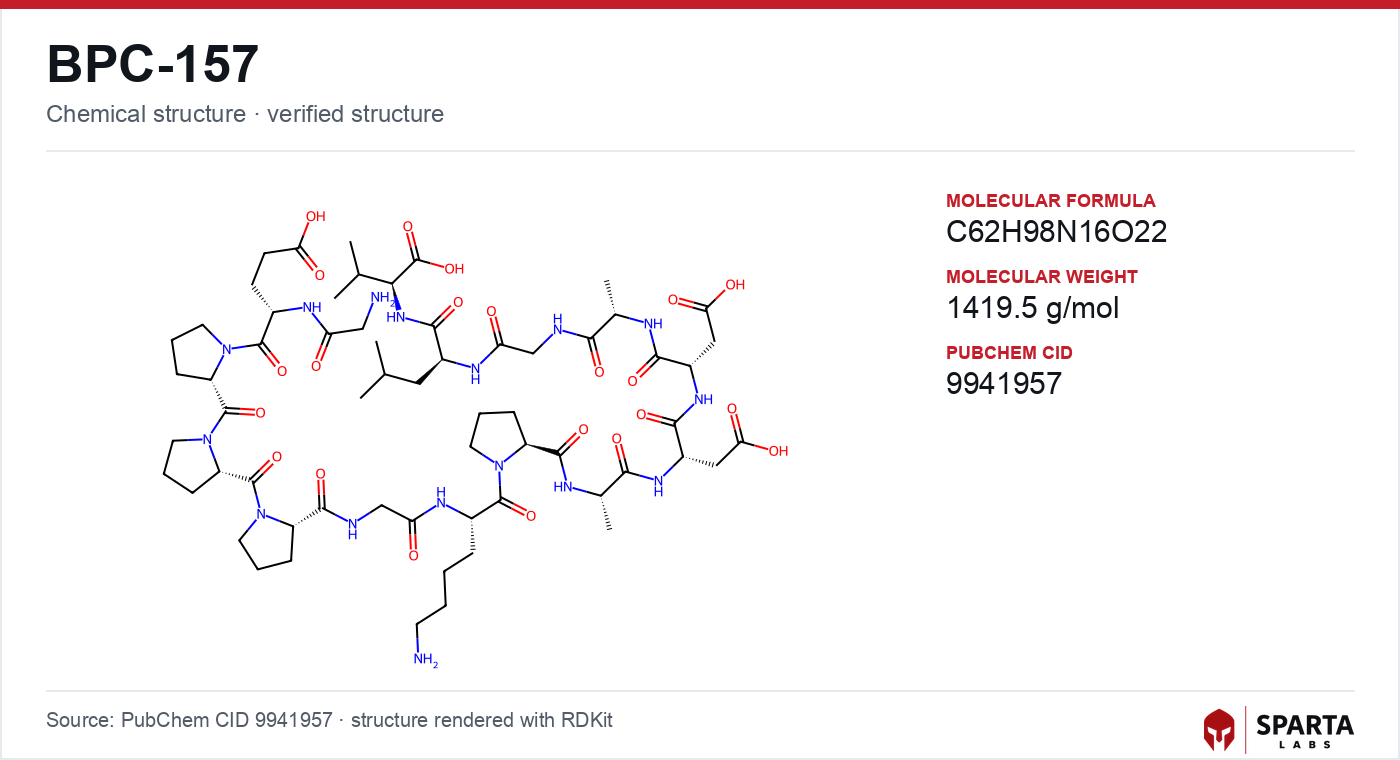
Figure: chemical structure of BPC-157.
The Src-Caveolin-1-eNOS Vascular Cascade
The nitric oxide (NO) signaling system is one of the more mechanistically resolved interactions in the BPC-157 literature. A 2020 study published in Scientific Reports by Hsieh and colleagues examined BPC-157 in an isolated aorta preparation and in cultured vascular endothelial cells [1]. The authors reported that BPC-157 modulated vasomotor tone in a concentration-dependent and NO-dependent manner, and they attributed the effect to activation of the Src-Caveolin-1-endothelial nitric oxide synthase (Src-Cav-1-eNOS) cascade.
Findings from research models do not establish safety or efficacy in humans. Sparta Labs makes no claims about the use of this compound.
At the biochemical level, the study reported phosphorylation of Src and Caveolin-1 in treated preparations. Co-immunoprecipitation experiments indicated a reduced physical association between Cav-1 and eNOS, a binding interaction that ordinarily restrains eNOS enzymatic activity [1]. Pretreatment with a Src-kinase inhibitor abolished the observed response, positioning Src as an upstream node in the proposed cascade. This study is notable methodologically because it moved beyond a phenotypic readout to a defined kinase-dependent mechanism tested with a pharmacological inhibitor.
Angiogenesis and the VEGF Axis: A Context-Dependent Interaction
A 2009 study published in the Journal of Physiology and Pharmacology by Brcic and colleagues examined BPC-157 and vascular endothelial growth factor (VEGF) expression in rat muscle and tendon injury models [2]. The authors reported that treated animals displayed altered VEGF expression patterns relative to controls, with the angiogenic response in treated tissue appearing more organized at defined time points.
A detail from that study is frequently under-emphasized: BPC-157 showed no direct angiogenic effect on isolated cell cultures in the same investigation [2]. That dissociation, an effect at the tissue level but not on isolated cells, is mechanistically informative. It suggests the compound's relationship with VEGF is not a simple case of direct receptor agonism on endothelial cells, but instead depends on the surrounding tissue context and likely on secondary or multicellular interactions. This "tissue-context-dependent" behavior recurs across the BPC-157 corpus and is one reason a single-receptor model has been difficult to establish.
FAK-Paxillin Signaling and Cytoskeletal Reorganization
A 2011 study in the Journal of Applied Physiology by Chang and colleagues investigated BPC-157 in cultured tendon fibroblasts [3]. The authors reported associations between BPC-157 exposure and tendon-fibroblast outgrowth, cell survival under serum-deprivation stress, and directional cell migration.
The biochemical basis they described centered on focal adhesion kinase (FAK) and paxillin, two proteins central to integrin-mediated cell adhesion and cytoskeletal remodeling. The study reported concentration-dependent phosphorylation of FAK and paxillin in treated cells, while total protein levels of both were not significantly changed [3]. That distinction matters mechanistically: it indicates BPC-157 was associated with a change in the activation state of these signaling proteins rather than their overall abundance, consistent with a post-translational rather than transcriptional effect on this pathway. The FAK-paxillin axis is one of the few BPC-157 interactions characterized directly in an isolated-cell system rather than only in whole-animal models.
Growth Hormone Receptor Expression in Fibroblasts
A 2014 study published in Molecules by Chang and colleagues used cDNA microarray analysis to survey gene-expression changes in BPC-157-treated tendon fibroblasts [4]. The growth hormone receptor (GHR) was reported among the most substantially upregulated transcripts, with the change confirmed at both the mRNA and protein level.
In a functional follow-up, fibroblasts pre-exposed to BPC-157 and then stimulated with exogenous growth hormone displayed concentration-dependent proliferation responses reported to involve the JAK2 pathway, a canonical downstream effector of GHR activation [4]. The study did not resolve whether BPC-157 acted on the GHR directly or altered its expression through an upstream transcriptional mechanism. Contrasting this receptor-expression effect with the post-translational FAK-paxillin effect illustrates that BPC-157 has been reported to operate at more than one regulatory layer in the same cell type.
Pharmacokinetic Context for the Mechanistic Data
Interpreting the pathway-level findings above requires understanding how the peptide is handled in vivo. A 2022 study in Frontiers in Pharmacology by He and colleagues characterized the pharmacokinetics, distribution, metabolism, and excretion of BPC-157 in rat and dog models [5]. The authors reported metabolism into small peptide fragments and short elimination half-lives.
The pharmacokinetic profile raises an open mechanistic question the field has yet to close: reconciling a short measured half-life with tissue-level effects observed over longer timeframes. Formal pharmacokinetic-pharmacodynamic (PK-PD) modeling linking exposure to the reported signaling events remains an identified gap in the literature. Sourcing and analytical-verification considerations relevant to reproducible mechanistic work are discussed in the BPC-157 sourcing and verification standards article.
Limits of Current Understanding
The BPC-157 mechanistic literature is distinguished by breadth rather than by a single unifying model. The NO, VEGF, FAK-paxillin, and GHR pathways have each been examined in peer-reviewed work, yet no shared upstream receptor or initiating molecular event has been identified in the primary literature. Characterizing that upstream trigger, and explaining how one short peptide engages such structurally different pathways, is the central open question.
Two additional caveats apply. First, much of the foundational mechanistic data originated from a small number of research groups, and independent replication across laboratories is still accumulating. Second, all findings summarized here derive from in vitro or animal-model systems; translation to human biology has not been established. The full body of published in vivo and in vitro studies is surveyed in the BPC-157 published research article. Comparable multi-pathway regenerative signaling profiles have also been reported for other peptides in this cluster, including GHK-Cu mechanism of action. Researchers sourcing the peptide for laboratory investigation can review specifications on the BPC-157 product page.
References
-
Hsieh MJ, Lee CH, Chueh HY, Ho TY, Lin CY, Chen KB, et al. Modulatory effects of BPC 157 on vasomotor tone and the activation of Src-Caveolin-1-endothelial nitric oxide synthase pathway. Sci Rep. 2020;10(1):17078. PMID: 33051481. DOI: 10.1038/s41598-020-74064-0. View on PubMed
-
Brcic L, Brcic I, Staresinic M, Novinscak T, Sikiric P, Seiwerth S. Modulatory effect of gastric pentadecapeptide BPC 157 on angiogenesis in muscle and tendon healing. J Physiol Pharmacol. 2009;60(Suppl 7):191–196. PMID: 20388964. View on PubMed
-
Chang CH, Tsai WC, Lin MS, Hsu YH, Pang JH. The promoting effect of pentadecapeptide BPC 157 on tendon healing involves tendon outgrowth, cell survival, and cell migration. J Appl Physiol. 2011;110(3):774–780. PMID: 21030672. DOI: 10.1152/japplphysiol.00945.2010. View on PubMed
-
Chang CH, Tsai WC, Hsu YH, Pang JH. Pentadecapeptide BPC 157 enhances the growth hormone receptor expression in tendon fibroblasts. Molecules. 2014;19(11):19066–19077. DOI: 10.3390/molecules191119066. View on PubMed
-
He Y, Chang R, Han B, Shi C, Li Y, Wang H, et al. Pharmacokinetics, distribution, metabolism, and excretion of body-protective compound 157, a potential drug for treating various wounds, in rats and dogs. Front Pharmacol. 2022;13:1086885. DOI: 10.3389/fphar.2022.1086885. View on PubMed
Disclaimer. Statements in this article have not been evaluated by the Food and Drug Administration. This compound is not intended to diagnose, treat, cure, or prevent any disease. Sparta Labs sells research-use-only materials. Content is provided for educational and informational purposes only and does not constitute medical advice. Consult a qualified medical professional for any health concerns.
Frequently asked questions
What signaling pathways have been studied for BPC-157?
Peer-reviewed preclinical research has examined BPC-157 across several distinct pathways: the Src-Caveolin-1-eNOS vascular cascade, the VEGF angiogenesis axis, focal adhesion kinase (FAK)-paxillin cytoskeletal signaling, and growth hormone receptor expression in fibroblasts. These interactions were characterized in separate in vitro and animal-model studies. No single unifying pathway has been identified in the primary literature.
Has a receptor for BPC-157 been identified?
A cognate receptor for BPC-157 has not been identified in the published primary literature. Studies to date describe engagement with multiple downstream signaling cascades without pinpointing a shared upstream receptor or initiating molecular event. Characterizing that trigger remains an open research question.
Why is BPC-157 described as having a multi-pathway mechanism?
BPC-157 entered the literature through phenotypic observations in tissue-injury models, and researchers subsequently identified the associated signaling events. Reported interactions span vascular (eNOS), angiogenic (VEGF), cytoskeletal (FAK-paxillin), and receptor-expression (growth hormone receptor) contexts. Some effects appear tissue-context-dependent, appearing in whole-tissue models but not always in isolated cells, which has complicated single-receptor modeling.
What did pharmacokinetic research report about BPC-157?
A 2022 study in Frontiers in Pharmacology characterized the pharmacokinetics, distribution, metabolism, and excretion of BPC-157 in rat and dog models, reporting metabolism into small peptide fragments and short elimination half-lives. Reconciling a short measured half-life with tissue-level effects observed over longer timeframes, through formal PK-PD modeling, is an identified gap in the field.