
BPC-157: Published Research
A critical bibliographic tour of the BPC-157 literature: its single-lineage provenance, the gastrointestinal and tendon-fibroblast studies, the nitric-oxide hypothesis, pharmacokinetic data, and the unresolved replication and human-evidence questions.
For research use only. Not for human consumption.
This article is educational reference material. It is not medical advice and is not a recommendation to use any substance.
Why the BPC-157 Literature Reads the Way It Does
Any researcher approaching the BPC-157 corpus encounters an unusual bibliographic signature before encountering a single result: a large fraction of the primary publications originate from a single research lineage, the laboratory of Predrag Sikirić and collaborators in Zagreb, Croatia. BPC-157 is a synthetic 15-amino-acid sequence corresponding to a fragment of a protein isolated from gastric juice, and it was introduced to the literature by that group in 1993 [1]. Understanding this concentrated provenance is the first analytical task, because it shapes how the evidence should be weighted: a broad, internally consistent preclinical record that has seen comparatively limited independent replication.
This article summarizes representative peer-reviewed studies by tissue domain, notes the reported mechanistic thread that the authors use to connect them, and identifies the specific reproducibility questions that a careful reader will want answered. All described findings were generated in cell-culture or animal (predominantly rat) models unless a human context is explicitly stated. Readers seeking chemical-identity and classification background should consult the BPC-157 research overview, and those interested in the proposed molecular pathways should see the BPC-157 mechanism of action article.
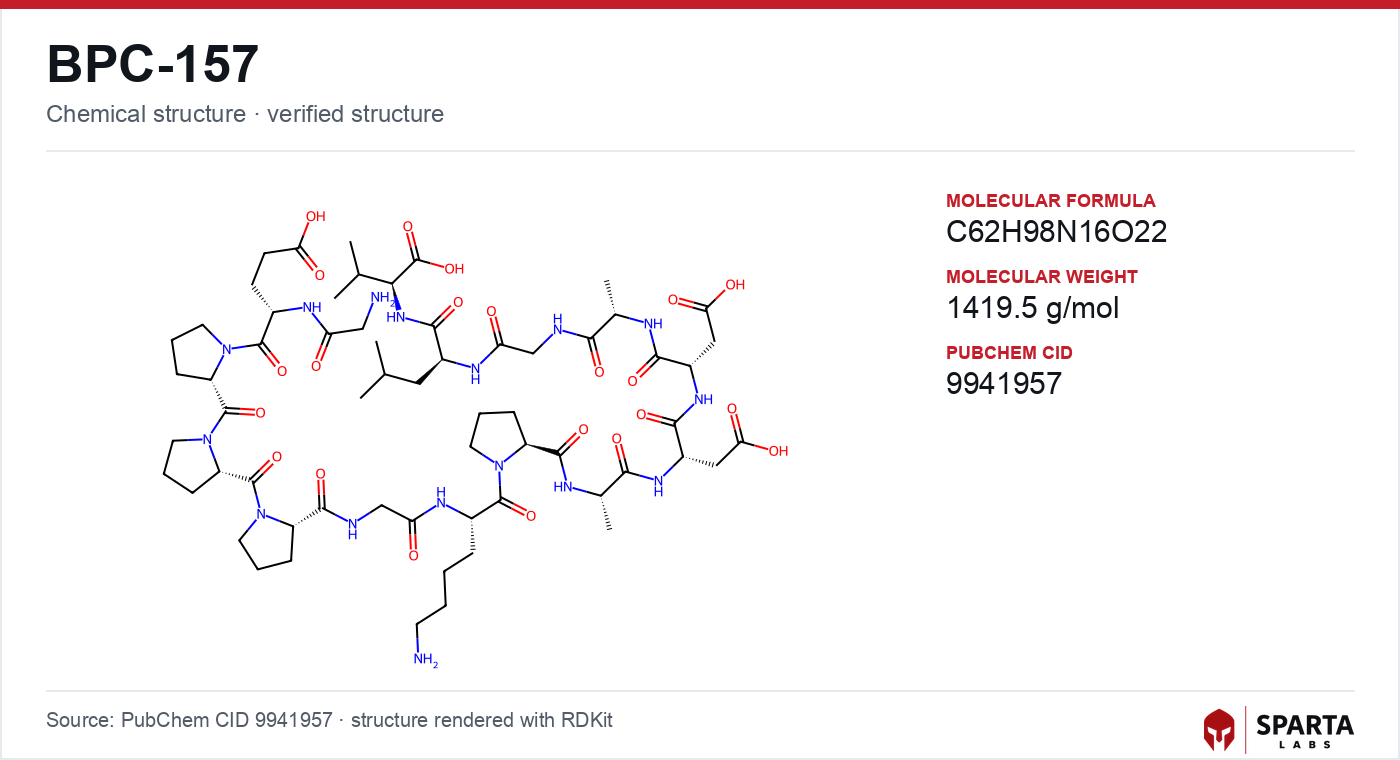
Figure: chemical structure of BPC-157.
The Founding Cytoprotection Papers
The oldest and densest cluster of BPC-157 work concerns the gastrointestinal tract, which is unsurprising given the peptide's origin in a gastric-juice protein sequence. The 1993 report by Sikirić and colleagues in the Journal of Physiology, Paris introduced BPC-157 within a broader "stomach-stress-organoprotection" framing and described preliminary observations in rodent gastric-lesion preparations [1].
Findings from research models do not establish safety or efficacy in humans. Sparta Labs makes no claims about the use of this compound.
Over the following two decades the same group published across a series of gastrointestinal lesion models. A 2004 study in Digestive Diseases and Sciences examined the pentadecapeptide in a rat gastric-ulcer preparation and reported differences in mucosal lesion scoring between treated and untreated animals [2]. A 2007 paper in the Journal of Pharmacological Sciences extended the work to a rat ileoileal-anastomosis model framed around inflammatory bowel disease research, reporting differences in anastomotic-healing parameters [3]. That 2007 title is also historically notable because it names the Pliva development-program designations (PL-10, PLD-116, PL14736), the identifiers under which BPC-157 formulations entered early-phase human investigation.
Musculoskeletal Models and the Fibroblast Mechanism
A second large cluster addresses connective tissue. A 2006 study in the Journal of Orthopaedic Research examined BPC-157 in a rat Achilles-tendon detachment model and reported histological differences between treated and control animals at defined post-procedure intervals, alongside an observed opposition to corticosteroid-associated impairment [4].
The most mechanistically specific musculoskeletal work moved from whole animals into cell culture. A 2011 study in the Journal of Applied Physiology by Chang and colleagues examined isolated tendon fibroblasts and reported that BPC-157 exposure was associated with differences in cell outgrowth, survival under stress conditions, and directional migration in scratch-wound assays, with the observations proposed to involve FAK and paxillin phosphorylation [5]. A follow-up from the same group, published in Molecules in 2014, reported that growth-hormone-receptor expression was among the more substantially altered transcripts in BPC-157-exposed fibroblasts [6]. Together these two papers supply much of the concrete in-vitro signaling detail that later reviews cite when they attempt to explain the tendon-model observations. The regenerative-peptide comparison here is instructive: TB-500 has been examined in an overlapping set of tendon and wound-healing animal models, though its proposed actin-sequestration mechanism is distinct.
The Nitric Oxide Thread and Vascular Work
The connective-tissue and gastrointestinal findings are frequently linked in the literature by a proposed involvement of the nitric-oxide (NO) system, and the vascular studies are where that hypothesis is examined most directly. A 2020 study in Scientific Reports by Hsieh and colleagues investigated vasomotor tone in an isolated rat-aorta preparation and in cultured endothelial cells, reporting NO-dependent effects and activation of a Src–caveolin-1–eNOS signaling cascade [7]. This paper is often cited as the clearest single line of endothelial-cell evidence for the NO hypothesis that the founding group had proposed across other tissues.
A reader evaluating this thread should note both its coherence and its limitation: a shared NO framing gives the disparate tissue findings a plausible common mechanism, but a unifying hypothesis advanced largely by the originating group is precisely the kind of claim that benefits from independent confirmation.
The Brain-Gut Framing
BPC-157 research also extends into the central nervous system, and here the authors explicitly connect the gastrointestinal origin to neurological observations. A 2016 review in Current Neuropharmacology set out a brain-gut-axis framework for the peptide, describing animal-model observations across gastrointestinal and neurological domains and proposing shared mechanistic involvement of NO and dopaminergic signaling [8]. This review is useful less as a source of new data than as an articulation of how the originating group conceptualizes the breadth of the compound's reported effects as a single pharmacological story rather than a collection of unrelated findings.
What Pharmacokinetics Actually Established
Amid a literature dominated by efficacy-style outcome measures, one study stands out for characterizing the compound's disposition rather than its effects. A 2022 paper in Frontiers in Pharmacology by He and colleagues reported systematic absorption, distribution, metabolism, and excretion characterization in rats and beagle dogs using LC-MS/MS methods, describing rapid metabolism to smaller peptide fragments and amino acids and distribution across multiple organ compartments [9]. The practical significance is that this behavior is consistent with conventional peptide metabolism and provides the exposure baseline that any future pharmacokinetic-pharmacodynamic modeling would need. It is one of the comparatively few BPC-157 papers whose methodology is straightforwardly replicable with standard analytical chemistry.
The Open Question: Replication and Human Data
The honest summary of the BPC-157 evidence base is that it is broad, internally consistent, and concentrated in provenance. The most consequential gaps a researcher should keep in view are three. First, independent replication: much of the tissue-domain work traces to a single lineage, and the field would be strengthened by confirmation in unaffiliated laboratories. Second, human evidence: early-phase investigation occurred under the Pliva program designations, but no pivotal late-phase trials are identifiable in publicly accessible regulatory databases as of this writing. Third, mechanistic integration: the NO-centered hypothesis is coherent but rests substantially on the originating group's own model systems.
These are ordinary maturation questions for a preclinical compound rather than indictments of the data, and they define where the useful next studies lie. Researchers sourcing material for laboratory work involving this peptide will find purity-verification details on the BPC-157 product page and analytical-standards discussion in the BPC-157 sourcing and quality article.
References
-
Sikirić P, Petek M, Rucman R, Seiwerth S, Grabarević Z, Rotkvić I, et al. A new gastric juice peptide, BPC. An overview of the stomach-stress-organoprotection hypothesis and beneficial effects of BPC. J Physiol Paris. 1993;87(5):313–327. PMID: 8298609. View on PubMed
-
Sikirić P, Seiwerth S, Rucman R, Grabarević Z, Petek M, Jagić V, et al. Protective effects of pentadecapeptide BPC 157 on gastric ulcer in rats. Dig Dis Sci. 2004;49(11–12):1897–1904. PMID: 15052688. View on PubMed
-
Sikirić P, Seiwerth S, Grabarević Z, Rucman R, Petek M, Jagić V, et al. Stable gastric pentadecapeptide BPC 157 in trials for inflammatory bowel disease (PL-10, PLD-116, PL14736, Pliva, Croatia) heals ileoileal anastomosis in the rat. J Pharmacol Sci. 2007;104(1):7–17. PMID: 17713731. View on PubMed
-
Staresinic M, Petrovic I, Novinscak T, Jukic I, Pevec D, Suknaic S, et al. Achilles detachment in rat and stable gastric pentadecapeptide BPC 157: promoted tendon-to-bone healing and opposed corticosteroid aggravation. J Orthop Res. 2006;24(5):982–989. PMID: 16583442. View on PubMed
-
Chang CH, Tsai WC, Lin MS, Hsu YH, Pang JH. The promoting effect of pentadecapeptide BPC 157 on tendon healing involves tendon outgrowth, cell survival, and cell migration. J Appl Physiol. 2011;110(3):774–780. PMID: 21030672. View on PubMed
-
Chang CH, Tsai WC, Hsu YH, Pang JH. Pentadecapeptide BPC 157 enhances the growth hormone receptor expression in tendon fibroblasts. Molecules. 2014;19(11):19066–19077. PMID: 25470275. View on PubMed
-
Hsieh MJ, Lee CH, Chueh HY, Ho TY, Lin CY, Chen KB, et al. Modulatory effects of BPC 157 on vasomotor tone and the activation of Src-Caveolin-1-endothelial nitric oxide synthase pathway. Sci Rep. 2020;10(1):17078. PMID: 33051481. View on PubMed
-
Sikirić P, Seiwerth S, Rucman R, Turkovic B, Rokotov DS, Brcic L, et al. Brain-gut Axis and Pentadecapeptide BPC 157: theoretical and practical implications. Curr Neuropharmacol. 2016;14(8):857–865. PMID: 27138887. View on PubMed
-
He Y, Chang R, Han B, Shi C, Li Y, Wang H, et al. Pharmacokinetics, distribution, metabolism, and excretion of body-protective compound 157, a potential drug for treating various wounds, in rats and dogs. Front Pharmacol. 2022;13:1086885. PMID: 36618944. View on PubMed
Disclaimer. Statements in this article have not been evaluated by the Food and Drug Administration. This compound is not intended to diagnose, treat, cure, or prevent any disease. Sparta Labs sells research-use-only materials. Content is provided for educational and informational purposes only and does not constitute medical advice. Consult a qualified medical professional for any health concerns.
Frequently asked questions
Why is so much BPC-157 research from one laboratory?
BPC-157 was introduced to the peer-reviewed literature in 1993 by the laboratory of Predrag Sikirić and collaborators in Zagreb, Croatia, and a large share of subsequent primary studies trace to that same lineage. This concentrated provenance is a bibliographic feature a careful reader should weigh, since a broad and internally consistent record has seen comparatively limited independent replication. It does not by itself invalidate the findings, but it identifies independent confirmation as a priority for the field.
What did the tendon fibroblast studies report?
A 2011 study in the Journal of Applied Physiology by Chang and colleagues examined isolated tendon fibroblasts and reported differences in cell outgrowth, survival under stress, and directional migration in scratch-wound assays, proposed to involve FAK and paxillin phosphorylation. A 2014 follow-up in Molecules reported that growth-hormone-receptor expression was among the more altered transcripts in exposed fibroblasts. These in-vitro papers supply much of the concrete signaling detail cited by later reviews.
Is there human clinical trial data for BPC-157?
Early-phase human investigation of BPC-157 formulations occurred under the Pliva development-program designations PL-10, PLD-116, and PL14736, referenced in publications from the originating group. No pivotal late-phase trials are identifiable in publicly accessible regulatory databases as of the preparation of this article. Human evidence remains one of the principal gaps in the compound's research record.
What does the nitric oxide hypothesis refer to in BPC-157 research?
The originating group has proposed that a common involvement of the nitric-oxide system links BPC-157 observations across gastrointestinal, connective-tissue, and vascular models. A 2020 study in Scientific Reports reported NO-dependent vasomotor effects and activation of a Src-caveolin-1-eNOS cascade in a rat-aorta preparation and endothelial cells. The hypothesis is coherent but rests substantially on the originating group's own model systems, which is why independent confirmation is noted as valuable.
What do pharmacokinetic studies say about BPC-157?
A 2022 study in Frontiers in Pharmacology by He and colleagues characterized absorption, distribution, metabolism, and excretion in rats and beagle dogs using LC-MS/MS methods. It reported rapid metabolism to smaller peptide fragments and amino acids and distribution across multiple organ compartments, consistent with conventional peptide behavior. It is one of the comparatively few BPC-157 papers whose methodology is straightforwardly replicable with standard analytical chemistry.