
BPC-157: Sourcing, Purity, and Verification Standards
A sourcing reference for BPC-157: how its proline-rich sequence shapes solid-phase synthesis, HPLC and mass-spectrometry release testing, salt form, and certificate-of-analysis review. Educational reference.
For research use only. Not for human consumption. This article is educational reference material. It is not medical advice and is not a recommendation to use any substance.
What BPC-157 Is, and Why Its Structure Drives Its Analytics
BPC-157 is a synthetic 15-amino-acid peptide with the sequence Gly-Glu-Pro-Pro-Pro-Gly-Lys-Pro-Ala-Asp-Asp-Ala-Gly-Leu-Val. The designation "BPC" stands for "body protection compound," and the sequence corresponds to a partial fragment identified within human gastric juice protein during research by Sikiric and colleagues [1]. Unlike a peptide isolated directly from tissue, the material sold for research is produced by chemical synthesis; the natural fragment provided the sequence, not the manufacturing route.
The sequence has two features that shape every downstream analytical decision. First, it is unusually proline-rich: five of the fifteen residues are proline, including a consecutive Pro-Pro-Pro stretch at positions three through five. Second, it carries no cysteine, so there is no disulfide bond to reduce, scramble, or misform. These two facts explain why a BPC-157 certificate of analysis reads the way it does, and why some quality problems that plague cysteine-containing peptides are simply not applicable here. This article treats the sequence as the starting point rather than reciting a generic peptide-quality checklist. Readers seeking the pharmacology and study literature will find companion pages on the reported mechanism of action and the published research summary.
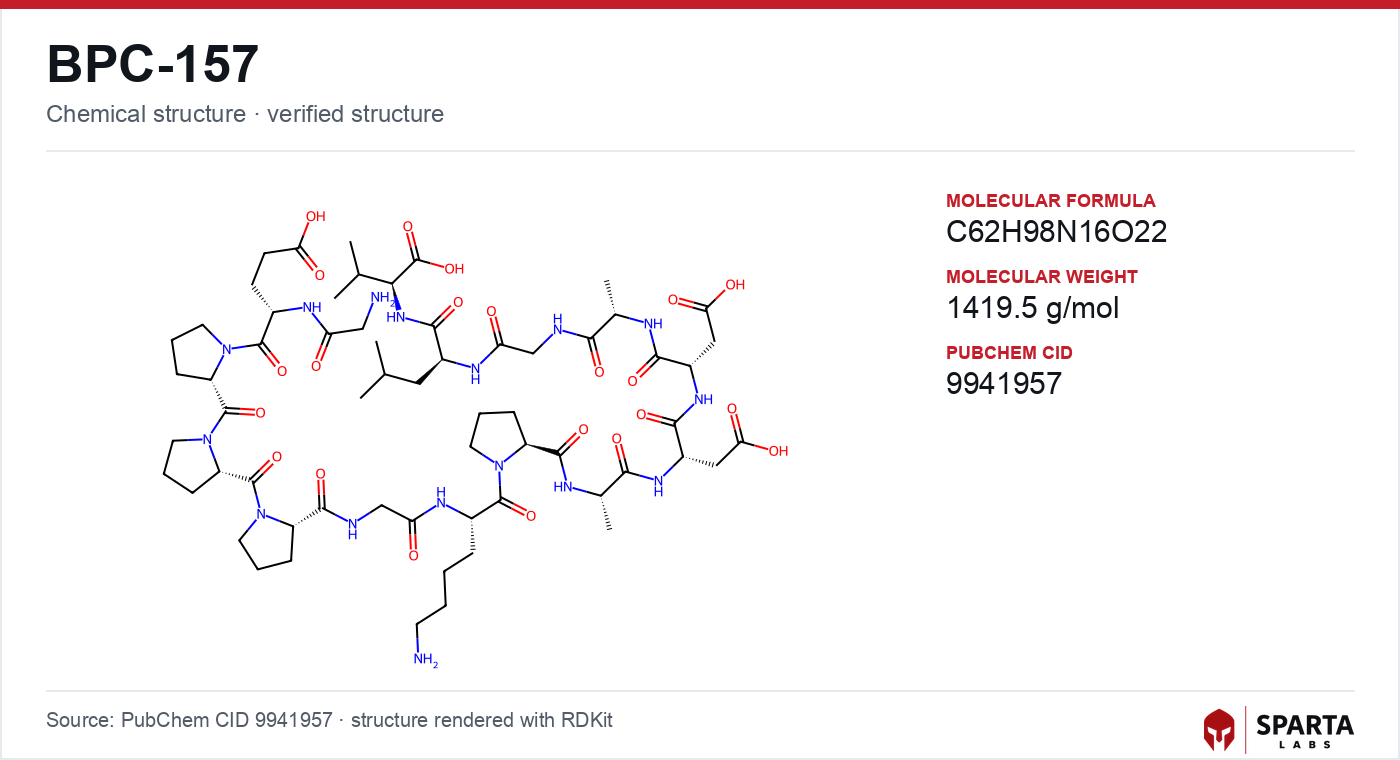
Figure: chemical structure of BPC-157.
Solid-Phase Synthesis and the Polyproline Problem
Peptides of this length are assembled by solid-phase peptide synthesis (SPPS), the technique introduced by R. B. Merrifield in 1963 and recognized with the 1984 Nobel Prize in Chemistry [2]. In SPPS the C-terminal residue is anchored to an insoluble resin, and the chain is extended one residue at a time toward the N-terminus; each cycle deprotects the growing chain and couples the next protected amino acid. Contemporary manufacturing overwhelmingly uses Fmoc (9-fluorenylmethoxycarbonyl) chemistry, in which base-labile Fmoc groups are removed with piperidine between couplings and the final peptide is cleaved from the resin under acidic conditions.
The Pro-Pro-Pro stretch is where BPC-157 synthesis diverges from routine. Proline is a secondary amine whose ring constrains the peptide backbone, and consecutive prolines are a documented source of incomplete coupling and aggregation-related "difficult sequences" during Fmoc SPPS [3]. Incomplete coupling at a proline junction produces a deletion sequence one residue short, which is chemically similar enough to the target that it can co-elute in some chromatographic methods. Manufacturers address polyproline regions through measures such as extended coupling times, elevated coupling temperatures, or double-coupling of the affected residues. The practical consequence for a purchaser is that BPC-157 purity is governed less by the peptide's length than by how completely the proline-rich core was coupled, which makes the analytical release testing described below the decisive control point.
Purity by HPLC and Identity by Mass Spectrometry
The primary purity measurement for a research peptide is reverse-phase high-performance liquid chromatography (RP-HPLC), which separates the target from related impurities by hydrophobicity. Purity is reported as the target peak area divided by total integrated peak area, expressed as a percentage. A common baseline for research-use peptides is HPLC purity of at least 98 percent; Sparta Labs applies an internal specification of at least 99 percent for BPC-157 and its other catalog peptides, a margin above the general research-grade minimum rather than a performance claim.
HPLC area alone does not confirm that the correct molecule is present, only that a dominant species elutes. Identity is established by mass spectrometry (MS), which measures the molecular mass and compares it against the theoretical value calculated from the sequence. BPC-157 has a monoisotopic and average molecular mass near 1419 daltons for the free peptide; an observed mass matching this figure confirms the assembled sequence and, critically, distinguishes the target from same-length deletion or insertion products that shift the mass. The pairing matters: HPLC catches impurities that MS cannot resolve when they share a mass, and MS catches sequence errors that HPLC cannot resolve when they share a retention time. Neither test substitutes for the other, and a defensible BPC-157 release record reports both.
The Counterion Question: Acetate, TFA, and Net Peptide Content
A quality dimension specific to peptides, and easy to overlook, is the counterion and the salt form. BPC-157 carries basic residues (a lysine and the N-terminal amine) that are positively charged at neutral pH and must be balanced by a negative counterion in the isolated solid. During Fmoc SPPS and the RP-HPLC purification that follows, trifluoroacetic acid (TFA) is used in cleavage cocktails and as a mobile-phase modifier, so the crude and first-pass purified peptide is typically isolated as a TFA salt.
Residual TFA is analytically relevant because it is not inert in many biological assays and because it adds mass that is not peptide. For this reason process chemistry often includes a counterion exchange, converting the peptide to an acetate salt, followed by residual-solvent and residual-TFA testing. The related figure is net peptide content, the fraction of the weighed solid that is actually peptide rather than counterion, bound water, or residual salts. Two vials can both report 99 percent HPLC purity yet differ in net peptide content if one carries more counterion and moisture, which is why a thorough certificate distinguishes chromatographic purity from peptide content. Endotoxin (bacterial lipopolysaccharide) testing is a further release consideration when research applications involve in vivo animal models, since lipopolysaccharide can confound biological readouts independent of the peptide itself [4].
Reading a BPC-157 Certificate of Analysis
Sparta Labs publishes a Certificate of Analysis (COA) for each batch of BPC-157. A COA is a document generated by the testing laboratory that records the analytical results for one specific production lot, and it should be read as a lot-specific record rather than a general product description. For BPC-157 the informative fields are:
- HPLC purity, reported as percent peak area with the accompanying chromatogram, from the analytical run on that lot
- Mass spectrometry result, reporting the observed mass against the theoretical mass near 1419 daltons, confirming sequence identity
- Salt form and, where reported, net peptide content, indicating whether the material is an acetate or TFA salt and what fraction of the solid is peptide
- Batch or lot number, a unique identifier traceable to the specific synthesis run
- Manufacturing and expiry dates, defining the validated stability window for the lyophilized solid under the stated storage conditions
Because the polyproline core is the likeliest site of a synthesis defect, the most informative check a researcher can perform is confirming that the reported mass matches the target and that the main HPLC peak is well resolved from any shoulder near it. COAs are accessible on the BPC-157 product page, where each listed batch links to its own COA document.
Lyophilized Stability and Handling
BPC-157 is supplied as a lyophilized (freeze-dried) solid. Lyophilization removes water under vacuum at low temperature, converting a peptide solution into a dry amorphous powder that is far more chemically stable than the same peptide in solution, because the hydrolytic and enzymatic reactions that degrade peptides require water and, in vivo, active proteases. The absence of cysteine in BPC-157 removes disulfide scrambling as a degradation route, which simplifies its stability profile relative to disulfide-bonded peptides.
Lyophilized BPC-157 is stored frozen, protected from light and moisture, for the duration of the stated expiry window; exposure to elevated temperature, humidity, or repeated freeze-thaw cycles is a recognized accelerant of peptide degradation. Once a peptide is returned to aqueous solution it becomes subject again to hydrolysis and, in biological matrices, to proteolysis. A 2022 pharmacokinetic characterization by He and colleagues reported that BPC-157 undergoes rapid metabolism in rats and dogs, with a short measured plasma half-life [5], which is consistent with the general expectation that reconstituted peptide solutions are less stable than their lyophilized precursors and is one reason the dry solid is the distributed form.
Findings from research models do not establish safety or efficacy in humans. Sparta Labs makes no claims about the use of this compound.
Why These Controls Matter for Reproducible Research
A research finding is only as interpretable as the material behind it. For a proline-rich peptide such as BPC-157, the questions that determine whether a result can be reproduced are concrete: was the polyproline core fully coupled, does the measured mass match the target sequence, what salt form and peptide content does the solid actually contain, and was the lyophilized material stored so that it retained identity from manufacture to bench. HPLC purity answers the first, mass spectrometry the second, counterion and peptide-content testing the third, and documented cold storage the fourth.
The value of a COA is that it converts each of these from an assumption into a recorded, lot-specific measurement that a researcher can inspect before an experiment rather than infer afterward. Sourcing considerations of this kind are not unique to BPC-157; the same analytical logic applies across the regenerative-research cluster, including the copper-binding tripeptide covered in the GHK-Cu sourcing and quality reference and the actin-binding peptide covered in the TB-500 sourcing and quality reference, though each peptide's chemistry shifts which tests carry the most weight.
References
-
Sikiric P, Seiwerth S, Rucman R, Turkovic B, Rokotov DS, Brcic L, et al. Stable gastric pentadecapeptide BPC 157: novel therapy in gastrointestinal tract. Curr Pharm Des. 2011;17(16):1612–1632. PMID: 21548867. View on PubMed
-
Merrifield RB. Solid phase peptide synthesis. I. The synthesis of a tetrapeptide. J Am Chem Soc. 1963;85(14):2149–2154. DOI: 10.1021/ja00897a025. Source: pubs.acs.org
-
Paradís-Bas M, Tulla-Puche J, Albericio F. The road to the synthesis of "difficult peptides". Chem Soc Rev. 2016;45(3):631–654. PMID: 26612670. DOI: 10.1039/c5cs00680e. View on PubMed
-
Gorbet MB, Sefton MV. Endotoxin: the uninvited guest. Biomaterials. 2005;26(34):6811–6817. PMID: 16019062. DOI: 10.1016/j.biomaterials.2005.04.063. View on PubMed
-
He Y, Chang R, Han B, Shi C, Li Y, Wang H, et al. Pharmacokinetics, distribution, metabolism, and excretion of body-protective compound 157, a potential drug for treating various wounds, in rats and dogs. Front Pharmacol. 2022;13:1086885. PMID: 36618946. Full text on PMC
Disclaimer. Statements in this article have not been evaluated by the Food and Drug Administration. This compound is not intended to diagnose, treat, cure, or prevent any disease. Sparta Labs sells research-use-only materials. Content is provided for educational and informational purposes only and does not constitute medical advice. Consult a qualified medical professional for any health concerns.
Frequently asked questions
Why is BPC-157 difficult to synthesize?
BPC-157 contains five proline residues out of fifteen, including a consecutive Pro-Pro-Pro stretch. Consecutive prolines are a recognized "difficult sequence" in Fmoc solid-phase peptide synthesis because they can cause incomplete coupling and aggregation. Manufacturers address this with measures such as extended or double couplings, and the completeness of that step is what analytical release testing is designed to confirm.
What does a mass spectrometry result confirm on a BPC-157 certificate of analysis?
Mass spectrometry measures the molecular mass of the isolated peptide and compares it against the theoretical value calculated from the BPC-157 sequence, which is near 1419 daltons for the free peptide. A match confirms the correct sequence was assembled and helps distinguish the target from deletion or insertion products that shift the mass. It complements HPLC, which measures purity but cannot always resolve species that share a mass.
What is the difference between HPLC purity and net peptide content for BPC-157?
HPLC purity is the target peak area as a percentage of total peak area, describing how much of the peptide present is the correct species. Net peptide content is the fraction of the weighed solid that is actually peptide rather than counterion, bound water, or residual salts. Two lots can report the same HPLC purity yet differ in net peptide content depending on salt form, which is why thorough certificates report both.
Why does the salt form of BPC-157 appear on a certificate of analysis?
BPC-157 carries basic groups that must be balanced by a negative counterion in the isolated solid. During synthesis and purification it is typically isolated as a trifluoroacetic acid (TFA) salt, and process chemistry may exchange this to an acetate salt with subsequent residual-TFA testing. The salt form affects net peptide content and is analytically relevant, so a detailed certificate records whether the material is an acetate or TFA salt.