
Cagrilintide: Sourcing, Purity, and Verification Standards
An analytical account of how cagrilintide, an acylated amylin-analog peptide, is synthesized, purified, and verified for research use. Educational reference.
For research use only. Not for human consumption. This article is educational reference material. It is not medical advice and is not a recommendation to use any substance.
Introduction
Cagrilintide is a long-acting analog of human amylin: a 36-residue peptide bearing a lipid modification that distinguishes it, both structurally and analytically, from the short unmodified sequences that dominate the research-peptide catalog. The chemistry that gives cagrilintide its extended plasma profile — an acyl chain conjugated to the backbone through a linker — is also the source of its principal manufacturing and characterization challenges. This article describes how cagrilintide is synthesized, purified, and verified as research material, with emphasis on the analytical questions specific to an acylated amylin-family peptide rather than to peptides in general. For receptor pharmacology and development background, see the cagrilintide research overview.
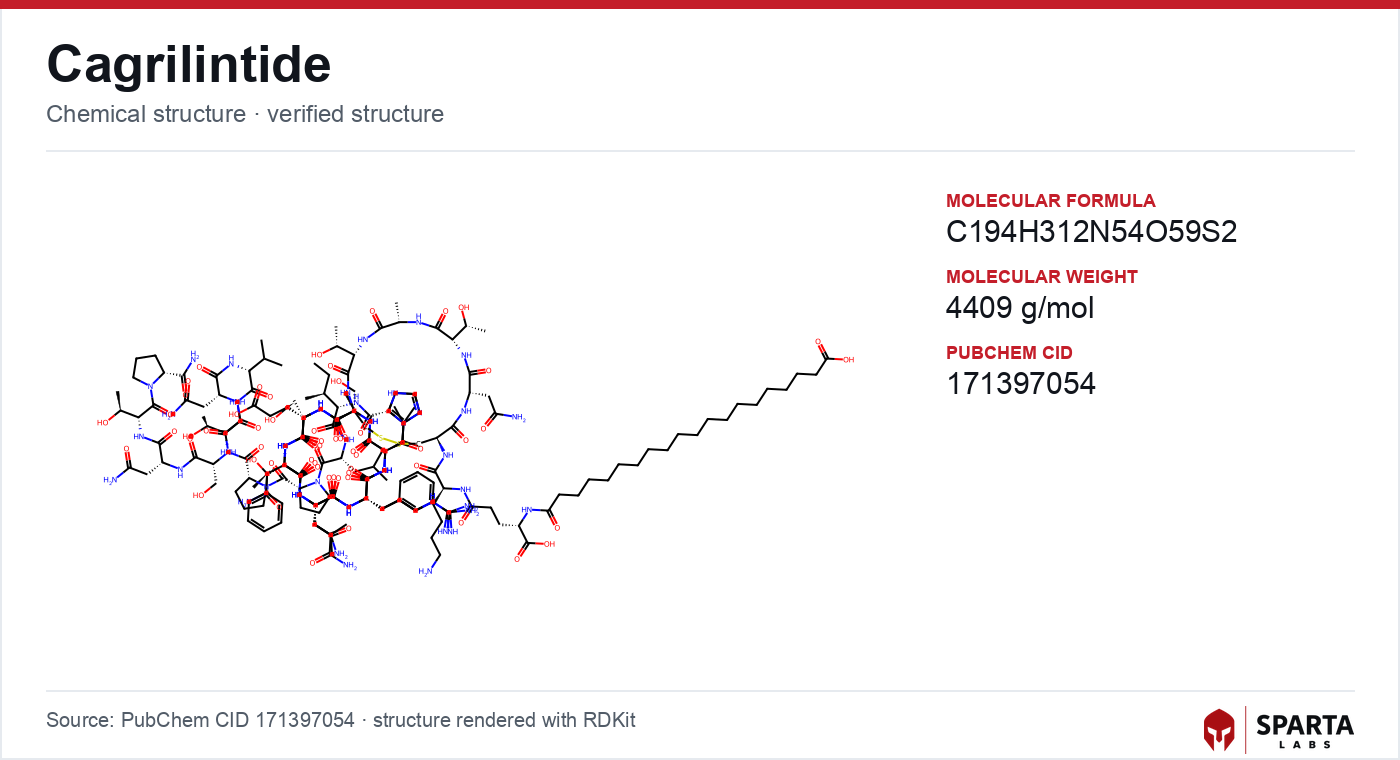
Figure: chemical structure of Cagrilintide.
Why the Amylin Scaffold Shapes Its Chemistry
Cagrilintide's lineage begins with human islet amyloid polypeptide (IAPP), the 37-residue hormone co-secreted with insulin, first isolated and sequenced in the 1980s [1]. Native human amylin is notably difficult to work with because it is amyloidogenic: under physiological conditions it aggregates and forms fibrils, a property central to its biology and a persistent obstacle to synthesis, handling, and formulation [2]. This aggregation tendency is the reason earlier clinical amylin analogs substituted proline residues to disrupt the fibril-forming region, and it remains the backdrop against which any amylin-class research peptide is characterized.
For sourcing purposes, the practical consequence is that cagrilintide belongs to a structural class where solution behavior and analytical reproducibility can be sensitive to concentration, buffer, and thermal history. Analytical work on the compound therefore accounts not only for chemical purity in the conventional sense but for the physical state of the peptide in solution.
Backbone Assembly by Solid-Phase Synthesis
The 36-amino-acid backbone is assembled by solid-phase peptide synthesis (SPPS), the method Merrifield introduced in 1963 and for which sequential coupling of protected amino acids to an insoluble resin support became the foundation of modern peptide manufacturing [3]. Each cycle couples a single residue, then removes its temporary protecting group before the next coupling; side chains remain protected until the completed chain is cleaved from the resin.
At 36 residues, cagrilintide sits well beyond the length at which stepwise SPPS yields become the limiting factor. Every incomplete coupling propagates a deletion sequence, and every incomplete deprotection risks a truncation, so the raw crude from synthesis is a mixture in which the target is one species among many closely related ones. Andersson and colleagues, reviewing large-scale peptide synthesis, documented that sequences of this complexity require deliberate optimization of coupling chemistry, protecting-group strategy, and post-synthetic handling to reach research-grade fidelity [4].
The Acylation Step and Its Byproducts
What sets cagrilintide apart from an unmodified 36-mer is the attached lipid: a long-chain fatty diacid conjugated to the backbone through a hydrophilic linker. This acylation is the design feature responsible for the compound's extended profile, and it introduces a distinct family of impurities that unmodified peptides never present. Incomplete conjugation leaves unacylated backbone; the linker and activated acyl reagent can generate adducts and over-acylated species; and the amphiphilic product itself behaves differently in solution than its precursor.
Because these byproducts are structurally similar to the target, they are not removed by synthesis optimization alone — they must be resolved during purification. Preparative reversed-phase HPLC is the workhorse here: it separates the acylated target from unacylated and mis-acylated species by exploiting the large difference in hydrophobicity that the lipid chain confers. This is the same interaction that later underlies analytical purity measurement, discussed below.
Characterizing an Acylated Peptide: RP-HPLC and Mass Spectrometry
Purity for a research-grade peptide is measured primarily by reversed-phase HPLC, which separates the target from truncation, deletion, and acylation-related species by differential affinity for a hydrophobic stationary phase, and reports purity as the area percentage of the target peak at the detection wavelength. For an acylated peptide the method conditions matter: the lipid chain shifts retention substantially, and gradient and column choices suited to unmodified peptides do not necessarily resolve the acylation byproduct family. Purity figures are therefore meaningful only in the context of a method developed for this compound class.
Chemical identity is confirmed by mass spectrometry (MS). The measured molecular weight is matched against the theoretical weight calculated from the full acylated formula, and the observed isotope pattern is checked against the expected distribution. For cagrilintide the added mass of the diacid and linker is part of that theoretical target, so an MS result that matched the bare backbone would flag incomplete acylation rather than confirm identity.
Counterion and residual-solvent analysis characterize the salt form (commonly acetate or trifluoroacetate, depending on the purification chemistry) and the solvent burden of each lot, both of which affect solubility. Endotoxin testing by limulus amebocyte lysate (LAL) assay is available for lots intended for cell-culture work.
Batch Documentation and Traceability
Each batch of cagrilintide is supplied with a Certificate of Analysis (COA) that ties the analytical data to a specific manufactured lot. A COA for this compound documents:
- RP-HPLC purity (%) — area percentage at the detection wavelength, with the chromatogram available for inspection.
- Mass-spectrometry confirmation — measured versus theoretical molecular weight for the acylated sequence, with the observed m/z spectrum.
- Batch and lot identifiers — enabling traceability from analytical data to the physical material.
- Manufacturing and expiry dates — referenced to the stability behavior of the lyophilized form.
- Counterion and salt form — acetate or trifluoroacetate, which affects solubility and handling in research use.
Traceable batch documentation is the mechanism by which a research group can link an experimental result back to a defined, analytically characterized material, which is a precondition for reproducibility in published work. The Sparta Labs product page for cagrilintide references the current batch documentation, and the same analytical framework is applied across the incretin and metabolic-peptide catalog; the retatrutide sourcing and quality article covers the analogous considerations for a multi-receptor agonist.
Storage and the Physical State of the Peptide
Cagrilintide is supplied lyophilized, the solid form in which peptides are substantially more stable than in solution. The protein-stability literature establishes that lyophilized peptide material stored cold, protected from light and moisture, retains its analytical profile across the shelf life stated on the COA, and that repeated freeze-thaw cycling of reconstituted material is associated with accelerated degradation [5]. Single-use aliquotting of reconstituted material is the conventional laboratory practice where a preparation is used over time.
For an amylin-class peptide these general principles carry an additional dimension. Because the parent hormone is aggregation-prone [2] and cagrilintide's lipid modification makes the molecule amphiphilic, the physical state of a reconstituted preparation — not only its chemical purity — is a variable worth attention in research workflows. The storage recommendations on the batch COA and published stability data for the compound class are the appropriate references for any specific application. For how these structural features translate into receptor engagement, the cagrilintide mechanism of action article summarizes the reported pharmacology.
References
-
Cooper GJS, Willis AC, Clark A, Turner RC, Sim RB, Reid KBM. Purification and characterization of a peptide from amyloid-rich pancreases of type 2 diabetic patients. Proc Natl Acad Sci USA. 1987;84(23):8628–8632. PMID: 3317417. DOI: 10.1073/pnas.84.23.8628. PubMed
-
Westermark P, Andersson A, Westermark GT. Islet amyloid polypeptide, islet amyloid, and diabetes mellitus. Physiol Rev. 2011;91(3):795–826. PMID: 21742788. DOI: 10.1152/physrev.00042.2009. PubMed
-
Merrifield RB. Solid phase peptide synthesis. I. The synthesis of a tetrapeptide. J Am Chem Soc. 1963;85(14):2149–2154. DOI: 10.1021/ja00897a025.
-
Andersson L, Blomberg L, Flegel M, Lepsa L, Nilsson B, Verlander M. Large-scale synthesis of peptides. Biopolymers. 2000;55(3):227–250. PMID: 11074410. DOI: 10.1002/1097-0282(2000)55:3<227::AID-BIP50>3.0.CO;2-7. PubMed
-
Manning MC, Chou DK, Murphy BM, Payne RW, Katayama DS. Stability of protein pharmaceuticals: an update. Pharm Res. 2010;27(4):544–575. PMID: 20143256. DOI: 10.1007/s11095-009-0045-6. PubMed
Disclaimer. Statements in this article have not been evaluated by the Food and Drug Administration. This compound is not intended to diagnose, treat, cure, or prevent any disease. Sparta Labs sells research-use-only materials. Content is provided for educational and informational purposes only and does not constitute medical advice. Consult a qualified medical professional for any health concerns.
Frequently asked questions
Why is cagrilintide harder to characterize than a short unmodified peptide?
Cagrilintide combines a 36-residue backbone with a C20 diacid lipid attached through a linker, so its analytical profile includes acylation-related byproducts (incomplete conjugation, linker adducts) on top of the usual truncation and deletion sequences. The lipid chain also alters retention behavior in reversed-phase HPLC, requiring method conditions suited to acylated peptides rather than defaults used for unmodified sequences.
What analytical methods confirm cagrilintide identity and purity?
Reversed-phase HPLC is the primary purity method, resolving the target from truncation, deletion, and acylation byproducts by hydrophobic interaction. Mass spectrometry confirms identity by matching the measured molecular weight and isotope pattern to the theoretical value for the acylated sequence. Counterion, residual-solvent, and, for cell-culture lots, endotoxin testing further characterize each batch.
Why does aggregation matter for amylin-class peptides like cagrilintide?
Native human amylin is amyloidogenic and readily forms fibrils, a property that shaped the engineering of amylin analogs. For research material this is relevant because aggregation state can affect solution behavior and analytical reproducibility, which is why lyophilized peptides are handled with attention to storage and freeze-thaw history as described in the peptide-stability literature.
What does a cagrilintide Certificate of Analysis document?
A Certificate of Analysis records the batch-specific analytical results: reversed-phase HPLC purity (area percent with chromatogram), mass-spectrometry confirmation of molecular weight, batch and lot identifiers, manufacturing and expiry dates, and the counterion or salt form. It provides traceability linking analytical data to the specific manufactured lot.