
Retatrutide: Sourcing, Purity, and Verification Standards
A sourcing reference for retatrutide (LY3437943): its acylated triple-agonist chemistry, why acylation completeness is the analytically demanding step, and the HPLC, mass-spectrometry, and batch-COA verification that supports research reproducibility. Educational reference.

For research use only. Not for human consumption. This article is educational reference material. It is not medical advice and is not a recommendation to use any substance.
Introduction
Retatrutide (development code LY3437943) is an investigational single-chain synthetic peptide characterized in the peer-reviewed literature as an agonist at three incretin-family receptors: the glucose-dependent insulinotropic polypeptide (GIP) receptor, the glucagon-like peptide-1 (GLP-1) receptor, and the glucagon receptor.[1] What distinguishes it as a sourcing subject is not its receptor pharmacology but its chemistry: a comparatively long peptide backbone carrying a site-specific fatty-diacid modification. That combination places specific, non-generic demands on analytical verification. This article documents how compounds of this structural class are synthesized, which analytical questions their structure raises, and what a batch-level verification package for retatrutide is designed to answer.
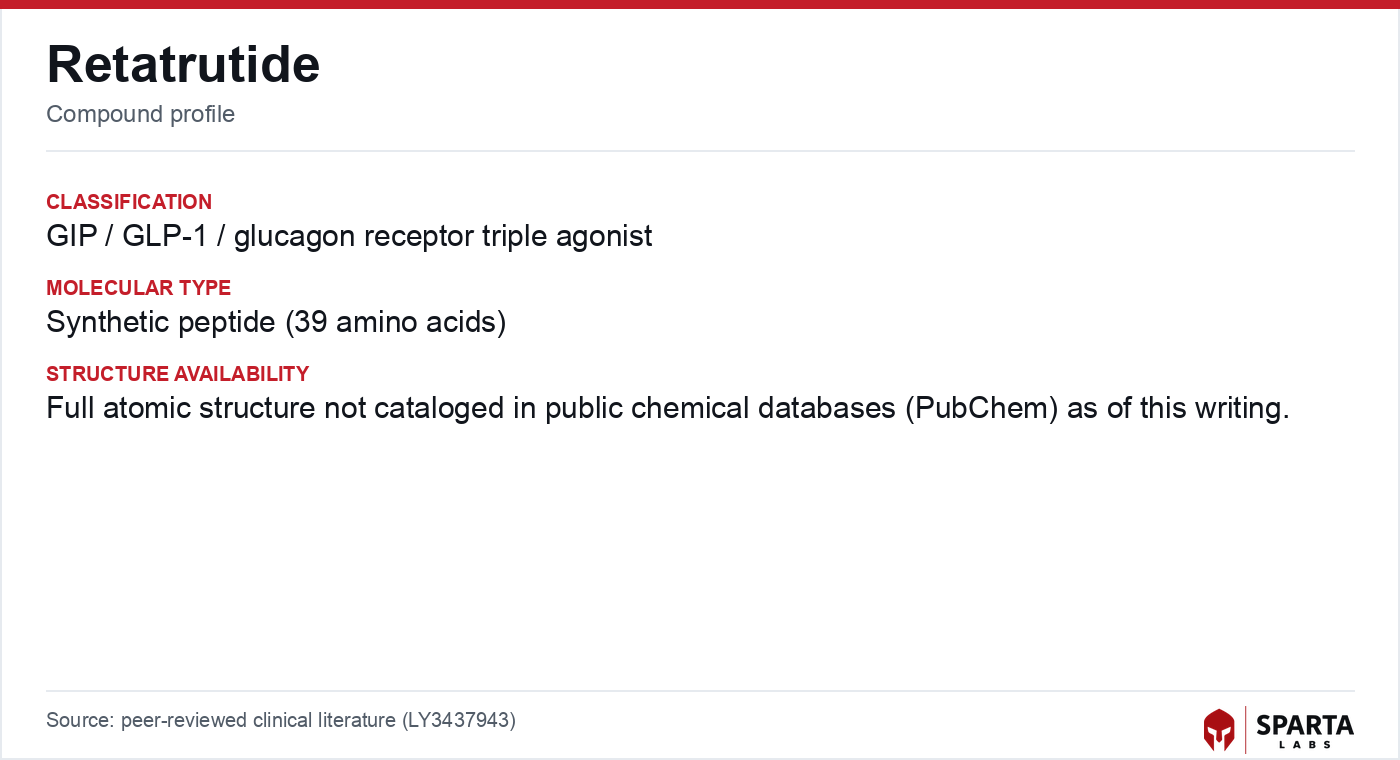
Figure: chemical structure of Retatrutide (LY3437943).
The molecule that has to be verified
Before discussing verification methods, it is worth being specific about the target. Coskun and colleagues (2022) described LY3437943 as a synthetic peptide of approximately 39 amino acid residues built on a GIP-based backbone, engineered with amino-acid substitutions that tune its balanced activity across the three receptors and stabilize the structure against enzymatic cleavage.[1]
Findings from research models do not establish safety or efficacy in humans. Sparta Labs makes no claims about the use of this compound.
The feature most relevant to quality control is a C20 fatty-diacid chain attached through a linker to a defined lysine residue. This acyl modification is a deliberate design strategy shared with other long-acting incretin agents: Knudsen and Lau (2019) reviewed how fatty-acid acylation promotes reversible binding to serum albumin and, in that class of molecules, is associated with a prolonged circulating half-life.[2] For sourcing purposes, the practical consequence is that a correct retatrutide molecule is defined by two independent facts at once. The amino-acid sequence must be right, and the lipid must be attached at the right place and to completion. A batch can satisfy one condition and fail the other. This article addresses how research-relevant peptides in this class are made, and how those companion articles relate: the retatrutide research overview covers its classification and investigational status, and the retatrutide mechanism of action article summarizes its reported receptor engagement.
Synthesis of a long acylated peptide
Peptides of this length and modification are assembled principally by solid-phase peptide synthesis (SPPS), the method first reported by Robert Bruce Merrifield in 1963 and recognized with the 1984 Nobel Prize in Chemistry.[3] In SPPS, the growing chain is anchored to an insoluble resin, and amino acids are added one at a time through repeated deprotection and coupling cycles. The approach is well suited to research-scale and manufacturing-scale peptide production, but its stepwise nature has a structural implication: any coupling step that proceeds at less than full efficiency leaves behind a small fraction of chains missing a residue.
Andersson and colleagues (2000) reviewed the technical considerations governing large-scale peptide synthesis and noted that yield and purity outcomes for longer sequences are strongly influenced by resin chemistry, the choice of coupling reagents, and the purification strategy.[4] For a backbone approaching forty residues, the accumulation of these single-residue deletion products across many cycles is the dominant source of sequence-related impurity, and it is why crude synthetic material is always purified before it can be considered research-grade.
The fatty-diacid acylation adds a second synthetic dimension on top of the sequence assembly. Attaching a lipid to one specific side chain requires orthogonal protecting-group strategy so that conjugation occurs at the intended lysine and nowhere else. Kaspar and Reichert (2013), reviewing peptide-therapeutic development, discussed lipidation as an established engineering approach for extending peptide half-life and noted the added synthetic and analytical complexity that site-specific modification introduces.[5] The controlled nature of this step is precisely why acylation completeness, rather than mere sequence identity, becomes a defining quality question for retatrutide.
Why acylation completeness is the hard analytical question
Two impurity families dominate the analytical picture for a compound like retatrutide, and neither is trivial to resolve.
The first is the deletion and truncation family inherited from SPPS. These species differ from the target by one or a few residues, which can mean only a modest change in both mass and chromatographic retention. The second, and more distinctive, is the incomplete-acylation family: a correctly assembled peptide backbone that never received its fatty-diacid chain, or received it at the wrong position. A non-acylated species has a lower molecular mass and materially different hydrophobicity, but because the modification sits on a single residue, some closely related mis-acylated variants can co-elute with the target under an insufficiently selective method.
This is why verification of an acylated peptide relies on two orthogonal techniques rather than one. Reversed-phase high-performance liquid chromatography (RP-HPLC) separates species by hydrophobicity and reports the proportion of the target relative to all UV-absorbing species; Mant and Hodges reviewed the retention behavior and analytical implications of peptide chromatography that underpin this measurement.[6] Mass spectrometry then confirms the intact molecular mass against the theoretical value calculated from the full sequence plus the diacid modification. HPLC answers "how much of the sample is the main peak"; mass spectrometry answers "is the main peak the correctly acylated molecule." Neither question is sufficient alone for a compound of this structural type.
Purity and identity standards
Analytical purity for research-grade synthetic peptides is commonly expressed as an RP-HPLC purity percentage, with a widely cited research-use minimum of at least 98%. Sparta Labs applies an internal HPLC standard of at least 98% for retatrutide, consistent with research-grade specifications for acylated peptides of this complexity.
Identity is established separately through mass-spectrometry confirmation of molecular weight. For retatrutide the theoretical mass must account for both the peptide sequence and the fatty-diacid linker, so the mass-spec check simultaneously serves as the primary evidence that acylation is present and correct. Sparta Labs treats HPLC purity and mass-spectrometry confirmation as co-requisite elements of the verification package, so that a high purity figure is never reported without an accompanying confirmation that the dominant peak corresponds to the intended acylated molecule. The same analytical logic applies across this structural class; the standards described for mazdutide sourcing and for cagrilintide sourcing follow comparable principles for other long-acting acylated peptides.
Third-party verification and Certificates of Analysis
Internal testing by a manufacturer is a necessary but not a complete basis for research-grade assurance. Independent third-party analysis, in which an accredited laboratory that is not affiliated with the manufacturer performs its own HPLC and mass-spectrometry testing on the finished batch, adds an evidentiary layer that supports reproducibility. Sparta Labs submits each retatrutide batch to an independent third-party laboratory for analytical verification prior to release, so that identity and purity data can be traced to a source outside the commercial supply chain.
Sparta Labs publishes a Certificate of Analysis (COA) for every batch of retatrutide, linked from the product page and specific to the batch from which a given order is fulfilled. Each retatrutide COA records:
- HPLC purity percentage with the chromatographic trace
- Mass-spectrometry confirmation of molecular weight with spectral data
- Batch number and unique lot identifier
- Manufacturing date and assigned expiry date
- Identity of the third-party laboratory that conducted verification testing
Batch-specific documentation allows researchers to record the analytical provenance of the exact material used in an experiment, which is relevant to internal reproducibility records and to the material-characterization detail expected in a methods section.
Storage and physical form
Synthetic acylated peptides such as retatrutide are typically supplied in lyophilized (freeze-dried) form, which extends shelf stability relative to material held in solution. General stability considerations for peptides of this class include storage of lyophilized material at low temperature, protection from moisture, and protection from light, which can promote oxidation of susceptible residues.
The acyl-linker junction is a defined chemical feature whose integrity is part of the identity established at batch release. Because the mass-spectrometry confirmation step measures the intact molecular mass, it verifies that the fatty-diacid modification is present as designed at the time of release, alongside the sequence identity of the backbone.
Why sourcing quality matters for research
The interpretability of a research result depends on confidence that the material generating it is what the label says. For a compound defined by both a long peptide sequence and a site-specific lipid modification, that confidence rests on two independent measurements: a chromatographic purity figure that resolves sequence-related and acylation-related impurities, and a mass-spectrometry identity check that confirms the intact, correctly acylated molecule. When both are documented at the batch level and confirmed by an independent laboratory, an experimental observation can be attributed to the compound rather than to an uncharacterized supply chain. Verified retatrutide from Sparta Labs is supplied with batch-specific analytical documentation of this kind.
References
-
Coskun T, Urva S, Roell WC, Qu H, Loghin C, Moyers JS, et al. LY3437943, a novel triple glucagon, GIP, and GLP-1 receptor agonist for glycemic control and weight loss. Cell Metab. 2022;34(9):1234-1247.e9. DOI: 10.1016/j.cmet.2022.07.013. PubMed
-
Knudsen LB, Lau J. The Discovery and Development of Liraglutide and Semaglutide. Front Endocrinol (Lausanne). 2019;10:155. DOI: 10.3389/fendo.2019.00155. PubMed
-
Merrifield RB. Solid Phase Peptide Synthesis. I. The Synthesis of a Tetrapeptide. J Am Chem Soc. 1963;85(14):2149-2154. DOI: 10.1021/ja00897a025. Journal
-
Andersson L, Blomberg L, Flegel M, Lepsa L, Nilsson B, Verlander M. Large-scale synthesis of peptides. Biopolymers. 2000;55(3):227-250. DOI: 10.1002/1097-0282(2000)55:3<227::AID-BIP50>3.0.CO;2-7. PubMed
-
Kaspar AA, Reichert JM. Future directions for peptide therapeutics development. Drug Discov Today. 2013;18(17-18):807-817. DOI: 10.1016/j.drudis.2013.05.011. PubMed
-
Mant CT, Hodges RS. Analysis of peptides by high-performance liquid chromatography. Methods Enzymol. 1991;193:185-229. DOI: 10.1016/0076-6879(91)93015-k. PubMed
Disclaimer. Statements in this article have not been evaluated by the Food and Drug Administration. This compound is not intended to diagnose, treat, cure, or prevent any disease. Sparta Labs sells research-use-only materials. Content is provided for educational and informational purposes only and does not constitute medical advice. Consult a qualified medical professional for any health concerns.
Frequently asked questions
What makes retatrutide analytically challenging to verify?
Retatrutide (LY3437943) is a long single-chain peptide of roughly 39 residues carrying a C20 fatty-diacid chain attached through a spacer at a defined lysine. Both the length of the peptide backbone and the site-specific lipid modification create closely related impurities, such as truncated sequences and incompletely acylated species, that can be difficult to separate. Verifying such a compound therefore requires reversed-phase HPLC to resolve these species alongside mass spectrometry to confirm the intact molecular mass.
Why does the fatty-acid acylation matter for retatrutide quality control?
The C20 diacid chain is a deliberate design element that promotes reversible albumin binding and, in the published pharmacology, is associated with an extended plasma half-life. Because the modification is site-specific, quality control must confirm not only that the peptide sequence is correct but that acylation occurred at the intended position and to completion. A non-acylated or mis-acylated species has a different mass and different chromatographic behavior, so mass-spectrometry identity confirmation is central to the verification package.
How is retatrutide's identity confirmed at batch release?
Identity is established by comparing the measured molecular mass from mass spectrometry against the theoretical mass calculated from the full sequence plus the fatty-diacid modification. Reversed-phase HPLC reports the proportion of the target compound relative to other UV-absorbing species. Sparta Labs treats HPLC purity and mass-spectrometry confirmation as co-requisite elements so that the main chromatographic peak is confirmed to correspond to the intended acylated compound rather than a co-eluting impurity.
What does a retatrutide Certificate of Analysis document?
A batch-specific Certificate of Analysis records the HPLC purity percentage with its chromatographic trace, the mass-spectrometry confirmation of molecular weight, the batch and lot identifiers, the manufacturing and assigned expiry dates, and the third-party laboratory that performed verification. Batch-specific documentation lets a researcher trace the analytical provenance of the exact material used, which supports internal reproducibility records and material characterization in a methods section.