
Epithalon: Published Research
A source-organized survey of the Epithalon (AEDG tetrapeptide) and Epithalamin extract literature, separating cell-culture telomerase and chromatin work from rodent lifespan experiments and long-term human observational cohorts, with the documented gaps noted. Educational reference.
For research use only. Not for human consumption. This article is educational reference material. It is not medical advice and is not a recommendation to use any substance.
Introduction
Epithalon (also spelled Epitalon) is a synthetic tetrapeptide with the sequence Ala-Glu-Asp-Gly (AEDG), designed as a short peptide mimetic of the pineal-gland polypeptide extract Epithalamin. The published research on this compound is unusual in one important respect: much of it spans two related but chemically distinct materials. Epithalamin is a heterogeneous polypeptide preparation isolated from bovine pineal tissue, while Epithalon is a single, chemically defined four-residue peptide derived from analysis of that extract. A large share of the animal and human literature was generated with the parent extract, whereas the in vitro molecular work was generated with the synthetic tetrapeptide. Reading the record accurately requires keeping that distinction in view throughout.
The research base originates primarily with a St. Petersburg group associated with Vladimir Khavinson and Vladimir Anisimov, whose publications appeared across several decades in journals including the Bulletin of Experimental Biology and Medicine, Mechanisms of Ageing and Development, and Biogerontology. This article organizes that record by material studied and by experimental system, summarizes the reported observations with attribution, and flags where the evidence is preliminary or single-source. It does not draw conclusions beyond what the individual papers stated. For the proposed molecular pathways behind these observations, the Epithalon mechanism of action article provides a dedicated account, and the Epithalon research overview situates the compound within its broader classification.
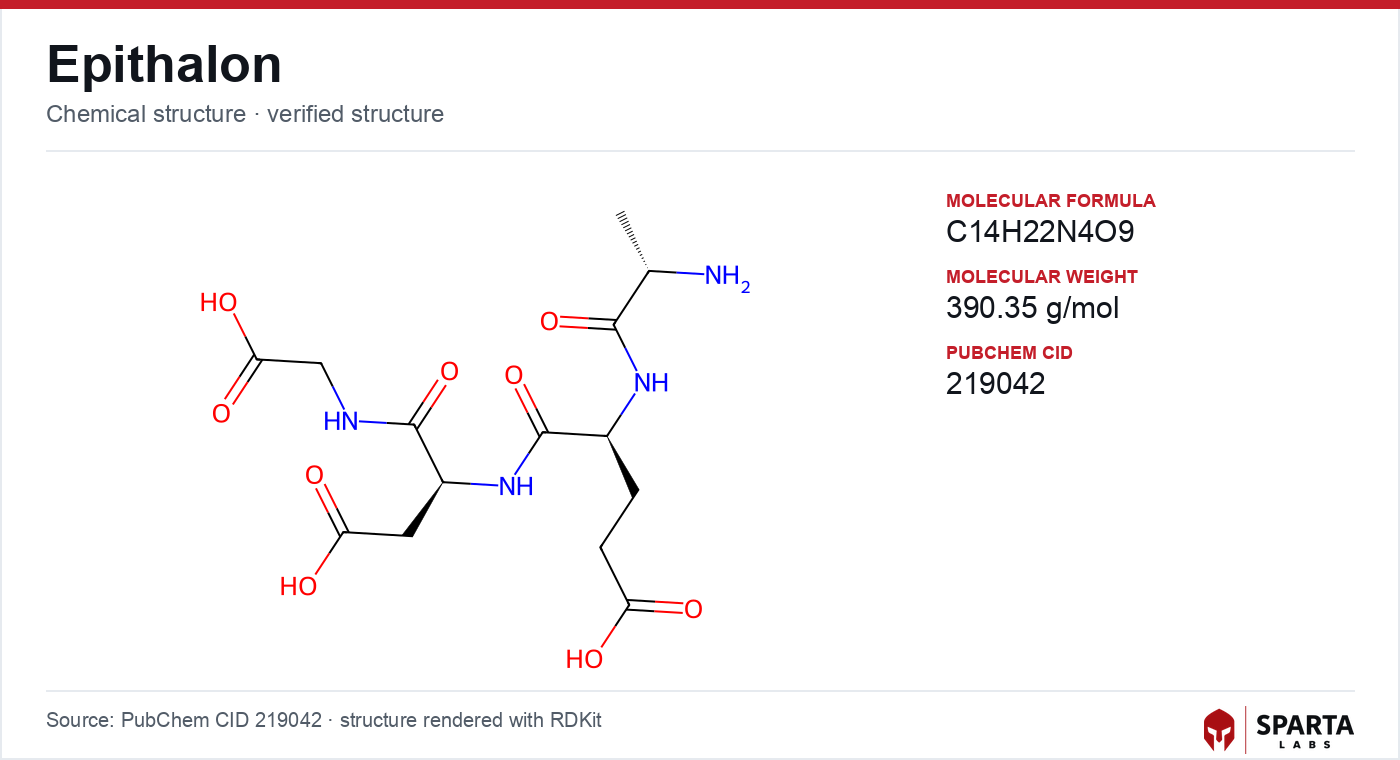
Figure: chemical structure of Epithalon (Ala-Glu-Asp-Gly).
How to Read This Literature: Extract Versus Tetrapeptide
A recurring interpretive challenge in the Epithalon record is that the synthetic AEDG tetrapeptide and the bovine pineal extract Epithalamin are frequently discussed together, yet they are not interchangeable materials. Epithalamin is a mixture of peptides isolated from pineal tissue; Epithalon is one defined sequence proposed to represent part of that mixture's activity.
The practical consequence for a researcher surveying the field is that findings reported for one material do not automatically transfer to the other. The multi-year human observational cohorts, discussed below, used the extract. The telomerase and chromatin cell-culture experiments used the synthetic tetrapeptide. Rodent lifespan work exists for both. Throughout this summary, the material actually administered in each study is named explicitly so that the boundary between the two is never blurred.
Cell-Culture Work: Telomerase and the Division Limit
The most mechanistically specific Epithalon literature comes from human cell culture. In a 2003 report in the Bulletin of Experimental Biology and Medicine, Khavinson, Bondarev, and Butyugov described adding the AEDG tetrapeptide to telomerase-negative human somatic cell cultures [1]. The authors reported induction of telomerase enzymatic activity and telomere elongation in treated cultures, with control cultures showing no such activity. This paper is the anchor citation that most subsequent discussions of the compound reference.
Findings from research models do not establish safety or efficacy in humans. Sparta Labs makes no claims about the use of this compound.
A follow-up report from the same group, published in 2004, examined proliferative lifespan in cultured human fibroblasts [2]. The authors reported that cultures reaching the expected replicative limit (consistent with the Hayflick limit) underwent additional population doublings after exposure to the peptide, an observation they associated with telomere elongation in the treated cultures. These two in vitro reports form the core empirical basis for the "telomerase-activating peptide" framing that later appeared throughout secondary literature. Both are cell-culture studies; neither addresses whole-organism outcomes, and independent replication by unaffiliated laboratories remains a documented gap in the record.
Cell-Culture Work: Chromatin State and Gene Expression
A separate line of in vitro work examined chromatin structure rather than telomeres. In a 2003 study, Khavinson and Lezhava reported on cultured lymphocytes from elderly donors and described peptide-associated changes in chromatin organization, including activation of ribosomal genes and decondensation of heterochromatin regions [3]. The authors framed this as age-associated chromatin becoming transcriptionally accessible following peptide exposure.
This chromatin theme reappeared in a 2020 study published in Molecules, which examined AEDG in the context of human gingival mesenchymal stem cells undergoing neurogenic differentiation [4]. The authors reported elevated messenger-RNA expression for several neurogenic markers and, using molecular docking, proposed that the peptide might interact with linker histone H1 at DNA-binding sites. Notably, the authors themselves characterized the histone-interaction model as a hypothesis requiring direct structural-biology validation rather than an established mechanism, which is the appropriate way to read it. Together the 2003 and 2020 reports describe a proposed epigenetic axis distinct from the telomerase axis, though the two are sometimes conflated in downstream summaries.
Rodent Lifespan and Tumor-Incidence Experiments
The animal lifespan literature is where the extract-versus-tetrapeptide distinction matters most, because both materials were tested. A 2001 study in Mechanisms of Ageing and Development by Anisimov, Khavinson, and colleagues examined synthetic pineal and thymic peptides in female CBA mice treated from six months of age [5]. The authors reported modest changes in survival biomarkers and slowed aging of estrous function relative to controls, alongside data on spontaneous tumor incidence.
A 2003 study in Biogerontology examined Epithalon specifically in female Swiss-derived SHR mice [6]. The authors reported an increase in the lifespan of the longest-lived fraction of the treated cohort (a maximum-lifespan metric), a reduced incidence of leukemia in treated animals, slowed age-related estrous changes, and fewer chromosomal aberrations in bone-marrow cells. The same report noted that mean lifespan and overall spontaneous-tumor incidence did not differ significantly between groups, an internal nuance that is often omitted when this study is cited secondhand.
The parent extract Epithalamin was examined across species in a 1998 Mechanisms of Ageing and Development report by Anisimov and colleagues, which described mean-lifespan changes in Drosophila melanogaster, mice, and rats treated with the pineal preparation [7]. Because this study used the extract rather than the tetrapeptide, its results speak to the parent material and should not be read as direct evidence for synthetic AEDG.
Multi-Year Human Observational Cohorts (Extract)
The human research record uses the parent extract Epithalamin, not the synthetic tetrapeptide, a distinction that materially constrains how the human data can be interpreted for the isolated peptide. Two reports from the Korkushko and Khavinson collaboration are most frequently cited.
A 2004 study in the Bulletin of Experimental Biology and Medicine measured circadian plasma melatonin profiles in elderly subjects before and after extract administration [8]. The authors reported that subjects with initially reduced nocturnal melatonin output showed higher nighttime melatonin concentrations following the extract, while subjects with normal output showed comparatively little change. The design was observational.
A 2006 report described outcomes from a long-term observational study in elderly patients with coronary artery disease [9]. A group receiving Epithalamin in addition to standard therapy over a multi-course schedule was compared with a group receiving standard therapy alone, with follow-up extending to twelve years. The authors reported a lower count of deceased subjects and lower cardiovascular mortality in the extract group at the final follow-up, while explicitly noting the observational design and absence of full randomization as limitations. These caveats are part of the primary source and belong in any accurate summary. Readers comparing this to other pineal-context neuropeptide records may find the Pinealon published research summary a useful adjacent reference.
Synthesis Reviews and the State of the Evidence
A 2010 review in Biogerontology by Anisimov and Khavinson consolidated the rodent, invertebrate, and human observational evidence accumulated to that point and discussed peptide bioregulation of aging as a research program [10]. As a review authored by the originating investigators, it is valuable for tracing how the group interpreted its own record, but it does not constitute independent confirmation of the individual findings.
Viewed as a whole, the Epithalon and Epithalamin literature is internally consistent within a single research lineage but thin on independent, unaffiliated replication, particularly for the headline in vitro telomerase results and the rodent lifespan effects. Researchers evaluating batch materials for laboratory work can review documentation on the Epithalon product page, and the Epithalon sourcing and quality article covers analytical verification considerations for the synthetic tetrapeptide.
Documented Knowledge Gaps
Several well-defined open questions recur across the primary literature and its reviews:
- Independent replication. The core telomerase [1] and rodent lifespan [6] findings originate largely with one collaboration; replication by unaffiliated groups is limited in the published record.
- Extract-to-peptide translation. The strongest whole-organism and human observational data used Epithalamin extract [7,8,9], leaving open how much transfers to the isolated synthetic AEDG tetrapeptide.
- Randomized human trials. The human studies were observational; controlled randomized designs using synthetic AEDG were not part of the reviewed record.
- Mechanism validation. The proposed histone-interaction model [4] was presented by its own authors as a docking-derived hypothesis awaiting direct structural confirmation.
Each of these is a tractable, well-scoped research question rather than a settled point, and each is the appropriate place for future work to concentrate.
References
-
Khavinson VKh, Bondarev IE, Butyugov AA. Epithalon peptide induces telomerase activity and telomere elongation in human somatic cells. Bull Exp Biol Med. 2003;135(6):590–592. DOI: 10.1023/A:1025493705728. PMID: 12937682. PubMed
-
Khavinson VKh, Bondarev IE, Butyugov AA, Smirnova TD. Peptide promotes overcoming of the division limit in human somatic cells. Bull Exp Biol Med. 2004;137(5):503–506. DOI: 10.1023/B:BEBM.0000038164.49947.8c. PMID: 15455129. PubMed
-
Khavinson VKh, Lezhava TA. Peptide Epitalon activates chromatin at the old age. Neuroendocrinol Lett. 2003;24(5):329–333. PMID: 14647006. PubMed
-
Khavinson V, Diomede F, Mironova E, Linkova N, Trofimova S, Trubiani O, et al. AEDG peptide (Epitalon) stimulates gene expression and protein synthesis during neurogenesis: possible epigenetic mechanism. Molecules. 2020;25(3):609. DOI: 10.3390/molecules25030609. PMCID: PMC7037223. PubMed Central
-
Anisimov VN, Khavinson VKh, Mikhalski AI, Yashin AI. Effect of synthetic thymic and pineal peptides on biomarkers of ageing, survival and spontaneous tumour incidence in female CBA mice. Mech Ageing Dev. 2001;122(1):41–68. DOI: 10.1016/s0047-6374(00)00184-6. PMID: 11163623. PubMed
-
Anisimov VN, Khavinson VKh, Popovich IG, Zabezhinski MA, Alimova IN, Rosenfeld SV, et al. Effect of Epitalon on biomarkers of aging, life span and spontaneous tumor incidence in female Swiss-derived SHR mice. Biogerontology. 2003;4(4):193–202. DOI: 10.1023/A:1025114230714. PMID: 14501183. PubMed
-
Anisimov VN, Mylnikov SV, Oparina TI, Khavinson VKh. Effect of melatonin and pineal peptide preparation epithalamin on life span and free radical oxidation in Drosophila melanogaster. Mech Ageing Dev. 1997;97(2):81–91. DOI: 10.1016/s0047-6374(97)00051-8. PMID: 9223129. PubMed
-
Korkushko OV, Khavinson VKh, Shatilo VB, Antonyuk-Shcheglova IA. Effect of peptide preparation Epithalamin on circadian rhythm of epiphyseal melatonin-producing function in elderly people. Bull Exp Biol Med. 2004;137(4):389–391. DOI: 10.1023/B:BEBM.0000035139.31138.cf. PMID: 15452611. PubMed
-
Korkushko OV, Khavinson VKh, Shatilo VB, Magdich LV. Geroprotective effect of epithalamine (pineal gland peptide preparation) in elderly subjects with accelerated aging. Bull Exp Biol Med. 2006;142(3):356–359. DOI: 10.1007/s10517-006-0365-z. PMID: 17426848. PubMed
-
Anisimov VN, Khavinson VKh. Peptide bioregulation of aging: results and prospects. Biogerontology. 2010;11(2):139–149. DOI: 10.1007/s10522-009-9249-8. PMID: 19830585. PubMed
Disclaimer. Statements in this article have not been evaluated by the Food and Drug Administration. This compound is not intended to diagnose, treat, cure, or prevent any disease. Sparta Labs sells research-use-only materials. Content is provided for educational and informational purposes only and does not constitute medical advice. Consult a qualified medical professional for any health concerns.
Frequently asked questions
What is the difference between Epithalon and Epithalamin in the research literature?
Epithalamin is a heterogeneous polypeptide extract isolated from bovine pineal tissue, while Epithalon (AEDG) is a single, chemically defined four-residue synthetic peptide. Much of the animal and human observational literature was generated with the extract, whereas the in vitro telomerase and chromatin work used the synthetic tetrapeptide. Findings reported for one material do not automatically transfer to the other.
What did the 2003 Khavinson telomerase study report?
Khavinson, Bondarev, and Butyugov (2003), publishing in the Bulletin of Experimental Biology and Medicine, reported that adding the AEDG tetrapeptide to telomerase-negative human somatic cell cultures was associated with induced telomerase enzymatic activity and telomere elongation, while control cultures showed no such activity. This is a cell-culture study and does not address whole-organism outcomes.
Were the human Epithalon studies randomized clinical trials?
No. The published human studies used the parent extract Epithalamin and were observational in design, including a long-term cohort in elderly patients followed for up to twelve years. The authors themselves noted the observational design and absence of full randomization as limitations, and randomized controlled trials using the synthetic AEDG tetrapeptide were not part of the reviewed record.
Has the Epithalon telomerase finding been independently replicated?
The core in vitro telomerase and rodent lifespan findings originate largely with a single research collaboration in St. Petersburg. Independent replication by unaffiliated laboratories is limited in the published record, which the primary literature and its reviews identify as a documented knowledge gap rather than a settled point.
What animal models were used in the Epithalon lifespan research?
Rodent lifespan experiments used female CBA mice and Swiss-derived SHR mice, with endpoints including survival biomarkers, estrous-cycle aging, spontaneous tumor incidence, and chromosomal aberrations. The parent extract Epithalamin was additionally studied across species including Drosophila melanogaster, mice, and rats.