
Epithalon: Sourcing, Purity, and Verification Standards
A quality-focused reference on Epithalon (AEDG): why its acidic four-residue sequence shapes synthesis, purification, and analytical verification. Educational reference.
Epithalon (AEDG): Analytical Verification and Quality Standards
For research use only. Not for human consumption. This article is educational reference material. It is not medical advice and is not a recommendation to use any substance.
Why AEDG Chemistry Governs Its Quality Requirements
Epithalon is the synthetic tetrapeptide alanyl-glutamyl-aspartyl-glycine (Ala-Glu-Asp-Gly), abbreviated AEDG. It is one of the shortest peptides in the research-compound catalog, and that brevity, combined with its unusual amino acid composition, shapes every downstream sourcing and verification decision. Two of its four residues, glutamic acid and aspartic acid, carry acidic side-chain carboxyl groups, giving AEDG a markedly acidic, hydrophilic character. This article describes how that chemistry informs the synthesis, purification, identity confirmation, and documentation appropriate to a research-grade AEDG preparation.
The integrity of laboratory work depends directly on the integrity of the materials used. A compound that does not match its stated sequence, purity, or molecular weight can produce results that mislead rather than inform. For AEDG in particular, where the published research record is built on a precisely defined four-residue sequence, confirming that a sample is the correct peptide is a condition of experimental validity, not paperwork.
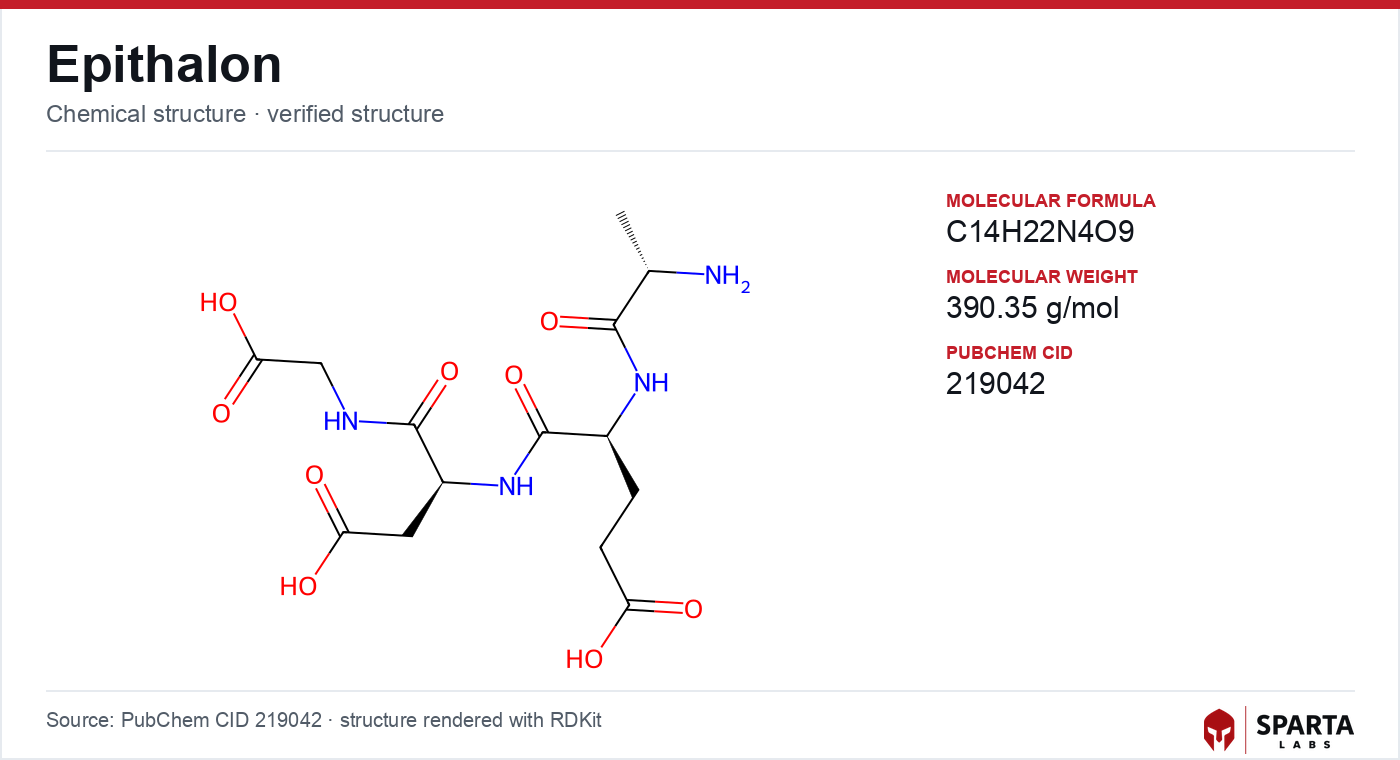
Figure: chemical structure of Epithalon (Ala-Glu-Asp-Gly).
Solid-Phase Synthesis of a Short Acidic Tetrapeptide
AEDG is produced by solid-phase peptide synthesis (SPPS), the approach introduced by R.B. Merrifield, who first demonstrated it on a tetrapeptide and later received the 1984 Nobel Prize in Chemistry for the method.[1] SPPS builds the chain one residue at a time on an insoluble resin support: each cycle couples a protected amino acid, then removes the temporary protecting group before the next residue is added, so that the growing peptide stays anchored while reagents and byproducts are washed away.
For a four-residue sequence the number of coupling cycles is small, which limits the accumulation of deletion sequences and truncated chains that complicate longer syntheses. The acidic residues introduce their own considerations: the glutamate and aspartate side-chain carboxyls are protected during chain assembly, and aspartyl-containing sequences are handled to limit aspartimide formation, a well-characterized side reaction in Asp-Gly contexts that Fmoc-SPPS strategies are designed to suppress. General scale-up and process-control considerations for producing research-grade peptides by SPPS have been reviewed in the peptide-manufacturing literature.[2]
After the chain is complete, it is cleaved from the resin and the side-chain protecting groups are removed, yielding a crude peptide in solution. Because AEDG is small and hydrophilic, the crude mixture is amenable to reversed-phase separation, described below. The purified material is then lyophilized to a dry powder for storage and handling.
Purity Assessment by Reversed-Phase HPLC
Reversed-phase high-performance liquid chromatography (RP-HPLC) is the primary quantitative measure of peptide quality across the research-compound supply chain. HPLC separates the target peptide from structurally similar impurities and reports the percentage of total integrated peak area attributable to the target compound. Research-grade peptide material is commonly characterized at HPLC purity of at least 98 percent; material below that threshold carries a higher risk of confounding results through the activity of co-eluting or related-sequence impurities.[3]
AEDG presents a specific separation challenge because it is short and highly polar, so it elutes early on a reversed-phase column and can sit close to hydrophilic synthesis byproducts. Ion-pairing mobile phases and shallow gradients are typically used to resolve it. Sparta Labs applies an internal HPLC purity specification of at least 99 percent for Epithalon, above the common minimum, reflecting the sequence-specificity demands of the cell and chromatin research contexts in which AEDG is studied.
Confirming Identity with Mass Spectrometry
HPLC purity establishes how much of a sample is a single component, but not that the component is the intended sequence. Mass spectrometry supplies the orthogonal identity check. For Epithalon (molecular formula C14H22N4O9, molecular weight approximately 390.3 daltons), mass spectrometry confirms that the observed molecular ion matches the value expected for the AEDG sequence.
This step catches errors that retention time alone cannot rule out, such as an amino acid substitution that leaves purity high but changes the mass, or a sequence isomer. Because AEDG's two acidic residues make its mass distinctive from a peptide of the same length with neutral residues, the expected and observed values are reported together on batch documentation so that reviewers can confirm the match directly.
Alongside HPLC and mass spectrometry, residual-solvent analysis characterizes solvents carried through synthesis and purification, and endotoxin testing establishes that bacterial lipopolysaccharide is not present at levels that could confound cell-based or in-vivo research.
Third-Party Verification and the Certificate of Analysis
Independent third-party analysis is the practice that distinguishes a documented quality claim from a manufacturer's self-report. An outside laboratory has no commercial stake in the outcome and no access to internal batch records, so its HPLC and mass-spectrometry results function as an external check on manufacturing consistency. Where cell-based or in-vivo applications are specified, endotoxin testing by the Limulus Amebocyte Lysate assay is also performed, and the data are reviewed against specification before a batch is released.
A Certificate of Analysis (COA) is the batch-specific record of that testing. Batch-level COA documentation is available directly on the Epithalon product page. A Sparta Labs Epithalon COA records:
- HPLC purity result (percent area, with the chromatogram available on request)
- Mass-spectrometric confirmation of molecular weight, with observed and expected m/z values for the AEDG sequence
- Batch number and manufacturing date
- Expiry date
- Third-party laboratory name and report reference
Recording these specifications matters beyond a single purchaser: when a research group can report the identity and purity of the exact material used, other groups are better positioned to interpret and reproduce the findings. For readers surveying quality documentation across the related Russian bioregulator peptides, the Pinealon sourcing and quality reference and the N-Acetyl Selank Amidate sourcing and quality article describe the analogous standards for adjacent compounds.
Storage and Stability of a Hydrophilic Tetrapeptide
Lyophilized peptides are stable as a dry powder when stored appropriately, but stability is sensitive to moisture, heat, and light. The general principles governing solid-state peptide and protein stability, including the role of lyophilization in limiting hydrolytic and oxidative degradation, are established in the pharmaceutical-formulation literature.[4]
In lyophilized form, Epithalon is kept sealed, protected from light and moisture, and stored frozen; under those conditions the powder is stable for the period stated on the batch COA. In aqueous solution, hydrophilic peptides are more exposed to hydrolysis and to microbial contamination, and repeated freeze-thaw cycling degrades peptide integrity. AEDG's Asp-Gly linkage is a recognized site of sequence-dependent instability in solution, which is one reason stable dry storage is favored over prolonged aqueous handling. No compound-specific published stability study for synthetic AEDG has been identified in the primary literature, so these handling principles are drawn from established short-peptide solid-state stability data and standard laboratory practice.
Why Chemical Identity Is the Foundation
For Epithalon, the research literature has carefully separated the parent pineal polypeptide extract, Epithalamin, from the synthetic AEDG tetrapeptide, because the two are chemically distinct entities with different composition and potentially different activity. That distinction is only meaningful if the material in hand is verified to be AEDG. The chemistry and classification context is developed further in the Epithalon research overview, and the reported mechanistic literature is summarized in the Epithalon mechanism of action article.
The same precision the published research applies to defining its experimental compound is the standard sourcing and quality control should meet. HPLC purity at 99 percent or above, mass-spectrometric sequence confirmation, endotoxin testing, third-party verification, and batch-level COA documentation are the practical expression of that principle: they convert a sequence on a label into a verified, reproducible research material.
References
-
Merrifield RB. Solid Phase Peptide Synthesis. I. The Synthesis of a Tetrapeptide. J Am Chem Soc. 1963;85(14):2149–2154. DOI: 10.1021/ja00897a025.
-
Andersson L, Blomberg L, Flegel M, Lepsa L, Nilsson B, Verlander M. Large-scale synthesis of peptides. Biopolymers. 2000;55(3):227–250. DOI: 10.1002/1097-0282(2000)55:3<227::AID-BIP50>3.0.CO;2-7. PMID: 11074410.
-
Fosgerau K, Hoffmann T. Peptide therapeutics: current status and future directions. Drug Discov Today. 2015;20(1):122–128. DOI: 10.1016/j.drudis.2014.10.003. PMID: 25450771.
-
Wang W. Lyophilization and development of solid protein pharmaceuticals. Int J Pharm. 2000;203(1-2):1–60. DOI: 10.1016/S0378-5173(00)00423-3. PMID: 10967427.
Disclaimer. Statements in this article have not been evaluated by the Food and Drug Administration. This compound is not intended to diagnose, treat, cure, or prevent any disease. Sparta Labs sells research-use-only materials. Content is provided for educational and informational purposes only and does not constitute medical advice. Consult a qualified medical professional for any health concerns.
Frequently asked questions
What sequence and molecular weight define Epithalon?
Epithalon is the synthetic tetrapeptide Ala-Glu-Asp-Gly (AEDG), a defined four-residue sequence with the molecular formula C14H22N4O9 and a molecular weight near 390.3 daltons. Because the published research record uses this exact sequence, analytical identity confirmation is a condition of experimental validity rather than an administrative formality.
Why is Epithalon distinguished from Epithalamin?
Epithalamin refers to a pineal polypeptide extract studied in the early Russian bioregulator literature, whereas Epithalon (AEDG) is a single, chemically defined synthetic tetrapeptide reported as an active fragment associated with that extract. The two are different chemical entities with different composition, so sourcing documentation that confirms the AEDG sequence is what establishes that a sample matches the synthetic-peptide research record.
How is the identity of an Epithalon batch confirmed analytically?
Reversed-phase HPLC reports the proportion of total peak area attributable to the target peptide, separating it from truncated or related sequences. Mass spectrometry provides an orthogonal check by confirming that the observed molecular ion matches the value expected for the AEDG sequence, catching substitutions that retention time alone cannot rule out.
What appears on a Sparta Labs Epithalon Certificate of Analysis?
A Certificate of Analysis is a batch-specific document recording the analytical results for one production lot. A Sparta Labs Epithalon COA records the HPLC purity result, mass-spectrometric confirmation of molecular weight with observed and expected values for the AEDG sequence, the batch number, manufacturing and expiry dates, and the third-party laboratory reference.