
Epithalon: Mechanism of Action
How the peer-reviewed literature describes the reported molecular activity of the Epithalon (AEDG) tetrapeptide, from telomerase and hTERT induction to chromatin decondensation, computational histone docking, and pineal neuroendocrine signaling in cell and animal models. Educational reference.

For research use only. Not for human consumption. This article is educational reference material. It is not medical advice and is not a recommendation to use any substance.
Introduction
Epithalon is the synthetic tetrapeptide alanyl-glutamyl-aspartyl-glycine (Ala-Glu-Asp-Gly), abbreviated AEDG and sometimes written Epitalon. It was designed in the 1990s at the St. Petersburg Institute of Bioregulation and Gerontology as a short, chemically defined analog of Epithalamin, a polypeptide extract of the bovine pineal gland. Rather than acting as a conventional receptor agonist, the published literature describes AEDG as a "bioregulator" peptide whose reported activity centers on gene-regulatory and chromatin-associated processes in cell-culture and animal models.
This article summarizes what peer-reviewed studies have reported about the molecular behavior of Epithalon, organized by the distinct mechanistic threads found in the primary literature: telomerase signaling, chromatin state, computational histone interactions, and pineal neuroendocrine rhythm. None of these reported mechanisms establish safety or efficacy for any human application. A companion catalog of individual studies is available in the Epithalon published research summary, and broader context on classification and history is covered in the Epithalon research overview.
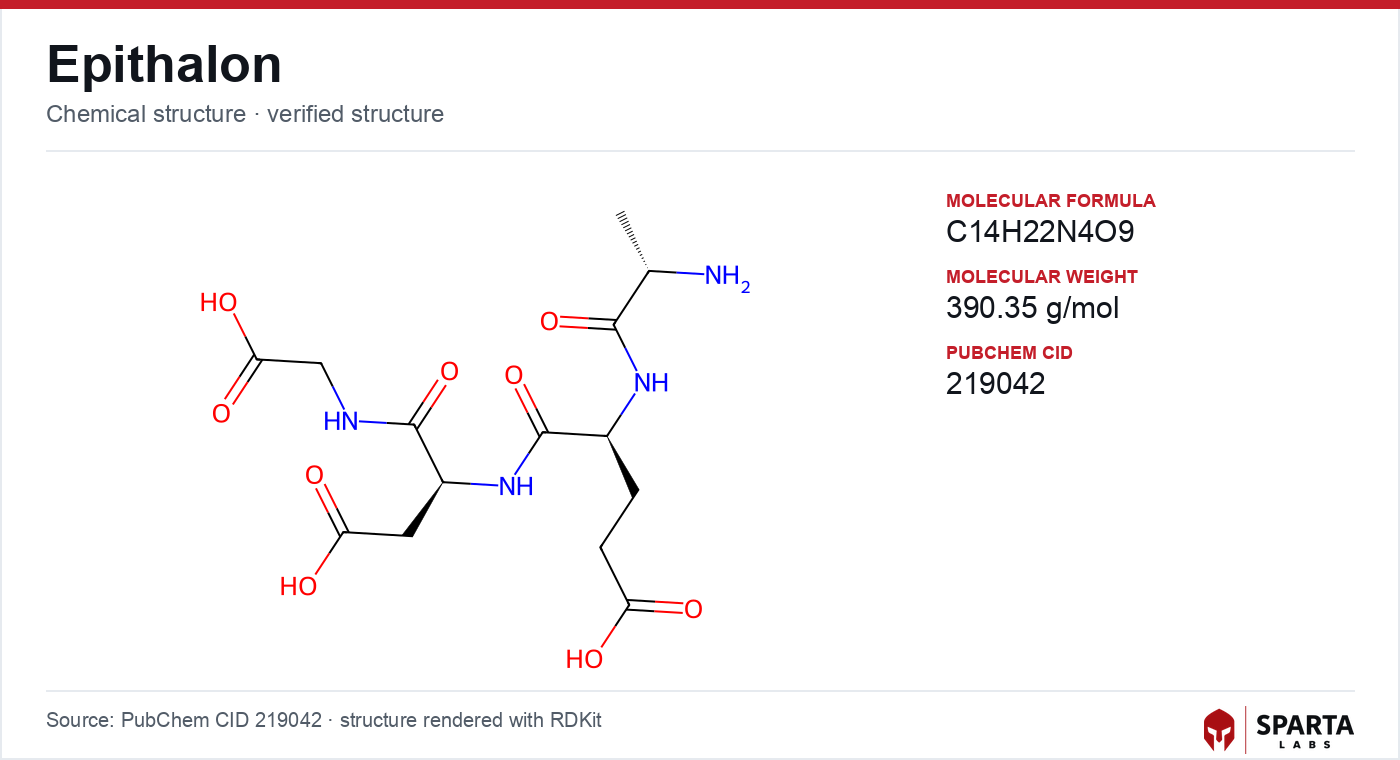
Figure: chemical structure of Epithalon (Ala-Glu-Asp-Gly).
From Epithalamin Extract to a Four-Residue Sequence
Understanding the reported mechanism of Epithalon begins with its lineage. Epithalamin is a heterogeneous peptide fraction isolated from pineal tissue, and its complexity made it difficult to attribute any single observed effect to a defined molecular species. The AEDG sequence was proposed as the minimal active motif abstracted from that extract, allowing researchers to study a homogeneous, synthesizable four-residue peptide instead of a mixture.
This design choice has a direct bearing on mechanism. Because AEDG carries two acidic side chains (glutamate and aspartate) flanked by small residues, the peptide is highly polar and short enough that classical membrane-receptor binding is not the presumed mode of action in the source literature. Instead, the working hypothesis advanced by the originating group is that such short acidic peptides can reach the nucleus and interact with DNA-associated proteins, a premise that frames all of the mechanistic studies described below.
The Telomerase and hTERT Axis
The most frequently cited molecular activity attributed to Epithalon concerns the telomerase enzymatic system. Telomerase (telomerase reverse transcriptase, hTERT) is a ribonucleoprotein enzyme that extends the repetitive DNA sequences capping chromosome ends. In most differentiated somatic cells, hTERT expression is silenced or markedly reduced, so telomeres shorten with successive divisions.
In a 2003 study published in the Bulletin of Experimental Biology and Medicine, Khavinson and colleagues reported that adding the AEDG peptide to telomerase-negative human fetal fibroblast cultures was associated with induction of hTERT expression, detectable enzymatic telomerase activity, and telomere elongation [1]. The authors proposed that Epithalon may de-repress the telomerase gene in somatic cells where it had been silenced during differentiation. The observations were made in vitro.
Findings from research models do not establish safety or efficacy in humans. Sparta Labs makes no claims about the use of this compound.
This telomerase report is the mechanistic anchor for much of the interest in Epithalon, but its interpretation carries important caveats. The study measured association between peptide exposure and enzyme activity in a specific cell type; it did not resolve the intermediate signaling steps between the extracellular peptide and transcriptional activation of the hTERT locus. That gap between an observed transcriptional outcome and a defined upstream binding event recurs throughout the Epithalon literature and motivates the chromatin studies that followed.
Chromatin Decondensation in Aged Cells
A parallel line of investigation examined whether AEDG influences the physical state of chromatin. In a 2003 report in Neuroendocrinology Letters, Khavinson and Lezhava studied cultured lymphocytes drawn from donors aged 76 to 80 years [2]. They reported that AEDG exposure was associated with decondensation of pericentromeric heterochromatin and reactivation of ribosomal genes that had become transcriptionally silent, a pattern the authors characterized as chromatin "activation" in aged cells.
Mechanistically, this observation is significant because it locates a reported Epithalon effect at the level of chromatin architecture rather than at a single gene. Age-associated heterochromatin condensation broadly represses transcription, so a peptide reported to shift the condensed-to-open balance would, in principle, be positioned to influence many downstream genes at once, including the telomerase locus discussed above. The report was observational and did not identify the protein contact responsible for the structural change.
A Computational Histone-Binding Hypothesis
The question of what AEDG physically touches inside the nucleus was addressed most directly in a 2020 study by Khavinson and colleagues published in Molecules, which examined human gingival mesenchymal stem cells undergoing neurogenic differentiation [3]. Using molecular docking, the authors proposed that the AEDG peptide preferentially associates with linker histone sites (reported for H1/6 and H1/3) at regions that interact with DNA. In parallel, the study reported elevated mRNA for neurogenic differentiation markers including Nestin, GAP43, β-Tubulin III, and Doublecortin following AEDG treatment.
This gives the field a concrete, testable structural hypothesis: that a short acidic tetrapeptide could modulate gene expression by engaging linker histones and thereby altering local chromatin accessibility. Two limits should be kept in view. First, molecular docking is a computational prediction of a favorable binding pose, not an experimental measurement of an actual complex. Second, the gene-expression readout and the docking prediction are correlative rather than causally linked within a single experiment. Experimental structural methods such as X-ray crystallography, NMR, or cryo-electron microscopy would be the conventional next steps to confirm or refute a direct peptide-histone interaction.
The Pineal Neuroendocrine Thread
Because Epithalon derives from a pineal extract, a distinct strand of the literature concerns the pineal hormone melatonin and circadian regulation. Here the evidence base largely used the parent extract Epithalamin rather than the isolated AEDG tetrapeptide, which matters for mechanistic attribution. In a 2004 report by Korkushko and colleagues in the Bulletin of Experimental Biology and Medicine, Epithalamin administration in elderly subjects with initially low nighttime melatonin was associated with higher measured melatonin output, while subjects with normal output showed a trend toward normalization [4].
For mechanism, this pineal thread is best read as a hypothesis about neuroendocrine rhythm rather than a defined molecular pathway. It is not established that the isolated AEDG tetrapeptide reproduces the melatonin-associated observations reported for the whole extract, and the studies did not identify the receptor or signaling cascade involved. The distinction between extract and defined peptide is one of the central unresolved questions in interpreting Epithalon mechanism. Researchers comparing pineal-derived short peptides often examine Pinealon, another peptide from this class studied along partly overlapping neuroprotective lines.
Gerontology-Model Observations and Antioxidant Signals
Beyond cell culture, animal-model work has been used to situate the reported molecular mechanisms in a whole-organism context. In a 2003 study in Biogerontology, Anisimov and colleagues reported that Epithalon administration in female SHR mice was associated with slowed age-related changes in estrous function, an observed increase in the lifespan of the longest-lived fraction of the cohort, and a lower frequency of chromosomal aberrations in bone marrow cells relative to untreated controls [5]. The reduced chromosomal-aberration finding is mechanistically notable because it connects a whole-animal outcome back to the genomic-stability themes raised by the telomerase and chromatin studies.
Several published animal reports have additionally described changes in oxidative-stress markers such as lipid peroxidation products and superoxide dismutase activity following peptide administration, pointing to antioxidant-pathway involvement as a further area of mechanistic interest. As with the other threads, these are reported associations in defined models rather than established causal pathways in humans.
How Epithalon's Mechanism Sits Among Short Regulatory Peptides
Epithalon is often grouped with the Russian short-peptide "bioregulator" tradition, but its documented mechanism is distinct within that group. Neuropeptides such as Semax and Selank are associated in the literature primarily with neuromodulatory and neurotrophic signaling; the Epithalon record instead concentrates on telomere biology, chromatin state, and pineal rhythm in gerontology models. Researchers mapping these mechanistic differences may find the Semax mechanism of action summary a useful contrast for how a related short peptide is described at the pathway level.
Limits of Current Understanding
Several structural features of the evidence base should temper mechanistic conclusions. A large share of the primary studies originate from a single institute, so independent replication across the full mechanistic set remains limited. The histone-binding hypothesis rests on computational docking rather than experimental structure determination. The intermediate signaling steps linking an extracellular tetrapeptide to nuclear transcriptional changes are not resolved. And several neuroendocrine observations used the Epithalamin extract rather than the synthetic AEDG peptide, leaving the translation between the two an open question. Taken together, the reported mechanisms are best understood as active hypotheses under investigation rather than settled pathways.
For researchers sourcing the synthetic tetrapeptide for laboratory work, batch-specific purity documentation is provided on the Epithalon product page.
References
-
Khavinson VKh, Bondarev IE, Butyugov AA. Peptide promotes overcoming of the division limit in human somatic cell cultures / Epithalon peptide induces telomerase activity and telomere elongation in human somatic cells. Bull Exp Biol Med. 2003;135(6):590–592. DOI: 10.1023/A:1025493705728. PMID: 12937682.
-
Khavinson VKh, Lezhava TA, Monaselidze JR, et al. Peptide Epitalon activates chromatin at the old age. Neuroendocrinol Lett. 2003;24(5):329–333. PMID: 14647006.
-
Khavinson V, Diomede F, Mironova E, Linkova N, Trofimova S, Trubiani O, et al. AEDG peptide (Epitalon) stimulates gene expression and protein synthesis during neurogenesis: possible epigenetic mechanism. Molecules. 2020;25(3):609. DOI: 10.3390/molecules25030609. PMID: 32019204.
-
Korkushko OV, Khavinson VKh, Shatilo VB, Antonyk-Sheglova IA. Effect of peptide preparation Epithalamin on circadian rhythm of epiphyseal melatonin-producing function in elderly people. Bull Exp Biol Med. 2004;137(4):389–391. DOI: 10.1023/B:BEBM.0000035139.31138.bf. PMID: 15467816.
-
Anisimov VN, Khavinson VKh, Popovich IG, Zabezhinski MA, Alimova IN, Rosenfeld SV, et al. Effect of Epitalon on biomarkers of aging, life span and spontaneous tumor incidence in female Swiss-derived SHR mice. Biogerontology. 2003;4(4):193–202. DOI: 10.1023/A:1025114230714. PMID: 14501183.
Disclaimer. Statements in this article have not been evaluated by the Food and Drug Administration. This compound is not intended to diagnose, treat, cure, or prevent any disease. Sparta Labs sells research-use-only materials. Content is provided for educational and informational purposes only and does not constitute medical advice. Consult a qualified medical professional for any health concerns.
Frequently asked questions
What is the AEDG sequence, and why is Epithalon called a bioregulator peptide?
Epithalon is the synthetic tetrapeptide alanyl-glutamyl-aspartyl-glycine (Ala-Glu-Asp-Gly, abbreviated AEDG). It was designed as a short, defined analog of the pineal polypeptide extract Epithalamin. Russian researchers classify such short peptides as "bioregulators" because the published literature reports they interact with gene-regulatory machinery rather than acting as classical receptor ligands.
What does the research literature report about Epithalon and telomerase?
A 2003 study in the Bulletin of Experimental Biology and Medicine reported that adding the AEDG peptide to telomerase-negative human fetal fibroblast cultures was associated with induction of the catalytic telomerase subunit hTERT, detectable telomerase activity, and telomere elongation in vitro. These are cell-culture observations. Findings from research models do not establish safety or efficacy in humans.
How is Epithalon proposed to interact with chromatin and histones?
A 2003 report in Neuroendocrinology Letters described chromatin decondensation and reactivation of ribosomal genes in cultured lymphocytes from elderly donors after AEDG exposure. A separate 2020 study in Molecules used molecular docking to propose that the peptide preferentially associates with linker histone H1 sites near DNA, offering a computational hypothesis for how such a small peptide might influence gene expression.
How does Epithalon differ mechanistically from other short regulatory peptides?
Unlike neuropeptides such as Semax or Selank, which the literature associates with neuromodulatory and BDNF-related signaling, the documented Epithalon literature centers on telomere biology, chromatin state, and pineal neuroendocrine rhythm in gerontology models. Pinealon, another short pineal-derived peptide, is studied along partly overlapping neuroprotective lines, making it a useful comparison point.
What are the main limits of current understanding of Epithalon's mechanism?
Much of the evidence base originates from a single research group, the proposed histone-binding mechanism rests on computational docking rather than experimental structural biology, and several neuroendocrine observations used the parent extract Epithalamin rather than the isolated AEDG tetrapeptide. These gaps mean the reported mechanisms remain hypotheses under investigation rather than established pathways.