
GHK-Cu: Discovery and Research History
How GHK-Cu moved from an unnamed serum activity in a 1973 liver-cell assay to a defined copper-binding tripeptide, traced through the primary literature and its cosmetic-ingredient regulatory path. Educational reference.
For research use only. Not for human consumption. This article is educational reference material. It is not medical advice and is not a recommendation to use any substance.
From a Liver-Cell Assay to a Named Tripeptide
The story of glycyl-L-histidyl-L-lysine–copper(II) (GHK-Cu) did not begin with a search for a peptide. It began with a question about the blood. In the early 1970s, Loren Pickart, working with Monroe Thaler at the University of California, San Francisco, was studying why hepatocytes behaved differently in the presence of human serum. Their co-culture assays indicated that some low-molecular-weight component of serum albumin fractions altered the survival and growth behavior of liver cells. Pickart and Thaler reported this activity in Nature New Biology in 1973, describing a small serum factor that prolonged the survival of normal rat hepatocytes and influenced neoplastic hepatocyte growth in culture [1].
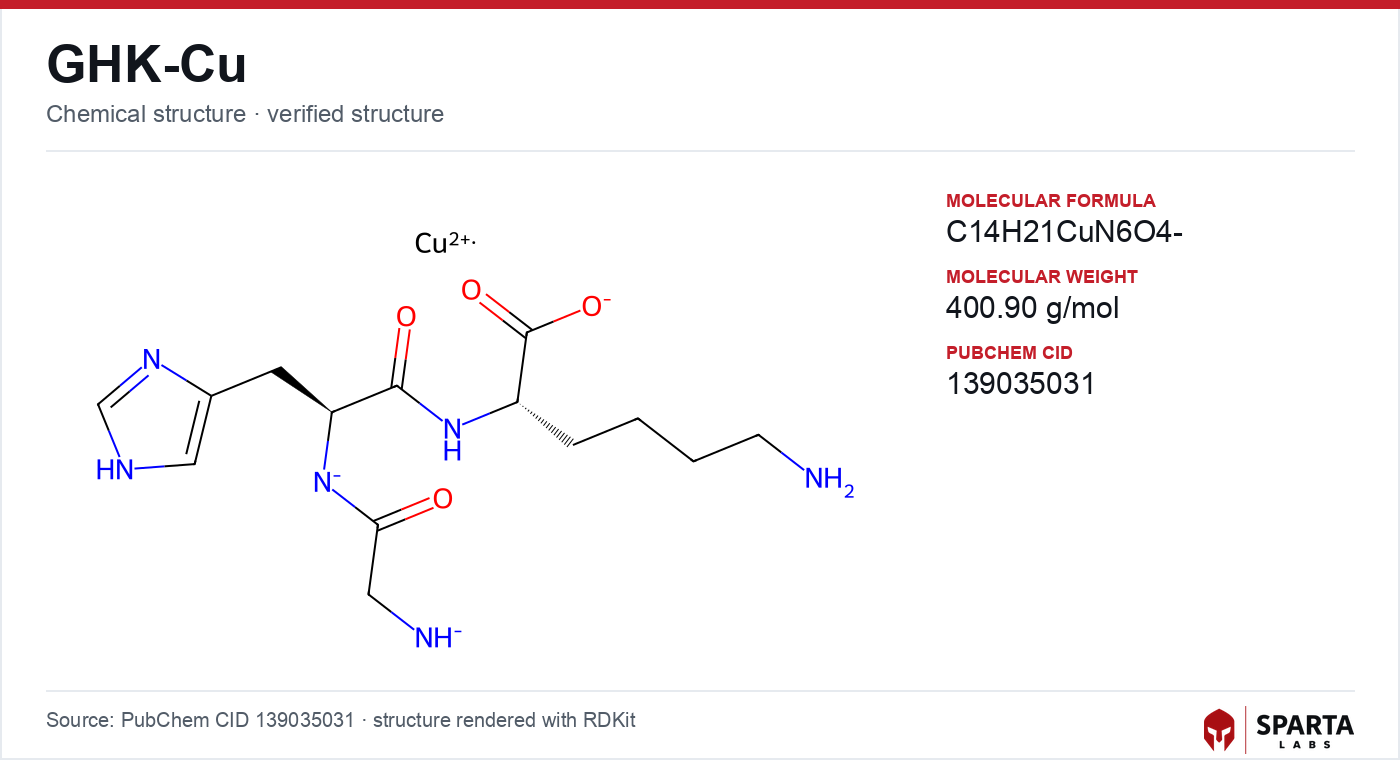
Figure: chemical structure of GHK-Cu.
The activity was small enough to suggest a peptide rather than a protein. Over the following years, isolation and characterization work resolved the active moiety to a three-residue sequence: glycine, L-histidine, L-lysine. Schlesinger, Pickart, and Thaler formally reported the identification of the growth-modulating serum tripeptide as glycyl-histidyl-lysine in Experientia in 1977 [2]. In the early literature the compound appears under several designations, including GHL and GHL-Cu, before GHK and GHK-Cu became the conventional shorthand. What began as an unnamed serum activity had, within roughly four years, become a defined chemical entity.
Findings from research models do not establish safety or efficacy in humans. Sparta Labs makes no claims about the use of this compound.
The Copper Connection: Coordination Chemistry Enters the Picture
A defining feature of GHK research is that the peptide's chemistry cannot be separated from copper. The Gly-His-Lys sequence contains the structural elements of a classic copper(II) chelation motif: an N-terminal amine, the imidazole nitrogen of histidine, and a deprotonated backbone amide together furnish a square-planar coordination sphere for the Cu²⁺ ion. This arrangement gives GHK a high affinity for copper and made coordination chemistry central to understanding the molecule.
The relevance of this chemistry was reinforced by parallel work on how copper is carried in plasma. Studies of the copper-transport site of human serum albumin, including the physical-chemistry investigations of Sarkar and colleagues, established that the N-terminal region of albumin coordinates Cu²⁺ through an analogous histidine-containing motif [3]. The structural parallel between GHK's copper site and albumin's transport site framed an enduring hypothesis: that GHK might participate in the exchange and distribution of copper rather than acting as a conventional signaling peptide. This copper-centric interpretation, discussed further in the GHK-Cu mechanism of action article, shaped how subsequent researchers designed their experiments.
The 1980 Nature Hypothesis: A Copper Shuttle, Not a Hormone
The single most influential conceptual step in GHK's early history came in 1980, when Pickart and colleagues published in Nature the proposal that the tripeptide's biological activity was mediated primarily through its capacity to facilitate copper uptake into cells [4]. Rather than treating GHK as a peptide hormone acting through a dedicated receptor, this paper reframed it as a copper-delivery molecule that could present bioavailable Cu²⁺ to intracellular copper-dependent enzymes.
This hypothesis had lasting consequences for the field. It tied GHK's observed effects to the broader biology of copper metabolism, connected the peptide to well-characterized cuproenzymes, and gave researchers a mechanistic framework that did not depend on identifying a specific receptor. Decades of subsequent work on GHK have continued to grapple with the question the 1980 paper posed: how much of the observed activity belongs to the peptide, how much to the copper, and how much to the complex as a coordinated unit.
The 1980s Pivot to Connective-Tissue Biology
Through the 1980s the research emphasis moved from liver-cell assays toward connective tissue and the extracellular matrix. The foundational in vitro study of this period was published by Maquart, Pickart, Laurent, Gillery, Monboisse, and Borel in FEBS Letters in 1988, which reported that the GHK-copper complex stimulated collagen synthesis in cultured human fibroblasts [5]. The observation that the effect appeared at very low concentrations attracted attention within matrix biology and redirected the research program toward connective-tissue questions.
This decade broadened the range of endpoints under study, from collagen output to other matrix components and the behavior of repair cells in culture. The applied interest of the period extended to collagen preparations and dressing materials. The connective-tissue framing of GHK also situates it alongside other peptides whose research histories center on matrix and repair models, such as BPC-157, whose literature likewise developed through in vitro and rodent studies over successive decades.
In Vivo Work and Matrix Remodeling in the 1990s
The 1990s added controlled in vivo experiments to a record that had been dominated by cell culture. Pickart and colleagues reported connective-tissue accumulation studies using rodent wound-chamber models, quantifying matrix deposition under defined GHK-copper exposure and providing a reference point for the compound's wound-biology literature [6]. These experiments moved the discussion from isolated fibroblast cultures toward integrated tissue responses in a living animal.
Later in the decade, attention turned toward the remodeling side of matrix biology. Work from Maquart's laboratory, including studies by Siméon, Wegrowski, and colleagues published around 2000, examined GHK-copper's influence on glycosaminoglycan and proteoglycan expression in wound and fibroblast systems [7]. Findings of this kind refined the picture of GHK-Cu from a purely anabolic matrix signal toward a molecule associated with bidirectional tissue remodeling, a conceptual shift that widened its research relevance.
Regulatory Trajectory: Cosmetic Ingredient, Not Approved Drug
GHK-Cu's regulatory history is distinct from that of the approved therapeutic peptides discussed elsewhere in this library. It has not been the subject of a successful new drug application or biologics license application with the United States Food and Drug Administration for any therapeutic indication, and no equivalent marketing authorization for a therapeutic use has been identified in the primary literature reviewed here.
Instead, GHK-Cu has a regulatory presence rooted in cosmetics. It appears in the International Nomenclature of Cosmetic Ingredients dictionary under the name "copper tripeptide-1," reflecting its use in cosmetic formulations. In the United States, cosmetic products are governed under the cosmetics provisions of the Federal Food, Drug, and Cosmetic Act, which do not require pre-market approval and do not constitute a determination of therapeutic efficacy. This regulatory posture, in which a molecule circulates widely in cosmetic use while remaining outside the drug-approval framework, is itself a notable feature of GHK-Cu's history. Manufacturing and verification practices for research-grade material are discussed in the GHK-Cu sourcing and quality article.
The Transcriptomic Era and Diversifying Research Base
From roughly 2010 onward, the availability of large-scale gene-expression tools reshaped GHK research. Pickart, Vasquez-Soltero, and Margolina published a series of analyses drawing on connectivity-map–style transcriptional data to characterize gene-expression patterns associated with GHK, with successive papers focused on copper regulation and antioxidant gene networks (2015), gene expression relevant to nervous-system function (2017), and broader regenerative gene-expression patterns (2018) [8, 9, 10]. These analyses extended the scientific conversation about GHK beyond connective tissue into new biological domains and generated hypotheses for follow-on study.
A parallel and independent line of work emerged in pulmonary biology, notably a rodent study of bleomycin-induced pulmonary fibrosis reported by Zhou and colleagues in Frontiers in Pharmacology in 2017 [11]. Investigations of this kind are significant to the compound's history because they represent research groups working with GHK outside the original UCSF-lineage program, introducing independent experimental perspectives into a literature that had long centered on a single laboratory. The current landscape is one of sustained preclinical activity across in vitro, rodent, and computational-transcriptomic approaches, with independent replication of core themes increasing over the most recent decade. Researchers evaluating material for laboratory work can review batch-specific purity data and certificates of analysis for GHK-Cu from Sparta Labs on the product page, and a broader summary of the primary studies is collected in the GHK-Cu published research article.
References
-
Pickart L, Thaler MM. Tripeptide in human serum which prolongs survival of normal liver cells and stimulates growth in neoplastic liver. Nat New Biol. 1973;243(124):85–87. PMID: 4349963. View on PubMed
-
Schlesinger DH, Pickart L, Thaler MM. Growth-modulating serum tripeptide is glycyl-histidyl-lysine. Experientia. 1977;33(3):324–325. PMID: 858356. View on PubMed
-
Laussac JP, Sarkar B. Characterization of the copper(II)- and nickel(II)-transport site of human serum albumin. Studies of copper(II) and nickel(II) binding to peptide 1-24 of human serum albumin by 13C and 1H NMR spectroscopy. Biochemistry. 1984;23(12):2832–2838. PMID: 6466620. View on PubMed
-
Pickart L, Freedman JH, Loker WJ, Peisach J, Perkins CM, Stenkamp RE, Weinstein B. Growth-modulating plasma tripeptide may function by facilitating copper uptake into cells. Nature. 1980;288(5792):715–717. PMID: 7453802. View on PubMed
-
Maquart FX, Pickart L, Laurent M, Gillery P, Monboisse JC, Borel JP. Stimulation of collagen synthesis in fibroblast cultures by the tripeptide-copper complex glycyl-L-histidyl-L-lysine-Cu2+. FEBS Lett. 1988;238(2):343–346. PMID: 3169264. View on PubMed
-
Pickart L, Freedman JH, Loker WJ, Peisach J, Perkins CM, Stenkamp RE, Weinstein B. In vivo stimulation of connective tissue accumulation by the tripeptide-copper complex glycyl-L-histidyl-L-lysine-Cu2+ in rat experimental wounds. Proc Natl Acad Sci USA. 1994;91(24):11069–11073. PMID: 7972010. PMCID: PMC288419. Full text on PMC
-
Siméon A, Wegrowski Y, Bontemps Y, Maquart FX. Expression of glycosaminoglycans and small proteoglycans in wounds: modulation by the tripeptide-copper complex glycyl-L-histidyl-L-lysine-Cu(2+). J Invest Dermatol. 2000;115(6):962–968. PMID: 11069607. View on PubMed
-
Pickart L, Vasquez-Soltero JM, Margolina A. GHK-Cu may prevent oxidative stress in skin by regulating copper and modifying expression of numerous antioxidant genes. Cosmetics. 2015;2(3):236–247. DOI: 10.3390/cosmetics2030236. Full text via DOI
-
Pickart L, Vasquez-Soltero JM, Margolina A. The effect of the human peptide GHK on gene expression relevant to nervous system function and cognitive decline. Brain Sci. 2017;7(2):20. PMID: 28212278. PMCID: PMC5332963. Full text on PMC
-
Pickart L, Vasquez-Soltero JM, Margolina A. Regenerative and protective actions of the GHK-Cu peptide in the light of the new gene data. Int J Mol Sci. 2018;19(7):1987. PMID: 29986520. PMCID: PMC6073405. Full text on PMC
-
Zhou XM, Wang GL, Wang XB, Liu L, Zhang Q, Yin Y, Wang QY, Kang J, Hou G. GHK peptide inhibits bleomycin-induced pulmonary fibrosis in mice by suppressing TGFβ1/Smad-mediated epithelial-to-mesenchymal transition. Front Pharmacol. 2017;8:904. PMID: 29311922. PMCID: PMC5733019. Full text on PMC
Disclaimer. Statements in this article have not been evaluated by the Food and Drug Administration. This compound is not intended to diagnose, treat, cure, or prevent any disease. Sparta Labs sells research-use-only materials. Content is provided for educational and informational purposes only and does not constitute medical advice. Consult a qualified medical professional for any health concerns.
Frequently asked questions
How was GHK-Cu originally discovered?
GHK was first identified as an unnamed low-molecular-weight activity in human serum during studies of liver-cell behavior. Loren Pickart and Monroe Thaler reported this serum factor in Nature New Biology in 1973, and the sequence glycyl-histidyl-lysine was formally identified by Schlesinger, Pickart, and Thaler in Experientia in 1977.
Why is copper central to the history of GHK research?
The Gly-His-Lys sequence contains a classic copper(II) coordination motif, giving the peptide a high affinity for copper. Studies also drew a structural parallel between GHK's copper site and the copper-transport site of human serum albumin, which framed much of the subsequent research around copper metabolism rather than receptor signaling.
What did the 1980 Nature paper propose about GHK-Cu?
Pickart and colleagues proposed in Nature in 1980 that the tripeptide's activity was mediated primarily through its capacity to facilitate copper uptake into cells. This reframed GHK as a copper-delivery molecule rather than a conventional peptide hormone, a framework that shaped decades of later work.
What is the regulatory status of GHK-Cu?
GHK-Cu has not been the subject of a successful new drug or biologics application with the United States FDA for any therapeutic indication. It has a cosmetic-ingredient presence, appearing in the International Nomenclature of Cosmetic Ingredients dictionary as copper tripeptide-1, which is a distinct regulatory category from drug approval.
How has GHK-Cu research changed since 2010?
From around 2010, large-scale gene-expression tools expanded the research, with Pickart, Vasquez-Soltero, and Margolina publishing transcriptomic analyses spanning antioxidant, nervous-system, and regenerative gene networks. Independent groups also began examining GHK in pulmonary models, diversifying a literature that had long centered on a single laboratory.