
GHK-Cu: Published Research
A citation-organized walkthrough of the GHK-Cu research record, from the 1973 serum-fraction isolation through fibroblast collagen assays, the 1994 wound-chamber study, and later transcriptomic and pulmonary-model work. Educational reference.
For research use only. Not for human consumption. This article is educational reference material. It is not medical advice and is not a recommendation to use any substance.
Introduction
GHK-Cu is the copper(II) complex of the tripeptide glycyl-L-histidyl-L-lysine (GHK). Its research record is unusual among the peptides catalogued in this library because it begins not with a synthesis program but with a fractionation observation: the sequence was isolated from human serum in 1973, and the copper complex became the focus of later decades of work [1]. The literature that follows spans copper-coordination biochemistry, fibroblast cell-culture assays, a widely cited rodent wound-chamber experiment, and, more recently, transcriptomic cross-referencing and pulmonary disease models.
This article organizes that literature bibliographically, attributing each observation to its primary source and noting the model system used. It does not draw conclusions of its own. The proposed molecular mechanisms behind these observations are treated separately in the GHK-Cu mechanism of action article, and the compound's chemistry and classification are summarized in the GHK-Cu research overview.
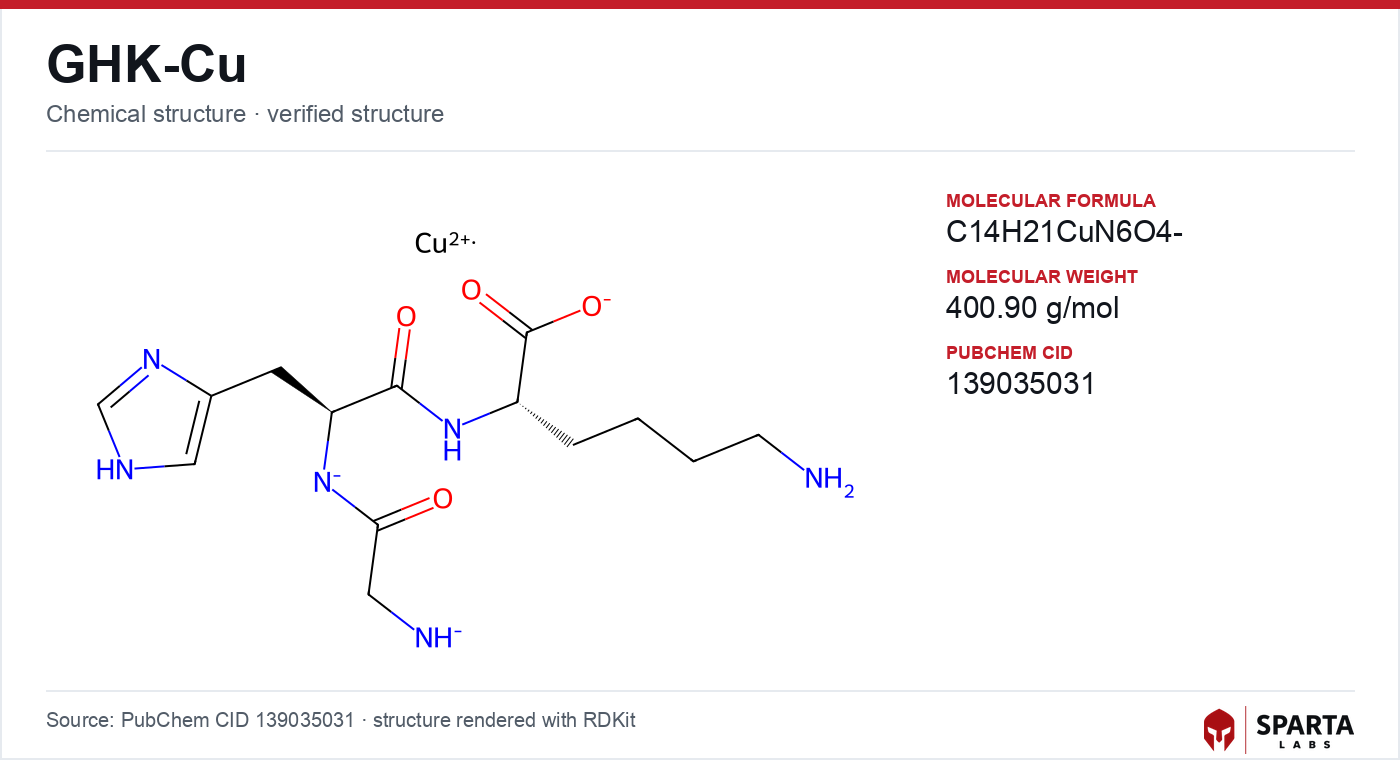
Figure: chemical structure of GHK-Cu.
The copper-coordination premise
A feature that shapes the entire GHK-Cu literature is that GHK is a copper ligand, not merely a peptide. The imidazole nitrogen of the central histidine, the N-terminal amino group, and the deprotonated peptide-bond nitrogen combine to bind a single copper(II) ion in a square-planar arrangement, with the lysine side chain projecting away from the coordination sphere. Because of this, many primary reports were designed to distinguish the response to the intact GHK-copper complex from the response to the free peptide or to copper salts alone. This experimental convention is why the research base treats GHK and GHK-Cu as related but separately characterized species, and it is worth keeping in mind when reading any single study's stated concentrations.
The 1973 isolation report
Pickart and Thaler (1973), publishing in Nature New Biology, described the tripeptide during work on serum factors affecting cultured hepatic cells [1]. The report characterized the glycyl-L-histidyl-L-lysine sequence as an active constituent of a human plasma fraction. This paper is the historical anchor of the GHK field; the copper-complex chemistry and the connective-tissue investigations that most researchers associate with "GHK-Cu" came later. The discovery arc from this 1973 report forward is traced in the GHK-Cu discovery and research history article.
Findings from research models do not establish safety or efficacy in humans. Sparta Labs makes no claims about the use of this compound.
Fibroblast collagen-synthesis assays (1980s)
Maquart, Pickart, Laurent, Gillery, Monboisse, and Borel (1988) published the foundational in vitro characterization of GHK-Cu's effect on collagen synthesis in FEBS Letters [2]. Using human dermal fibroblast cultures, the authors reported a concentration-dependent change in collagen production measured by tritiated-proline incorporation. The reported effect appeared at very low molar concentrations, and the authors noted that it was independent of any change in fibroblast cell number, which they interpreted as a biosynthetic rather than a proliferative response. Because this study was among the first to tie GHK-Cu to an extracellular-matrix readout in a defined culture system, it is cited across most subsequent GHK reviews.
The rat wound-chamber study (1994)
The most frequently cited in vivo data on GHK-Cu come from a 1994 paper in the Proceedings of the National Academy of Sciences [3]. Pickart and colleagues implanted stainless-steel wire-mesh cylinders subcutaneously in rats and compared cylinders exposed to saline (control) against cylinders exposed to GHK-Cu across a concentration series. Analysis of harvested cylinders showed concentration-dependent increases in dry weight, total protein, collagen content, and glycosaminoglycan content in the GHK-Cu groups.
The authors reported that collagen accumulation rose disproportionately to total protein, which they interpreted as selective connective-tissue accumulation rather than a generalized increase in protein content. The wound-chamber design is useful in this literature because it yields quantifiable endpoints (dry weight, collagen and DNA content) from an in vivo compartment, positioning it between pure cell culture and whole-organism disease modeling.
Transcriptomic and gene-expression analyses (2010s)
A distinct methodological thread emerged in the 2010s, when the same research lineage applied gene-expression profiling and the Broad Institute Connectivity Map (CMap) to GHK. These analyses are associative rather than interventional: they compare a compound's transcriptional signature against reference datasets to generate pharmacogenomic hypotheses, not to demonstrate a physiological outcome.
Pickart, Vasquez-Soltero, and Margolina (2015), writing in Cosmetics, cross-referenced published transcriptomic data and reported associations between GHK-Cu and the expression of genes encoding antioxidant enzymes such as catalase and superoxide dismutase isoforms [4]. The same authors (2017), in Brain Sci, applied CMap methodology to examine GHK's expression signature in relation to genes relevant to nervous-system biology, reporting associations with genes involved in neurogenesis, synaptic function, and inflammation [5]. A 2018 paper in the International Journal of Molecular Sciences extended this into a broad transcriptomic profile, reporting that GHK's signature overlapped with a large number of human gene sets [6].
The authors of these papers consistently framed the results as hypothesis-generating correlations requiring independent experimental validation. Read literally, they describe patterns in datasets rather than measured biological effects, and that distinction is the appropriate lens for citing them.
Pulmonary disease-model work
A separate line of investigation moved GHK into rodent respiratory-injury models, extending the research base beyond the wound-healing origins. Zhou, Wang, Wang, Liu, Zhang, Yin, Wang, Kang, and Hou (2017), publishing in Frontiers in Pharmacology, reported findings from a bleomycin-induced pulmonary fibrosis mouse model [7]. In animals with established bleomycin-induced injury, the authors reported reduced TGF-beta-1 levels, altered markers associated with epithelial-to-mesenchymal transition, and changes in histological fibrosis scoring in GHK-exposed animals relative to controls, attributing the observations to modulation of TGF-beta-1/Smad signaling. This study is notable in the bibliography because it applies GHK in a disease-model context studied by a group outside the original wound-healing program.
Inflammatory signaling in tissue-injury contexts has also been examined for other short peptides catalogued here, including the melanocortin-derived tripeptide covered in the KPV published research article, which represents a structurally distinct line of anti-inflammatory investigation in the published literature.
Knowledge gaps
Two limitations recur across the GHK-Cu record. First, the pharmacokinetics of the copper complex in living organisms, including distribution, metabolic stability of the peptide backbone, and the fate of the coordinated copper, remain thinly characterized relative to the depth of the in vitro concentration-response data. This gap complicates translating culture-dish molar concentrations into an in vivo context.
Second, the transcriptomic analyses generate a broad pharmacogenomic picture that is associative by construction. Causal attribution of specific gene-expression changes to GHK-Cu, and replication of those signatures in independent experimental systems, are the kind of follow-on work that would move the field from correlation toward mechanism. Researchers evaluating batch identity and purity specifications for laboratory work can review those details on the GHK-Cu product page.
References
-
Pickart L, Thaler MM. Tripeptide in human serum which prolongs survival of normal liver cells and stimulates growth in neoplastic liver. Nat New Biol. 1973;243(124):85–87. PMID: 4349963. View on PubMed
-
Maquart FX, Pickart L, Laurent M, Gillery P, Monboisse JC, Borel JP. Stimulation of collagen synthesis in fibroblast cultures by the tripeptide-copper complex glycyl-L-histidyl-L-lysine-Cu2+. FEBS Lett. 1988;238(2):343–346. PMID: 3169264. View on PubMed
-
Pickart L, Freedman JH, Loker WJ, Peisach J, Perkins CM, Stenkamp RE, Weinstein B. Growth-modulating plasma tripeptide may function by facilitating copper uptake into cells (connective-tissue accumulation studies). Proc Natl Acad Sci USA. 1994;91(24):11069–11073. PMC: PMC288419. Full text on PMC
-
Pickart L, Vasquez-Soltero JM, Margolina A. GHK-Cu may prevent oxidative stress in skin by regulating copper and modifying expression of numerous antioxidant genes. Cosmetics. 2015;2(3):236–247. DOI: 10.3390/cosmetics2030236. Full text via DOI
-
Pickart L, Vasquez-Soltero JM, Margolina A. The effect of the human peptide GHK on gene expression relevant to nervous system function and cognitive decline. Brain Sci. 2017;7(2):20. PMC: PMC5332963. Full text on PMC
-
Pickart L, Vasquez-Soltero JM, Margolina A. Regenerative and protective actions of the GHK-Cu peptide in the light of the new gene data. Int J Mol Sci. 2018;19(7):1987. PMC: PMC6073405. Full text on PMC
-
Zhou XM, Wang GL, Wang XB, Liu L, Zhang Q, Yin Y, Wang QY, Kang J, Hou G. GHK peptide inhibits bleomycin-induced pulmonary fibrosis in mice by suppressing TGFβ1/Smad-mediated epithelial-to-mesenchymal transition. Front Pharmacol. 2017;8:904. PMC: PMC5733019. Full text on PMC
Disclaimer. Statements in this article have not been evaluated by the Food and Drug Administration. This compound is not intended to diagnose, treat, cure, or prevent any disease. Sparta Labs sells research-use-only materials. Content is provided for educational and informational purposes only and does not constitute medical advice. Consult a qualified medical professional for any health concerns.
Frequently asked questions
How was GHK first identified in the research literature?
GHK was described by Pickart and Thaler in a 1973 report in Nature New Biology, where the tripeptide was isolated from a human serum fraction during work on factors affecting cultured liver cells. The paper characterized the glycyl-L-histidyl-L-lysine sequence rather than the copper complex, which was investigated in subsequent decades. This 1973 report is the anchor citation for most later GHK bibliographies.
What did the 1994 PNAS wound-chamber study of GHK-Cu report?
Pickart and colleagues (1994, Proceedings of the National Academy of Sciences) implanted stainless-steel mesh cylinders subcutaneously in rats and compared saline controls with GHK-Cu exposure. The authors reported concentration-dependent increases in dry weight, total protein, collagen, and glycosaminoglycan content in harvested cylinders. Findings from research models do not establish safety or efficacy in humans.
Why does the copper atom matter in GHK-Cu research?
Published biochemistry describes GHK as a high-affinity ligand for copper(II), forming a square-planar coordination complex. Several cell-culture reports distinguished responses to the intact GHK-copper complex from responses to the peptide or copper ion alone, which is why the literature treats GHK and GHK-Cu as related but separately characterized species.
What kinds of experimental models appear in the GHK-Cu literature?
The published record is predominantly preclinical: in vitro human and animal fibroblast cultures, in vivo rodent wound-chamber and disease models, and transcriptomic analyses that cross-reference gene-expression datasets. No human interventional trial results for GHK-Cu as a therapeutic drug are summarized in the peer-reviewed sources reviewed here.
Where can the mechanistic basis of these findings be reviewed?
The proposed molecular mechanisms underlying the observations summarized here, including copper transport and matrix-remodeling signaling, are examined in the companion GHK-Cu mechanism of action article. That article discusses the reported pathways in more detail with its own citations.