
KPV: Published Research
A thematic bibliographic summary of peer-reviewed preclinical KPV (Lys-Pro-Val) research, organized around three recurring questions: receptor independence, cellular uptake and engineered delivery, and structural stability. Educational reference.

For research use only. Not for human consumption. This article is educational reference material. It is not medical advice and is not a recommendation to use any substance.
Introduction
KPV is a synthetic tripeptide corresponding to the C-terminal three residues (Lys-Pro-Val, positions 11–13) of alpha-melanocyte-stimulating hormone (alpha-MSH). Unlike the intact hormone, KPV lacks the central His-Phe-Arg-Trp pharmacophore that drives melanocortin receptor activation, and much of the published research on the tripeptide has focused on characterizing an anti-inflammatory profile that appears, in the cited literature, to operate largely independently of that receptor family. This article organizes the identified peer-reviewed literature not by generic template but along the three research threads that actually define the KPV corpus: the receptor-independence question, the cellular-uptake and delivery question, and the structural-stability question. Every finding below is attributed to its source publication. The evidence base is preclinical; no clinical trials listing KPV as a primary investigational agent appear in publicly available registries.
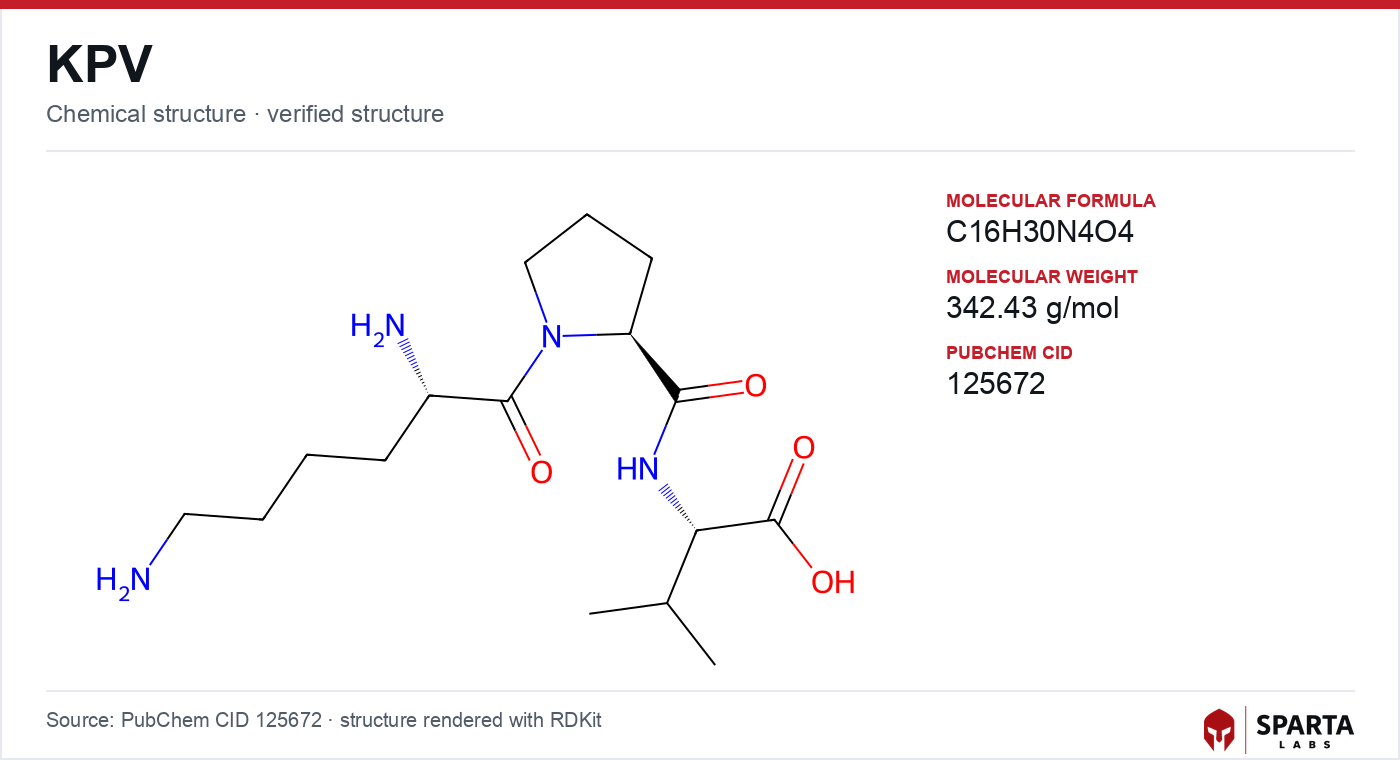
Figure: chemical structure of KPV (Lys-Pro-Val).
How the KPV Literature Is Organized
The tripeptide occupies an unusual position in melanocortin research. It is small enough to be handled by peptide transporters that normally process dietary di- and tripeptides, and it retains reported biological activity despite lacking the sequence motif that defines classical melanocortin agonism. As a result, the published studies cluster around a small number of recurring experimental questions rather than a linear therapeutic-development arc. The sections below trace those questions. Readers seeking the chemistry and classification context may find the companion KPV research overview a useful starting point, while the molecular detail behind the receptor-independence findings is treated in the KPV mechanism of action article.
Thread One: Is KPV Activity Receptor-Independent?
Getting, Schiöth, and Perretti (2003)
The foundational pharmacological dissection appeared in the Journal of Pharmacology and Experimental Therapeutics [1]. Using a murine model of crystal-induced peritonitis, Getting and colleagues compared intact alpha-MSH, a synthetic core-pharmacophore melanocortin agonist (MTII), and the C-terminal tripeptide KPV. The study reported that systemic administration of KPV was associated with a statistically significant reduction in polymorphonuclear leukocyte accumulation in the peritoneal cavity. Critically, the KPV effect was not abolished by a melanocortin MC3/MC4 receptor antagonist, whereas the MTII effect was. The authors interpreted this dissociation as evidence that KPV's reported anti-inflammatory activity did not depend on canonical MC3R/MC4R signaling.
Findings from research models do not establish safety or efficacy in humans. Sparta Labs makes no claims about the use of this compound.
This 2003 paper set the agenda for the subsequent decade of KPV research: if the tripeptide acts without the receptors that alpha-MSH uses, then some other molecular pathway must account for its observed activity.
Land (2012)
Land addressed the receptor-independence question at the molecular level in the International Journal of Physiology, Pathophysiology and Pharmacology [2]. Working in human bronchial epithelial cells stimulated with TNF-alpha, the author used co-immunoprecipitation and GST pull-down assays and reported that KPV translocated to the nucleus and interfered with the interaction between importin-alpha and the nuclear localization signal of the NF-kB subunit p65 (RelA). The paper described reduced p65 nuclear import without a corresponding change in upstream IkB-alpha phosphorylation, alongside reductions in downstream inflammatory readouts including IL-8. The study also noted a parallel contribution from MC3R agonism in the same epithelial system, framing the receptor-independent nuclear-import blockade and the receptor-mediated pathway as potentially convergent rather than mutually exclusive.
Thread Two: How Does KPV Enter Cells, and Can Delivery Be Engineered?
Dalmasso and colleagues (2008)
A study published in Gastroenterology examined the route by which KPV reaches its intracellular targets [3]. Dalmasso and colleagues reported that KPV is a substrate for PepT1 (SLC15A1), the proton-coupled oligopeptide transporter expressed on small-intestinal epithelium that normally handles dietary di- and tripeptides. In intestinal epithelial cell lines, low concentrations of KPV were reported to interfere with NF-kB and MAP kinase inflammatory signaling and to reduce pro-inflammatory cytokine secretion. Identifying a specific transporter provided a mechanistic account of how a charged tripeptide might cross the epithelial membrane, and it seeded a downstream research direction around engineered delivery.
Xiao and colleagues (2017)
That delivery direction was extended in Molecular Therapy [4]. Xiao and colleagues encapsulated KPV in hyaluronic-acid-functionalized polymeric nanoparticles (roughly 272 nm in diameter) and, when the nanoparticles were incorporated into an oral chitosan/alginate hydrogel, reported preferential delivery to colonic epithelial cells and macrophages expressing the hyaluronic-acid receptor CD44, which is upregulated in inflamed colonic tissue in the models used. The study reported macroscopic and histological differences relative to controls. Read alongside the Dalmasso PepT1 work, this paper illustrates two distinct delivery routes under investigation: endogenous transporter uptake and engineered nanoparticulate carriers.
Thread Three: Confirmation Across Models and Structural Stability
Kannengiesser and colleagues (2008)
Published in Inflammatory Bowel Diseases, this study evaluated KPV in two independent murine models of experimentally induced intestinal inflammation using DSS and TNBS protocols [5]. The authors reported reduced clinical disease-activity scores, improved macroscopic tissue appearance, reduced histological inflammatory infiltrate, and lower pro-inflammatory cytokine expression relative to vehicle-treated controls. Appearing in the same year as the Dalmasso paper but from a separate laboratory, it provided independent replication of the tripeptide's reported modulation of intestinal inflammatory readouts.
Schaible and colleagues (2013)
A study in PLoS One extended KPV research beyond mucosal inflammation into a neurological injury model [6]. Schaible and colleagues administered the alpha-MSH(11–13) tripeptide (the sequence equivalent to KPV) in a murine controlled cortical impact model of traumatic brain injury. At 24 hours post-injury, the treated group was reported to show a smaller secondary lesion volume than vehicle controls, reduced neuronal apoptosis by TUNEL staining, and altered microglial morphology in the peri-lesion region. Accompanying in vitro work with murine microglia reported reductions in TNF-alpha, IL-6, and nitric oxide following lipopolysaccharide stimulation. The authors noted that the tripeptide did not produce the melanotropic effects associated with full-length alpha-MSH, consistent with its lack of the core melanocortin pharmacophore.
Songok and colleagues (2018)
The stability question was addressed in a synthetic-chemistry study in PLoS One [7]. Songok and colleagues applied reductive "glycoalkylation" to the lysine epsilon-amine using a glucose-derived aldehyde and reported that the glycoalkylated derivatives resisted pronase-mediated proteolysis more than the unmodified tripeptide. The work established the feasibility of producing metabolically stabilized KPV analogues through lysine-targeted chemistry, and whether such analogues retain the parent tripeptide's reported activity profile remains an open experimental question.
Cross-Compound Context
Because KPV is a fragment of alpha-MSH, its literature intersects with research on other melanocortin-derived compounds. The receptor-dependent branch of that family, exemplified by compounds discussed in the PT-141 published research and Melanotan-2 research overview articles, offers a contrast: those molecules retain the His-Phe-Arg-Trp pharmacophore and are studied for their receptor agonism, whereas the KPV literature centers on the receptor-independent thread described above. Research-grade KPV from Sparta Labs is supplied with certificate-of-analysis documentation for investigators extending this work.
Open Questions in the KPV Corpus
Several gaps recur across the cited literature. Systematic pharmacokinetic characterization of the tripeptide, including plasma half-life, distribution, and tissue penetration, is not established in the identified publications. The relative contribution of the importin-alpha nuclear-import blockade (described in bronchial epithelium) versus PepT1-mediated uptake (described in intestinal epithelium) across other tissues remains unresolved. Residue-level structure-activity mapping is incomplete, and the biological profile of the proteolysis-resistant glycoalkylated analogues has not been reported. Each represents a direction available to subsequent investigators.
References
-
Getting SJ, Schiöth HB, Perretti M. Dissection of the anti-inflammatory effect of the core and C-terminal (KPV) alpha-melanocyte-stimulating hormone peptides. J Pharmacol Exp Ther. 2003;306(2):631-637. PMID: 12750433. DOI: 10.1124/jpet.103.051623. PubMed{target="_blank" rel="noopener noreferrer"}
-
Land SC. Inhibition of cellular and systemic inflammation cues in human bronchial epithelial cells by melanocortin-related peptides: mechanism of KPV action and a role for MC3R agonists. Int J Physiol Pathophysiol Pharmacol. 2012;4(2):59-73. PMID: 22837805. PubMed{target="_blank" rel="noopener noreferrer"}
-
Dalmasso G, Charrier-Hisamuddin L, Nguyen HTT, Yan Y, Sitaraman S, Merlin D. PepT1-mediated tripeptide KPV uptake reduces intestinal inflammation. Gastroenterology. 2008;134(1):166-178. PMID: 18061177. DOI: 10.1053/j.gastro.2007.10.026. PubMed{target="_blank" rel="noopener noreferrer"}
-
Xiao B, Xu Z, Viennois E, Zhang Y, Zhang Z, Zhang M, Han MK, Kang Y, Merlin D. Orally Targeted Delivery of Tripeptide KPV via Hyaluronic Acid-Functionalized Nanoparticles Efficiently Alleviates Ulcerative Colitis. Mol Ther. 2017;25(7):1628-1640. PMID: 28143741. DOI: 10.1016/j.ymthe.2016.11.020. PubMed{target="_blank" rel="noopener noreferrer"}
-
Kannengiesser K, Maaser C, Heidemann J, Luegering A, Ross M, Brzoska T, Böhm M, Luger TA, Domschke W, Kucharzik T. Melanocortin-derived tripeptide KPV has anti-inflammatory potential in murine models of inflammatory bowel disease. Inflamm Bowel Dis. 2008;14(3):324-331. PMID: 18092346. DOI: 10.1002/ibd.20334. PubMed{target="_blank" rel="noopener noreferrer"}
-
Schaible EV, Steinsträßer A, Jahn-Eimermacher A, Luh C, Sebastiani A, Kornes F, Pieter D, Schäfer MK, Engelhard K, Thal SC. Single administration of tripeptide alpha-MSH(11–13) attenuates brain damage by reduced inflammation and apoptosis after experimental traumatic brain injury in mice. PLoS One. 2013;8(8):e71056. PMID: 23940690. DOI: 10.1371/journal.pone.0071056. PubMed{target="_blank" rel="noopener noreferrer"}
-
Songok AC, Panta P, Doerrler WT, Macnaughtan MA, Taylor CM. Structural modification of the tripeptide KPV by reductive "glycoalkylation" of the lysine residue. PLoS One. 2018;13(6):e0199686. PMID: 29953505. DOI: 10.1371/journal.pone.0199686. PubMed{target="_blank" rel="noopener noreferrer"}
Disclaimer. Statements in this article have not been evaluated by the Food and Drug Administration. This compound is not intended to diagnose, treat, cure, or prevent any disease. Sparta Labs sells research-use-only materials. Content is provided for educational and informational purposes only and does not constitute medical advice. Consult a qualified medical professional for any health concerns.
Frequently asked questions
What are the main research threads in the KPV literature?
The peer-reviewed KPV literature clusters around three recurring questions rather than a linear therapeutic arc. These are whether its reported activity is independent of melanocortin receptors, how the tripeptide enters cells and whether delivery can be engineered, and how to stabilize the peptide against proteolysis. The identified studies span in vitro assays and murine models from 2003 through 2018.
What did the Getting et al. 2003 study report about KPV?
Getting, Schioth, and Perretti published a pharmacological dissection study in the Journal of Pharmacology and Experimental Therapeutics. In a murine crystal-induced peritonitis model they reported that KPV was associated with reduced polymorphonuclear leukocyte accumulation, and that this effect was not abolished by a melanocortin MC3/MC4 receptor antagonist. They interpreted this as evidence of activity independent of canonical melanocortin receptor signaling.
How is KPV reported to enter cells?
Dalmasso and colleagues reported in Gastroenterology (2008) that KPV is a substrate for PepT1 (SLC15A1), a proton-coupled oligopeptide transporter expressed on intestinal epithelium that normally handles dietary di- and tripeptides. A separate 2017 Molecular Therapy study by Xiao and colleagues explored an engineered alternative using hyaluronic-acid-functionalized nanoparticles targeting CD44-expressing cells.
Are there clinical trials involving KPV?
No clinical trials listing KPV as a primary investigational agent appear in publicly available registries. The identified evidence base is entirely preclinical, comprising in vitro cell-culture experiments and murine animal-model studies.
What open questions remain in KPV research?
The cited literature does not establish systematic pharmacokinetics such as plasma half-life or tissue distribution. The relative contribution of the importin-alpha nuclear-import blockade versus PepT1-mediated uptake across different tissues is unresolved, residue-level structure-activity mapping is incomplete, and the biological profile of proteolysis-resistant glycoalkylated analogues has not been reported.