
Hexarelin: A Research Overview
A research-library profile of hexarelin (examorelin): the hexapeptide's D-2-methyltryptophan chemistry, its position in the GHRP secretagogue lineage, dual GHS-R1a and CD36 binding described in the literature, and its Phase II development history. Educational reference.

For research use only. Not for human consumption. This article is educational reference material. It is not medical advice and is not a recommendation to use any substance.
Introduction
Hexarelin (International Nonproprietary Name: examorelin; development code EP-23905; CAS 140703-51-1) is a synthetic hexapeptide belonging to the growth hormone-releasing peptide (GHRP) subclass of growth hormone secretagogues (GHS). It occupies an unusual place in the history of endocrine pharmacology: it and its sibling peptides were synthetic ligands whose activity was documented years before the natural hormone they mimic was identified. This article provides an educational reference profile of hexarelin's chemical identity, its structural relationship to the wider GHRP family, the receptor targets described for it in published research, and its regulatory development history, drawing on primary literature.
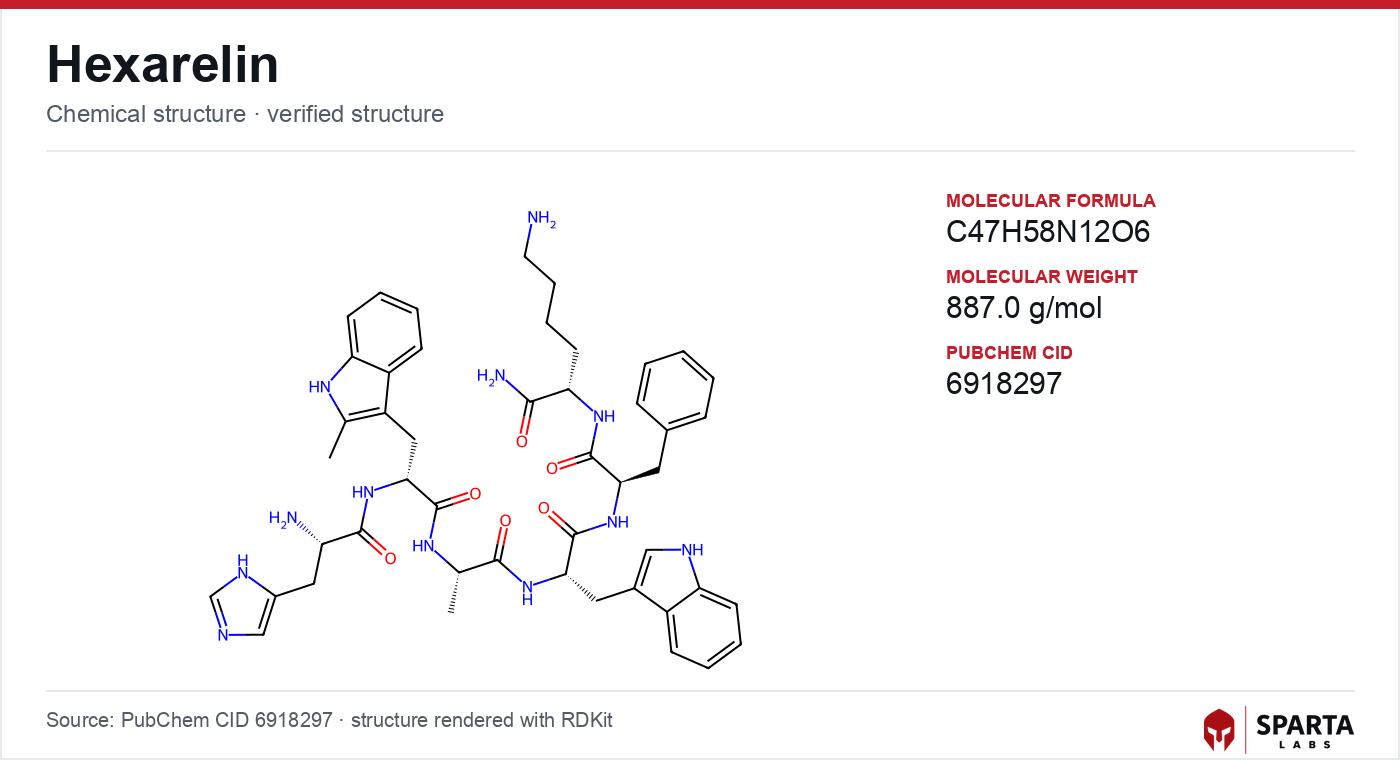
Figure: chemical structure of Hexarelin.
A synthetic ligand that arrived before its receptor
The synthetic GHRP story began with observations by the endocrinologist Cyril Bowers, whose laboratory reported in the late 1970s that certain enkephalin-derived analogs elicited growth hormone release in pituitary cell cultures. GHRP-6 became the first member of the family shown to produce dose-related GH release in vitro and in vivo, and it established the structural template that subsequent analogs, including hexarelin, refined. Hexarelin emerged from iterative structure-activity work on that scaffold, and Deghenghi and colleagues reported its GH-releasing activity in infant and adult rats in 1994. [1]
Findings from research models do not establish safety or efficacy in humans. Sparta Labs makes no claims about the use of this compound.
What made this lineage scientifically distinctive is that the peptides were designed and characterized as pharmacological agents before their molecular target was known. Howard and colleagues cloned the receptor these compounds act on in 1996, naming it the growth hormone secretagogue receptor and demonstrating that it functioned in GH release from pituitary and hypothalamic tissue. [2] Only in 1999 did Kojima and colleagues isolate the receptor's endogenous ligand, an acylated 28-amino acid peptide they named ghrelin, from stomach tissue. [3] Hexarelin and the other GHRPs were, in effect, the keys that led researchers to the lock and then to its natural key. Related members of this same secretagogue lineage are profiled in the GHRP-6 research overview and the GHRP-2 research overview.
The hexapeptide scaffold and the D-2-methyltryptophan modification
Hexarelin is a six-residue peptide with the sequence His-D-2-methyl-Trp-Ala-Trp-D-Phe-Lys-NH₂. Its molecular formula is C₄₇H₅₈N₁₂O₆, with a molecular weight of approximately 887 daltons, and its C-terminus carries an amide group rather than a free carboxyl.
The feature that separates hexarelin from its progenitor GHRP-6 is a single position. Where GHRP-6 carries D-tryptophan at position two, hexarelin carries D-2-methyltryptophan (D-2-Me-Trp). Deghenghi and colleagues reported in 1994 that this methyl substitution was associated with greater resistance to enzymatic degradation and with increased GH-releasing potency relative to the parent sequence in rat models. [1] The presence of non-standard D-amino acids at positions two and five (D-2-Me-Trp and D-Phe) is a recurring design theme across the GHRP family, chosen because D-configuration residues are cleaved more slowly by mammalian proteases than their L-counterparts.
Notably, hexarelin shares no sequence homology with growth hormone-releasing hormone (GHRH), the endogenous hypothalamic peptide that stimulates GH via a separate receptor system. This structural independence is why GHRPs and GHRH-class peptides act through distinct pathways. The GHRH-analog side of that comparison is covered in the ipamorelin research overview, which discusses a secretagogue that shares hexarelin's receptor target while differing in length and selectivity profile.
Two receptors: GHS-R1a and CD36
Hexarelin is classified pharmacologically as a synthetic growth hormone secretagogue acting as an agonist at the ghrelin receptor, GHS-R1a. That receptor, cloned by Howard and colleagues in 1996, is a G protein-coupled receptor expressed in the anterior pituitary and hypothalamus, where its activation is associated with GH secretion, and in peripheral tissues including the heart. [2] Because ghrelin was later confirmed as the endogenous GHS-R1a ligand, hexarelin is understood as a synthetic agonist at the receptor for a natural hormone with documented roles in GH regulation and energy homeostasis. [3]
A second binding site distinguishes hexarelin and structurally related GHRPs within their class. Bodart, Escher, and colleagues used photoaffinity cross-linking to localize a hexarelin binding site on CD36, a class B scavenger receptor expressed in cardiomyocytes, macrophages, and endothelial microvasculature, and reported that the interaction was situated within the CD36 extracellular domain. [4] This dual-receptor pharmacology has provided a framework for interpreting cardiovascular observations in animal preparations that were reported to persist independently of GHS-R1a signaling. The molecular detail of both binding pathways is examined in the hexarelin mechanism of action article, and the corresponding study bibliography is collected in the hexarelin published research summary.
A 2017 review in Clinical Medicine Insights: Cardiology surveyed the preclinical evidence describing cytoprotective properties across the synthetic GHRP family and situated hexarelin within that developmental and mechanistic lineage. [5]
Development lineage and regulatory status
Hexarelin advanced from Deghenghi and colleagues' original characterization into Phase II clinical investigation, and the World Health Organization assigned it the International Nonproprietary Name examorelin, formally recognizing its status as a pharmaceutical development candidate. Investigation did not proceed to Phase III, and hexarelin has not received marketing authorization from the United States Food and Drug Administration (FDA), the European Medicines Agency (EMA), or comparable authorities for any indication in humans.
As a synthetic peptide supplied in research grade, hexarelin from Sparta Labs is classified as a research-use-only (RUO) material. It appears on the World Anti-Doping Agency (WADA) Prohibited List under the category covering peptide hormones, growth factors, related substances, and mimetics, a listing that reflects its pharmacological class rather than any approved clinical application.
References
-
Deghenghi R, Cananzi MM, Torsello A, Battisti C, Müller EE, Locatelli V. GH-releasing activity of Hexarelin, a new growth hormone releasing peptide, in infant and adult rats. Life Sci. 1994;54(18):1321–1328. PMID: 7910650. DOI: 10.1016/0024-3205(94)00845-X. PubMed
-
Howard AD, Feighner SD, Cully DF, Arena JP, Liberator PA, Rosenblum CI, et al. A receptor in pituitary and hypothalamus that functions in growth hormone release. Science. 1996;273(5277):974–977. PMID: 8688086. DOI: 10.1126/science.273.5277.974. PubMed
-
Kojima M, Hosoda H, Date Y, Nakazato M, Matsuo H, Kangawa K. Ghrelin is a growth-hormone-releasing acylated peptide from stomach. Nature. 1999;402(6762):656–660. PMID: 10604470. DOI: 10.1038/45230. PubMed
-
Bodart V, Bouchard JF, McNicoll N, Escher E, Carrière P, Ghigo E, et al. Identification of a new binding site for growth hormone-releasing peptides on CD36, a scavenger receptor of the innate immune system. Biochemistry. 2004;43(18):5557–5565. PMID: 15176951. DOI: 10.1021/bi0302085. PubMed
-
Granado M, Martín AI, López-Menduiña M, López-Calderón A, Villanúa MA. Synthetic Growth Hormone-Releasing Peptides (GHRPs): A Historical Appraisal of the Evidences Supporting Their Cytoprotective Effects. Clin Med Insights Cardiol. 2017;11:1179546817694558. PMID: 28469471. DOI: 10.1177/1179546817694558. PubMed
Disclaimer. Statements in this article have not been evaluated by the Food and Drug Administration. This compound is not intended to diagnose, treat, cure, or prevent any disease. Sparta Labs sells research-use-only materials. Content is provided for educational and informational purposes only and does not constitute medical advice. Consult a qualified medical professional for any health concerns.
Frequently asked questions
What is hexarelin?
Hexarelin, which carries the International Nonproprietary Name examorelin, is a synthetic hexapeptide in the growth hormone-releasing peptide (GHRP) family of growth hormone secretagogues. It was characterized by Romano Deghenghi and colleagues in the early 1990s and appears frequently in the preclinical GHRP literature as a highly potent member of its structural class.
How does hexarelin differ from GHRP-6?
Hexarelin was derived from the GHRP-6 template by replacing the D-tryptophan at position two with D-2-methyltryptophan. Deghenghi and colleagues reported in 1994 that this single substitution was associated with greater resistance to enzymatic degradation and higher GH-releasing potency in rat models relative to the parent sequence. The two peptides otherwise share the same six-residue scaffold and the same primary receptor target.
What receptors have been described for hexarelin?
The literature describes two binding sites. The principal target is GHS-R1a, the ghrelin receptor, a G protein-coupled receptor cloned in 1996 that mediates GH release from pituitary somatotrophs. Photoaffinity cross-linking work published in 2004 also localized a hexarelin binding site on CD36, a class B scavenger receptor expressed in cardiac and vascular tissue, which has framed later interpretation of GH-independent cardiovascular findings in animal models.
Is hexarelin FDA approved?
No. Hexarelin advanced to Phase II clinical investigation under its original development program but did not proceed to Phase III, and it has not received marketing authorization from the FDA, the EMA, or comparable authorities for any indication. In the United States it is handled as a research-use-only material and is listed on the World Anti-Doping Agency Prohibited List by pharmacological class.
Is hexarelin the same as ghrelin?
No. Ghrelin is a 28-amino acid acylated peptide isolated in 1999 and is the endogenous ligand for GHS-R1a. Hexarelin is a much smaller synthetic six-residue peptide that acts as a pharmacological agonist at the same receptor. The synthetic GHRPs, including hexarelin, actually preceded the discovery of their natural counterpart and were the pharmacological tools that led investigators to search for it.