
GHRP-2: A Research Overview
GHRP-2 (pralmorelin, KP-102) is a synthetic hexapeptide growth hormone secretagogue defined by its D-2-naphthylalanine residue. This overview traces its chemistry, ghrelin-receptor pharmacology, and status as the first GHS approved for diagnostic use in Japan. Educational reference.
For research use only. Not for human consumption. This article is educational reference material. It is not medical advice and is not a recommendation to use any substance.
GHRP-2 (Pralmorelin): Chemistry, Ghrelin-Receptor Pharmacology, and Regulatory Overview
Introduction
GHRP-2, assigned the International Nonproprietary Name (INN) pralmorelin and developed under the code KP-102, is a synthetic hexapeptide belonging to the growth hormone secretagogue (GHS) class. In the published pharmacology literature it is described as an agonist at the growth hormone secretagogue receptor subtype 1a (GHS-R1a), the G protein-coupled receptor that also transduces signaling from the endogenous hormone ghrelin. What makes GHRP-2 a distinctive entry in the peptide research record is a combination of a single defining structural substitution and an unusual regulatory footnote: pralmorelin was authorized in Japan as a diagnostic challenge agent, one of the few growth hormone secretagogues to reach any national regulatory approval. This overview examines the compound's chemical identity, the receptor pharmacology that frames it, and the discovery arc that ties synthetic GHRPs to the later isolation of ghrelin.
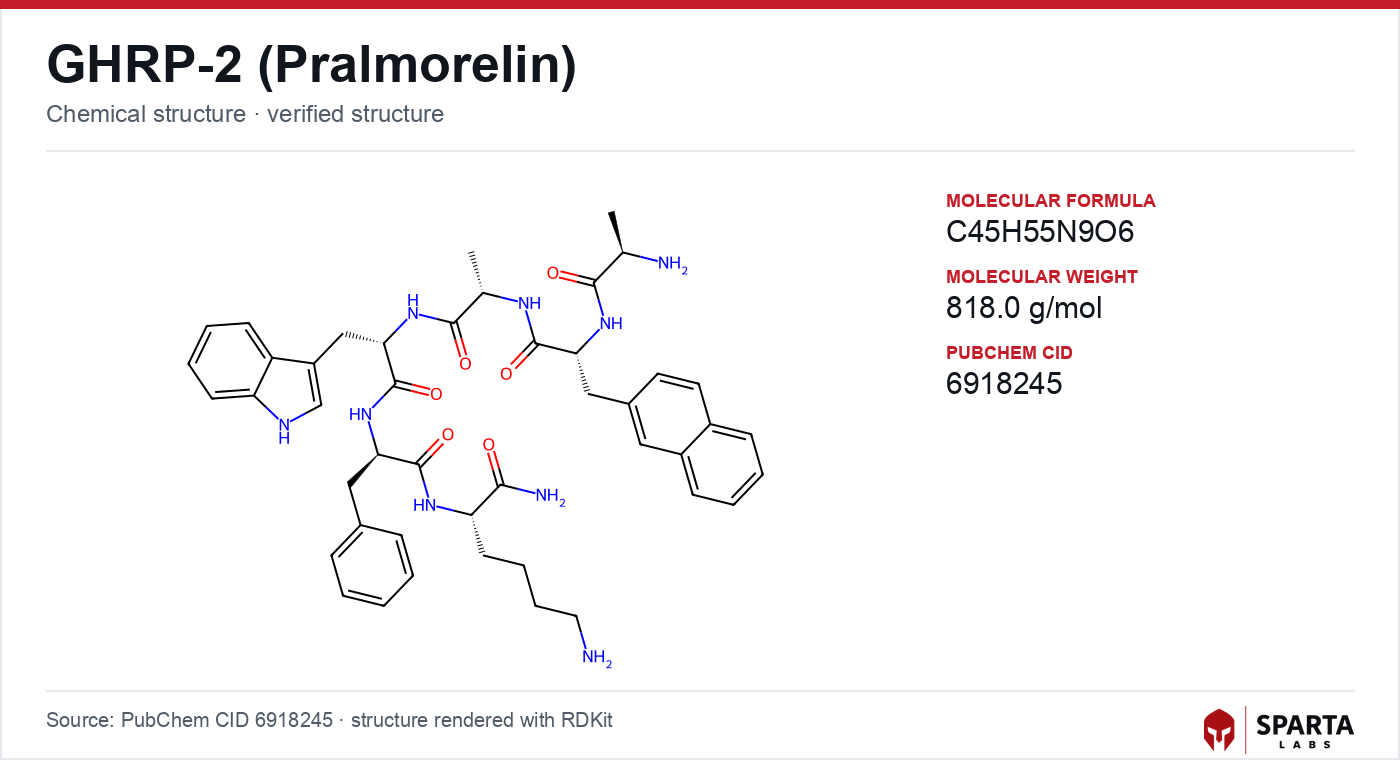
Figure: chemical structure of GHRP-2 (pralmorelin).
The single substitution that defines GHRP-2
GHRP-2 is best understood not as an isolated molecule but as one product of a systematic medicinal-chemistry program. Its amino acid sequence is D-Ala-D-2-Nal-Ala-Trp-D-Phe-Lys-NH2, a C-terminally amidated hexapeptide. Three residues sit in the D (right-handed) configuration rather than the L configuration found in ribosomally synthesized proteins: D-alanine at position 1, D-2-naphthylalanine at position 2, and D-phenylalanine at position 5. The presence of D-amino acids is a deliberate design feature of the GHRP family; peptides built from non-natural residues resist recognition by the proteases that rapidly degrade all-L peptides, a general principle in peptide medicinal chemistry.
The residue that most sharply distinguishes GHRP-2 from its predecessor GHRP-6 is D-2-naphthylalanine (D-2-Nal) at position 2. Where GHRP-6 presents a D-tryptophan indole ring at that position, GHRP-2 presents the larger, planar, bicyclic naphthalene ring system. This is a small edit to the sequence but a meaningful change in the aromatic surface offered to the receptor. The structure-activity relationship (SAR) logic behind such substitutions traces directly to the foundational work of Bowers and colleagues, who established in early pituitary-cell studies that the growth hormone-releasing activity of these peptides depends critically on specific aromatic and D-configured residues [1].
The reported molecular formula of pralmorelin free base is C45H55N9O6, corresponding to a molecular weight of approximately 817 daltons; the compound is commonly handled as a dihydrochloride salt. Its CAS Registry Number is 158861-67-7. The two aromatic residues at positions 2 and 4 (naphthylalanine and tryptophan) dominate the compound's hydrophobic character and its ultraviolet absorbance profile, a property that has practical relevance for the analytical methods used to identify and quantify it.
From enkephalin analogs to a hexapeptide scaffold
The lineage of GHRP-2 begins with an observation that had nothing to do with growth hormone. In the 1970s, researchers at Tulane University led by Cyril Y. Bowers were examining analogs of the opioid pentapeptide met-enkephalin and noticed that certain modified sequences released growth hormone from cultured pituitary cells through a mechanism independent of the classical opioid pathway. A landmark structure-activity report published in Endocrinology in 1980 formalized this finding, describing a synthetic pentapeptide that specifically released growth hormone in vitro [1].
Findings from research models do not establish safety or efficacy in humans. Sparta Labs makes no claims about the use of this compound.
Iterative optimization of this scaffold produced the first hexapeptide of the class, later designated GHRP-6, reported by Bowers, Momany, Reynolds, and Hong in 1984 as a hexapeptide that acted directly on the pituitary to release growth hormone [2]. GHRP-2 was a subsequent analog of that hexapeptide template, arising from the same SAR program's exploration of position-2 aromatic substitutions. The relationship between the two compounds is treated in more detail in the GHRP-6 research overview, which shares the same discovery lineage. Readers tracing the wider hexapeptide family may also find the hexarelin research overview a useful comparison, as hexarelin emerged from the same generation of GHRP optimization.
GHS-R1a: a receptor described before its natural ligand was known
For most of the GHRP research program, the compounds were pharmacological orphans in a specific sense: they clearly acted through a receptor, but that receptor and its natural ligand were unidentified. The situation changed in 1996, when Howard and colleagues reported the cloning of the growth hormone secretagogue receptor, a G protein-coupled receptor they showed to be the molecular target through which synthetic GHSs stimulate growth hormone release [3]. This receptor, GHS-R1a, is a Gq/11-coupled GPCR expressed on the somatotroph cells of the anterior pituitary and on neurons of the hypothalamic arcuate nucleus.
The story acquired its final piece in 1999, when Kojima and colleagues isolated ghrelin from the stomach and identified it as an acylated peptide hormone that is the endogenous ligand for GHS-R1a [4]. This finding retroactively reframed the entire GHRP class: compounds such as GHRP-2 had been mimicking, for well over a decade, the action of a hormone whose existence had not yet been established. The discovery of ghrelin is one of the more frequently cited examples of "reverse pharmacology," in which a synthetic ligand and its receptor are characterized before the natural ligand is found. The downstream signaling detail that follows receptor engagement is discussed in the GHRP-2 mechanism of action article.
Pharmacological classification and comparative profile
GHRP-2 is classified as a peptidyl growth hormone secretagogue and, in the published literature, as an agonist at GHS-R1a. The GHS class is pharmacologically distinct from the growth hormone-releasing hormone (GHRH) class. Although both ultimately elicit growth hormone secretion, they engage different receptors and partly separate intracellular pathways. Comparative human research by Arvat and colleagues reported that GHRP-2 and the related hexapeptide hexarelin produced growth hormone responses in study subjects, and characterized their effects on growth hormone, prolactin, ACTH, and cortisol relative to GHRH and other secretagogues [5]. That study is a standard reference point for the comparative endocrine profile of these hexapeptides and situates GHRP-2 alongside its structural relatives.
Within the GHRP family, the literature commonly describes GHRP-2 in relation to GHRP-6, its immediate structural predecessor, with the position-2 substitution as the point of departure. Because the GHS and GHRH classes act through separate receptors, they have been studied together in physiological research examining how the two systems interact at the level of pituitary output.
Regulatory status and analytical context
The most consequential regulatory event for pralmorelin was its authorization by Japan's Pharmaceuticals and Medical Devices Agency (PMDA) in 2004. In that context the compound is used as a single-challenge diagnostic agent to provoke pituitary growth hormone secretion so that the magnitude of the response can be measured to assess somatotroph reserve. This authorization is notable because it represents one of the few instances of any growth hormone secretagogue receiving national regulatory approval for a defined clinical purpose. Outside Japan, pralmorelin has not received FDA approval for any indication and its status remains investigational.
GHRP-2 also appears in the anti-doping literature. The World Anti-Doping Agency lists growth hormone secretagogues among prohibited substances, and analytical chemists have developed and published validated liquid chromatography-tandem mass spectrometry methods for detecting pralmorelin and its metabolites in human urine to support doping-control programs [6]. These methods, which exploit the compound's characteristic mass fragmentation and its aromatic residues, are also relevant to the identity-confirmation techniques used in laboratory verification of the compound. Research-grade GHRP-2 offered by Sparta Labs is characterized by independent third-party laboratory analysis for identity and purity; the analytical standards involved are discussed further in the GHRP-2 sourcing and quality reference.
References
-
Bowers CY, Momany F, Reynolds GA, Chang D, Hong A, Chang K. Structure-activity relationships of a synthetic pentapeptide that specifically releases growth hormone in vitro. Endocrinology. 1980;106(3):663–667. PMID: 6109621. DOI: 10.1210/endo-106-3-663. PubMed
-
Bowers CY, Momany FA, Reynolds GA, Hong A. On the in vitro and in vivo activity of a new synthetic hexapeptide that acts on the pituitary to specifically release growth hormone. Endocrinology. 1984;114(5):1537–1545. PMID: 6714155. DOI: 10.1210/endo-114-5-1537. PubMed
-
Howard AD, Feighner SD, Cully DF, Arena JP, Liberator PA, Rosenblum CI, et al. A receptor in pituitary and hypothalamus that functions in growth hormone release. Science. 1996;273(5277):974–977. PMID: 8688086. DOI: 10.1126/science.273.5277.974. PubMed
-
Kojima M, Hosoda H, Date Y, Nakazato M, Matsuo H, Kangawa K. Ghrelin is a growth-hormone-releasing acylated peptide from stomach. Nature. 1999;402(6762):656–660. PMID: 10604470. DOI: 10.1038/45230. PubMed
-
Arvat E, Di Vito L, Maccario M, Broglio F, Boghen MF, Deghenghi R, et al. Effects of GHRP-2 and hexarelin, two synthetic GH-releasing peptides, on GH, prolactin, ACTH and cortisol levels in man. Comparison with the effects of GHRH, TRH and hCRH. Peptides. 1997;18(6):885–891. PMID: 9285939. DOI: 10.1016/s0196-9781(97)00016-8. PubMed
-
Okano M, Sato M, Kageyama S, Niioka T, Yonezawa K, Suzuki H, et al. Determination of growth hormone secretagogue pralmorelin (GHRP-2) and its metabolite in human urine by liquid chromatography/electrospray ionization tandem mass spectrometry. Rapid Commun Mass Spectrom. 2010;24(14):2046–2056. PMID: 20552695. DOI: 10.1002/rcm.4619. PubMed
Disclaimer. Statements in this article have not been evaluated by the Food and Drug Administration. This compound is not intended to diagnose, treat, cure, or prevent any disease. Sparta Labs sells research-use-only materials. Content is provided for educational and informational purposes only and does not constitute medical advice. Consult a qualified medical professional for any health concerns.
Frequently asked questions
What is GHRP-2 (pralmorelin)?
GHRP-2, assigned the International Nonproprietary Name pralmorelin and the development code KP-102, is a synthetic hexapeptide classified as a growth hormone secretagogue. Published pharmacology characterizes it as an agonist at the growth hormone secretagogue receptor subtype 1a (GHS-R1a), the same G protein-coupled receptor that mediates the actions of the endogenous hormone ghrelin.
What is the amino acid sequence of GHRP-2?
GHRP-2 has the sequence D-Ala-D-2-Nal-Ala-Trp-D-Phe-Lys-NH2, a C-terminally amidated hexapeptide incorporating three D-configuration residues. Its defining feature is D-2-naphthylalanine at position 2, which distinguishes it structurally from GHRP-6. Reported molecular formula is C45H55N9O6 as the free base, with a molecular weight near 817 daltons.
What distinguishes GHRP-2 from GHRP-6 structurally?
The two hexapeptides share the same backbone length but differ at position 2: GHRP-2 carries D-2-naphthylalanine where GHRP-6 carries D-tryptophan. This single-residue substitution was identified through structure-activity relationship work on the GHRP scaffold and alters the aromatic side-chain presented to the GHS-R1a binding pocket.
Is GHRP-2 FDA approved?
GHRP-2 has not received FDA approval for any indication. It received regulatory approval from Japan's Pharmaceuticals and Medical Devices Agency in 2004 as a diagnostic challenge agent for assessing growth hormone secretory reserve. Its status outside Japan remains investigational.
How does GHRP-2 relate to ghrelin?
GHRP-2 predates the discovery of ghrelin. Synthetic growth hormone secretagogues, including GHRP-2, were developed years before Kojima and colleagues identified ghrelin in 1999 as the endogenous acylated peptide ligand for the receptor these compounds were already activating. GHRP-2 is therefore described in the literature as a synthetic ligand that anticipated an unknown natural hormone.