
Hexarelin: Sourcing, Purity, and Verification Standards
Why hexarelin's two D-amino-acid residues make stereochemical control and mass-spectrometric identity confirmation central to its sourcing and quality verification. Educational reference.
For research use only. Not for human consumption. This article is educational reference material. It is not medical advice and is not a recommendation to use any substance.
Introduction
This article examines the sourcing and quality-verification considerations specific to hexarelin, a synthetic growth-hormone-releasing hexapeptide. Hexarelin belongs to the growth-hormone secretagogue (GHS) class and is characterized, in the primary literature, by a short six-residue sequence that incorporates two non-standard D-configured amino acids. That structural detail is not incidental to sourcing: it shapes how the compound is assembled, how synthesis errors present, and which analytical methods are required to confirm that a given batch is what its label states. The sections below build the sourcing discussion outward from hexarelin's own chemistry rather than from a generic peptide template.
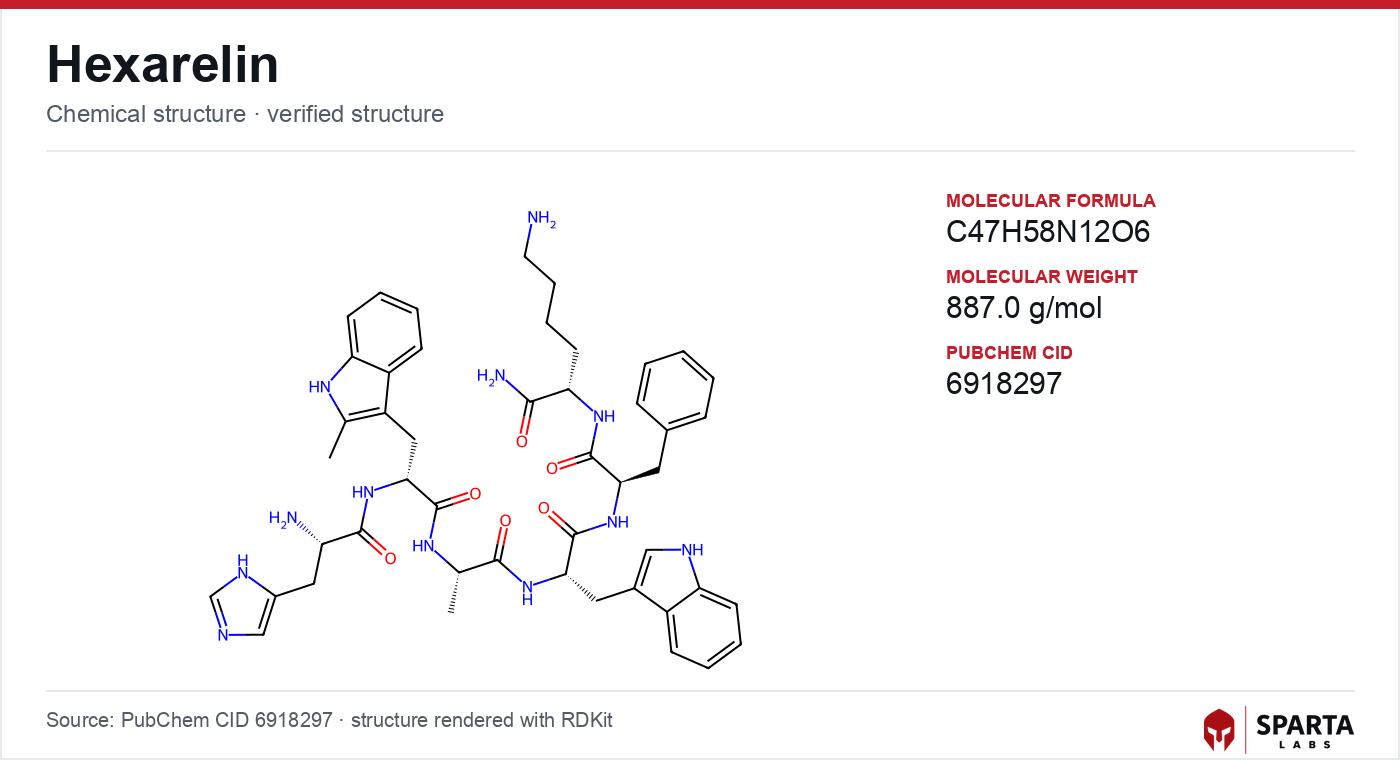
Figure: chemical structure of Hexarelin.
The Hexapeptide and Its Two D-Amino Acids
Hexarelin is a hexapeptide, meaning its backbone comprises six amino-acid residues. Its published sequence includes D-2-methyl-tryptophan at position two and D-phenylalanine at position five, with the remaining residues in the standard L-configuration and a C-terminal amide. These D-configured substitutions were introduced deliberately in the design work described by Deghenghi and colleagues (1994), who reported hexarelin's growth-hormone-releasing activity in infant and adult rat models [1].
Findings from research models do not establish safety or efficacy in humans. Sparta Labs makes no claims about the use of this compound.
The chemical significance of the D-residues for sourcing is twofold. First, D-amino acids are not naturally abundant substrates for the mammalian proteases that cleave L-peptide bonds, and their incorporation is associated in the peptide-chemistry literature with reduced enzymatic degradation relative to all-L peptides of comparable length. Second, and more directly relevant to quality control, a residue's stereochemistry is a property that ordinary composition analysis does not report. Two molecules can share an identical amino-acid content and mass yet differ in configuration at a single center, producing distinct pharmacological behavior. This is the analytical problem that hexarelin sourcing must address.
Solid-Phase Assembly of a Stereochemically Demanding Sequence
Hexarelin is produced by solid-phase peptide synthesis (SPPS), the technique introduced by Robert Merrifield in 1963 and later recognized with the 1984 Nobel Prize in Chemistry [2]. In SPPS the peptide is built one residue at a time on an insoluble resin support, with iterative coupling and deprotection cycles. For a sequence of hexarelin's length, SPPS offers the sequence control needed to place each residue, including the non-standard positions, in the intended order.
The stereochemically demanding character of hexarelin sits in those non-standard positions. Coupling and deprotection steps can, under poorly controlled conditions, promote racemization at an activated residue, converting a fraction of the intended configuration to its stereoisomer. Validated SPPS protocols manage this risk through choice of coupling reagent, base, and reaction conditions. General conventions for peptide manufacturing at scale, including the coupling and purification pipeline that governs sequence fidelity, are reviewed by Andersson and colleagues (2000) [3].
After chain assembly, the peptide is cleaved from the resin and the crude mixture is purified, conventionally by reverse-phase HPLC, to separate the target from truncated chains, deletion sequences, and other byproducts. The purified fraction is lyophilized to a dry powder for research handling. The composition of the initial crude material, and therefore the burden placed on purification, is directly influenced by how cleanly the demanding coupling steps proceeded.
Diastereomer Risk and Why Identity Confirmation Matters
The central quality question for hexarelin is not merely how much impurity is present but whether the correct molecule was made. Because hexarelin carries defined stereochemistry at two positions, a synthesis error that inverts configuration yields a diastereomer: a distinct compound with the same molecular formula and nominal mass as the target. Such variants are not always cleanly separated by routine inspection of a chromatogram, and they can carry different receptor-binding behavior.
That receptor context is what makes identity confirmation more than a formality for this compound. Hexarelin is reported to interact not only with the growth-hormone secretagogue receptor (GHS-R1a) but also with the scavenger receptor CD36; Bodart and colleagues (2002) described CD36 as a binding partner for growth-hormone-releasing peptides in cardiac tissue [4]. A structural variant that fails to reproduce hexarelin's defined configuration cannot be assumed to reproduce this pharmacology. A fuller treatment of these dual-receptor interactions appears in the hexarelin research overview and the hexarelin mechanism of action article.
Independent identity confirmation therefore rests on two complementary measurements. Mass spectrometry compares the measured molecular weight against the theoretical value for the correct sequence (molecular formula C₄₇H₅₈N₁₂O₆; molecular weight approximately 887 Da), flagging deletion or substitution errors that change mass. Chromatographic separation resolves related species that share mass but differ in retention. Bioanalytical method-validation guidance describes exactly this pairing, identity confirmation by mass spectrometry and purity assessment by chromatographic methods, as foundational to characterizing a research material [5]. Sparta Labs performs mass-spectrometric molecular-weight confirmation on every batch of hexarelin.
Purity Benchmarks and Residual Analysis
HPLC purity is the primary metric used to characterize research-grade peptides. It expresses the proportion of the target compound relative to all UV-absorbing species in a sample; a reading of 99 percent indicates that 99 percent of the detected material corresponds to the intended peptide, with the remainder attributable to related impurities and synthesis byproducts. It is a measure of relative composition, not of biological activity.
The common minimum for research-use peptides is HPLC purity of at least 98 percent. Sparta Labs applies an internal standard of at least 99 percent HPLC purity for hexarelin, above the research-grade floor. Beyond the purity percentage, residual analysis is relevant to hexarelin because SPPS introduces process reagents that must be reduced to acceptable levels in the finished powder. These typically include trifluoroacetic acid from cleavage and deprotection steps, counter-ions from any salt-exchange step, residual purification solvents, and, where the intended research application requires it, endotoxin assessed by the limulus amebocyte lysate assay.
Independent Verification and the Certificate of Analysis
Third-party analytical testing provides an external check on in-house quality control and removes the potential for confirmation bias in supplier-generated data. Sparta Labs engages independent laboratories to perform HPLC purity analysis and mass-spectrometric molecular-weight confirmation on production batches of hexarelin, with endotoxin testing where applicable. The same verification framework is applied to other growth-hormone secretagogues in the catalog, and the parallel considerations for a distinct GHS peptide are set out in the ipamorelin sourcing reference.
The documentation that carries these results is the Certificate of Analysis (COA). A batch-specific COA for hexarelin conventionally records:
- HPLC purity — the percentage and its chromatographic trace, confirming the material against the internal standard
- Mass-spectrometric confirmation — measured versus theoretical molecular weight, confirming identity of the synthesized hexapeptide
- Batch number — a unique identifier linking released material to its production and testing records
- Manufacturing date — the date synthesis and purification were completed
- Expiry date — established from available stability data for the lyophilized powder under specified storage conditions
Sparta Labs publishes a batch-specific COA with every product, accessible from the product page. Retaining the COA for any batch used in published work supports the batch traceability on which reproducible peptide research depends.
Storage and Stability of the Lyophilized Powder
The stability behavior of hexarelin follows the general principles reviewed in the protein-pharmaceuticals literature by Manning and colleagues (2010), which indicates that lyophilized preparations are more stable than reconstituted solutions and that cold storage away from light and moisture slows degradation [6]. Sparta Labs describes storage of lyophilized hexarelin at reduced temperature in a sealed, moisture- and light-protected container, under which the powder retains analytical purity through the stated expiry period.
Once a peptide is returned to solution, the hydrolytic and oxidative pathways that lyophilization suppresses resume, and repeated temperature cycling compounds the effect. The D-amino-acid substitutions that reduce hexarelin's susceptibility to enzymatic cleavage do not remove these purely chemical degradation routes, so handling considerations for the reconstituted state remain relevant independent of the compound's proteolytic resistance.
Why Stereochemical Fidelity Is a Functional Prerequisite
For most research materials, sourcing is a matter of confirming purity. For hexarelin, it is additionally a matter of confirming configuration. The compound's defined pharmacology, including the GHS-R1a and CD36 interactions noted above, is contingent on a structure that ordinary composition analysis cannot fully report. A batch that is high in nominal purity but carries an undetected diastereomer fraction can introduce a confounding variable that no downstream experiment will isolate.
This is why the analytical package for hexarelin emphasizes independent mass-spectrometric identity confirmation alongside chromatographic purity, rather than purity alone. Method-validation guidance frames identity and purity as separate, both-required checks precisely because a material can satisfy one while failing the other [5]. Sourcing from a supply that publishes batch-linked, third-party-verified COA data gives a researcher a characterized starting point whose identity and purity have been independently established before it enters an experiment.
References
-
Deghenghi R, Cananzi MM, Torsello A, Battisti C, Müller EE, Locatelli V. GH-releasing activity of Hexarelin, a new growth hormone releasing peptide, in infant and adult rats. Life Sci. 1994;54(18):1321–1328. PMID: 7910650. DOI: 10.1016/0024-3205(94)00845-X
-
Merrifield RB. Solid phase peptide synthesis. I. The synthesis of a tetrapeptide. J Am Chem Soc. 1963;85(14):2149–2154. DOI: 10.1021/ja00897a025
-
Andersson L, Blomberg L, Flegel M, Lepsa L, Nilsson B, Verlander M. Large-scale synthesis of peptides. Biopolymers. 2000;55(3):227–250. PMID: 11025540. DOI: 10.1002/1097-0282(2000)55:3<227::AID-BIP50>3.0.CO;2-7
-
Bodart V, Febbraio M, Demers A, McNicoll N, Pohankova P, Perreault A, et al. CD36 mediates the cardiovascular action of growth hormone-releasing peptides in the heart. Circ Res. 2002;90(8):844–849. PMID: 11988484. DOI: 10.1161/01.RES.0000016164.02525.B4
-
Bansal S, DeStefano A. Key elements of bioanalytical method validation for small molecules. AAPS J. 2007;9(1):E109–E114. PMID: 17408240. DOI: 10.1208/aapsj0901011
-
Manning MC, Chou DK, Murphy BM, Payne RW, Katayama DS. Stability of protein pharmaceuticals: an update. Pharm Res. 2010;27(4):544–575. PMID: 20143256. DOI: 10.1007/s11095-009-0045-6
Disclaimer. Statements in this article have not been evaluated by the Food and Drug Administration. This compound is not intended to diagnose, treat, cure, or prevent any disease. Sparta Labs sells research-use-only materials. Content is provided for educational and informational purposes only and does not constitute medical advice. Consult a qualified medical professional for any health concerns.
Frequently asked questions
What makes hexarelin's synthesis chemically distinctive?
Hexarelin is a synthetic hexapeptide whose sequence includes two non-standard D-configured residues: D-2-methyl-tryptophan at position two and D-phenylalanine at position five. These substitutions are introduced deliberately during solid-phase peptide synthesis and are a defining feature of the molecule reported in the original characterization by Deghenghi and colleagues. Their presence is one reason stereochemical control during coupling and deprotection is emphasized in the analytical literature on synthetic peptides.
Why is mass spectrometry central to verifying hexarelin identity?
Racemization or substitution errors at hexarelin's D-amino-acid positions can produce diastereomers or sequence variants that are not always resolved by routine visual inspection. Mass-spectrometric measurement of molecular weight against the theoretical value for the correct sequence provides an independent identity check. Bioanalytical method-validation guidance describes mass-spectrometric identity confirmation and chromatographic purity assessment as core elements of characterizing a research material.
What does HPLC purity describe for a research peptide?
Reverse-phase HPLC purity expresses the proportion of a sample's UV-absorbing signal attributable to the target peptide relative to related impurities, truncated sequences, and synthesis byproducts. A 98 percent reading indicates that 98 percent of the detected material corresponds to the intended compound. It is a chromatographic metric of relative composition, not a measure of biological activity.
What information does a Certificate of Analysis for hexarelin document?
A batch-specific Certificate of Analysis typically records HPLC purity with its chromatographic trace, a mass-spectrometric comparison of measured versus theoretical molecular weight, a unique batch identifier, and manufacturing and expiry dates. Sparta Labs publishes a batch-specific Certificate of Analysis accessible from the product page. Retaining this documentation supports the batch traceability that reproducible peptide research relies on.
Why is lyophilized peptide generally more stable than a reconstituted solution?
The protein-stability literature reviewed by Manning and colleagues indicates that removing water by lyophilization slows the hydrolytic and conformational degradation pathways that operate in solution. Lyophilized material stored cold and protected from light and moisture is therefore described as more stable than a reconstituted preparation. This is a general property of peptide and protein preparations rather than a claim specific to any single compound.