
Kisspeptin-10: Discovery and Research History
How kisspeptin-10 traveled from a 1996 cancer-metastasis gene named in Hershey to the 2001 GPR54 deorphanization and the 2003 puberty-genetics findings that founded a field. Educational reference.
For research use only. Not for human consumption. This article is educational reference material. It is not medical advice and is not a recommendation to use any substance.
Introduction
Few peptides in neuroendocrinology carry a discovery arc as unusual as kisspeptin-10 (KP-10). Its parent gene entered the scientific record not through hormone research but through cancer biology, where it was catalogued as a suppressor of tumor metastasis. Only years later did three independent laboratories, working in parallel on an unrelated orphan receptor, reveal that the gene encoded a family of signaling peptides. A further genetic discovery then placed those peptides at the center of how puberty begins. This article traces that arc chronologically, from a 1996 melanoma-hybrid experiment in Hershey, Pennsylvania, to the controlled human neuroendocrine studies that define the modern KP-10 literature.
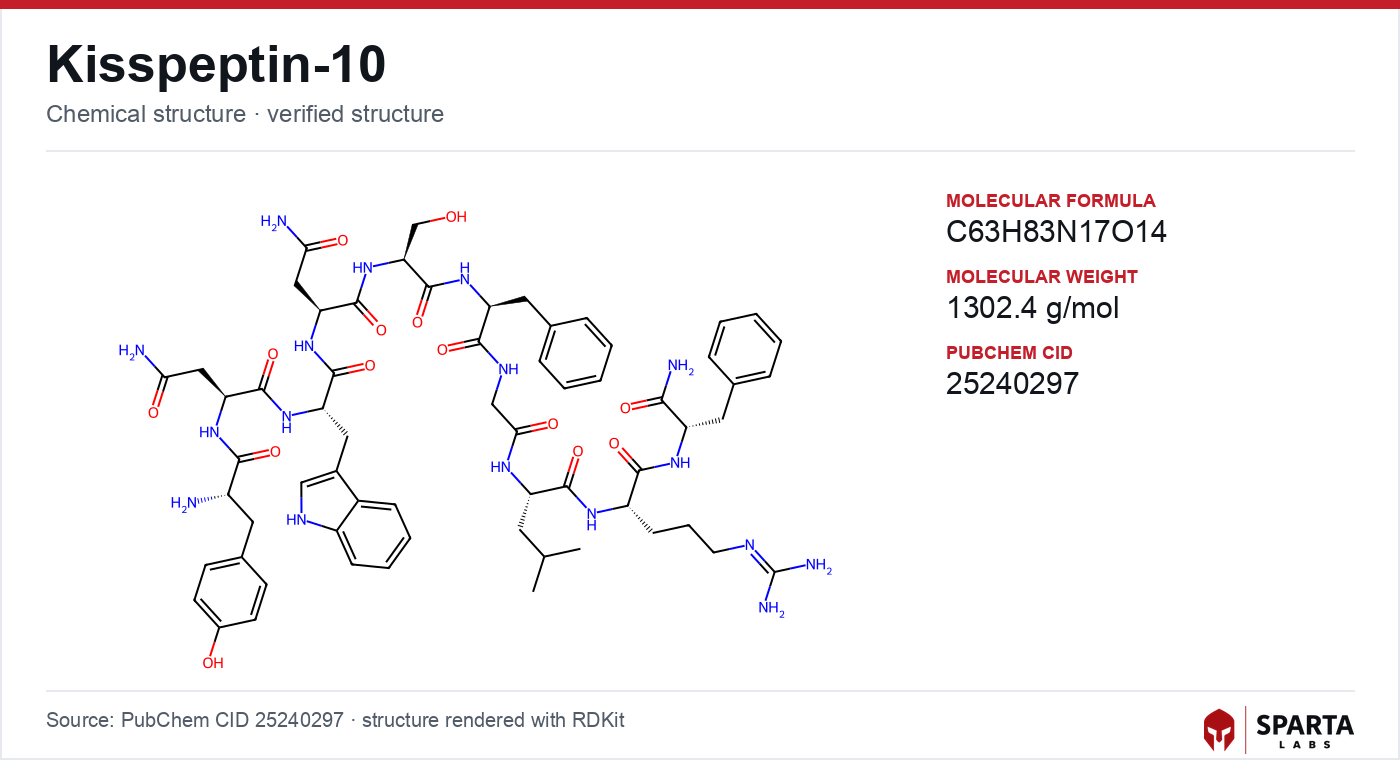
Figure: chemical structure of Kisspeptin-10.
A Metastasis-Suppressor Gene Named After Chocolate (1996)
The gene now designated KISS1 was first cloned and reported in 1996 by Lee and colleagues at The Pennsylvania State University College of Medicine in Hershey, Pennsylvania [1]. The project was framed entirely around cancer biology: the investigators were searching for the gene responsible for the metastasis-suppressing behavior observed when human chromosome 6 was introduced into metastatic melanoma cell lines. Using subtractive hybridization, they isolated a novel cDNA that was expressed in non-metastatic hybrid cells but reduced or absent in metastatic lines, and named it KiSS-1.
The naming is itself documented in the primary literature. The "KiSS" designation was chosen to reference the gene's suppressor function and, informally, to nod to the site of discovery, Hershey being home to the Hershey Company's Kisses confections [1]. The etymology has proved durable, and it explains why a reproductive-axis peptide carries a name with no obvious biological meaning. For roughly five years after this report, KISS1 was studied almost exclusively as a tumor-suppressor gene, with its endocrine role entirely unsuspected.
Findings from research models do not establish safety or efficacy in humans. Sparta Labs makes no claims about the use of this compound.
Three Laboratories, One Ligand (2001)
The link between KISS1 and receptor pharmacology emerged in 2001, and it emerged three times over. The early-2000s wave of orphan G-protein-coupled receptor (GPCR) "deorphanization" programs meant that several groups were independently hunting for the natural ligand of the orphan receptor then called GPR54, and their results converged within months.
Ohtaki and colleagues at Takeda Chemical Industries in Japan reported in Nature that the KISS1 gene product was the endogenous ligand for GPR54 [2]. They isolated the peptide from human placenta, named it "metastin" in reference to its metastasis-suppressor origin, and confirmed its activity at the receptor using calcium-mobilization assays in transfected cells.
Kotani and colleagues, publishing in the Journal of Biological Chemistry, independently described the same ligand-receptor pairing and introduced the name that stuck: "kisspeptins" [3]. Their report characterized four biologically active fragments, kisspeptin-54, kisspeptin-14, kisspeptin-13, and kisspeptin-10, and established that biological activity resided in the shared C-terminal decapeptide, the fragment now designated KP-10. The receptor pharmacology and downstream signaling that grew out of this work is examined in the Kisspeptin-10 mechanism of action article.
Muir and colleagues, approaching the problem from the receptor side, reported the same pairing after having named the receptor AXOR12 [4]. The convergence of a ligand-first and a receptor-first discovery on the same molecule lent the finding unusual robustness. The name "kisspeptin" achieved field consensus, and the receptor was later renamed KISS1R, formalized by the IUPHAR nomenclature committee, superseding the GPR54 label [5].
The 2003 Puberty Discovery That Redirected the Field
For two years after deorphanization, the physiological role of kisspeptin signaling beyond cancer remained an open question. That question was answered decisively in 2003, when two clinical-genetics groups, working independently, identified inactivating mutations in GPR54 as a cause of idiopathic hypogonadotropic hypogonadism, a condition marked by absent or incomplete pubertal development due to insufficient gonadotropin-releasing hormone (GnRH) signaling.
Seminara and colleagues at Massachusetts General Hospital and Harvard Medical School published in the New England Journal of Medicine [6]. Studying an extended consanguineous pedigree and generating a Gpr54-null mouse, they reported that loss-of-function mutations produced reproductive failure and absence of pubertal development in both humans and mice, establishing GPR54 as an essential gatekeeper of the reproductive axis.
De Roux and colleagues in France simultaneously reported an inactivating GPR54 deletion in an inbred family with the same phenotype, published in the Proceedings of the National Academy of Sciences [7]. Identified through linkage analysis, this finding independently confirmed the connection between GPR54 signaling and human pubertal onset. Together these twin 2003 papers converted kisspeptin from a metastasis-biology curiosity into a foundational subject of reproductive neuroendocrinology, and they redirected a large share of subsequent research toward the hypothalamic-pituitary-gonadal (HPG) axis.
Mapping Kisspeptin Onto the HPG Axis (2003–2005)
With a genetic mandate established, research between 2003 and 2005 worked out where kisspeptin acted and how. Rodent studies documented KISS1R expression on GnRH neurons and reported that kisspeptin administration was associated with GnRH release and activation of the reproductive axis. This positioned kisspeptin as an upstream signal to the GnRH neuron rather than a direct pituitary agent.
Smith and colleagues characterized hypothalamic Kiss1 messenger RNA in the arcuate nucleus and the anteroventral periventricular nucleus of rodents, reporting that gonadal steroids regulated Kiss1 expression in opposite directions in these two regions [8]. This provided an anatomical basis for how steroid feedback, both negative and positive, could be relayed to GnRH neurons through distinct kisspeptin populations. The compound's chemistry and classification as a research tool are summarized in the Kisspeptin-10 research overview.
The Controlled Human Study Program (2005–Present)
From 2005 onward, a sustained program centered at Imperial College London, associated with Waljit Dhillo and colleagues, produced a series of controlled human studies characterizing neuroendocrine responses to kisspeptin isoforms in healthy volunteers and defined research populations. This program examined responses to kisspeptin-54 and KP-10 across physiological states, including differences across the menstrual cycle, with results appearing in peer-reviewed endocrinology journals.
Chan and colleagues reported that KP-10 administration was a potent stimulator of luteinizing hormone release and altered pulse characteristics in men, published in the Journal of Clinical Endocrinology & Metabolism [9]. Separately, a research line explored kisspeptin-54 as an investigational trigger for oocyte maturation; Abbara and colleagues reported findings in women undergoing in vitro fertilization who were at high risk of ovarian hyperstimulation syndrome [10]. This latter work involved kisspeptin-54 rather than KP-10, but it illustrates the breadth of investigational contexts in which kisspeptin isoforms have been studied. This clinical-research trajectory parallels that of other hypothalamic neuropeptides such as oxytocin, whose formal research program likewise emerged from convergent pharmacological and clinical findings.
Kisspeptin isoforms have been examined under Investigational New Drug (IND) applications in the United States and equivalent ethics-approved frameworks in the United Kingdom and Europe. No kisspeptin isoform, including KP-10, has received FDA or EMA approval for any therapeutic indication, and the compound is not scheduled under the US Controlled Substances Act.
Current Research Landscape
Contemporary KP-10 research spans several threads. Structural and computational work continues to refine the receptor-binding mode of the decapeptide and has informed the design of modified analogs with altered pharmacokinetic profiles. The "KNDy neuron" model of GnRH pulse generation, in which kisspeptin functions as the output of arcuate-nucleus interneurons co-expressing neurokinin B and dynorphin, has become a central framework, and pharmacological probing of KISS1R with KP-10 is a common tool for interrogating that circuit.
Interest in KISS1R biology outside the hypothalamus has also expanded, with published work examining roles in placental biology, the cardiovascular system, and the cancer-metastasis context in which the gene was first found. These non-HPG dimensions add interpretive complexity to systemic kisspeptin studies. Researchers evaluating supply for such work often review the analytical documentation described in the Kisspeptin-10 sourcing and quality reference; catalog specifications for the kisspeptin-10 research material are listed on its product page. The depth of the published record, from in vitro pharmacology through controlled human studies, places KP-10 among the well-characterized neuropeptide research tools in the field.
References
-
Lee JH, Miele ME, Hicks DJ, Phillips KK, Trent JM, Weissman BE, Welch DR. KiSS-1, a novel human malignant melanoma metastasis-suppressor gene. J Natl Cancer Inst. 1996;88(23):1731-1737. PMID: 8944003. DOI: 10.1093/jnci/88.23.1731
-
Ohtaki T, Shintani Y, Honda S, Matsumoto H, Hori A, Kanehashi K, et al. Metastasis suppressor gene KiSS-1 encodes peptide ligand of a G-protein-coupled receptor. Nature. 2001;411(6837):613-617. PMID: 11385580. DOI: 10.1038/35079135
-
Kotani M, Detheux M, Vandenbogaerde A, Communi D, Vanderwinden JM, Le Poul E, et al. The metastasis suppressor gene KiSS-1 encodes kisspeptins, the natural ligands of the orphan G protein-coupled receptor GPR54. J Biol Chem. 2001;276(37):34631-34636. PMID: 11457843. DOI: 10.1074/jbc.M104847200
-
Muir AI, Chamberlain L, Elshourbagy NA, Michalovich D, Moore DJ, Calamari A, et al. AXOR12, a novel human G protein-coupled receptor, activated by the peptide KiSS-1. J Biol Chem. 2001;276(31):28969-28975. PMID: 11387442. DOI: 10.1074/jbc.M102743200
-
Pinilla L, Aguilar E, Dieguez C, Millar RP, Tena-Sempere M. Kisspeptins and reproduction: physiological roles and regulatory mechanisms. Physiol Rev. 2012;92(3):1235-1316. PMID: 22811428. DOI: 10.1152/physrev.00037.2010
-
Seminara SB, Messager S, Chatzidaki EE, Thresher RR, Acierno JS Jr, Shagoury JK, et al. The GPR54 gene as a regulator of puberty. N Engl J Med. 2003;349(17):1614-1627. PMID: 14573733. DOI: 10.1056/NEJMoa035322
-
de Roux N, Genin E, Carel JC, Matsuda F, Chaussain JL, Milgrom E. Hypogonadotropic hypogonadism due to loss of function of the KiSS1-derived peptide receptor GPR54. Proc Natl Acad Sci USA. 2003;100(19):10972-10976. PMID: 12944565. DOI: 10.1073/pnas.1834399100
-
Smith JT, Cunningham MJ, Rissman EF, Clifton DK, Steiner RA. Regulation of Kiss1 gene expression in the brain of the female mouse. Endocrinology. 2005;146(9):3686-3692. PMID: 15919743. DOI: 10.1210/en.2005-0488
-
Chan YM, Butler JP, Pinnell NE, Pralong FP, Crowley WF Jr, Ren C, et al. Kisspeptin-10 is a potent stimulator of LH and increases pulse frequency in men. J Clin Endocrinol Metab. 2011;96(8):E1315-E1319. PMID: 21632807. DOI: 10.1210/jc.2011-0265
-
Abbara A, Jayasena CN, Christopoulos G, Narayanaswamy S, Izzi-Engbeaya C, Nijher GM, et al. Efficacy of kisspeptin-54 to trigger oocyte maturation in women at high risk of ovarian hyperstimulation syndrome (OHSS) during in vitro fertilization (IVF) therapy. J Clin Endocrinol Metab. 2015;100(9):3322-3331. PMID: 26168278. DOI: 10.1210/JC.2015-2332
Disclaimer. Statements in this article have not been evaluated by the Food and Drug Administration. This compound is not intended to diagnose, treat, cure, or prevent any disease. Sparta Labs sells research-use-only materials. Content is provided for educational and informational purposes only and does not constitute medical advice. Consult a qualified medical professional for any health concerns.
Frequently asked questions
Why is the kisspeptin gene named KISS1?
The gene was cloned in 1996 as a metastasis-suppressor gene by Lee and colleagues at Penn State College of Medicine in Hershey, Pennsylvania. As documented in the original paper, the KiSS designation referenced its suppressor function and informally nodded to Hershey, home of the Hershey Company's Kisses confections. The reproductive role of its peptide products was unknown at the time of naming.
When was kisspeptin-10 discovered?
The KISS1 gene was first reported in 1996, but its peptide products were not identified until 2001, when three independent groups (Ohtaki et al., Kotani et al., and Muir et al.) reported that the gene encoded ligands for the orphan receptor GPR54. Those 2001 publications established kisspeptin-10 as the minimal C-terminal fragment carrying the shared biological activity.
Why did kisspeptin research shift toward puberty and reproduction?
In 2003, two independent clinical-genetics groups, Seminara and colleagues in the United States and de Roux and colleagues in France, reported that inactivating mutations in GPR54 caused a form of hypogonadotropic hypogonadism with absent pubertal development. These findings identified the receptor as essential to the reproductive axis and redirected much of the field toward hypothalamic-pituitary-gonadal research.
What is the regulatory status of kisspeptin-10?
Kisspeptin isoforms have been studied under Investigational New Drug applications in the United States and equivalent ethics-approved frameworks in the United Kingdom and Europe. No kisspeptin isoform, including KP-10, has received FDA or EMA approval for any therapeutic indication, and the compound is not scheduled under the US Controlled Substances Act.