
Kisspeptin-10: A Research Overview
How a melanoma metastasis-suppressor gene named in Hershey, Pennsylvania yielded KP-10, the ten-residue RF-amide fragment that deorphanized GPR54. A structure- and discovery-driven reference on kisspeptin-10. Educational reference.
For research use only. Not for human consumption. This article is educational reference material. It is not medical advice and is not a recommendation to use any substance.
A metastasis suppressor named after a candy bar
Kisspeptin-10 (KP-10) has an unusual scientific pedigree for a neuropeptide: it began not in an endocrinology lab but in cancer biology. In 1996 Lee and colleagues at the Penn State College of Medicine, in Hershey, Pennsylvania, cloned a gene that suppressed metastasis in chromosome-6/melanoma hybrid cell experiments and named it KiSS-1 [1]. The capitalized "KiSS" was a nod to the town's famous confection, and the "1" marked it as a novel suppressor. For several years the gene was studied purely as a tumor-biology entity, and its product was informally called "metastin."
That naming accident sits at the front of KP-10's story because it explains why the peptide's early literature and its later reproductive-endocrinology literature use different vocabulary for the same molecule. This overview traces KP-10 from that origin through its chemistry, the deorphanization event that redirected the field, and the neuroendocrine research context in which the ten-residue fragment is now studied. It reports what primary literature has published; it makes no claims of its own. A companion piece, the kisspeptin-10 discovery and research history article, covers the chronology in finer detail.
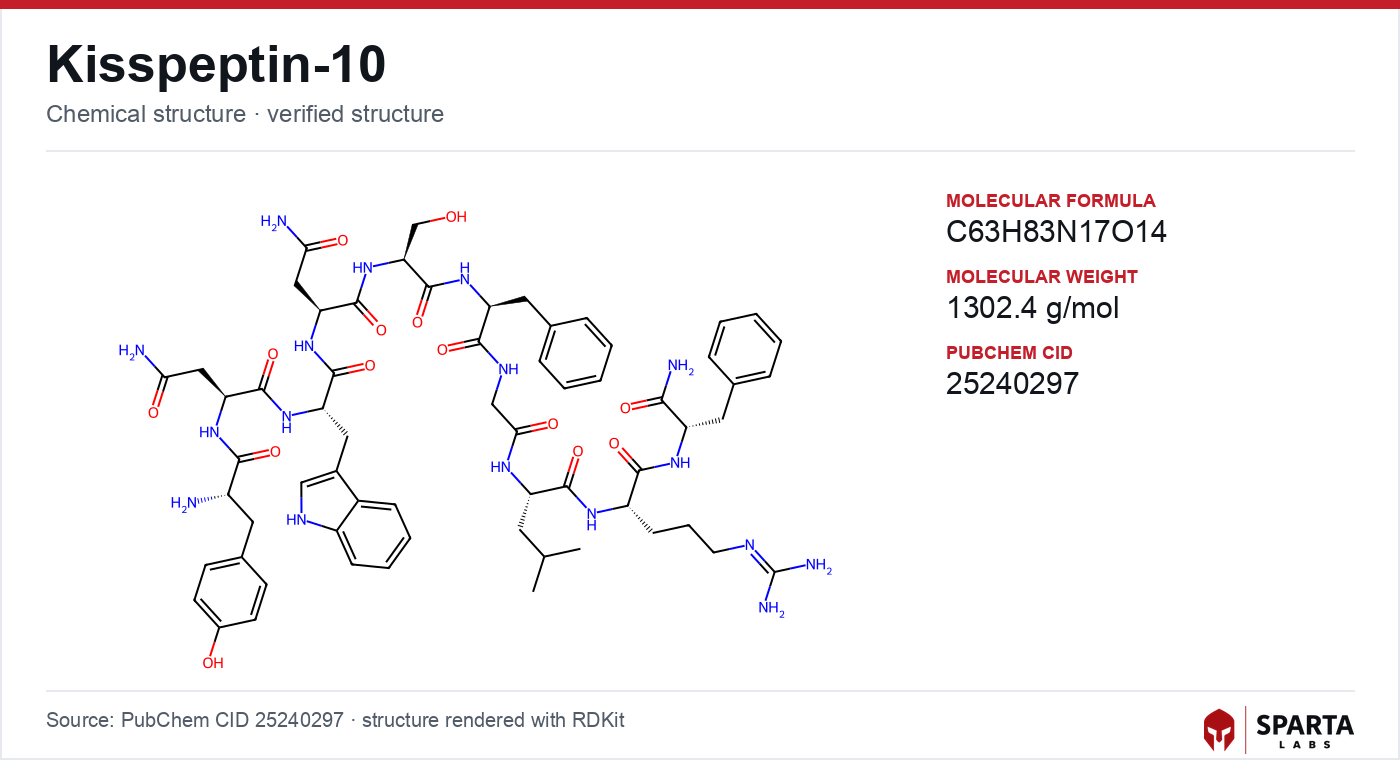
Figure: chemical structure of Kisspeptin-10.
The decapeptide problem: why ten residues
The full-length KISS1 gene product is a 145-amino-acid prepropeptide. Proteolytic processing in vivo does not release a single active species but a nested set of C-terminal fragments distinguished by length: kisspeptin-54 (KP-54, historically "metastin"), kisspeptin-14 (KP-14), kisspeptin-13 (KP-13), and kisspeptin-10 (KP-10) [6]. All four share the same terminal decapeptide, which raised an obvious pharmacological question in the early 2000s: how short can the fragment be trimmed before it stops working?
The answer defined KP-10. Research characterized the ten-residue sequence as the minimal fragment that retains full agonist activity at the receptor. That made KP-10, rather than the unwieldy 54-residue parent, the practical scaffold for synthesis and structure-activity work. Its sequence is Tyr-Asn-Trp-Asn-Ser-Phe-Gly-Leu-Arg-Phe-NH₂, with a molecular weight of approximately 1,302 daltons.
The trimming has a cost. Pharmacokinetic work in rats reported a plasma half-life on the order of four minutes following intravenous administration, reflecting rapid enzymatic degradation of the short peptide [8].
Findings from research models do not establish safety or efficacy in humans. Sparta Labs makes no claims about the use of this compound.
That short in-vivo persistence is itself a documented driver of the analog-development literature: researchers pursued modified sequences precisely because the native decapeptide is cleared quickly.
Anatomy of an RF-amide: the binding pharmacophore
KP-10 belongs to the RF-amide peptide superfamily, a class of neuropeptides unified by a conserved C-terminal arginine-phenylalanine-amide (Arg-Phe-NH₂) motif. That terminal chemistry is not incidental. Structure-activity relationship studies identified a pharmacophore centered on Phe-6, Arg-9, and the C-terminal Phe-10-NH₂ as the residues primarily responsible for KISS1R engagement [7].
Two structural details recur across that literature. First, the C-terminal amide (–NH₂) matters: removing it substantially attenuates receptor binding affinity, which is why synthetic KP-10 is prepared as the amidated form rather than the free-acid carboxyl terminus [7]. Second, NMR-restrained molecular modeling indicated that KP-10 adopts a helicoidal conformation spanning roughly Asn-4 to Tyr-10, with mixed alpha-helix and 3(10)-helix character [7]. This conformational picture informed the downsized-analog program described by Niida and colleagues, who synthesized metastin(45–54) analogs that maintained high agonist activity while altering the peptide backbone.
The pharmacophore work is what connects KP-10's structure to the receptor-level literature; that mechanistic detail is treated in depth in the kisspeptin-10 mechanism of action article.
Deorphanizing GPR54: three groups, one receptor
For most of the 1990s, GPR54 was an "orphan" G-protein-coupled receptor: a receptor cloned from sequence, with no known endogenous ligand. The pivotal event in KP-10's history was the pairing of that orphan receptor with the KISS1 gene product.
In 2001 three independent groups reported the match within a short window. Ohtaki and colleagues at Takeda Chemical Industries, publishing in Nature, reported that the KISS1 product they called metastin was the endogenous ligand for GPR54 [2]. Kotani et al. and Muir et al. published parallel characterizations, each arriving at the same receptor-ligand pairing through independent approaches [3]. The convergence of three deorphanization reports on one receptor was itself a strong signal to the field.
KP-10 is classified as a full agonist at this receptor, a class A GPCR that signals primarily through the Gq/11 pathway. In 2010 the International Union of Basic and Clinical Pharmacology (IUPHAR) formally recommended the designation "kisspeptin receptor," following the convention of naming a receptor after its endogenous ligand, and the gene was correspondingly renamed KISS1R [6]. Kisspeptins remain the only known endogenous ligands for KISS1R, which is expressed in the hypothalamus, pituitary, and peripheral tissues including placenta, ovary, and testis.
From orphan receptor to KNDy neurons: the research frame
The reason KP-10 became a heavily studied research tool was not the deorphanization alone but what followed it. In 2003 two landmark human genetic studies linked the receptor to development. Seminara and colleagues reported in the New England Journal of Medicine that loss-of-function mutations in GPR54 were associated with disrupted pubertal development [4], and de Roux and colleagues independently reported inactivating mutations in an inbred family, in the Proceedings of the National Academy of Sciences [5]. Together these reports moved the KISS1 system from tumor biology into the core of neuroendocrine research on the hypothalamic–pituitary–gonadal (HPG) axis.
Subsequent work localized much of this signaling to a specific hypothalamic neuron population. Colledge and others characterized kisspeptin signaling onto gonadotropin-releasing hormone (GnRH) neurons [9], and the field converged on the so-called KNDy neurons (co-expressing kisspeptin, neurokinin B, and dynorphin) as an anatomical substrate for KISS1R research. In this respect KP-10 sits alongside other GPCR-targeted hypothalamic neuropeptides such as oxytocin (acetate salt), which is studied in overlapping neuroendocrine circuitry, and the melanocortin-system peptide PT-141 (bremelanotide), another neuropeptide characterized against a defined receptor family. Cataloguing the primary studies in this program is the subject of the kisspeptin-10 published research summary.
Regulatory status and research handling
KP-10 is not approved by the US Food and Drug Administration (FDA) or the European Medicines Agency (EMA) for any therapeutic indication, and it is not listed as a scheduled controlled substance under the US Controlled Substances Act. Human research on kisspeptin isoforms has been conducted under Investigational New Drug (IND) applications and equivalent UK and European frameworks; controlled neuroendocrine studies in healthy volunteers, for example, have been reported by groups at Imperial College London under ethics-approved protocols [10].
As a research-use-only compound, kisspeptin-10 from Sparta Labs is intended for laboratory study under applicable institutional and regulatory guidelines; researchers evaluating a supplier can review the product listing alongside the compound's sourcing, purity, and verification standards reference before acquiring material. This overview is educational and does not describe any use in humans.
References
-
Lee JH, Miele ME, Hicks DJ, Phillips KK, Trent JM, Weissman BE, Welch DR. KiSS-1, a novel human malignant melanoma metastasis-suppressor gene. J Natl Cancer Inst. 1996;88(23):1731-1737. PMID: 8944003. DOI: 10.1093/jnci/88.23.1731. PubMed
-
Ohtaki T, Shintani Y, Honda S, Matsumoto H, Hori A, Kanehashi K, et al. Metastasis suppressor gene KiSS-1 encodes peptide ligand of a G-protein-coupled receptor. Nature. 2001;411(6837):613-617. PMID: 11385580. DOI: 10.1038/35079135. PubMed
-
Kotani M, Detheux M, Vandenbogaerde A, Communi D, Vanderwinden JM, Le Poul E, et al. The metastasis suppressor gene KiSS-1 encodes kisspeptins, the natural ligands of the orphan G protein-coupled receptor GPR54. J Biol Chem. 2001;276(37):34631-34636. PMID: 11457843. DOI: 10.1074/jbc.M104847200. PubMed
-
Seminara SB, Messager S, Chatzidaki EE, Thresher RR, Acierno JS Jr, Shagoury JK, et al. The GPR54 gene as a regulator of puberty. N Engl J Med. 2003;349(17):1614-1627. PMID: 14573733. DOI: 10.1056/NEJMoa035322. PubMed
-
de Roux N, Genin E, Carel JC, Matsuda F, Chaussain JL, Milgrom E. Hypogonadotropic hypogonadism due to loss of function of the KiSS1-derived peptide receptor GPR54. Proc Natl Acad Sci USA. 2003;100(19):10972-10976. PMID: 12944565. DOI: 10.1073/pnas.1834399100. PubMed
-
Pinilla L, Aguilar E, Dieguez C, Millar RP, Tena-Sempere M. Kisspeptins and reproduction: physiological roles and regulatory mechanisms. Physiol Rev. 2012;92(3):1235-1316. PMID: 22811428. DOI: 10.1152/physrev.00037.2010. PubMed
-
Niida A, Wang Z, Tomita K, Oishi S, Tamamura H, Otaka A, et al. Design and synthesis of downsized metastin (45–54) analogs with maintenance of high GPR54 agonistic activity. Bioorg Med Chem Lett. 2006;16(1):134-137. PMID: 16214345. DOI: 10.1016/j.bmcl.2005.09.054. PubMed
-
Liu Z, Ren C, Jones W, Chen P, Seminara SB, Chan YM, et al. LC-MS/MS quantification of a neuropeptide fragment kisspeptin-10 (NSC 741805) and characterization of its decomposition product and pharmacokinetics in rats. J Chromatogr B Analyt Technol Biomed Life Sci. 2013;926:1-8. PMID: 23524040. DOI: 10.1016/j.jchromb.2013.02.027. PubMed
-
Colledge WH. Kisspeptins and GnRH neuronal signalling. Trends Endocrinol Metab. 2009;20(3):115-121. PMID: 19272794. DOI: 10.1016/j.tem.2008.10.005. PubMed
-
Jayasena CN, Nijher GM, Comninos AN, Abbara A, Januszewski A, Vaal ML, et al. The effects of kisspeptin-10 on reproductive hormone release show sexual dimorphism in humans. J Clin Endocrinol Metab. 2011;96(8):E1299-E1307. PMID: 21632807. DOI: 10.1210/jc.2011-0231. PubMed
Disclaimer. Statements in this article have not been evaluated by the Food and Drug Administration. This compound is not intended to diagnose, treat, cure, or prevent any disease. Sparta Labs sells research-use-only materials. Content is provided for educational and informational purposes only and does not constitute medical advice. Consult a qualified medical professional for any health concerns.
Frequently asked questions
Why is kisspeptin-10 called a decapeptide, and what happened to kisspeptin-54?
Kisspeptin-10 (KP-10) is the ten-residue C-terminal fragment of the larger KISS1 gene product. Proteolytic processing in vivo generates several fragments (KP-54, KP-14, KP-13, KP-10), all sharing the same C-terminal decapeptide. Research characterized KP-10 as the minimal sequence that retains full agonist activity at the receptor, which is why the shorter fragment became a widely used scaffold in structure-activity studies.
What does the 'RF-amide' classification of kisspeptin-10 mean?
RF-amide peptides are a family of neuropeptides defined by a conserved C-terminal arginine-phenylalanine-amide (Arg-Phe-NH2) motif. KP-10 ends in this motif, placing it in the RFamide-related peptide superfamily alongside other neuropeptides. Published structure-activity work identified the C-terminal amide group as important for receptor binding affinity.
How did a metastasis-suppressor gene become linked to reproductive research?
The KISS1 gene was first identified in 1996 as a metastasis suppressor in melanoma cell lines. Its physiological reach proved far broader: in 2001 three independent groups reported that KISS1-derived kisspeptins were the endogenous ligands for the orphan receptor GPR54. Human genetic studies in 2003 then linked GPR54 loss-of-function to disrupted pubertal development, moving the KISS1 system to the center of neuroendocrine research.
What is the KISS1R receptor and how is it classified?
KISS1R, formerly designated GPR54, is a class A G-protein-coupled receptor that signals primarily through the Gq/11 pathway. The IUPHAR formally recommended the name kisspeptin receptor in 2010. Kisspeptins including KP-10 are the only known endogenous ligands for this receptor, which is expressed in the hypothalamus, pituitary, and several peripheral tissues.
Is kisspeptin-10 an FDA-approved product?
No. Kisspeptin-10 is not approved by the US Food and Drug Administration or the European Medicines Agency for any therapeutic indication, and it is not a scheduled controlled substance under the US Controlled Substances Act. It is handled as a research-use-only material under applicable institutional and regulatory frameworks.