
KPV: Sourcing, Purity, and Verification Standards
A sourcing reference for KPV (Ac-Lys-Pro-Val-NH2): why a three-residue alpha-MSH fragment is straightforward to synthesize but demanding to characterize, and how HPLC, mass spectrometry, and COA documentation establish batch identity. Educational reference.
For research use only. Not for human consumption. This article is educational reference material. It is not medical advice and is not a recommendation to use any substance.
Introduction
KPV is a tripeptide composed of lysine, proline, and valine. In the form studied across the published pharmacological literature it is N-terminally acetylated and C-terminally amidated, written Ac-Lys-Pro-Val-NH2, and it corresponds to the final three residues (positions 11 to 13) of alpha-melanocyte-stimulating hormone (alpha-MSH) [1]. Because KPV is so short, its sourcing and quality profile is different from that of larger peptides: the synthesis chemistry is uncomplicated, but the analytical burden of proving that a given batch is the correct acetylated, amidated sequence, and not a near-identical variant, is proportionally larger. This article documents how KPV is synthesized, why identity confirmation is treated as separate from purity, and what a Certificate of Analysis (COA) records for each batch of Sparta Labs KPV. For the compound's classification and research context, the KPV research overview provides the foundational reference.
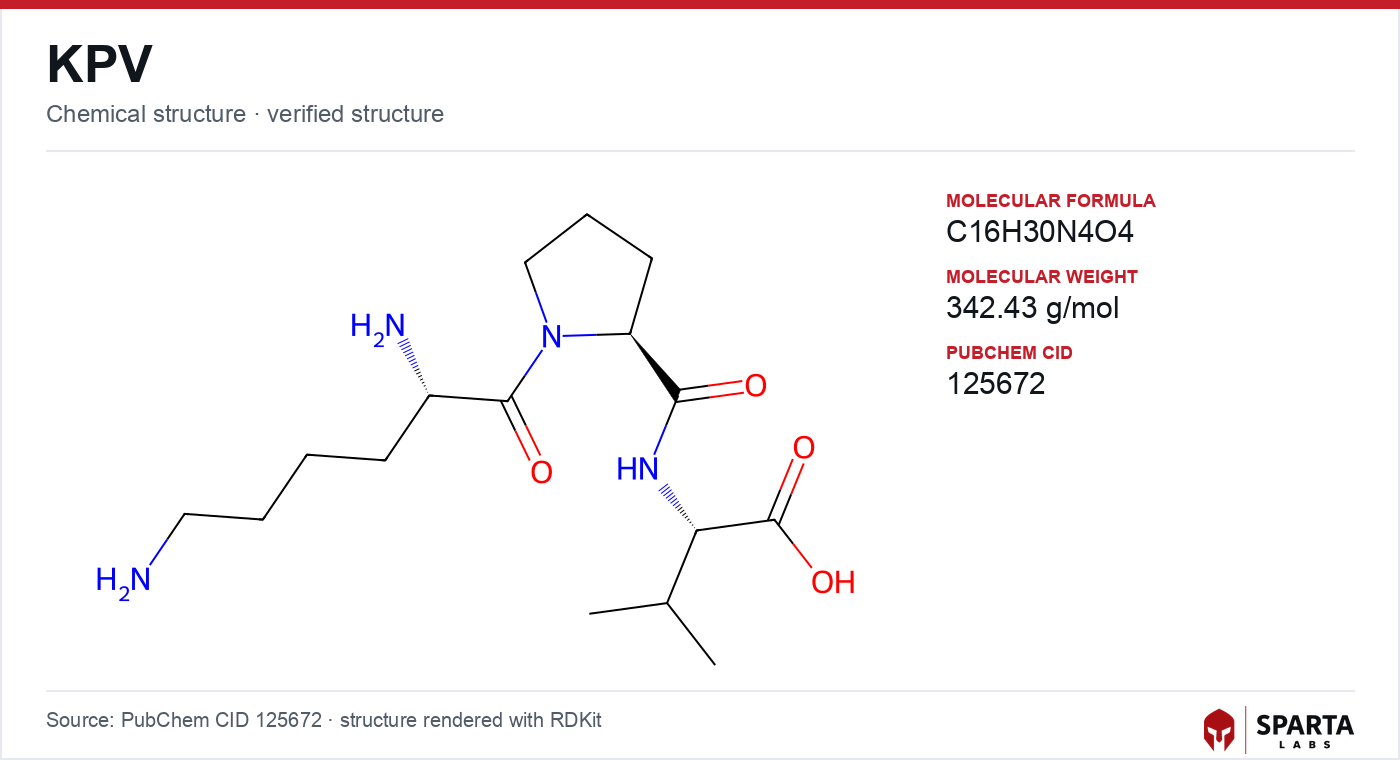
Figure: chemical structure of KPV.
KPV as a defined molecular target
Quality control begins with an unambiguous definition of the target molecule, and for KPV that definition carries more nuance than the three-letter name suggests. Alpha-MSH is a 13-residue peptide, and its C-terminal tripeptide Lys-Pro-Val was identified as the segment associated with the anti-inflammatory activity described for the parent hormone in cell and animal models [1]. The pharmacologically characterized fragment is not the bare tripeptide but the capped analogue: an acetyl group on the N-terminal lysine and an amide on the C-terminal valine, matching the way those termini are presented within the intact alpha-MSH sequence.
This matters for sourcing because "KPV" can, in principle, refer to several distinct chemical entities. A free-acid tripeptide with an unmodified N-terminus is a different molecule from Ac-Lys-Pro-Val-NH2, with a different molecular mass and different chromatographic behavior. A batch that is nominally "KPV" but lacks the acetyl or amide group is a mislabeled compound, not an impurity within the correct compound. For this reason, the identity specification for research-grade KPV names the specific capped analogue, and mass-spectrometric confirmation is used to verify that the acetyl and amide modifications are present.
Findings from research models do not establish safety or efficacy in humans. Sparta Labs makes no claims about the use of this compound.
Solid-phase synthesis of a three-residue sequence
KPV is produced by solid-phase peptide synthesis (SPPS), the standard method for research-grade peptides of this size. SPPS was introduced by Robert Bruce Merrifield, whose 1963 report in the Journal of the American Chemical Society described anchoring a growing peptide chain to an insoluble resin and elongating it residue by residue through iterative coupling and deprotection cycles [2]. Merrifield received the Nobel Prize in Chemistry in 1984 for the method, which remains the foundation of laboratory and industrial peptide manufacturing.
For KPV, synthesis proceeds from the C-terminal valine anchored to the resin, using Fmoc (9-fluorenylmethyloxycarbonyl) protection of the alpha-amino group during stepwise coupling. Proline and then lysine are added in sequence. The lysine side-chain epsilon-amine carries an orthogonal protecting group, commonly Boc (tert-butoxycarbonyl), so that only the intended backbone bonds form during chain assembly. N-terminal acetylation is performed on-resin before cleavage, and an amide-functionalized resin yields the C-terminal amide, together delivering the Ac-Lys-Pro-Val-NH2 target. Final cleavage and global side-chain deprotection are accomplished with trifluoroacetic acid (TFA)-based cleavage cocktails, after which the crude product is purified by reverse-phase HPLC. Andersson and colleagues reviewed large-scale peptide synthesis and purification in Biopolymers in 2000, providing an authoritative account of these processes at manufacturing scale [3].
Because the sequence is only three residues, the number of coupling cycles is small and the yield of full-length product is typically high. The impurity classes that do arise, principally single-residue deletion sequences and incompletely capped species, are therefore few in kind but analytically consequential, as discussed below.
The salt-form and acetylation problem
Two features of KPV chemistry dominate its quality specification: the salt form and the completeness of terminal capping. TFA cleavage leaves the basic lysine epsilon-amine as its TFA salt by default, so residual trifluoroacetate is the expected counter-ion of freshly cleaved material. Residual TFA is quantified and reported because it contributes to the measured mass of a lyophilized lot and, in some experimental systems, can influence buffer behavior. Where an alternative counter-ion is required, a salt exchange is a defined additional processing step rather than an assumption.
The acetyl and amide modifications are the second focus. Incomplete N-terminal acetylation leaves a fraction of free-amine tripeptide, and incomplete amidation or hydrolysis of the amide yields free-acid species. Both are detectable by mass spectrometry because each modification shifts the molecular mass by a characteristic increment. Confirming that the dominant species carries both the acetyl and the amide is central to verifying that a batch is the pharmacologically characterized analogue rather than a related but distinct peptide. The reported structural work on KPV establishes the reference mass used for that confirmation [4].
Establishing identity: purity is not the same as identity
Peptide quality control rests on two independent measurements that answer different questions. Reverse-phase HPLC answers "how much of the eluting material is the primary peak," reported as a purity percentage; mass spectrometry answers "is that peak the intended molecule." For a three-residue peptide, keeping these questions separate is important, because a near-identical deletion or capping variant can co-elute closely with the target and inflate an apparent purity figure if identity is not confirmed independently.
The analytical benchmark for research-grade peptides is HPLC purity of at least 98 percent, the threshold at which the primary compound accounts for that fraction of the UV-absorbing material eluting from the analytical column. Reverse-phase separation of short, hydrophilic peptides such as KPV depends on carefully chosen column chemistry, ion-pairing conditions, and gradient design; Mant and Hodges have documented the principles of RP-HPLC method development for peptide analysis in detail [5]. Sparta Labs applies an internal specification of HPLC purity at or above 99 percent for KPV.
Mass-spectrometric confirmation is performed on every batch against the expected mass of Ac-Lys-Pro-Val-NH2, reported in the structural characterization literature as an (M+H)+ value near 384 [4]. Confirming the observed mass against this reference distinguishes the correct capped analogue from free-amine, free-acid, and deletion species, and complements the HPLC purity figure that alone cannot resolve co-eluting isobaric material.
Independent confirmation and the Certificate of Analysis
Confirmatory analysis by an independent laboratory adds a check that does not share the assumptions of any single in-house instrument or method. Sparta Labs engages independent laboratories to perform confirmatory HPLC purity analysis and mass-spectrometric identity confirmation, with endotoxin testing by limulus amebocyte lysate (LAL) assay applied where relevant to the research application.
Every batch is documented in a Certificate of Analysis, accessible from the product page, which records:
- HPLC purity as a percentage, with the analytical method specified
- Mass-spectrometric confirmation of molecular weight against the expected (M+H)+
- Batch and lot numbers, and manufacturing date
- Expiry date
- Residual TFA or solvent content
- The identity of the third-party laboratory that performed independent verification
- Testing date
Retaining the batch COA alongside experimental records supports reproducibility documentation for any publications arising from the work, because it ties a specific analytical fingerprint to a specific set of results. Comparable identity-and-purity documentation is applied to other short copper- and inflammation-associated peptides in the library; the standards for GHK-Cu sourcing and quality follow the same purity-versus-identity logic adapted to that compound's metal-binding chemistry.
Handling and storage of the lyophilized solid
KPV is supplied as a lyophilized (freeze-dried) solid, the physical form in which short peptides are most chemically stable. General peptide-handling principles apply: the dry solid is kept sealed, stored cold, and protected from moisture and light, and freeze-thaw cycling of the lyophilized material is minimized. Chemical stability in solution is governed by pH, temperature, oxidative conditions, and sequence composition.
KPV's composition is favorable in this respect. It lacks the residues most associated with common peptide degradation pathways, including methionine oxidation, asparagine deamidation, aspartate isomerization, and cysteine-mediated disulfide scrambling, so the principal degradation routes that complicate more reactive sequences do not apply to its three residues. The internal proline also constrains backbone geometry. As with any research compound, solution stability under a particular set of experimental conditions is a property researchers validate for their own workflows rather than assume. The reported mechanistic literature, summarized in the KPV mechanism of action reference, describes the cellular models in which the acetylated, amidated form was characterized, underscoring why maintaining that exact molecular identity through synthesis, purification, and storage is a prerequisite for extending the published work.
References
-
Catania A, Gatti S, Colombo G, Lipton JM. Targeting melanocortin receptors as a novel strategy to control inflammation. Pharmacol Rev. 2004;56(1):1-29. PMID: 15001661. DOI: 10.1124/pr.56.1.1
-
Merrifield RB. Solid phase peptide synthesis. I. The synthesis of a tetrapeptide. J Am Chem Soc. 1963;85(14):2149-2154. DOI: 10.1021/ja00897a025
-
Andersson L, Blomberg L, Flegel M, Lepsa L, Nilsson B, Verlander M. Large-scale synthesis of peptides. Biopolymers. 2000;55(3):227-250. PMID: 10737870. DOI: 10.1002/1097-0282(2000)55:3<227::AID-BIP60>3.0.CO;2-7
-
Songok AC, Panta P, Doerrler WT, Macnaughtan MA, Taylor CM. Structural modification of the tripeptide KPV by reductive "glycoalkylation" of the lysine residue. PLoS One. 2018;13(6):e0199686. PMID: 29953505. DOI: 10.1371/journal.pone.0199686
-
Mant CT, Hodges RS. Analysis of peptides by high-performance liquid chromatography. Methods Enzymol. 1996;271:3-50. PMID: 8782661. DOI: 10.1016/s0076-6879(96)71003-0
Disclaimer. Statements in this article have not been evaluated by the Food and Drug Administration. This compound is not intended to diagnose, treat, cure, or prevent any disease. Sparta Labs sells research-use-only materials. Content is provided for educational and informational purposes only and does not constitute medical advice. Consult a qualified medical professional for any health concerns.
Frequently asked questions
What is the correct chemical form of research-grade KPV?
The form characterized in the published pharmacological literature is the N-terminally acetylated, C-terminally amidated tripeptide, written Ac-Lys-Pro-Val-NH2 or Ac-KPV-NH2. This corresponds to residues 11 to 13 of alpha-melanocyte-stimulating hormone. A free-acid, non-acetylated KPV is a distinct molecular entity with a different mass, so mass-spectrometric confirmation of the acetyl and amide groups is a core identity check on any batch.
Why is a three-residue peptide like KPV still analytically demanding?
Short peptides synthesize quickly, but their small mass makes several impurity classes proportionally significant. Deletion sequences differing by a single residue, incomplete acetylation, and residual trifluoroacetic acid salt each shift a large fraction of the total mass. Reverse-phase HPLC for purity and mass spectrometry for identity are used together because purity percentage alone does not confirm that the eluting peak is the intended acetylated, amidated sequence.
How is KPV identity confirmed on each batch?
Molecular identity is confirmed by mass spectrometry against the expected monoisotopic mass of Ac-Lys-Pro-Val-NH2, reported in the structural literature as an (M+H)+ near 384. Reverse-phase HPLC establishes the purity percentage of the primary peak. A Certificate of Analysis records both results alongside batch number, manufacture and expiry dates, and residual-solvent data.
What does a KPV Certificate of Analysis document?
A batch Certificate of Analysis records HPLC purity with the analytical method specified, mass-spectrometric confirmation against the expected mass, batch and lot numbers, manufacturing and expiry dates, and residual trifluoroacetic acid or solvent content. It provides the traceable analytical record a researcher retains alongside experimental data to support reproducibility.
How is lyophilized KPV kept stable?
General peptide-handling principles apply: lyophilized material is kept sealed, cold, and protected from moisture and light, with freeze-thaw cycling of the dry solid minimized. KPV lacks the residues most associated with common degradation pathways such as methionine oxidation, asparagine deamidation, and cysteine disulfide scrambling. Researchers validate solution stability under their own experimental conditions.