
Mazdutide: Published Research
A literature-anchored summary of published mazdutide (IBI362 / LY3305677) research, tracing how a synthetic GLP-1R/GCGR dual agonist moved from receptor pharmacology through early-phase Chinese clinical trials, with attention to the glucagon-associated signals that distinguish it from single-incretin agonists. Educational reference.

For research use only. Not for human consumption. This article is educational reference material. It is not medical advice and is not a recommendation to use any substance.
Introduction
Mazdutide (development codes IBI362 and LY3305677) is a synthetic peptide characterized in the published literature as a dual agonist of the glucagon-like peptide-1 receptor (GLP-1R) and the glucagon receptor (GCGR). It sits within a distinct branch of incretin research: rather than targeting a single receptor, a single engineered peptide engages two related class B1 G protein-coupled receptors at once. This article summarizes the peer-reviewed primary literature on mazdutide, organized around what makes its research program specific, its oxyntomodulin-derived design, the balanced dual-receptor pharmacology reported by its investigators, and the early-phase clinical evidence generated primarily in Chinese adult populations. All findings below are attributed to their source publications; this article draws no independent conclusions about the compound's clinical utility.
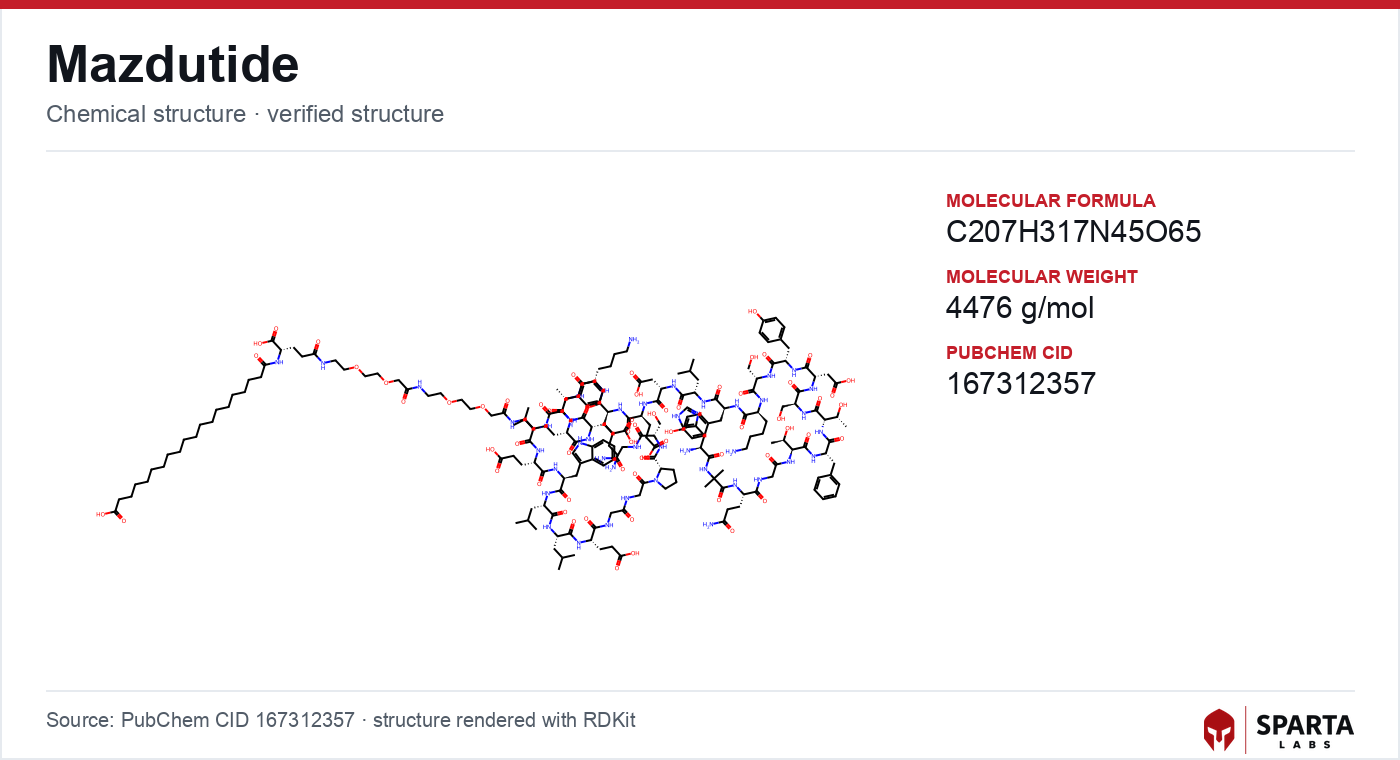
Figure: chemical structure of Mazdutide.
The Oxyntomodulin Lineage Behind the Molecule
Mazdutide belongs to a design lineage that predates the compound itself. The conceptual starting point is oxyntomodulin, a naturally occurring gut peptide that activates both the GLP-1 receptor and the glucagon receptor. Day and colleagues (2009) reported in Nature Chemical Biology the rational construction of a stable, single-molecule co-agonist uniting GLP-1 and glucagon receptor activity, work that established the pharmacological rationale for the GLP-1R/GCGR dual-agonist class [1]. Mazdutide is one member of that class engineered for a once-weekly pharmacokinetic profile.
Findings from research models do not establish safety or efficacy in humans. Sparta Labs makes no claims about the use of this compound.
Understanding this lineage matters when reading the mazdutide literature, because the added glucagon-receptor arm is precisely what separates it from single GLP-1 receptor agonists. Readers comparing pharmacological classes may find the mazdutide mechanism of action article useful for the receptor-signaling detail, and the retatrutide published research summary for a related multi-receptor agonist that adds GIP activity to the same conceptual framework.
Structural Basis of Dual-Receptor Engagement
The structural biology of how one peptide occupies two receptors was clarified by Zhou and colleagues (2023), who published cryo-electron microscopy structures of the GLP-1 receptor and the glucagon receptor in complex with heterotrimeric Gs protein and GLP-1R/GCGR dual-agonist peptides in the Proceedings of the National Academy of Sciences [2]. Although that study did not center on mazdutide specifically, it described the binding geometry at these class B1 receptors that permits balanced dual agonism, providing mechanistic context relevant to the entire co-agonist design strategy.
This structural work is relevant to the mazdutide literature because "balanced" agonism, comparable activity at both receptors rather than heavy bias toward one, is a characterization the compound's own investigators have used, and the receptor-level structures help explain how such balance can be tuned into a single peptide sequence.
Early-Phase Clinical Investigation in Overweight and Obesity
The clinical literature on mazdutide begins with dose-ascending phase 1b work conducted in Chinese adult populations.
Ji and colleagues (2021) published the first phase 1b study of IBI362 in eClinicalMedicine [3]. This randomized, placebo-controlled, multiple-ascending-dose study enrolled adults with overweight or obesity across multiple centres in China, administering the compound once weekly across ascending cohorts or placebo over a 12-week period. The authors reported a safety and tolerability profile they described as consistent with other GLP-1-based agents. A notable observation was coincident change across several cardiometabolic parameters, including serum uric acid, in a subset of recipients, a pattern the authors discussed in the context of the compound's glucagon-receptor activity [3].
Ji and colleagues (2022) subsequently reported results from higher-dose cohorts of the phase 1b overweight and obesity program, also in eClinicalMedicine [4]. This report extended the dose-ranging characterization used to inform later-phase trial design, again describing a tolerability profile the authors judged manageable within the studied cohorts.
Early-Phase Investigation in Type 2 Diabetes
Parallel early-phase work examined mazdutide in a distinct population. Jiang and colleagues (2022) published a phase 1b randomized controlled trial of IBI362 in Chinese patients with type 2 diabetes in Nature Communications [5]. Participants were randomized to receive once-weekly IBI362 across ascending dose cohorts, placebo, or an open-label GLP-1 receptor agonist comparator over a 12-week period.
In this report the investigators explicitly characterized IBI362 as a "balanced once-weekly GLP-1 and glucagon receptor dual agonist," language that ties the clinical program back to the receptor pharmacology discussed above [5]. The type 2 diabetes setting is analytically useful because it lets researchers observe glycemic parameters alongside the weight and cardiometabolic signals seen in the obesity cohorts, within a single dual-agonist framework.
The Phase 2 Randomized Controlled Trial
The dose-ranging phase 1b evidence set the stage for a larger controlled study. Feng and colleagues (2023) published a phase 2 randomized controlled trial of mazdutide in Chinese overweight adults or adults with obesity in Nature Communications [6]. The trial randomized participants to mazdutide at multiple dose levels or placebo over a 24-week period, with percentage change from baseline in body weight as the primary endpoint. The authors reported that the tested doses were associated with statistically significant differences from placebo on the primary endpoint at week 24 [6].
This publication marks the transition of mazdutide from exploratory dose-finding into a controlled efficacy-and-safety design, and it remains one of the more fully reported peer-reviewed trials in the compound's public literature. Its findings are attributed to the source and are not generalized beyond the studied Chinese adult population.
The Glucagon-Arm Signal as a Research Theme
A recurring analytical thread across the mazdutide reports is the set of observations attributed to glucagon-receptor engagement rather than GLP-1 activity alone. The coincident cardiometabolic changes noted in the phase 1b obesity work, including the serum uric acid observation, are of interest to researchers precisely because they may reflect the second receptor arm. Disentangling which reported outcomes derive from GCGR versus GLP-1R activity in human studies remains an open question in the literature and is a central reason the dual-agonist class is studied as a category distinct from single-incretin agonists.
Researchers examining how this dual-agonist framing sits alongside amylin-based and single-incretin approaches within the broader metabolic-peptide research space may find the cagrilintide published research summary a useful adjacent reference. Research-grade mazdutide from Sparta Labs is supplied with batch-specific Certificates of Analysis for non-clinical laboratory investigation.
Knowledge Gaps and Open Questions
Several limitations frame the current published record. The peer-reviewed clinical evidence base summarized here is concentrated in Chinese adult populations, which constrains generalization; the compound's characterization in populations without significant metabolic comorbidity is not established in these reports. Long-term outcome data and the relative mechanistic contribution of each receptor arm to individual observed parameters remain areas of continuing inquiry. As with any research compound, findings from the cited trials describe outcomes within their specific study designs and populations and do not establish safety or efficacy for any use. A structural and classificatory overview of the compound is available in the mazdutide research overview article.
References
-
Day JW, Ottaway N, Patterson JT, Gelfanov V, Smiley D, Gidda J, et al. A new glucagon and GLP-1 co-agonist eliminates obesity in rodents. Nat Chem Biol. 2009;5(10):749-757. DOI: 10.1038/nchembio.209. Full text via DOI
-
Zhou F, Zhang H, Cong Z, Zhao LH, Zhang Y, Zhao F, et al. Structural insights into the dual agonism at GLP-1R and GCGR. Proc Natl Acad Sci USA. 2023;120(35):e2303696120. DOI: 10.1073/pnas.2303696120. Full text via DOI
-
Ji L, Jiang H, Cheng Z, Qiu W, Liao L, Zhang Y, et al. A multicentre, randomized, double-blind, placebo-controlled, multiple ascending dose study of IBI362 (LY3305677), a weekly-dose GLP-1 and glucagon receptor dual agonist, in Chinese adults with overweight or obesity. eClinicalMedicine. 2021;39:101088. DOI: 10.1016/j.eclinm.2021.101088. Full text via DOI
-
Ji L, Gao L, Jiang H, Yang J, Yu L, Wen J, et al. Safety and efficacy of a GLP-1 and glucagon receptor dual agonist mazdutide (IBI362) in Chinese adults with overweight or obesity: a randomised, placebo-controlled, multiple-ascending-dose phase 1b trial. eClinicalMedicine. 2022;54:101691. DOI: 10.1016/j.eclinm.2022.101691. Full text via DOI
-
Jiang H, Pang S, Zhang Y, Yu T, Liu M, Deng H, et al. A phase 1b randomised controlled trial of a glucagon-like peptide-1 and glucagon receptor dual agonist IBI362 (LY3305677) in Chinese patients with type 2 diabetes. Nat Commun. 2022;13(1):3613. DOI: 10.1038/s41467-022-31328-x. Full text via DOI
-
Feng Z, Zhao C, Wang X, Gan L, Xia L, Han C, et al. A phase 2 randomised controlled trial of mazdutide in Chinese overweight adults or adults with obesity. Nat Commun. 2023;14(1):8156. DOI: 10.1038/s41467-023-44067-4. Full text via DOI
Disclaimer. Statements in this article have not been evaluated by the Food and Drug Administration. This compound is not intended to diagnose, treat, cure, or prevent any disease. Sparta Labs sells research-use-only materials. Content is provided for educational and informational purposes only and does not constitute medical advice. Consult a qualified medical professional for any health concerns.
Frequently asked questions
What is mazdutide and how is it classified in the research literature?
Mazdutide (IBI362 / LY3305677) is a synthetic peptide described in the published literature as a dual agonist of the glucagon-like peptide-1 receptor (GLP-1R) and the glucagon receptor (GCGR). It belongs to the oxyntomodulin-inspired co-agonist class, in which a single peptide engages two related class B1 G protein-coupled receptors. Researchers have characterized it as a balanced, once-weekly agonist across both receptor targets.
What distinguishes mazdutide research from single-incretin agonist research?
The mazdutide literature places emphasis on the added glucagon-receptor arm, which is not present in single GLP-1 receptor agonists. Published phase 1b reports noted coincident changes across several cardiometabolic parameters, including serum uric acid, and the compound is studied specifically as a dual GLP-1R/GCGR agonist. The 2023 structural work in PNAS on GLP-1R and GCGR helps contextualize how dual-receptor engagement differs mechanistically from single-target binding.
In what populations has mazdutide been studied in published trials?
The peer-reviewed early-phase trials were conducted primarily in Chinese adult populations with overweight, obesity, or type 2 diabetes. Phase 1b results appeared in eClinicalMedicine and Nature Communications, and a phase 2 randomized controlled trial was published in Nature Communications in 2023. Findings from these studies are attributed to their source publications in this article and are not extrapolated beyond the studied populations.
What does the structural biology literature say about GLP-1R/GCGR dual agonism?
A 2023 study in the Proceedings of the National Academy of Sciences reported cryo-electron microscopy structures of the GLP-1 receptor and the glucagon receptor in complex with Gs protein and dual-agonist peptides. This work described the binding geometry that allows a single peptide to engage both class B1 receptors, providing structural context for the co-agonist design strategy that mazdutide exemplifies.