
Retatrutide: Published Research Summary
A bibliographic summary of the primary peer-reviewed literature on retatrutide (LY3437943), tracing the compound from its founding discovery paper through cryo-EM structural biology and its phase 1 and phase 2 clinical trial program. Educational reference.

For research use only. Not for human consumption. This article is educational reference material. It is not medical advice and is not a recommendation to use any substance.
Introduction
Retatrutide (development code LY3437943) is an investigational single-molecule agonist reported to engage three incretin- and metabolism-related receptors: the glucose-dependent insulinotropic polypeptide receptor (GIPR), the glucagon-like peptide-1 receptor (GLP-1R), and the glucagon receptor (GCGR). It was developed by Eli Lilly and Company. Because the triple-receptor design distinguishes it from earlier single- and dual-agonist peptides, the published literature has grown along an unusually legible arc: a founding discovery paper, a structural-biology study resolving how one peptide can occupy three distinct receptor complexes, and a sequence of clinical trials that broadened from glycemic endpoints into obesity and liver-fat endpoints. This article summarizes those primary publications with attribution and methodology context. It reports what investigators reported and does not draw independent conclusions, offer a meta-analysis, or extrapolate beyond the cited sources.
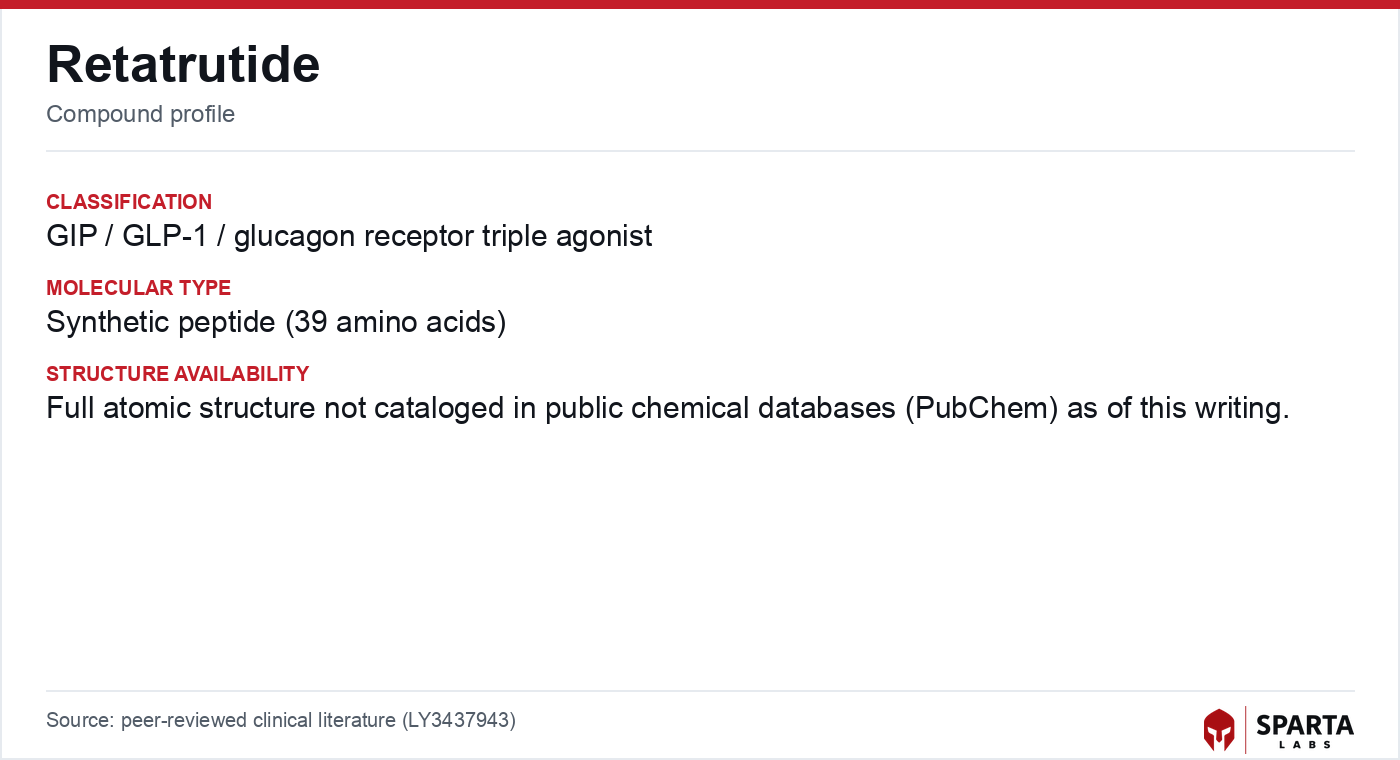
Figure: chemical structure of retatrutide.
How the Retatrutide Literature Is Organized
Unlike compounds with decades of scattered publications, retatrutide's peer-reviewed record is compact and recent, which makes its methodological structure easy to trace. The literature falls into four tiers. The first is molecular pharmacology and medicinal-chemistry characterization, describing the peptide's design and its in vitro potency across the three receptors. The second is structural biology, using cryo-electron microscopy to resolve the compound in complex with each receptor and its associated G protein. The third is early-phase human pharmacology, characterizing pharmacokinetics and pharmacodynamics in small cohorts. The fourth is phase 2 randomized controlled trials, which extended into distinct enrolled populations and reported metabolic endpoints over 24- to 48-week windows. A parallel phase 3 program is registered but, at the time of writing, its pivotal peer-reviewed reports are still emerging.
Readers seeking the receptor-level rationale behind these findings may consult the companion retatrutide mechanism of action article, while the retatrutide research overview situates the compound within its pharmacological class.
The Founding Paper: Coskun et al., 2022
Coskun, Urva, Roell, and colleagues reported the discovery and preclinical characterization of LY3437943 in Cell Metabolism in 2022 [1]. The paper described the design rationale for a peptide built to engage all three receptors, including a fatty-acid acylation intended to promote albumin binding and an extended circulating half-life. The authors characterized in vitro receptor pharmacology across GIPR, GLP-1R, and GCGR, and reported results in diet-induced obese rodent models comparing the triple agonist with a selective GLP-1R agonist. The paper also included first-in-human single-ascending-dose pharmacokinetic data, positioning the pharmacokinetic profile as consistent with extended-interval administration. As the founding reference, this publication anchors nearly every downstream study's account of the molecule.
Findings from research models do not establish safety or efficacy in humans. Sparta Labs makes no claims about the use of this compound.
Resolving Triple Engagement: Structural Biology
A recurring question in the retatrutide literature is how a single peptide can act as an agonist at three related but distinct class B G-protein-coupled receptors. Li, Zhou, Cong, and colleagues addressed this in Cell Discovery in 2024 by publishing cryo-electron microscopy structures of retatrutide bound to the GLP-1R–Gs, GIPR–Gs, and GCGR–Gs complexes [2]. The authors described distinct binding geometries at each complex and characterized residue-level interactions consistent with the compound's differing relative potencies across the three receptors. This structural work provided an atomic-resolution frame for interpreting the pharmacological asymmetry reported in the earlier characterization studies, and it is the principal structural reference cited by subsequent reviews.
Early-Phase Human Pharmacology: Urva et al., 2022
Urva, Coskun, Loh, and colleagues reported a phase 1b, multicenter, double-blind, placebo-controlled, randomized, multiple-ascending-dose trial in The Lancet in 2022 [3]. The study enrolled adults with type 2 diabetes across several dose cohorts and characterized the pharmacokinetic and pharmacodynamic profile of the compound in humans over repeated administration. The authors reported a pharmacokinetic profile consistent with extended-interval administration and described the observed tolerability findings in the context of the broader incretin-agonist class. This publication represented the first peer-reviewed multi-dose human clinical data for retatrutide and established the pharmacological groundwork for the phase 2 program.
The Phase 2 Program: Three Distinct Populations
Retatrutide's phase 2 evidence is notable because it did not confine itself to a single endpoint or population. Three separate randomized trials examined the compound in obesity, in type 2 diabetes, and in metabolic dysfunction-associated steatotic liver disease, each reported in a different high-profile journal.
Obesity: Jastreboff et al., 2023 (NEJM)
Jastreboff, Kaplan, Frías, and colleagues reported a phase 2, double-blind, randomized, placebo-controlled trial in the New England Journal of Medicine in 2023 [4]. The trial enrolled adults with obesity (or overweight with at least one weight-related condition) and randomized participants across several retatrutide dose levels or placebo over a 48-week period. The authors reported statistically significant mean reductions in body weight from baseline across the retatrutide groups relative to placebo, with the magnitude differing by dose level. Gastrointestinal adverse events, principally nausea, diarrhea, and vomiting, were the most frequently reported findings, consistent with the incretin-agonist class. The authors noted that body weight had not appeared to plateau by week 48 in the highest-dose group and characterized this as warranting evaluation in longer-duration studies.
Type 2 Diabetes: Rosenstock et al., 2023 (Lancet)
Rosenstock, Frías, Jastreboff, and colleagues reported a phase 2, randomized, double-blind, placebo- and active-controlled, parallel-group trial in The Lancet in 2023 [5]. Conducted at US sites, the trial enrolled adults with type 2 diabetes across several retatrutide dose groups, a dulaglutide active-control group, and a placebo group over a 36-week period. The authors reported statistically significant mean reductions in HbA1c and greater mean reductions in body weight in the retatrutide groups relative to both placebo and active control. Gastrointestinal adverse events were again among the most frequently reported findings. The authors observed that several endpoints had not reached an apparent plateau by 36 weeks in the higher-dose groups, an observation they noted as informative for phase 3 program design.
Liver Fat: Sanyal et al., 2024 (Nature Medicine)
Sanyal, Kaplan, Frías, Brouwers, and colleagues reported a phase 2a, randomized, placebo-controlled trial in adults with metabolic dysfunction-associated steatotic liver disease (MASLD) in Nature Medicine in 2024 [6]. The 98-participant trial used liver fat content, assessed by MRI-derived proton density fat fraction (MRI-PDFF), as the primary endpoint at 24 weeks. The authors reported statistically significant mean relative reductions in liver fat from baseline in the retatrutide groups relative to placebo, with magnitude varying by dose level, and reported secondary histological and biochemical measures. The authors characterized the findings as hypothesis-generating and identified larger confirmatory trials as the appropriate next step.
Where the Evidence Is Still Thin
Several recognized gaps define the current frontier of the retatrutide literature. The relative contribution of each receptor target (GIPR, GLP-1R, GCGR) to the effects reported in human trials remains a mechanistic priority, because receptor-selective dissection studies in humans have not appeared in the primary literature; the structural work in reference [2] frames but does not resolve this question. Durability of metabolic effects beyond the phase 2 windows, and outcomes following discontinuation, are questions that longer trials are designed to address. Dedicated cardiovascular-outcomes evidence had not been reported in the peer-reviewed literature at the time of writing.
The phase 3 program is registered on public trial registries, including trials under the TRIUMPH (obesity) and TRANSCEND (type 2 diabetes) program names; NCT05929066 is one such registered obesity trial [7]. Pivotal phase 3 peer-reviewed publications were still emerging, and this article does not summarize unpublished results.
For a complementary incretin-adjacent approach, the cagrilintide published research article covers an amylin/GLP-1 co-agonist line of investigation, and the tirzepatide published research article summarizes the dual GIP/GLP-1 agonist that preceded triple-agonist development. Research-grade retatrutide from Sparta Labs is supplied with third-party purity documentation.
References
-
Coskun T, Urva S, Roell WC, Qu H, Loghin C, Moyers JS, et al. LY3437943, a novel triple glucagon, GIP, and GLP-1 receptor agonist for glycemic control and weight loss: From discovery to clinical proof of concept. Cell Metab. 2022;34(9):1234-1247.e9. PMID: 35921817. DOI: 10.1016/j.cmet.2022.07.013. Available at: View on PubMed
-
Li W, Zhou Q, Cong Z, Yuan Q, Li W, Zhao F, et al. Structural insights into the triple agonism at GLP-1R, GIPR and GCGR manifested by retatrutide. Cell Discov. 2024;10:77. PMID: 39019866. DOI: 10.1038/s41421-024-00700-0. Available at: View on PubMed
-
Urva S, Coskun T, Loh MT, Du Y, Thomas MK, Gurbuz S, et al. LY3437943, a novel triple GIP, GLP-1, and glucagon receptor agonist in people with type 2 diabetes: a phase 1b, multicentre, double-blind, placebo-controlled, randomised, multiple-ascending dose trial. Lancet. 2022;400(10366):1869-1881. PMID: 36354040. DOI: 10.1016/S0140-6736(22)02033-5. Available at: View on PubMed
-
Jastreboff AM, Kaplan LM, Frías JP, Wu Q, Du Y, Gurbuz S, et al. Triple–hormone-receptor agonist retatrutide for obesity — a phase 2 trial. N Engl J Med. 2023;389(6):514-526. PMID: 37366315. DOI: 10.1056/NEJMoa2301972. Available at: View on PubMed
-
Rosenstock J, Frías JP, Jastreboff AM, Du Y, Lou J, Gurbuz S, et al. Retatrutide, a GIP, GLP-1 and glucagon receptor agonist, for people with type 2 diabetes: a randomised, double-blind, placebo and active-controlled, parallel-group, phase 2 trial conducted in the USA. Lancet. 2023;402(10401):529-544. PMID: 37385280. DOI: 10.1016/S0140-6736(23)01053-X. Available at: View on PubMed
-
Sanyal AJ, Kaplan LM, Frías JP, Brouwers B, Wu Q, Thomas MK, et al. Triple hormone receptor agonist retatrutide for metabolic dysfunction-associated steatotic liver disease: a randomized phase 2a trial. Nat Med. 2024;30(7):2037-2048. PMID: 38858523. DOI: 10.1038/s41591-024-03018-2. Available at: View on PubMed
-
ClinicalTrials.gov. A study of retatrutide (LY3437943) in participants who have obesity or overweight (TRIUMPH-1). Identifier NCT05929066. Available at: ClinicalTrials.gov record
Disclaimer. Statements in this article have not been evaluated by the Food and Drug Administration. This compound is not intended to diagnose, treat, cure, or prevent any disease. Sparta Labs sells research-use-only materials. Content is provided for educational and informational purposes only and does not constitute medical advice. Consult a qualified medical professional for any health concerns.
Frequently asked questions
What peer-reviewed research exists on retatrutide?
The primary retatrutide literature includes a discovery and preclinical characterization paper in Cell Metabolism (2022), a cryo-electron microscopy structural study in Cell Discovery (2024), a phase 1b multiple-ascending-dose trial in The Lancet (2022), and phase 2 trials reported in the New England Journal of Medicine (2023), The Lancet (2023), and Nature Medicine (2024). This article summarizes each with attribution and methodology context.
Why is retatrutide described as a triple receptor agonist?
Retatrutide (LY3437943) is reported to act as an agonist at three receptors: the GIP receptor, the GLP-1 receptor, and the glucagon receptor. A 2024 cryo-electron microscopy study in Cell Discovery resolved the compound bound to each of the three receptor complexes and described distinct binding geometries, providing atomic-resolution context for how one peptide engages all three targets.
What did the phase 2 obesity trial (Jastreboff et al., 2023) report?
Jastreboff and colleagues reported a 48-week phase 2, randomized, double-blind, placebo-controlled trial in the New England Journal of Medicine in 2023. The authors reported statistically significant mean reductions in body weight from baseline across the retatrutide dose groups relative to placebo, with gastrointestinal adverse events the most frequently reported findings, consistent with the incretin-agonist class.
What did the retatrutide MASLD study examine?
Sanyal and colleagues reported a phase 2a, randomized, placebo-controlled trial in adults with metabolic dysfunction-associated steatotic liver disease in Nature Medicine in 2024. The 98-participant trial used liver fat measured by MRI-PDFF as the primary endpoint at 24 weeks and reported statistically significant mean relative reductions in liver fat across retatrutide groups relative to placebo, which the authors characterized as hypothesis-generating.
Are phase 3 retatrutide trials published?
A phase 3 program is registered on public trial registries under program names including TRIUMPH (obesity) and TRANSCEND (type 2 diabetes); NCT05929066 is one registered obesity trial. At the time of writing, pivotal phase 3 peer-reviewed publications were still emerging, so this article summarizes only the published preclinical, phase 1, and phase 2 literature.