
MOTS-c: Discovery and Regulatory History
MOTS-c was identified in 2015 within the mitochondrial 12S rRNA gene at USC, building on the 2001 discovery of humanin. This article traces the peptide's lineage, the growth of the mitochondrial-derived peptide field, and its regulatory context. Educational reference.

For research use only. Not for human consumption. This article is educational reference material. It is not medical advice and is not a recommendation to use any substance.
Introduction
MOTS-c is a 16-amino-acid mitochondrial-derived peptide (MDP) that entered the published scientific record in March 2015, when a team at the University of Southern California (USC) reported a peptide-coding open reading frame (ORF) embedded within the mitochondrial 12S ribosomal RNA gene, MT-RNR1 [1]. Its arrival did not happen in isolation. MOTS-c was the second member of an emerging peptide class whose founding molecule, humanin, had been described in 2001, and its discovery reflects a shift in how the mitochondrial genome itself came to be read. This article traces that lineage: the intellectual groundwork laid by humanin, the bioinformatic approach that surfaced MOTS-c, the international expansion of the research field, and the regulatory context in which the peptide now sits. A companion account of the peptide's chemistry and pharmacological classification appears in the MOTS-c research overview.
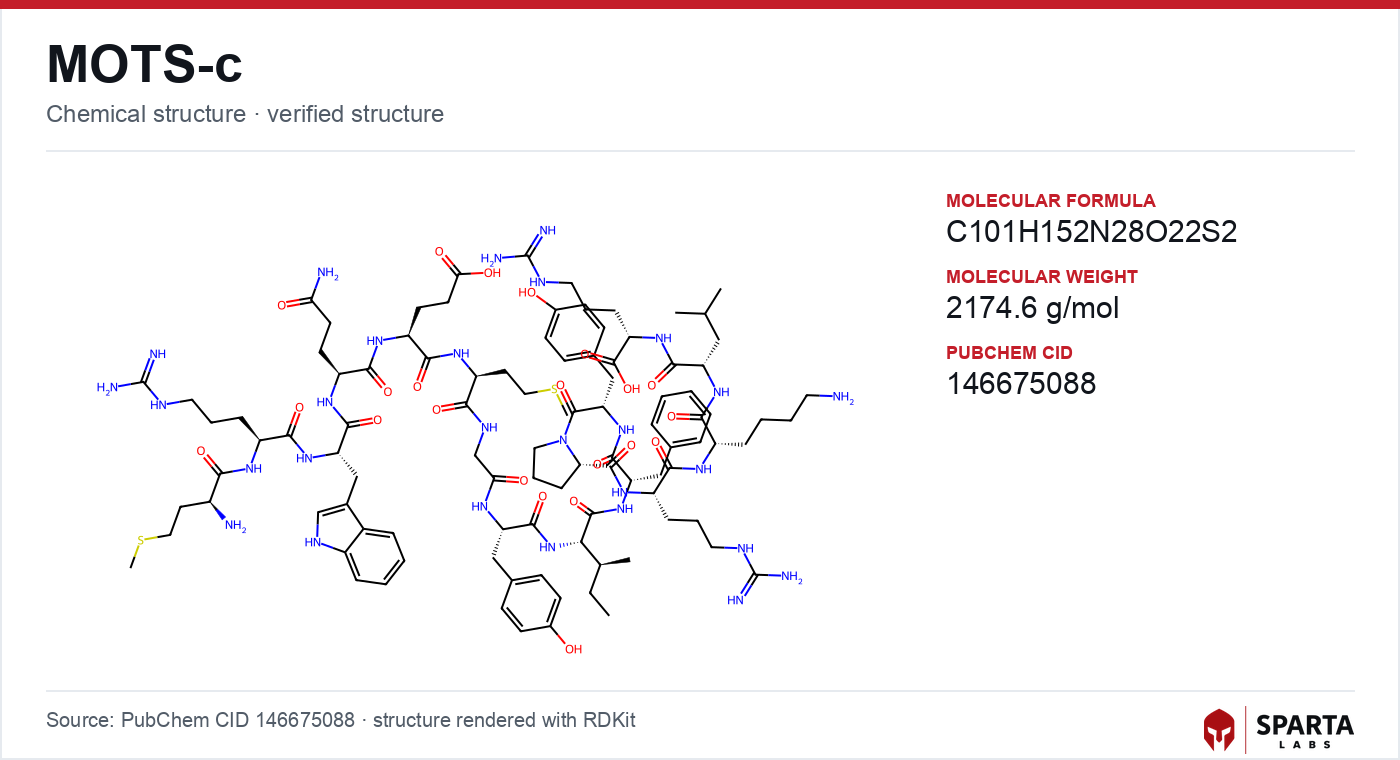
Figure: chemical structure of MOTS-c.
Reading the Mitochondrial Genome as a Source of Peptides
For most of the twentieth century, the 16.5-kilobase circular mitochondrial genome was understood almost entirely through its 13 protein-coding genes for oxidative phosphorylation subunits, plus the transfer-RNA and ribosomal-RNA genes needed to translate them. The two rRNA genes, MT-RNR1 (12S) and MT-RNR2 (16S), were classified as structural rather than protein-coding. That classification was the assumption MOTS-c's discovery would eventually overturn.
The turning point came in 2001. Working in the laboratory of Ikuo Nishimoto, Hashimoto and colleagues screened a cDNA library built from the preserved cerebral cortex of a patient with Alzheimer's disease and isolated a short sequence encoding a 24-amino-acid peptide, which they named humanin. In their assays, humanin was reported to suppress neuronal cell death induced by familial Alzheimer's disease genes. The sequence mapped to the 16S rRNA region (MT-RNR2) of mitochondrial DNA [2]. This was the first demonstration that an rRNA-coding stretch of the mitochondrial genome contained a functional peptide-encoding ORF.
Findings from research models do not establish safety or efficacy in humans. Sparta Labs makes no claims about the use of this compound.
Humanin reframed a structural region of the genome as a potential source of bioactive peptides. It also seeded a research program at USC, where Pinchas Cohen's group developed both the assays and the conceptual framework for a systematic question: if the 16S region encoded one bioactive peptide, did other rRNA regions encode more?
The 2015 Identification of MOTS-c
By the early 2010s, improved computational tools for scanning ORFs within non-canonical coding regions made that question tractable. Within the Cohen laboratory, Changhan Lee applied the approach to the 12S rRNA region (MT-RNR1) and identified a short ORF encoding a 16-amino-acid peptide with the sequence MRWQEMGYIFYPRKLR. The peptide was chemically synthesized, and its endogenous presence was confirmed by mass spectrometry in human plasma and cultured cells. The team named it MOTS-c, for mitochondrial ORF of the 12S rRNA type-c [1].
The findings appeared in Cell Metabolism in March 2015, authored by Lee, Zeng, Drew, Sallam, Martin-Montalvo, Wan, Kim, Mehta, Hevener, de Cabo, and Cohen [1]. The paper reported the peptide's conservation across mammalian species, characterized a mechanism involving the folate cycle and AMP-activated protein kinase (AMPK), and described metabolic observations in rodent models. The mechanistic account is examined in more detail in the MOTS-c mechanism of action article. The report drew immediate interest because it suggested that the organellar genome, long treated as a bystander in cellular signaling, might encode a class of molecules with reach beyond the mitochondrion itself.
Consolidation of the Mitochondrial-Derived Peptide Class
MOTS-c did not remain a solitary example for long. In 2016, the Cohen group described a set of small humanin-like peptides (SHLP 1 through 6) encoded within the same 16S region that had yielded humanin, further populating the mitochondrial-derived peptide category [3]. Humanin, MOTS-c, and the SHLPs together supplied enough members for the MDP class to be treated as a coherent research field rather than a collection of isolated curiosities, and they anchored the broader hypothesis that mitochondria communicate with the rest of the cell, and with distant tissues, through peptide products of their own genome.
From 2016 onward, laboratories in Japan, China, South Korea, and Europe began publishing independently on MOTS-c. An early and influential thread connected the peptide to human population genetics: a 2015 letter in Aging Cell by Fuku and colleagues observed that variants in the MT-RNR1 region had previously been associated with longevity in Japanese cohorts, and raised the hypothesis that MOTS-c biology might be relevant to variation in aging trajectories [4]. That observation moved MOTS-c research beyond cell and rodent models toward human genetic epidemiology.
From Cytoplasmic Signal to Nuclear Messenger
A conceptually significant development arrived in 2018, when Kim, Son, Benayoun, and Lee reported in Cell Metabolism that MOTS-c can translocate to the nucleus under conditions of metabolic stress and participate in the regulation of nuclear gene expression [5]. This positioned MOTS-c as a candidate mitochondrial-to-nuclear retrograde signal, a molecule through which the mitochondrial genome could influence nuclear transcriptional programs directly rather than only through metabolic intermediates.
The exercise-physiology literature expanded the picture further. A 2021 study in Nature Communications by Reynolds and colleagues examined MOTS-c in the context of skeletal muscle and physical activity across species, reporting associations between the peptide and exercise-related metabolic adaptation in the models studied [6]. Together, the nuclear-translocation and exercise findings broadened the range of biological questions researchers brought to the peptide.
Regulatory Milestones
MOTS-c's regulatory status reflects a compound still under active preclinical and observational investigation. As of the date of this article, no New Drug Application or Biologics License Application for MOTS-c has been filed with the US Food and Drug Administration. It has not been approved for any human use and is handled as a research-use-only material consistent with that stage of development.
The most concrete regulatory event to date comes from anti-doping policy. In 2024, the World Anti-Doping Agency added MOTS-c to its Prohibited List within the category of metabolic modulators addressing AMPK-pathway activity, applicable to athletes subject to WADA rules. The listing is notable less as a therapeutic determination than as formal recognition, by a standards body, of the peptide's characterized activity in the AMPK pathway. Broader questions of manufacturing and analytical verification for peptides at this stage are addressed in the MOTS-c sourcing and quality article.
The Research Landscape a Decade On
Roughly a decade after the founding paper, the MOTS-c literature spans cell biology, rodent physiology, human observational and genetic studies, and review articles. A 2023 review in the Journal of Translational Medicine by Wan and colleagues synthesized the mechanistic and translational state of the field, describing a substantial preclinical foundation across stress-response, metabolic, and aging-related research contexts while noting that interventional human data remained limited [7]. The arc from a single-group discovery paper in 2015 to an internationally distributed effort across many laboratories illustrates how quickly the mitochondrial-derived peptide concept moved from hypothesis to established subject of study.
MOTS-c sits within a broader cluster of compounds studied for their roles in mitochondrial and metabolic biology. Readers tracing adjacent research lineages may find useful context in the glutathione research overview, which discusses antioxidant signaling in an intersecting research space, and the NAD+ discovery and research history, which follows a coenzyme central to mitochondrial energy metabolism. The MOTS-c reference material sold as a research chemical is catalogued on the MOTS-c product page.
References
-
Lee C, Zeng J, Drew BG, Sallam T, Martin-Montalvo A, Wan J, Kim SJ, Mehta H, Hevener AL, de Cabo R, Cohen P. The mitochondrial-derived peptide MOTS-c promotes metabolic homeostasis and reduces obesity and insulin resistance. Cell Metab. 2015 Mar 3;21(3):443–454. doi: 10.1016/j.cmet.2015.02.009. PMID: 25738459. View on PubMed
-
Hashimoto Y, Niikura T, Tajima H, Yasukawa T, Sudo H, Ito Y, Kita Y, Kawasumi M, Kouyama K, Doyu M, Sobue G, Koide T, Tsuji S, Lang J, Kurokawa K, Nishimoto I. A rescue factor abolishing neuronal cell death by a wide spectrum of familial Alzheimer's disease genes and Abeta. Proc Natl Acad Sci U S A. 2001 May 22;98(11):6336–6341. doi: 10.1073/pnas.101133498. PMID: 11371646. View on PubMed
-
Cobb LJ, Lee C, Xiao J, Yen K, Wong RG, Nakamura HK, Mehta HH, Gao Q, Ashur C, Huffman DM, Wan J, Muzumdar R, Barzilai N, Cohen P. Naturally occurring mitochondrial-derived peptides are age-dependent regulators of apoptosis, insulin sensitivity, and inflammatory markers. Aging (Albany NY). 2016 Apr;8(4):796–809. doi: 10.18632/aging.100943. PMID: 27070891. View on PubMed
-
Fuku N, Pareja-Galeano H, Zempo H, Alis R, Arai Y, Lucia A, Hirose N. The mitochondrial-derived peptide MOTS-c: a player in exceptional longevity? Aging Cell. 2015 Dec;14(6):921–923. doi: 10.1111/acel.12389. PMID: 26332820. View on PubMed
-
Kim KH, Son JM, Benayoun BA, Lee C. The mitochondrial-encoded peptide MOTS-c translocates to the nucleus to regulate nuclear gene expression in response to metabolic stress. Cell Metab. 2018 Sep 4;28(3):516–524.e7. doi: 10.1016/j.cmet.2018.06.015. PMID: 29983246. View on PubMed
-
Reynolds JC, Lai RW, Woodhead JST, Joly JH, Mitchell CJ, Cameron-Smith D, Lu R, Cohen P, Graham NA, Benayoun BA, Merry TL, Lee C. MOTS-c is an exercise-induced mitochondrial-encoded regulator of age-dependent physical decline and muscle homeostasis. Nat Commun. 2021 Jan 20;12(1):470. doi: 10.1038/s41467-020-20790-0. PMID: 33473109. View on PubMed
-
Wan W, Zhang L, Lin Y, Rao X, Wang X, Hua F, Ying J. Mitochondria-derived peptide MOTS-c: effects and mechanisms related to stress, metabolism and aging. J Transl Med. 2023 Jan 20;21(1):36. doi: 10.1186/s12967-023-03885-2. PMID: 36670507. View on PubMed
Disclaimer. Statements in this article have not been evaluated by the Food and Drug Administration. This compound is not intended to diagnose, treat, cure, or prevent any disease. Sparta Labs sells research-use-only materials. Content is provided for educational and informational purposes only and does not constitute medical advice. Consult a qualified medical professional for any health concerns.
Frequently asked questions
When and where was MOTS-c discovered?
MOTS-c was first described in a March 2015 paper in Cell Metabolism by Lee, Zeng, Drew, Sallam and colleagues at the University of Southern California. It was identified through bioinformatic screening of the mitochondrial 12S ribosomal RNA gene (MT-RNR1) for uncharacterized peptide-coding open reading frames.
How does humanin relate to the discovery of MOTS-c?
Humanin, a 24-amino-acid peptide encoded in the 16S rRNA region (MT-RNR2) of mitochondrial DNA, was described in 2001 and was the first mitochondrial-derived peptide identified. Its discovery established that rRNA regions of the mitochondrial genome could encode functional peptides, providing the conceptual and methodological groundwork for the later identification of MOTS-c in the 12S region.
What is the mitochondrial-derived peptide (MDP) class?
The mitochondrial-derived peptide class refers to bioactive peptides encoded within the mitochondrial genome, particularly its ribosomal RNA regions. As of the mid-2020s the class includes humanin, MOTS-c, and the small humanin-like peptides (SHLP 1 through 6), described in a 2016 report by the Cohen group.
What is the regulatory status of MOTS-c?
As of this article, no New Drug Application or Biologics License Application for MOTS-c has been filed with the US FDA, and it is not approved for human use. In 2024 the World Anti-Doping Agency added MOTS-c to its Prohibited List within the metabolic-modulator category addressing AMPK-pathway activity, for athletes subject to WADA rules.
Why did the discovery of MOTS-c attract scientific attention?
The mitochondrial genome had long been studied mainly for its role in oxidative phosphorylation, with its rRNA genes treated as structural. Reporting a bioactive peptide encoded within the 12S rRNA gene supported the idea that mitochondria communicate through peptide products of their own genome, a concept later extended by findings on nuclear translocation and exercise physiology.