
MOTS-c Mechanism of Action
A mechanism-focused summary of MOTS-c, the mitochondrial-encoded peptide: its origin in the 12S rRNA reading frame, the folate cycle to AICAR to AMPK signaling axis, stress-induced nuclear translocation, and exercise-responsive expression as reported in cell and rodent studies. Educational reference.

For research use only. Not for human consumption. This article is educational reference material. It is not medical advice and is not a recommendation to use any substance.
Introduction
MOTS-c (mitochondrial open reading frame of the twelve-S rRNA type-c) is a 16-amino-acid peptide encoded not in the nuclear genome but within the mitochondrial 12S ribosomal RNA gene (MT-RNR1). It was first characterized by Lee and colleagues in 2015 [1]. Its mechanistic literature is unusual among signaling peptides because the compound originates inside the organelle whose activity it is reported to influence. This article summarizes how published cell-culture and rodent studies have described the peptide's molecular behavior. Broader chemistry, classification, and nomenclature are covered in the MOTS-c research overview.
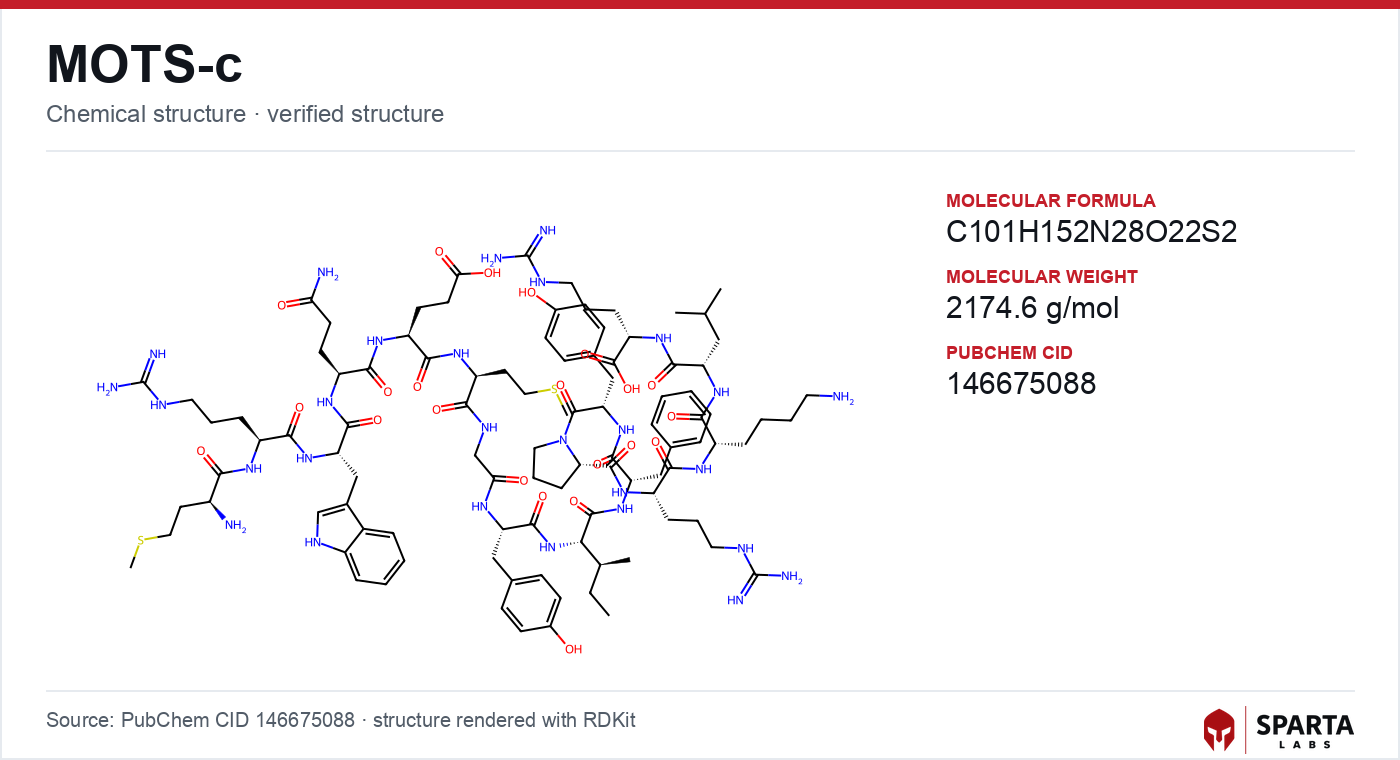
Figure: chemical structure of MOTS-c.
Origin in the Mitochondrial Genome
The mechanistic story of MOTS-c begins with where its sequence sits. Lee et al. reported that the peptide is translated from a short open reading frame residing inside the MT-RNR1 (12S rRNA) region of mitochondrial DNA [1]. This places MOTS-c within the class of mitochondrial-derived peptides, small peptides read from cryptic reading frames embedded in mitochondrial ribosomal RNA genes rather than from dedicated nuclear genes.
That genomic address matters mechanistically for two reasons discussed in the literature. First, expression of the peptide is tied to the state of the mitochondrial genome and to mitochondrial translation, linking its abundance to organellar status. Second, because the coding region overlaps a functional rRNA element, sequence variation in this region can carry both structural (ribosomal) and peptide-level consequences, a feature reviewed by Wan and colleagues in a 2023 overview of the field [7]. The peptide's mitochondrial origin frames the recurring theme in its mechanism: a factor produced inside mitochondria acting on cytoplasmic and nuclear targets.
The Folate Cycle to AICAR to AMPK Axis
The central cytoplasmic mechanism reported for MOTS-c is indirect rather than receptor-driven. The 2015 discovery paper reported that, following cellular uptake, MOTS-c interferes with the folate cycle at a step involving 5-methyl-tetrahydrofolate, which is tightly coupled to de novo purine biosynthesis [1].
Findings from research models do not establish safety or efficacy in humans. Sparta Labs makes no claims about the use of this compound.
Because that pathway feeds purine synthesis, its inhibition was reported to cause accumulation of AICAR (5-aminoimidazole-4-carboxamide ribonucleotide), an intermediate that is itself a well-characterized direct activator of AMP-activated protein kinase (AMPK). The authors reported a greater-than-20-fold rise in endogenous AICAR in MOTS-c-treated human embryonic kidney (HEK293) cells relative to controls [1].
AMPK is a heterotrimeric serine/threonine kinase that acts as a cellular energy sensor, becoming active as intracellular AMP-to-ATP ratios rise. The reported sequence — folate cycle interference, AICAR accumulation, AMPK activation — was observed both in cell culture and in mouse skeletal muscle after peripheral peptide administration [1]. The mechanistic significance is that MOTS-c is characterized as engaging AMPK through an endogenous metabolite intermediate rather than by binding AMPK directly, a distinction that has drawn continued research attention.
Metabolite-Level Signatures in Rodent Models
A 2019 study in Physiological Reports by Kim, Miller, Mehta, and colleagues applied targeted metabolomics to mice administered MOTS-c to map the downstream metabolic profile [2]. The authors reported alterations in sphingolipid, monoacylglycerol, and dicarboxylate metabolic pathways in treated animals relative to controls.
Those pathways had been associated in earlier literature with insulin-resistant metabolic states. The authors noted their reduction in treated animals while stating explicitly that a causal link between the observed metabolomic shifts and any specific physiological outcome remained to be established. The value of this work in the mechanistic picture is that it moves beyond a single kinase step and characterizes MOTS-c administration as associated with a broader, measurable shift in the metabolite landscape of the treated animal. A wider survey of these study designs appears in the MOTS-c published-research summary.
Retrograde Signaling: Nuclear Translocation Under Stress
A distinct and much-discussed mechanism was described by Kim, Son, Benayoun, and Lee in a 2018 Cell Metabolism paper [3]. The authors reported that MOTS-c can translocate from the cytoplasm into the nucleus within roughly 30 minutes of experimentally induced metabolic stress — created by glucose restriction, serum deprivation, or oxidative stress in cultured cells. This nuclear movement was reported to depend on AMPK activity, since pharmacological AMPK inhibition attenuated nuclear accumulation of the peptide [3].
Inside the nucleus, MOTS-c was reported to associate with the regulation of a broad set of stress-responsive genes, including genes bearing antioxidant response elements (AREs) in their promoters. The authors described interactions with ARE-linked transcription factors including NRF2 (nuclear factor erythroid 2-related factor 2). They framed this behavior as mitochondrial-to-nuclear retrograde signaling: a peptide encoded by the mitochondrial genome directly participating in nuclear gene regulation under metabolic or oxidative challenge. This concept of an organellar-genome-encoded factor acting in the nucleus is the reason the paper attracted attention across the mitochondrial-communication field.
Exercise-Responsive Expression
Mechanistic interest in MOTS-c extends to when the endogenous peptide appears. Reynolds and colleagues, in a 2021 Nature Communications paper, reported that acute exercise in young male human participants (n = 10) was associated with an approximately 11.9-fold rise in intramuscular MOTS-c expression and an approximately 1.6-fold rise in circulating plasma levels [5]. The same study reported exercise- and age-related patterns in rodent models.
The human component was observational and limited by its small sample. The authors described the findings as consistent with a role for endogenous MOTS-c in physiological adaptation, connecting the peptide's regulation to skeletal-muscle activity. In mechanistic terms, this positions MOTS-c not as a static constituent but as a stress- and activity-responsive signal whose abundance changes with the metabolic demands placed on tissue. Research-grade material for laboratory study is described on the MOTS-c product page.
Limits of Current Mechanistic Understanding
Several mechanistic questions remain open in the published literature. The specific cell-surface receptor or transport mechanism that mediates MOTS-c entry into target cells — if a dedicated one exists — had not been conclusively identified in the cited studies. Its determination would substantially clarify tissue selectivity and the route by which an extracellular peptide reaches intracellular folate-cycle and nuclear targets.
The relative contribution of the folate-AICAR-AMPK axis versus the nuclear retrograde pathway in any given physiological or pathological context also remains an area of active inquiry, as does published pharmacokinetic characterization of exogenously administered MOTS-c in humans. The 2023 Wan et al. review in the Journal of Translational Medicine identifies these gaps, together with the physiological meaning of age-related changes in circulating MOTS-c, as priority directions for future work [7]. For a comparison with another mitochondrially targeted peptide operating in the oxidative-stress domain, the SS-31 mechanism of action offers a useful contrast within the same research cluster, and the regulatory and discovery context for MOTS-c itself is covered in the MOTS-c discovery and regulatory history.
References
-
Lee C, Zeng J, Drew BG, Sallam T, Martin-Montalvo A, Wan J, Kim SJ, Mehta H, Hevener AL, de Cabo R, Cohen P. The mitochondrial-derived peptide MOTS-c promotes metabolic homeostasis and reduces obesity and insulin resistance. Cell Metab. 2015 Mar 3;21(3):443–454. doi: 10.1016/j.cmet.2015.02.009. PMID: 25738459. View on PubMed
-
Kim SJ, Miller B, Mehta HH, Xiao J, Wan J, Arpawong TE, Yen K, Cohen P. The mitochondrial-derived peptide MOTS-c is a regulator of plasma metabolites and enhances insulin sensitivity. Physiol Rep. 2019 Jul;7(13):e14171. doi: 10.14814/phy2.14171. PMID: 31318170. View on PubMed
-
Kim KH, Son JM, Benayoun BA, Lee C. The mitochondrial-encoded peptide MOTS-c translocates to the nucleus to regulate nuclear gene expression in response to metabolic stress. Cell Metab. 2018 Sep 4;28(3):516–524.e7. doi: 10.1016/j.cmet.2018.06.015. PMID: 29983246. View on PubMed
-
Reynolds JC, Lai RW, Woodhead JST, Joly JH, Mitchell CJ, Cameron-Smith D, Lu R, Cohen P, Graham NA, Benayoun BA, Merry TL, Lee C. MOTS-c is an exercise-induced mitochondrial-encoded regulator of age-dependent physical decline and muscle homeostasis. Nat Commun. 2021 Jan 20;12(1):470. doi: 10.1038/s41467-020-20790-0. PMID: 33473109. View on PubMed
-
Wan W, Zhang L, Lin Y, Rao X, Wang X, Hua F, Ying J. Mitochondria-derived peptide MOTS-c: effects and mechanisms related to stress, metabolism and aging. J Transl Med. 2023 Jan 20;21(1):36. doi: 10.1186/s12967-023-03885-2. PMID: 36670507. View on PubMed
Disclaimer. Statements in this article have not been evaluated by the Food and Drug Administration. This compound is not intended to diagnose, treat, cure, or prevent any disease. Sparta Labs sells research-use-only materials. Content is provided for educational and informational purposes only and does not constitute medical advice. Consult a qualified medical professional for any health concerns.
Frequently asked questions
Where is MOTS-c encoded, and why is that unusual?
MOTS-c is a 16-amino-acid peptide whose coding sequence lies within the mitochondrial 12S ribosomal RNA gene (MT-RNR1), rather than in the nuclear genome. Lee and colleagues reported this in 2015, placing MOTS-c among the class of mitochondrial-derived peptides read from short open reading frames inside mitochondrial rRNA regions. This mitochondrial genomic origin is a defining feature that distinguishes it from conventionally nuclear-encoded signaling peptides.
What is the folate-AICAR-AMPK axis described for MOTS-c?
The 2015 discovery study reported that MOTS-c interferes with the folate cycle at a step coupled to de novo purine biosynthesis, producing accumulation of AICAR, an endogenous small-molecule activator of AMP-activated protein kinase. Through this metabolite intermediate, the peptide was associated with AMPK activation in cultured cells and mouse skeletal muscle. This indirect route distinguishes the reported mechanism from direct receptor binding at the cell surface.
What is meant by mitochondrial-to-nuclear retrograde signaling for MOTS-c?
A 2018 Cell Metabolism study reported that under metabolic stress such as glucose restriction, MOTS-c can move from the cytoplasm into the nucleus, where it was associated with regulation of stress-response and antioxidant-response-element genes. Researchers framed this as retrograde signaling, meaning a mitochondrially encoded factor communicating with the nuclear genome. The reported translocation was dependent on AMPK activity in those experiments.
How does exercise relate to endogenous MOTS-c in published research?
A 2021 Nature Communications study reported that acute exercise in a small group of human participants was associated with a marked rise in intramuscular MOTS-c expression and a smaller rise in circulating plasma levels. The human component was observational and limited in sample size. The authors described these findings as consistent with a role for endogenous MOTS-c in physiological adaptation.
Has a MOTS-c cell-surface receptor been identified?
As of the cited literature, no specific cell-surface receptor mediating MOTS-c uptake had been conclusively identified. Current review articles describe this as one of the field's highest-priority open questions, since a defined receptor would clarify how the peptide reaches its intracellular targets and whether tissue selectivity exists.