
Oxytocin (Acetate Salt): Published Research
Peer-reviewed oxytocin research summarized along its historical arc, from du Vigneaud's landmark synthesis to OXTR structural biology, obstetric trials, cardiovascular physiology, and neuroimaging paradigms. Educational reference.

Introduction
Oxytocin is a nine-residue cyclic neuropeptide (sequence Cys-Tyr-Ile-Gln-Asn-Cys-Pro-Leu-Gly-NH2, disulfide-bridged between Cys1 and Cys6) that occupies an unusual position in the peptide research literature: it was among the first peptide hormones to have its structure fully determined and to be chemically synthesized, and it has since been studied across obstetric pharmacology, cardiovascular physiology, receptor structural biology, and behavioral neuroscience. The acetate salt form is the presentation most frequently handled in laboratory settings for its improved solubility and handling characteristics. This article summarizes representative peer-reviewed publications on oxytocin, organized by the historical arc of the research rather than by generic study category, and draws no independent conclusions about clinical utility. The receptor pharmacology underlying these domains is described in the companion oxytocin mechanism of action article, and its regulatory lineage in the discovery and regulatory history article.
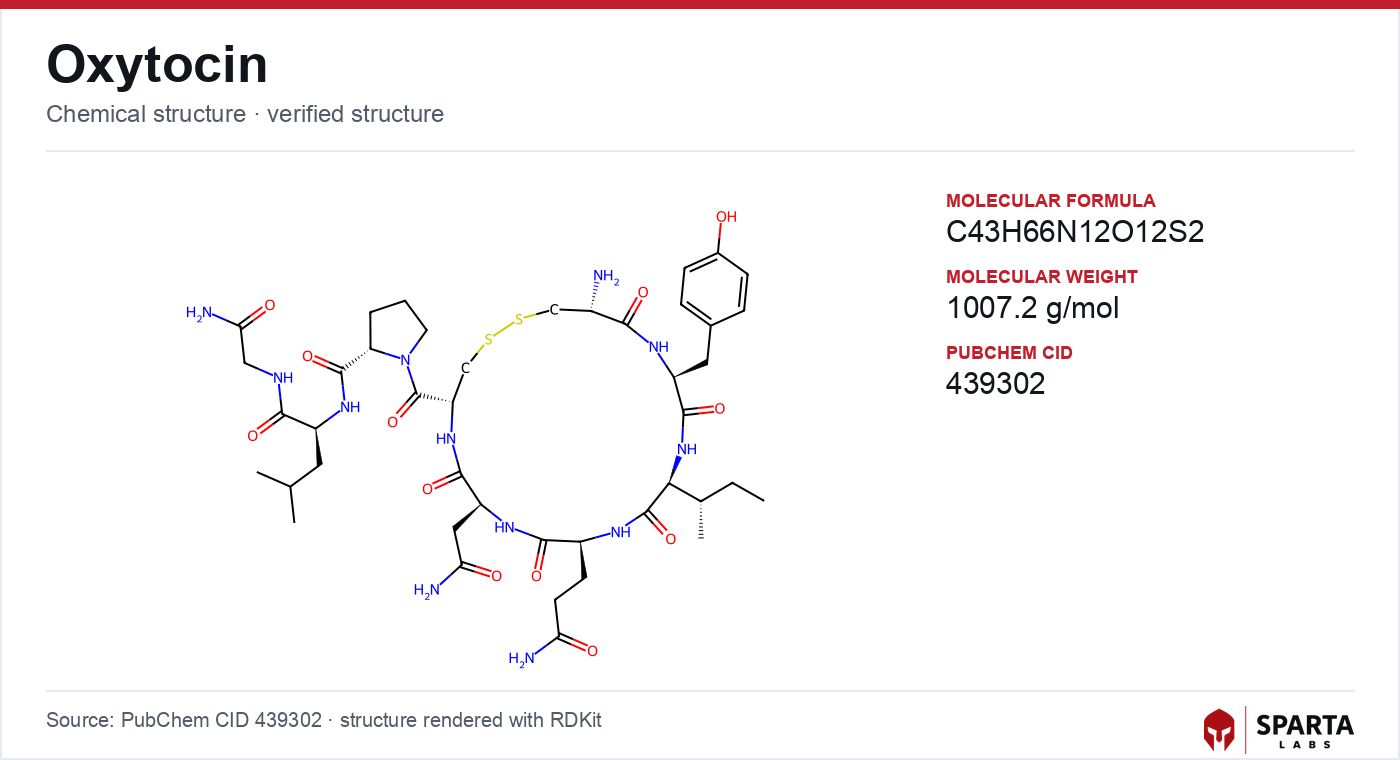
Figure: chemical structure of Oxytocin.
The Foundational Chemistry: A Landmark of Peptide Synthesis
Oxytocin holds a defining place in the history of chemistry. Du Vigneaud and colleagues (1953) reported the total chemical synthesis of oxytocin in the Journal of the American Chemical Society, demonstrating that a synthetic preparation reproduced the biological activity attributed to the natural pituitary principle [1]. This was among the earliest total syntheses of any polypeptide hormone and provided the proof-of-structure that anchors all subsequent oxytocin research; the work contributed to the award of the 1955 Nobel Prize in Chemistry to du Vigneaud.
Findings from research models do not establish safety or efficacy in humans. Sparta Labs makes no claims about the use of this compound.
Because the sequence and disulfide topology were established so early, later structural and pharmacological studies could be interpreted against a fixed molecular reference. The nonapeptide differs from the closely related hormone vasopressin at only two positions, a fact that has framed decades of work on receptor selectivity.
Resolving the Receptor: Structural Biology of OXTR
For most of oxytocin's research history, the three-dimensional architecture of its receptor was inferred rather than observed. Waltenspühl and colleagues (2022) reported a cryo-electron microscopy structure of the active-state human oxytocin receptor (OXTR) bound to oxytocin, published in Nature Communications at 3.2 Angstrom resolution [2]. The authors described a binding mode in which the cyclic ring portion of the peptide occupies the orthosteric transmembrane pocket, and they characterized a coordinated divalent cation as a component of the ligand-receptor interface. These structural data provided a molecular framework for rationalizing OXTR selectivity relative to the vasopressin receptor subtypes and established a reference geometry for structurally guided analog research.
Obstetric Pharmacology and the Clinical Trial Record
Synthetic oxytocin has an FDA-approved clinical role in labor management, and that regulatory status has produced a large randomized-trial literature. Tita and colleagues (2012), in a double-blind randomized controlled trial published in Obstetrics & Gynecology, compared higher-dose and routine-dose postpartum oxytocin regimens in participants who delivered vaginally, enrolling 1,798 women and measuring postpartum hemorrhage-related outcomes [3]. The trial reported comparative data across the study arms and informed subsequent discussion of postpartum regimen design.
Complementing the trial literature, Osilla and colleagues, writing in StatPearls on the National Institutes of Health Bookshelf, summarized the pharmacological profile of oxytocin as used in labor management, noting that uterine responsiveness is influenced by gestational age and by pre-existing myometrial sensitization [4]. Together these sources represent the obstetric evidence base against which non-obstetric research questions are frequently contrasted.
Beyond Reproduction: Cardiovascular Physiology
A distinct research program, developing from the 1990s, asked whether oxytocin has physiological roles outside the reproductive axis. Gutkowska and colleagues (2000) reported in the Brazilian Journal of Medical and Biological Research that cardiac tissue expresses OXTR and synthesizes oxytocin locally, describing associations between receptor activation and atrial natriuretic peptide release, negative chronotropic effects, and vasodilation in animal preparations [5]. On the strength of these observations the authors characterized oxytocin as a cardiovascular hormone.
Jankowski, Broderick, and Gutkowska (2020), in a review in Frontiers in Psychology, synthesized preclinical evidence on the reported cardiac associations of oxytocin, including data from rodent ischemia-reperfusion preparations, and identified anti-inflammatory, anti-apoptotic, and nitric oxide-mediated vasodilatory pathways as proposed mechanisms warranting further study [6]. Camerino (2023), reviewing the field in the International Journal of Molecular Sciences, traced oxytocin cardiovascular research from the late nineteenth-century pituitary-extract experiments of Oliver and Schäfer through contemporary molecular work, cataloguing the reported cardiac and vascular associations across the intervening decades [7]. This cardiovascular literature illustrates how a peptide first characterized for one physiological system became a subject of investigation in another.
Neuroimaging and Social-Cognition Paradigms
A separate strand of research examined whether oxytocin modulates neural responses in defined behavioral paradigms. Domes and colleagues (2007), publishing in Biological Psychiatry, reported that healthy male participants who received intranasal oxytocin displayed measurably different performance on the Reading the Mind in the Eyes Test relative to placebo, in a double-blind within-subject design with 30 participants, with a more pronounced difference on items rated as difficult [8]. This study established a widely replicated methodology for probing OXTR-related function in human cognitive paradigms.
Zink and Meyer-Lindenberg (2012), reviewing the neuroimaging literature on oxytocin and vasopressin in Hormones and Behavior, summarized pharmacological functional-MRI evidence and identified amygdala signal modulation as among the more consistently reported effects across studies [9]. The authors framed these observations as a research base for understanding how OXTR engagement influences task-related neural activation, while noting substantial methodological heterogeneity across the literature.
Cross-Cutting Methodological Considerations and Knowledge Gaps
Reading across these domains surfaces recurring open questions rather than settled conclusions. A central one concerns delivery: the pathway by which peripherally or intranasally administered oxytocin reaches central OXTR populations remains under investigation, and reviewers have flagged blood-brain-barrier transport as an unresolved variable in interpreting neuroimaging results [9]. A second concerns species translation, since much of the cardiovascular signal derives from rodent preparations whose predictive value for human physiology continues to be examined [6][7]. A third concerns inter-individual variability: documented polymorphisms in the OXTR gene are a candidate source of heterogeneity and a target for future pharmacogenomic stratification.
For laboratories comparing analytical characterization across neuropeptide reference materials, batch-specific documentation matters to reproducibility; the oxytocin acetate product page lists the certificate-of-analysis and purity data associated with each lot. The published research on kisspeptin-10, another hypothalamic neuropeptide within the neuroendocrine reproductive axis, and the oxytocin research overview provide adjacent context for situating these findings.
References
-
du Vigneaud V, Ressler C, Swan JM, Roberts CW, Katsoyannis PG, Gordon S. The synthesis of an octapeptide amide with the hormonal activity of oxytocin. J Am Chem Soc. 1953;75(19):4879–4880. DOI: 10.1021/ja01115a553
-
Waltenspühl Y, Ehrenmann J, Vacca S, Thom C, Medalia O, Plückthun A. Structural basis for the activation and ligand recognition of the human oxytocin receptor. Nat Commun. 2022;13(1):4153. PMID: 35851571. PMCID: PMC9293896. DOI: 10.1038/s41467-022-31325-0
-
Tita AT, Szychowski JM, Rouse DJ, Bean CM, Chang E, Cliver S, et al. Higher-dose oxytocin and hemorrhage after vaginal delivery: a randomized controlled trial. Obstet Gynecol. 2012;119(2 Pt 1):293–300. PMID: 22270281. PMCID: PMC3282278. DOI: 10.1097/AOG.0b013e318242da74
-
Osilla EV, Sharma S. Oxytocin. In: StatPearls [Internet]. Treasure Island (FL): StatPearls Publishing; 2024. NBK507848. Available at: Source: ncbi.nlm.nih.gov
-
Gutkowska J, Jankowski M, Mukaddam-Daher S, McCann SM. Oxytocin is a cardiovascular hormone. Braz J Med Biol Res. 2000;33(6):625–633. PMID: 10829090. DOI: 10.1590/s0100-879x2000000600003
-
Jankowski M, Broderick TL, Gutkowska J. The role of oxytocin in cardiovascular protection. Front Psychol. 2020;11:2139. PMID: 32982875. PMCID: PMC7477297. DOI: 10.3389/fpsyg.2020.02139
-
Camerino C. The long way of oxytocin from the uterus to the heart in 70 years from its discovery. Int J Mol Sci. 2023;24(3):2556. PMID: 36768879. PMCID: PMC9916674. DOI: 10.3390/ijms24032556
-
Domes G, Heinrichs M, Michel A, Berger C, Herpertz SC. Oxytocin improves "mind-reading" in humans. Biol Psychiatry. 2007;61(6):731–733. PMID: 17137561. DOI: 10.1016/j.biopsych.2006.07.015
-
Zink CF, Meyer-Lindenberg A. Human neuroimaging of oxytocin and vasopressin in social cognition. Horm Behav. 2012;61(3):400–409. PMID: 22326707. PMCID: PMC3311781. DOI: 10.1016/j.yhbeh.2012.01.016
Frequently asked questions
Why is oxytocin significant in the history of chemistry?
Du Vigneaud and colleagues reported the total chemical synthesis of oxytocin in 1953, among the earliest total syntheses of any polypeptide hormone. The synthetic preparation reproduced the biological activity attributed to the natural pituitary principle, and the work contributed to du Vigneaud's 1955 Nobel Prize in Chemistry. This early proof-of-structure anchors subsequent oxytocin research.
What did the cryo-EM structure of the oxytocin receptor reveal?
Waltenspuhl and colleagues (2022) reported a 3.2 Angstrom cryo-electron microscopy structure of the active human oxytocin receptor bound to oxytocin in Nature Communications. They described a binding mode in which the cyclic ring of the peptide occupies the transmembrane pocket and characterized a coordinated divalent cation at the interface, providing a framework for rationalizing receptor selectivity versus vasopressin receptors.
What cardiovascular research has been published on oxytocin?
Gutkowska and colleagues (2000) reported that cardiac tissue expresses the oxytocin receptor and synthesizes oxytocin locally, associating receptor activation with atrial natriuretic peptide release and vasodilation in animal preparations. Reviews by Jankowski and colleagues (2020) and Camerino (2023) synthesized this preclinical literature and identified anti-inflammatory and nitric oxide-mediated pathways as proposed mechanisms for further study.
What did the Domes et al. 2007 neuroimaging study report?
Domes and colleagues (2007), in a double-blind within-subject design with 30 healthy male participants published in Biological Psychiatry, reported that intranasal oxytocin was associated with measurably different performance on the Reading the Mind in the Eyes Test relative to placebo, with a more pronounced difference on items rated as difficult. The study established a widely used methodology for probing oxytocin-related function in human cognitive paradigms.
What open questions remain in oxytocin research?
Reviewers have flagged the pathway by which peripherally or intranasally administered oxytocin reaches central receptor populations as unresolved, with blood-brain-barrier transport an active area of inquiry. Species translation of rodent cardiovascular findings and inter-individual variability linked to OXTR gene polymorphisms are further open questions identified across the literature.