
Oxytocin (Acetate Salt): A Research Overview
An educational overview of oxytocin (acetate salt): its nine-residue sequence and disulfide ring, acetate salt form, neurohypophysial classification against vasopressin, US regulatory record, and the 1953 du Vigneaud total synthesis that made it the first synthesized peptide hormone.
For research use only. Not for human consumption. This article is educational reference material. It is not medical advice and is not a recommendation to use any substance.
Introduction
Oxytocin (acetate salt) is the acetate counter-ion form of oxytocin, a cyclic nonapeptide neurohormone endogenous to mammals. Within the peptide research literature it occupies an unusual position: it was the first polypeptide hormone whose complete covalent structure was solved and then confirmed by total chemical synthesis, work carried out in the laboratory of Vincent du Vigneaud and reported in 1953 [1,2]. That achievement recast oxytocin from a poorly defined "posterior pituitary principle" into a precisely specified molecule and, more broadly, established that peptide hormones could be assembled synthetically from their constituent amino acids. This overview treats the compound as a chemical and historical subject: its sequence and salt form, its classification within neurohypophysial pharmacology, and the regulatory record attached to the synthetic drug. A separate treatment of oxytocin-receptor signaling appears in the companion oxytocin mechanism of action article, and the primary-literature summaries are collected in the published research overview.
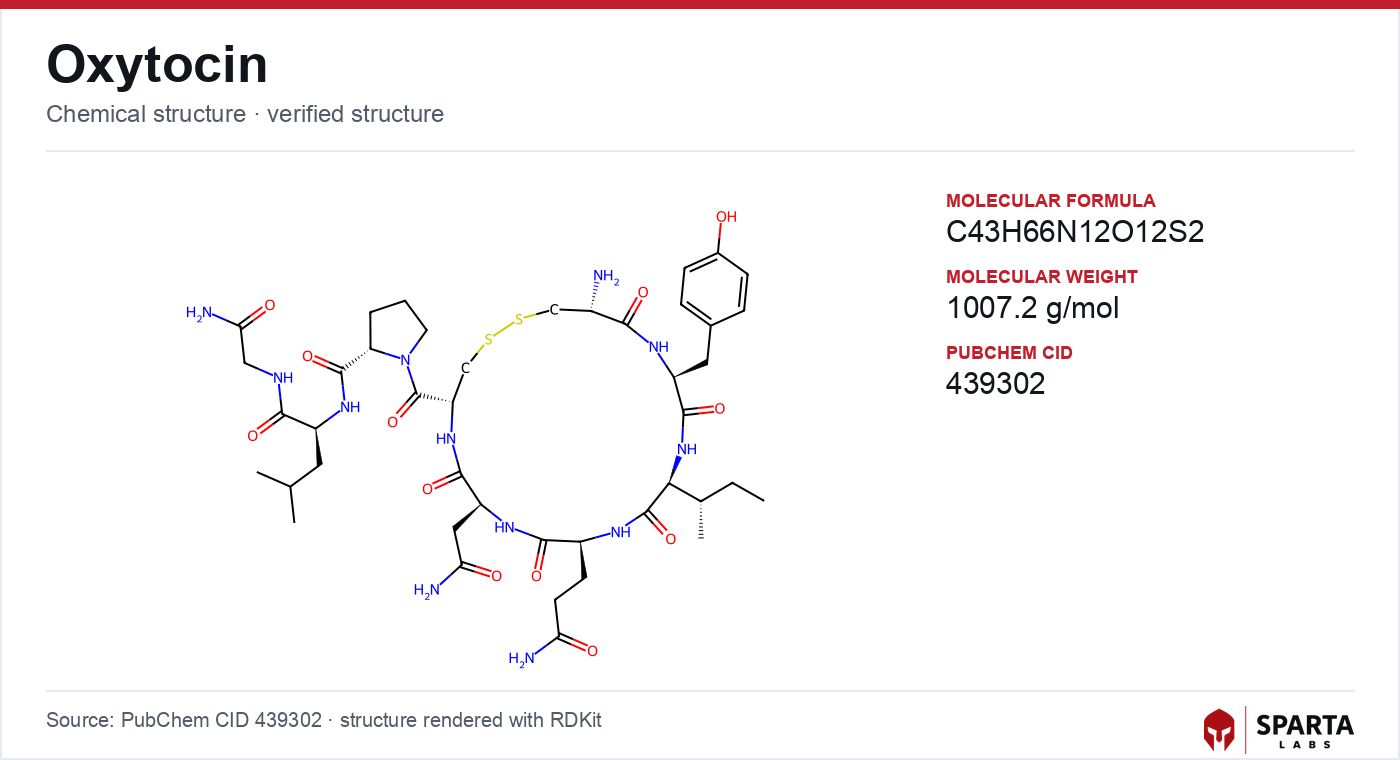
Figure: chemical structure of oxytocin.
From "Pituitary Principle" to a Named Molecule
The activity later attributed to oxytocin was described long before the molecule was isolated. A 2023 historical review in the International Journal of Molecular Sciences summarizes how late-nineteenth and early-twentieth-century investigators worked with crude posterior pituitary extracts that produced several distinct effects in animal preparations [3]. Reports of uterotonic (uterus-contracting) activity in such extracts date to Henry Dale's experiments in the first decade of the twentieth century, and the same review traces how the milk-ejection and pressor activities were gradually recognized as separable phenomena within the same starting material [3].
That separability was the central puzzle. The crude extract carried both a uterotonic/milk-ejection activity and a distinct vasopressor activity, and for years it was unclear whether one substance or two accounted for the profile. The eventual resolution, that oxytocin and vasopressin are two closely related but separate nonapeptides, is why the compound's name derives from the Greek oxutokia ("quick birth") rather than from any cardiovascular property. The acetate salt discussed here is a solid-state presentation of the resolved, defined molecule rather than of any historical extract.
Findings from research models do not establish safety or efficacy in humans. Sparta Labs makes no claims about the use of this compound.
Sequence, Ring Topology, and the Acetate Salt
Oxytocin is a nine-residue peptide with the sequence Cys-Tyr-Ile-Gln-Asn-Cys-Pro-Leu-Gly(NH₂). Its defining structural feature is an intramolecular disulfide bridge between the cysteine residues at positions one and six, which closes a six-residue ring and leaves a three-residue "tail" (Pro-Leu-Gly) terminating in a C-terminal glycinamide. This cyclic-plus-tail architecture is the topology that du Vigneaud's group proposed in 1953 and then reproduced synthetically [1,2].
The free-base peptide has the molecular formula C₄₃H₆₆N₁₂O₁₂S₂ and a monoisotopic-to-average molecular weight near 1,007 daltons. In the acetate salt (CAS 6233-83-6), one or more acetate counter-ions associate with basic sites on the peptide, raising the nominal formula weight to roughly 1,067 daltons depending on the acetate stoichiometry of a given lot. Acetate is a common counter-ion for research peptides because it supports a stable, handleable lyophilized solid and is compatible with reversed-phase purification workflows; the choice of salt form is discussed further in the oxytocin sourcing and verification reference.
The disulfide ring is not incidental to the molecule's identity. Foundational structure-activity work established that reduction or disruption of the ring markedly changes the peptide's receptor-binding behavior [4], which is one reason analytical characterization of oxytocin lots typically attends to the oxidation state of the cysteines and to disulfide-related impurities.
A Neurohypophysial Nonapeptide, Distinguished from Vasopressin
Pharmacologically, oxytocin is classified as a neurohypophysial (posterior-pituitary) hormone: a peptide synthesized by hypothalamic magnocellular neurons and released from the neurohypophysis. It is the endogenous agonist of the oxytocin receptor (OXTR), a class A G-protein-coupled receptor whose distribution and signaling were catalogued in the landmark 2001 review by Gimpl and Fahrenholz [4] and revisited in a 2018 review by Jurek and Neumann [5].
The most instructive comparison for classification purposes is with arginine vasopressin (AVP). The two nonapeptides differ at only two of nine positions, yet they define separate receptor families, OXTR versus the vasopressin receptors V1a, V1b, and V2. Because of the sequence similarity, cross-reactivity between oxytocin and vasopressin receptors is a recurring theme in the pharmacology literature, and selectivity for OXTR over the V-family receptors is treated as a defining property when the peptide is used as a reference agonist [4,5]. Readers interested in how another hypothalamic peptide is positioned within the neuroendocrine reproductive axis may compare the kisspeptin-10 overview, which acts upstream via the KISS1R receptor.
As a defined reference peptide, oxytocin acetate from Sparta Labs is offered as a research-use-only material for laboratory investigations that call for a characterized OXTR agonist standard.
Regulatory Record of the Synthetic Compound
Synthetic oxytocin is an approved drug in the United States, marketed as Pitocin under NDA 018261. According to the FDA prescribing information, the approved obstetric indications include antepartum initiation or stimulation of labor, adjunctive management of incomplete or inevitable abortion, and postpartum control of uterine bleeding; the label describes the product as a synthetic peptide identical in structure and action to the endogenous hormone [6]. This long approval history has generated an extensive pharmacokinetic and safety literature for the clinical drug, which forms part of the background against which mechanistic and analytical studies of the peptide are conducted.
The regulatory record also includes a discontinued intranasal presentation. An intranasal oxytocin spray (marketed historically as Syntocinon) was withdrawn from the US market in the 1990s; FDA discontinuation records do not attribute the withdrawal to a safety finding [6]. Oxytocin acetate supplied as a research-use-only material sits outside these approved clinical uses entirely and is not intended for human administration.
The 1953 Synthesis and Its Place in Peptide Chemistry
The defining episode in oxytocin's scientific history is the du Vigneaud group's structural and synthetic work at Cornell University Medical College. Over the late 1940s and early 1950s the group applied partial hydrolysis, ion-exchange chromatography, and paper chromatography to the peptide isolated from bovine posterior pituitary, and in 1953 published the amino-acid sequence together with the proposed cyclic structure in the Journal of Biological Chemistry [2]. Later that year the same group reported, in the Journal of the American Chemical Society, the total chemical synthesis of a product carrying the hormonal activity of natural oxytocin [1].
The significance was twofold. First, it settled the sequence and ring topology of a specific molecule that had previously existed only as an operationally defined extract activity. Second, and more consequentially for the field, it demonstrated that a biologically active peptide hormone could be built de novo, a proof of principle that opened the way to synthetic analogs and to the modern practice of solid-phase peptide synthesis. The work was recognized with the 1955 Nobel Prize in Chemistry awarded to du Vigneaud. The broader arc of that discovery, from crude extracts to a named molecule, is developed in the oxytocin discovery and regulatory history article.
References
-
du Vigneaud V, Ressler C, Swan JM, Roberts CW, Katsoyannis PG, Gordon S. The synthesis of an octapeptide amide with the hormonal activity of oxytocin. J Am Chem Soc. 1953;75(19):4879–4880. DOI: 10.1021/ja01641a004
-
du Vigneaud V, Ressler C, Trippett S. The sequence of amino acids in oxytocin, with a proposal for the structure of oxytocin. J Biol Chem. 1953;205(2):949–957. PMID: 13129273. View on PubMed
-
Camerino C. The long way of oxytocin from the uterus to the heart in 70 years from its discovery. Int J Mol Sci. 2023;24(3):2556. PMID: 36768879. PMCID: PMC9916674. DOI: 10.3390/ijms24032556
-
Gimpl G, Fahrenholz F. The oxytocin receptor system: structure, function, and regulation. Physiol Rev. 2001;81(2):629–683. PMID: 11274341. DOI: 10.1152/physrev.2001.81.2.629
-
Jurek B, Neumann ID. The oxytocin receptor: from intracellular signaling to behavior. Physiol Rev. 2018;98(3):1805–1908. PMID: 29897293. DOI: 10.1152/physrev.00031.2017
-
US Food and Drug Administration. Pitocin (oxytocin injection, USP) synthetic: prescribing information. NDA 018261. Source: accessdata.fda.gov
Disclaimer. Statements in this article have not been evaluated by the Food and Drug Administration. This compound is not intended to diagnose, treat, cure, or prevent any disease. Sparta Labs sells research-use-only materials. Content is provided for educational and informational purposes only and does not constitute medical advice. Consult a qualified medical professional for any health concerns.
Frequently asked questions
What is oxytocin acetate?
Oxytocin acetate is the acetate counter-ion form of oxytocin, a cyclic nine-amino-acid neurohormone endogenous to mammals. It is typically supplied as a white to off-white lyophilized powder for laboratory research and is the same chemical entity as the synthetic drug marketed as Pitocin.
What is the amino acid sequence and structure of oxytocin?
Oxytocin is a nonapeptide with the sequence Cys-Tyr-Ile-Gln-Asn-Cys-Pro-Leu-Gly(NH2). A disulfide bridge between the cysteines at positions one and six closes a ring, leaving a short glycinamide-terminated tail. The free-base molecular formula is C43H66N12O12S2, near 1,007 daltons.
How does oxytocin differ from vasopressin?
Oxytocin and arginine vasopressin are closely related nonapeptides that differ at only two of nine positions. Despite this similarity they define separate receptor families, the oxytocin receptor (OXTR) versus the vasopressin V1a, V1b, and V2 receptors, and selectivity for OXTR is treated as a defining property in the pharmacology literature.
Why is oxytocin historically important in peptide chemistry?
In 1953 Vincent du Vigneaud's laboratory determined oxytocin's sequence and then achieved its total chemical synthesis, making it the first polypeptide hormone to be synthesized. The work demonstrated that biologically active peptide hormones could be built from amino acids and earned du Vigneaud the 1955 Nobel Prize in Chemistry.
Is oxytocin approved as a drug in the United States?
Synthetic oxytocin is FDA-approved as Pitocin under NDA 018261 for obstetric indications described in the prescribing information. Oxytocin acetate supplied as a research-use-only material is a separate, non-clinical presentation and is not intended for human administration outside FDA-approved clinical contexts.