
Oxytocin (Acetate Salt): Sourcing, Purity, and Verification Standards
A sourcing reference for oxytocin (acetate salt): du Vigneaud's landmark synthesis, disulfide oxidative folding, pharmacopeial identity, and batch verification. Educational reference.
For research use only. Not for human consumption. This article is educational reference material. It is not medical advice and is not a recommendation to use any substance.
A synthesized hormone with a documented chemical lineage
Oxytocin occupies an unusual position among research peptides: its structure was solved and chemically reproduced in the laboratory more than seventy years ago, and it has existed as a defined pharmaceutical compound ever since. In 1953, Vincent du Vigneaud and colleagues reported the total synthesis of a nonapeptide amide with the hormonal activity of oxytocin, the first chemical synthesis of a polypeptide hormone, work published in the Journal of the American Chemical Society [1]. A companion 1954 report described the full synthesis and characterization of the cyclic structure [2]. Du Vigneaud received the Nobel Prize in Chemistry in 1955 for this achievement.
That lineage matters for sourcing because it means oxytocin's identity, sequence, and analytical fingerprint are exhaustively documented in the primary literature and in pharmacopeial standards, an external reference base most novel research peptides do not have. This article describes how oxytocin (acetate salt) is produced and verified for research applications, organized around the features that are genuinely specific to this compound: its disulfide-cyclized architecture, the oxidative folding step required to build it, its counterion chemistry, and the published standards against which a batch can be interpreted. For its classification, sequence, and receptor pharmacology, see the companion oxytocin research overview.
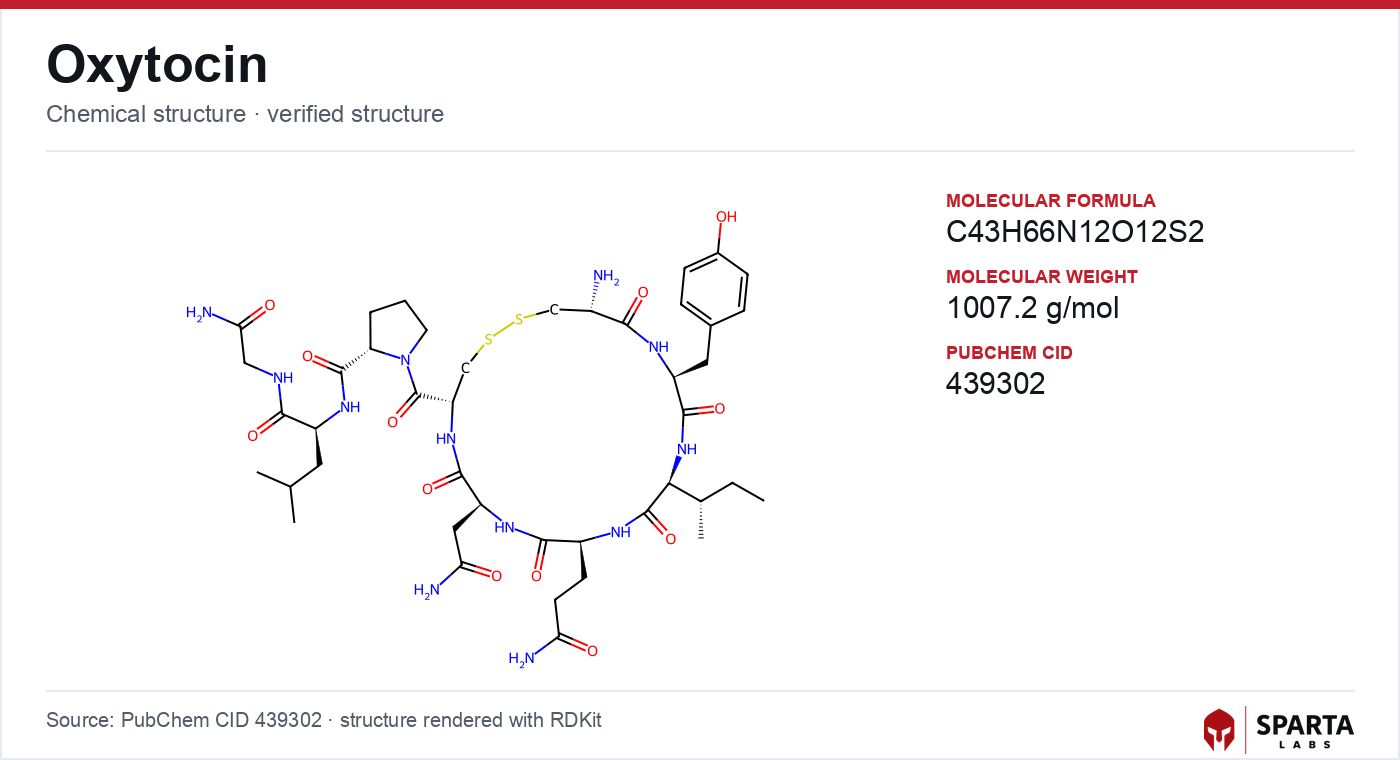
Figure: chemical structure of oxytocin.
Chain assembly: from du Vigneaud's solution synthesis to solid-phase methods
Du Vigneaud's original route used classical solution-phase peptide coupling, assembling protected fragments and joining them in solution before removing protecting groups [1][2]. That approach was laborious and low-yielding by modern standards, but it established the exact covalent structure of the molecule.
Contemporary production of a nine-residue peptide such as oxytocin generally relies on solid-phase peptide synthesis (SPPS), the methodology reported by Robert Bruce Merrifield in the Journal of the American Chemical Society in 1963 and recognized with the 1984 Nobel Prize in Chemistry [3]. In SPPS, the peptide chain is built stepwise on an insoluble resin support: each amino acid is added with its reactive side chains protected, coupled to the growing chain, deprotected at the alpha-amino terminus, and the cycle repeats until the sequence is complete. Andersson and colleagues reviewed the scale-up of this chemistry from Merrifield's bench method to industrial peptide manufacturing in Biopolymers, describing coupling efficiency, resin loading, and cleavage conditions as the principal determinants of crude peptide quality [4].
The key point for oxytocin specifically is that finishing the linear chain is only half the synthesis. Oxytocin contains two cysteine residues, at positions one and six, whose thiol side chains must be joined into a single intramolecular disulfide bond. The linear precursor coming off the resin is not yet oxytocin.
Oxidative folding: the disulfide bridge as the defining manufacturing step
The disulfide bridge between Cys1 and Cys6 closes a six-membered ring and leaves a three-residue C-terminal tail, the architecture on which oxytocin's biological recognition depends. Manning and colleagues, in a review of oxytocin and vasopressin peptide chemistry, emphasized that the constrained ring and its disulfide are central structural features of this hormone family and its analogs [5]. Building that bond correctly is the analytical crux of oxytocin manufacturing.
Formation of the disulfide requires a controlled oxidation of the reduced, linear precursor, a step commonly called oxidative folding. Under uncontrolled conditions, free cysteine thiols can form the wrong connectivity or bridge between two separate peptide molecules, producing intermolecular (dimeric and oligomeric) by-products rather than the intended intramolecular ring. Because these mis-folded species share the same amino acid composition as the target, they are a category of impurity that distinguishes cyclic peptides such as oxytocin from simple linear sequences. Reverse-phase high-performance liquid chromatography (HPLC) is used to separate the correctly folded monomer from these related species, and the purified fraction is then isolated by lyophilization.
Counterion chemistry: why the compound is supplied as an acetate salt
Peptides carrying basic residues are typically isolated as salts, and the counterion is not incidental to the product. During SPPS, trifluoroacetic acid (TFA) is a routine reagent for side-chain deprotection and resin cleavage, and crude peptides often carry residual trifluoroacetate. Because trifluoroacetate can interfere with certain downstream assays and is not a desirable residual, purification workflows frequently exchange it for acetate, yielding the acetate salt form named in "oxytocin acetate."
This counterion exchange is generally accomplished during or after reverse-phase HPLC purification, followed by lyophilization to a white to off-white amorphous solid. The residual acetate content, along with residual TFA and residual organic solvents from synthesis and washing, is part of the impurity picture that batch characterization is designed to document. Endotoxin, arising from microbial contamination rather than the chemistry itself, is a separate residual concern most relevant when material is handled in cell-based research systems, where it can confound experimental readouts.
Pharmacopeial identity: an external standard most research peptides lack
Oxytocin's long regulatory history gives its sourcing an anchor that novel peptides do not have. Oxytocin is the subject of an established monograph in the United States Pharmacopeia (USP), which defines identity tests, an assay, and impurity expectations for the compound [6]. A pharmacopeial monograph is a published, consensus analytical standard; its existence means the identity and purity characteristics that a research-grade batch should exhibit can be interpreted against an external, authoritative reference rather than against an in-house specification alone.
For research-grade material, the practical analytical toolkit reflects this. Chromatographic purity is reported by reverse-phase HPLC with UV detection, expressed as the percentage of the target peak relative to total UV-absorbing material. Identity is confirmed by mass spectrometry, most commonly electrospray ionization, which verifies that the main chromatographic peak corresponds to the expected molecular mass of the cyclic nonapeptide, approximately 1,007 daltons for the free base, and can distinguish it from disulfide-dimer and deletion by-products that differ in mass. The combination of chromatographic purity plus mass confirmation is the minimum characterization that establishes both quantity and identity.
Disulfide-driven stability and storage principles
The same disulfide bond that defines oxytocin's ring also shapes its stability profile. Disulfide bonds are susceptible to reduction and to thiol–disulfide exchange, and cyclic peptides can undergo hydrolytic and deamidation changes over time [5]. Removing water is the most direct way to slow these reactions, which is why oxytocin acetate is supplied and stored as a lyophilized solid rather than in solution: the freeze-dried form eliminates the aqueous medium that drives hydrolysis, disulfide scrambling, and microbial growth.
Consistent with the general behavior of disulfide-containing peptides, a dry, cold, light-excluding, and non-reducing storage environment is the relevant set of conditions for preserving the documented purity of lyophilized material. Temperature cycling and moisture ingress are recognized accelerants of degradation for peptide solids. Because reconstituted solutions reintroduce the aqueous conditions the lyophilization was meant to avoid, solution-phase material is inherently less stable than the dry solid. These are analytical-chemistry considerations for maintaining the characterized state of a research sample, not administration guidance.
Batch verification and the certificate of analysis
Because the failure modes above, mis-folded disulfide species, counterion and solvent residuals, and disulfide degradation, are specific and measurable, they are the substance of a per-batch certificate of analysis (COA). Sparta Labs publishes a COA for every batch of oxytocin acetate, documenting the analytical record for that lot. A COA for a compound of this class typically reports:
- HPLC purity: the percentage purity of the target compound by reverse-phase HPLC with UV detection, against the batch-specific chromatogram
- Mass spectrometry confirmation: the observed molecular mass versus the theoretical mass of the cyclic nonapeptide, confirming identity and separating it from disulfide-dimer and deletion species
- Batch number: a unique identifier linking each unit to its production and testing record
- Manufacturing and expiry dates: the date of synthesis completion and the period over which the documented specification is expected to hold under stated storage conditions
Retaining the COA alongside experimental records is standard practice for reproducible research, since documentation of compound identity and purity is a routine element of methods reporting. Comparable sourcing considerations for another hypothalamic neuropeptide in the same research cluster are discussed in the kisspeptin-10 sourcing and quality reference, and oxytocin's receptor pharmacology is covered in the oxytocin mechanism of action article.
References
-
du Vigneaud V, Ressler C, Swan JM, Roberts CW, Katsoyannis PG, Gordon S. The synthesis of an octapeptide amide with the hormonal activity of oxytocin. J Am Chem Soc. 1953;75(19):4879–4880. DOI: 10.1021/ja01115a553
-
du Vigneaud V, Ressler C, Swan JM, Roberts CW, Katsoyannis PG. The synthesis of oxytocin. J Am Chem Soc. 1954;76(12):3115–3121. DOI: 10.1021/ja01641a004
-
Merrifield RB. Solid phase peptide synthesis. I. The synthesis of a tetrapeptide. J Am Chem Soc. 1963;85(14):2149–2154. DOI: 10.1021/ja00897a025
-
Andersson L, Blomberg L, Flegel M, Lepsa L, Nilsson B, Verlander M. Large-scale synthesis of peptides. Biopolymers. 2000;55(3):227–250. PMID: 11074412. DOI: 10.1002/1097-0282(2000)55:3<227::AID-BIP50>3.0.CO;2-7
-
Manning M, Misicka A, Olma A, Bankowski K, Stoev S, Chini B, et al. Oxytocin and vasopressin agonists and antagonists as research tools and potential therapeutics. J Neuroendocrinol. 2012;24(4):609–628. PMID: 22375852. DOI: 10.1111/j.1365-2826.2012.02303.x
-
United States Pharmacopeia. Oxytocin monograph. USP–NF. Rockville (MD): United States Pharmacopeial Convention. Available from: Source: uspnf.com
Disclaimer. Statements in this article have not been evaluated by the Food and Drug Administration. This compound is not intended to diagnose, treat, cure, or prevent any disease. Sparta Labs sells research-use-only materials. Content is provided for educational and informational purposes only and does not constitute medical advice. Consult a qualified medical professional for any health concerns.
Frequently asked questions
What makes oxytocin difficult to synthesize compared with a linear peptide?
Oxytocin is a cyclic nonapeptide whose activity depends on a disulfide bridge between the cysteine residues at positions one and six. Beyond assembling the nine-residue chain, the manufacturing process must carry out a controlled oxidation, called oxidative folding, that closes this ring correctly rather than forming misbridged or dimeric by-products. This folding step is a defining analytical checkpoint that a simple linear peptide does not require.
Why does the acetate counterion appear in the name 'oxytocin acetate'?
During reverse-phase HPLC purification and lyophilization, the peptide is commonly converted to an acetate salt through counterion exchange, replacing residual trifluoroacetate from synthesis. The acetate form yields the characteristic white to off-white lyophilized powder. The salt form and its residual acetate content are typically documented on a batch certificate of analysis.
How is the identity of oxytocin acetate confirmed analytically?
Reverse-phase HPLC with UV detection reports chromatographic purity, but identity is established by mass spectrometry, which confirms that the main peak corresponds to the expected molecular mass of the cyclic nonapeptide, near 1,007 daltons for the free base. Oxytocin also has an established pharmacopeial monograph that defines identity and purity test expectations for the compound.
Why is oxytocin's pharmacopeial monograph relevant to research-grade sourcing?
Unlike many research peptides, oxytocin is a long-approved pharmaceutical with a defined United States Pharmacopeia monograph specifying identity, assay, and impurity standards. That published standard provides an external analytical reference point against which the identity and purity of a research-grade batch can be interpreted, which is not available for most novel peptides.
How does disulfide chemistry affect the stability of stored oxytocin acetate?
The intramolecular disulfide bridge that defines oxytocin's ring is susceptible to reduction and disulfide exchange, and cyclic peptides can also undergo hydrolytic changes over time. Lyophilized solid removes the aqueous medium that drives many of these reactions, which is why the freeze-dried acetate salt is generally more stable than a reconstituted solution. Maintaining a dry, cold, non-reducing environment is a recognized variable in disulfide-peptide stability.