
PT-141 (Bremelanotide): Published Research
A research-library summary of the published bremelanotide (PT-141) literature, organized by its melanotan II lineage, the intranasal male-population trials, and the subcutaneous RECONNECT phase 3 program that supported FDA approval. Educational reference.

For research use only. Not for human consumption. This article is educational reference material. It is not medical advice and is not a recommendation to use any substance.
From melanocortin agonist to approved drug: the PT-141 evidence base
Bremelanotide (PT-141) occupies an unusual position in the peptide literature: it is one of a small number of synthetic melanocortin receptor agonists to have completed a full regulatory development program and reached FDA approval. Its published record traces a distinctive arc, beginning with the parent alpha-melanocyte-stimulating hormone (alpha-MSH) analog melanotan II, moving through an abandoned intranasal formulation, and culminating in the subcutaneous RECONNECT phase 3 program that supported the 2019 approval of Vyleesi. This article summarizes the methodology and reported findings of the principal peer-reviewed studies in that arc. All findings are attributed to their source publications and are not Sparta Labs claims.
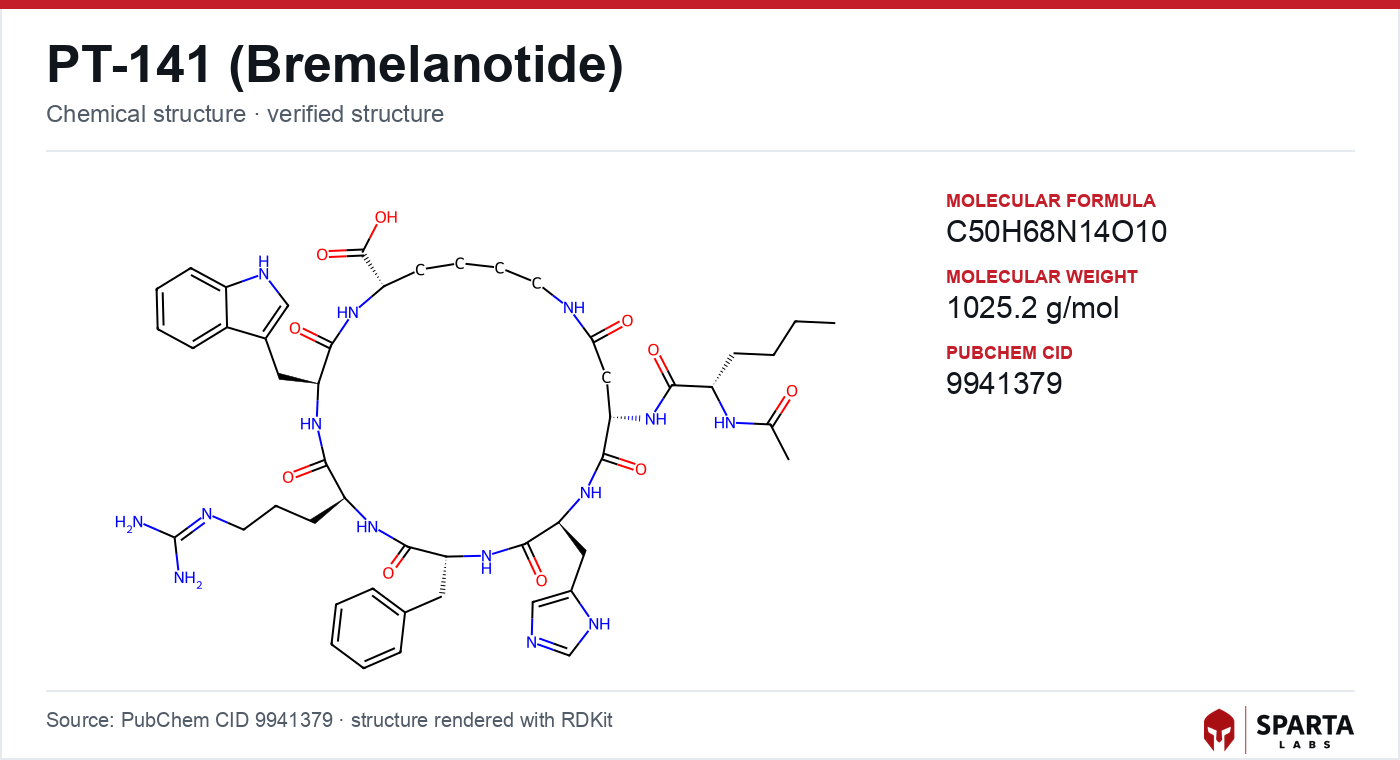
Figure: chemical structure of PT-141.
How the study base is organized
Unlike compounds whose literature is dominated by scattered preclinical work, the bremelanotide record clusters into three chronological and methodological tiers. The first is receptor-pharmacology characterization, situating PT-141 as a cyclic heptapeptide metabolite of melanotan II with agonist activity at melanocortin receptors, notably MC4R. The second is the early intranasal clinical phase in male populations, which established proof of concept but surfaced tolerability constraints that redirected the program. The third is the subcutaneous clinical phase in premenopausal women, comprising phase 2b dose selection, the two pivotal RECONNECT randomized trials, and post-approval drug profiles. Reading the literature in these tiers, rather than as a single undifferentiated body, clarifies why the approved product differs so markedly from the compound described in the earliest papers.
Tier 1: receptor pharmacology and the melanotan II lineage
Molinoff and colleagues (2003), writing in the Annals of the New York Academy of Sciences, characterized PT-141 as a melanocortin receptor agonist and situated it within the melanocortin pathway relevant to sexual function research [1]. The authors described PT-141 as a metabolite of the earlier synthetic analog melanotan II and summarized preclinical activity across rodent and primate models alongside early observations in men.
Findings from research models do not establish safety or efficacy in humans. Sparta Labs makes no claims about the use of this compound.
The structural relationship documented in this work is central to interpreting the later clinical data: PT-141 is the deaminated, C-terminal-modified product of melanotan II, and its melanocortin-agonist profile is why the compound was investigated as a centrally acting agent with a mechanistic basis distinct from phosphodiesterase type 5 inhibitors. Readers tracing that lineage may find the companion PT-141 mechanism of action article and the Melanotan-2 published research summary useful context for the receptor pharmacology underlying this compound class.
Tier 2: the intranasal era and why the program pivoted
Diamond and colleagues (2004), reporting in the International Journal of Impotence Research, published a double-blind, placebo-controlled evaluation of an intranasal PT-141 formulation in healthy male volunteers and in patients with mild-to-moderate erectile dysfunction [2]. The study documented pharmacokinetic parameters for the intranasal route together with pharmacodynamic observations, and collected cardiovascular monitoring data as part of safety characterization. The authors reported findings that informed formulation decisions carried forward into subsequent development.
Safarinejad and Hosseini (2008), publishing in The Journal of Urology, reported a randomized, double-blind, placebo-controlled study of intranasal bremelanotide in men with erectile dysfunction who had not responded to sildenafil [3]. Among the participants randomized to bremelanotide or placebo, the authors reported statistically significant differences on erectile-function measures favoring the active peptide. The cardiovascular observations associated with the intranasal formulation, together with the tolerability profile reported across these male-population studies, are the documented reasons the program later shifted to a subcutaneous formulation and a different target population.
Tier 3: the subcutaneous program in premenopausal women
Phase 2b dose selection
Clayton and colleagues (2016), writing in Women's Health (London), reported a randomized, placebo-controlled dose-finding study of subcutaneous bremelanotide in premenopausal women with female sexual dysfunction [4]. The study evaluated multiple active dose levels against placebo using validated psychometric instruments as endpoints. The authors reported that a specific dose level was associated with statistically significant differences from placebo on pre-specified sexual-function and distress measures, and this outcome provided the empirical basis for the dose carried into the phase 3 program. Framed as attributed reporting: in this cited trial the compound was administered subcutaneously on an as-needed basis, and the dose selected here defined the phase 3 design.
RECONNECT: the two pivotal phase 3 trials
Kingsberg and colleagues (2019), publishing in Obstetrics and Gynecology, reported the primary efficacy and safety results of the two parallel RECONNECT randomized controlled trials [5]. The trials enrolled premenopausal women with acquired, generalized hypoactive sexual desire disorder, randomizing participants to subcutaneous bremelanotide or matching placebo, self-administered on an as-needed basis over 24 weeks. The co-primary endpoints were change from baseline in the Female Sexual Function Index desire domain and in a Female Sexual Distress Scale item measuring desire-related distress.
The authors reported that bremelanotide was associated with statistically significant differences from placebo on both co-primary endpoints across the two trials. Nausea was reported as the most common adverse event, with the majority of events characterized as mild to moderate; the authors also described flushing and headache among frequently reported events. These data formed the core efficacy and safety evidence for the New Drug Application.
Post-approval drug profile
Dhillon and Keam (2019), in Drugs, published a drug-profile review documenting bremelanotide's approval as the first melanocortin receptor agonist cleared by the FDA for its indication, and summarizing the pharmacology, clinical evidence, and regulatory milestones of the development program [6]. The review situates the RECONNECT results within the compound's approval history and notes the labeled subcutaneous route of the approved product.
What the literature does not settle
Several questions remain open in the peer-reviewed record. The relative contributions of MC3R and MC4R agonism to bremelanotide's measured effects are not fully resolved, and the neural-circuit basis for the outcomes recorded in the RECONNECT trials continues to be investigated within the broader melanocortin-pharmacology field. The divergence between the intranasal male-population studies and the subcutaneous female-population program also leaves the earlier proof-of-concept observations without a completed late-stage program in that setting. The wider melanocortin field remains active, reflected in the separate approval of the MC4R agonist setmelanotide for genetic obesity syndromes, which underscores how much of this receptor system's pharmacology is still being mapped. Batch-verified PT-141 from Sparta Labs is available for research applications, and readers may also consult the PT-141 sourcing and quality reference for analytical-standards context.
References
-
Molinoff PB, Shadiack AM, Earle D, Diamond LE, Quon CY. PT-141: a melanocortin agonist for the treatment of sexual dysfunction. Ann N Y Acad Sci. 2003;994:96-102. PMID: 12851303. DOI: 10.1111/j.1749-6632.2003.tb03168.x. Available from: View on PubMed
-
Diamond LE, Earle DC, Rosen RC, Willett MS, Molinoff PB. Double-blind, placebo-controlled evaluation of the safety, pharmacokinetic properties and pharmacodynamic effects of intranasal PT-141, a melanocortin receptor agonist, in healthy males and patients with mild-to-moderate erectile dysfunction. Int J Impot Res. 2004;16(1):51-59. PMID: 14963471. DOI: 10.1038/sj.ijir.3901139. Available from: View on PubMed
-
Safarinejad MR, Hosseini SY. Salvage of sildenafil failures with bremelanotide: a randomized, double-blind, placebo controlled study. J Urol. 2008;179(3):1066-1071. PMID: 18206919. DOI: 10.1016/j.juro.2007.10.068. Available from: View on PubMed
-
Clayton AH, Althof SE, Kingsberg S, DeRogatis LR, Kroll R, Goldstein I, et al. Bremelanotide for female sexual dysfunctions in premenopausal women: a randomized, placebo-controlled dose-finding trial. Womens Health (Lond). 2016;12(3):325-337. PMID: 27181790. DOI: 10.2217/whe-2016-0018. Available from: View on PubMed
-
Kingsberg SA, Clayton AH, Portman D, Williams LA, Krop J, Jordan R, et al. Bremelanotide for the treatment of hypoactive sexual desire disorder: two randomized phase 3 trials. Obstet Gynecol. 2019;134(5):899-908. PMID: 31599840. DOI: 10.1097/AOG.0000000000003500. Available from: View on PubMed
-
Dhillon S, Keam SJ. Bremelanotide: first approval. Drugs. 2019;79(14):1599-1606. PMID: 31485879. DOI: 10.1007/s40265-019-01187-w. Available from: View on PubMed
Disclaimer. Statements in this article have not been evaluated by the Food and Drug Administration. This compound is not intended to diagnose, treat, cure, or prevent any disease. Sparta Labs sells research-use-only materials. Content is provided for educational and informational purposes only and does not constitute medical advice. Consult a qualified medical professional for any health concerns.
Frequently asked questions
What is the published research history of PT-141 (bremelanotide)?
The peer-reviewed record clusters into three tiers: receptor-pharmacology work characterizing PT-141 as a melanocortin agonist and metabolite of melanotan II; early intranasal clinical studies in male populations; and the subcutaneous program in premenopausal women that included phase 2b dose selection and the two RECONNECT phase 3 trials. Molinoff and colleagues (2003) provide the foundational pharmacology description.
What did the RECONNECT phase 3 trials report?
Kingsberg and colleagues (2019), writing in Obstetrics and Gynecology, reported that in two parallel randomized controlled trials, subcutaneous bremelanotide was associated with statistically significant differences from placebo on both co-primary endpoints over 24 weeks. Nausea was the most commonly reported adverse event, with most events described as mild to moderate. These data supported the New Drug Application.
Why did the bremelanotide program change from intranasal to subcutaneous?
Early studies, including Diamond and colleagues (2004) and Safarinejad and Hosseini (2008), evaluated an intranasal formulation in male populations. The cardiovascular monitoring data and tolerability profile reported for the intranasal route are the documented reasons the program shifted to a subcutaneous formulation and a different target population for its later trials.
How is PT-141 related to melanotan II?
Molinoff and colleagues (2003) described PT-141 as a metabolite of the synthetic melanocortin analog melanotan II. This structural lineage explains PT-141's melanocortin-agonist profile and is why it was studied as a centrally acting agent with a mechanistic basis distinct from phosphodiesterase type 5 inhibitors.