
Melanotan-2: Published Research
A research-library survey of the published Melanotan-2 (MT-II) literature, tracing the compound's role as a conformationally constrained melanocortin probe across in vitro receptor pharmacology, rodent hypothalamic circuit studies, a single 1990s human pilot, and post-market clinical case reports. Educational reference.

For research use only. Not for human consumption. This article is educational reference material. It is not medical advice and is not a recommendation to use any substance.
Melanotan-2 as a Conformationally Constrained Melanocortin Probe
Melanotan-2 (MT-II) occupies an unusual place in the peptide research literature: it was designed less as a candidate therapeutic and more as a chemical tool for interrogating the melanocortin receptor family. The molecule is a cyclic heptapeptide analogue of α-melanocyte-stimulating hormone (α-MSH) in which a lactam bridge between a diaminobutyric acid residue and an aspartate residue locks the peptide backbone into a constrained ring. This design, developed in the laboratory of Victor Hruby and colleagues at the University of Arizona, was intended to stabilize the receptor-active conformation of the shared melanocortin "message" sequence His-Phe-Arg-Trp and to resist enzymatic degradation [1].
Because the melanocortin system comprises five receptor subtypes (MC1R through MC5R) distributed across skin, brain, adrenal cortex, and other tissues, a stable, high-affinity, broadly acting agonist proved valuable for mapping receptor pharmacology before subtype-selective ligands existed. The published MT-II record therefore reads as a lineage of tool-compound studies rather than a conventional drug-development program. The molecular rationale for these observations is discussed further in the Melanotan-2 mechanism of action article, and the broader chemistry and classification context appears in the Melanotan-2 research overview.
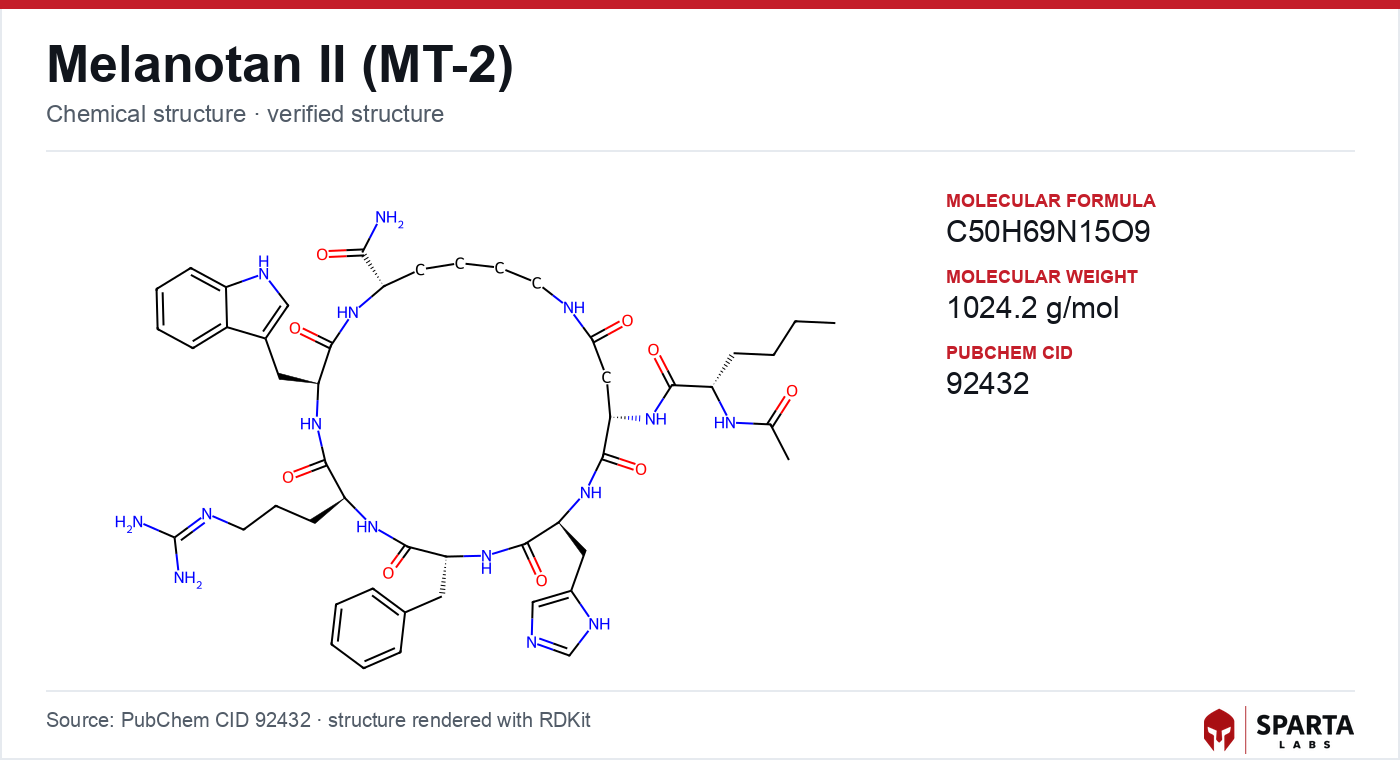
Figure: chemical structure of Melanotan II.
Methodological Landscape of the Published Literature
The MT-II literature is dominated by preclinical methodologies, with a single early-phase human pilot study anchoring the human-facing record. Four broad approaches recur across the corpus.
The first is in vitro receptor characterization, in which MT-II is applied to cell lines expressing individual cloned melanocortin receptor subtypes and its potency is read out through second-messenger assays such as cyclic AMP accumulation. The second is rodent in vivo pharmacology, including both central and peripheral routes of administration in rats and mice, used to probe hypothalamic circuits governing feeding, autonomic tone, and thermoregulation. The third comprises human pharmacodynamic observation, represented principally by a small pilot study conducted in the 1990s. The fourth is post-market clinical case reporting, in which physicians document adverse events observed in individuals who obtained the compound outside research settings.
Findings from research models do not establish safety or efficacy in humans. Sparta Labs makes no claims about the use of this compound.
Each methodology carries distinct interpretive limits. In vitro potency values do not translate directly into whole-organism responses; rodent central-administration studies use routes and exposures that have no human-research analogue; and uncontrolled case reports describe correlation under unknown conditions rather than controlled cause and effect.
Receptor Pharmacology and the Origin of Non-Selectivity
A recurring theme in the receptor-characterization literature is that conformational constraint confers potency across multiple subtypes rather than selectivity for one. The comprehensive review by Hadley and Dorr documented MT-II as a superpotent, non-selective melanocortin agonist and traced this profile to the lactam cyclization that pre-organizes the message sequence into its bioactive geometry [1]. Because native α-MSH is rapidly degraded and adopts a flexible conformation, the constrained analogue displayed markedly greater activity in the assays these authors summarized.
This non-selectivity is central to interpreting the downstream physiological literature: an observed effect in a rodent model cannot be cleanly assigned to one receptor subtype from an MT-II experiment alone. Investigators therefore paired MT-II with subtype-selective antagonists and genetic knockout models to attribute effects, a strategy that appears throughout the feeding and autonomic studies below. The structural design principles that MT-II helped validate later informed subtype-selective agonists; the clinically approved melanocortin agonist bremelanotide is discussed in the PT-141 (Bremelanotide) published research article.
Hypothalamic Feeding and Autonomic Circuit Studies (Rodent)
The melanocortin system is a well-characterized node in central energy-balance regulation, and MT-II served as a probe in this circuit-mapping work. Raposinho, White, and Aubert reported that central administration of MT-II in male rats was associated with reduced food intake and attenuation of neuropeptide Y (NPY)-driven orexigenic signaling, while the NPY-associated effects on gonadotropic and somatotropic axes were dissociable from the feeding response [2]. The authors interpreted this dissociation as evidence that distinct hypothalamic melanocortin circuits govern separable physiological outputs.
Autonomic-outflow studies extended MT-II's role as a circuit-mapping tool. Brito and colleagues used melanocortin receptor stimulation to examine sympathetic innervation of adipose depots and reported differential activation of sympathetic outflow to distinct fat depots, consistent with a model in which melanocortin-responsive neurons participate in depot-specific autonomic control [3]. Because these experiments combined MT-II with pharmacological and anatomical controls, they contributed to receptor-attribution efforts rather than resting on MT-II response alone.
Central melanocortin activation has also been examined in the context of cardiovascular autonomic regulation. Da Silva, do Carmo, and Hall reviewed evidence that central melanocortin receptor engagement in rodent models was associated with changes in sympathetic drive and hemodynamic parameters, situating MT-II-type agonism within broader research on brain melanocortin control of blood pressure [4]. These observations are presented as reported findings within rodent physiology and are not extrapolated to humans.
Pigmentation Biology and the Role of MC1R Genotype
The pigmentation literature contains MT-II's principal controlled human data point. Dorr and colleagues published a pilot phase-I evaluation of MT-II, describing a small, placebo-controlled study in which pharmacodynamic signals attributable to melanocortin receptor engagement were observed and the compound was characterized as warranting further controlled investigation [5]. This study is frequently cited as the origin of subsequent human melanocortin research interest.
Complementary human genetics work clarified why melanocortin pharmacodynamics vary between individuals. Naysmith and colleagues examined pigmentary responses stratified by MC1R genotype and reported that individuals carrying MC1R variant alleles differed in melanin-related measures from non-variant individuals, providing quantitative evidence that MC1R genotype modulates the pigmentary response to melanocortin signaling [6]. Together these papers frame MC1R as the receptor subtype most directly relevant to the cutaneous arm of melanocortin pharmacology.
Post-Market Clinical Case Reports
Distinct from controlled research, the peer-reviewed clinical literature contains case reports describing adverse events in individuals who self-administered MT-II obtained outside research channels. Nelson, Bryant, and Aks described a case of systemic toxicity including rhabdomyolysis temporally associated with self-reported MT-II administration [7]. Such reports arise under uncontrolled conditions with unverified material and self-reported exposure, and they are included here for completeness of the published record rather than as controlled pharmacological evidence. They underscore why analytical verification of research material matters; sourcing and identity-testing considerations are discussed in the Melanotan-2 sourcing and quality article.
Interpretive Boundaries and Open Questions
Several structural features of the MT-II literature constrain what can be concluded from it. The compound's non-selectivity means that any whole-animal observation reflects composite engagement across multiple receptor subtypes unless selective antagonists or genetic models isolate a pathway. The human record rests on a single small pilot study plus uncontrolled case reports, so pharmacodynamic characterization in humans remains limited. And the reliance on central-administration routes in rodent work produces exposures without direct translational analogue.
These boundaries define the active questions that the melanocortin field continues to pursue: cleaner receptor-subtype attribution, species-difference characterization, and the search for subtype-selective ligands that separate the effects MT-II elicited in combination. That trajectory produced clinically developed selective agonists and remains an area of ongoing pharmacological interest. Researchers surveying adjacent melanocortin-class compounds may also consult the PT-141 (Bremelanotide) mechanism of action article. Verified reference material for these studies is available on the Melanotan-2 product page.
References
-
Hadley ME, Dorr RT. Melanocortin peptide therapeutics: historical milestones, clinical studies and commercialization. Peptides. 2006;27(4):921-30. PMID: 16412534. DOI: 10.1016/j.peptides.2005.01.029. PubMed
-
Raposinho PD, White RB, Aubert ML. The melanocortin agonist Melanotan-II reduces the orexigenic and adipogenic effects of neuropeptide Y (NPY) but does not affect the NPY-driven suppressive effects on the gonadotropic and somatotropic axes in the male rat. J Neuroendocrinol. 2003;15(2):173-81. PMID: 12535159. DOI: 10.1046/j.1365-2826.2003.00963.x. PubMed
-
Brito MN, Brito NA, Baro DJ, Song CK, Bartness TJ. Differential activation of the sympathetic innervation of adipose tissues by melanocortin receptor stimulation. Endocrinology. 2007;148(11):5339-47. PMID: 17690163. DOI: 10.1210/en.2007-0621. PubMed
-
da Silva AA, do Carmo JM, Hall JE. Role of the brain melanocortins in blood pressure regulation. Curr Opin Nephrol Hypertens. 2013;22(2):216-21. PMID: 23314562. DOI: 10.1097/MNH.0b013e32835d7e9e. PubMed
-
Dorr RT, Lines R, Levine N, Brooks C, Xiang L, Hruby VJ, Hadley ME. Evaluation of melanotan-II, a superpotent cyclic melanotropic peptide in a pilot phase-I clinical study. Life Sci. 1996;58(20):1777-84. PMID: 8637402. DOI: 10.1016/0024-3205(96)00160-9. PubMed
-
Naysmith L, Waterston K, Ha T, Flanagan N, Bisset Y, Ray A, Wakamatsu K, Ito S, Rees JL. Quantitative measures of the effect of the melanocortin 1 receptor on human pigmentary status. J Invest Dermatol. 2004;122(2):423-8. PMID: 15009724. DOI: 10.1046/j.0022-202X.2004.22221.x. PubMed
-
Nelson ME, Bryant SM, Aks SE. Melanotan II injection resulting in systemic toxicity and rhabdomyolysis. Clin Toxicol (Phila). 2012;50(10):1169-73. PMID: 23121206. DOI: 10.3109/15563650.2012.740592. PubMed
Disclaimer. Statements in this article have not been evaluated by the Food and Drug Administration. This compound is not intended to diagnose, treat, cure, or prevent any disease. Sparta Labs sells research-use-only materials. Content is provided for educational and informational purposes only and does not constitute medical advice. Consult a qualified medical professional for any health concerns.
Frequently asked questions
What kind of research exists on Melanotan-2?
The published Melanotan-2 (MT-II) record is dominated by preclinical work: in vitro receptor characterization on cloned melanocortin subtypes and rodent in vivo pharmacology examining hypothalamic feeding and autonomic circuits. The human-facing literature centers on a single early-phase pilot study from the 1990s, supplemented by post-market clinical case reports. It reads as a lineage of tool-compound studies rather than a conventional drug-development program.
Why is Melanotan-2 described as a non-selective melanocortin agonist?
MT-II is a cyclic analogue of alpha-MSH in which a lactam bridge constrains the peptide into its receptor-active conformation. Reviews summarized by Hadley and Dorr attribute its high potency across multiple melanocortin receptor subtypes to this conformational constraint rather than to selectivity for any one subtype. As a result, whole-animal observations from MT-II experiments reflect composite receptor engagement unless selective antagonists or genetic models isolate a pathway.
What did the 1996 Dorr et al. pilot study report?
Dorr and colleagues published a small placebo-controlled phase-I pilot evaluation of MT-II in Life Sciences in 1996. They reported pharmacodynamic signals attributed to melanocortin receptor engagement and characterized the compound as warranting further controlled investigation. This study is frequently cited as the origin point of subsequent human melanocortin research interest.
Does MC1R genotype affect the response to melanocortin agonism?
Naysmith and colleagues reported quantitative pigmentary measures stratified by MC1R genotype, finding that individuals carrying MC1R variant alleles differed from non-variant individuals in melanin-related measures. The authors interpreted this as evidence that MC1R genotype modulates the pigmentary response to melanocortin signaling. This frames MC1R as the receptor subtype most directly relevant to the cutaneous arm of melanocortin pharmacology.
What are the interpretive limits of the Melanotan-2 literature?
Three constraints recur across the corpus. The compound's non-selectivity means whole-animal effects reflect multiple receptor subtypes at once; the human record rests on one small pilot plus uncontrolled case reports; and rodent studies frequently used central-administration routes with no direct translational analogue. These boundaries define the field's open questions around receptor-subtype attribution and subtype-selective ligand development.