
PT-141 (Bremelanotide): Sourcing, Purity, and Verification Standards
A sourcing reference for PT-141 (bremelanotide): why its cyclic lactam architecture and MT-II lineage shape analytical verification, and what a batch COA documents. Educational reference.

For research use only. Not for human consumption. This article is educational reference material. It is not medical advice and is not a recommendation to use any substance.
Introduction
This article examines how the chemistry of PT-141 (bremelanotide) determines what its sourcing and analytical verification must accomplish. Bremelanotide is a synthetic cyclic heptapeptide with a molecular weight near 1,025 daltons, and its structure carries three features that ordinary linear peptides do not: an intramolecular lactam bridge, two non-standard residues, and a defined C-terminal chemistry that separates it from its structural parent. Each feature creates a specific class of impurity that verification is designed to detect. A broader account of the compound's classification and pharmacology is available in the PT-141 research overview. The sections below treat sourcing as a chemistry problem rather than a checklist.
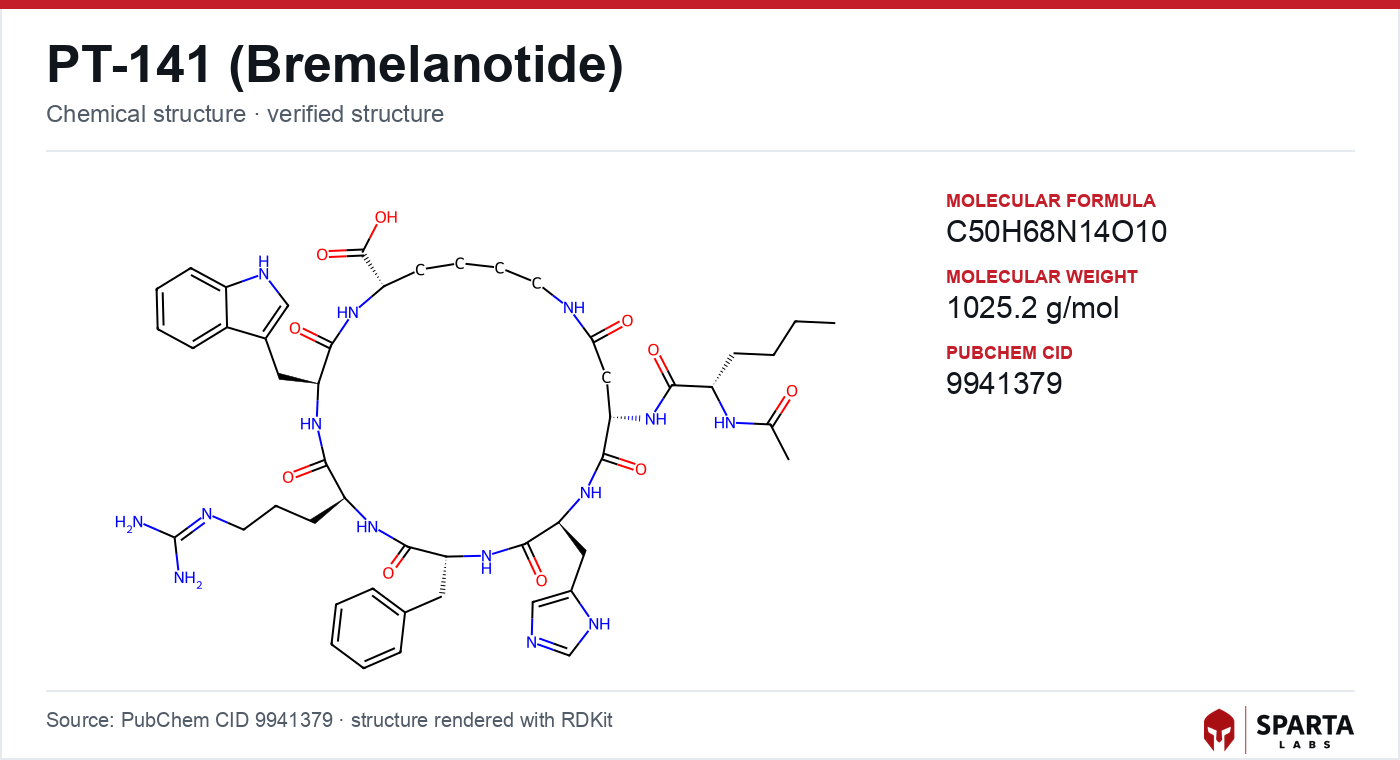
Figure: chemical structure of PT-141.
A Structure Defined by Its C-Terminus
Bremelanotide did not originate as a designed molecule in isolation. It was identified as the principal metabolite of Melanotan-2 (MT-II), an earlier synthetic melanocortin agonist, arising when the C-terminal amide of MT-II is converted to a free carboxylic acid [1]. Molinoff and colleagues (2003) characterized PT-141 in this lineage as a melanocortin-receptor agonist derived from that metabolic conversion [1].
Findings from research models do not establish safety or efficacy in humans. Sparta Labs makes no claims about the use of this compound.
The practical consequence for sourcing is that bremelanotide and MT-II share an identical cyclic core and differ only in one terminal functional group, a difference of roughly one mass unit at the amide-to-acid position. That near-identity is why a sourcing program cannot rely on chromatographic retention alone: two peptides this similar can co-elute or elute closely, and mass measurement becomes the discriminating test. The relationship also means the analytical considerations discussed here overlap substantially with those for the Melanotan-2 sourcing profile, which shares the same ring system.
Assembling a Cyclic Peptide
Bremelanotide is produced by solid-phase peptide synthesis (SPPS), the stepwise resin-based method introduced by Robert Merrifield, work recognized with the Nobel Prize in Chemistry in 1984 [2]. In SPPS the peptide chain is built residue by residue on an insoluble support, allowing controlled incorporation of the norleucine and D-phenylalanine residues that appear in bremelanotide's sequence. The presence of a D-configured residue is deliberate; it distinguishes the intended compound from any L-configured diastereomer that partial racemization during coupling could generate.
Andersson and colleagues (2000) reviewed large-scale peptide synthesis and identified SPPS as the standard route for peptides of this size, noting that resin choice, coupling reagents, and deprotection conditions govern crude purity and yield [3]. For a cyclic target, an additional step dominates the quality picture: after the linear precursor is assembled and selectively deprotected, the aspartate and lysine side chains must close into a lactam ring. Cyclization has to outcompete two side reactions, intermolecular oligomerization and incomplete ring closure, both of which yield species with masses distinct from the monomeric cyclic product. This is a different manufacturing risk profile from the linear growth-hormone secretagogues covered in the Ipamorelin sourcing profile, where no cyclization step is involved.
What HPLC Resolves, and What It Cannot
Reverse-phase HPLC is the primary purity metric for research-grade synthetic peptides. A sample is separated across a chromatographic column and detected by UV absorbance, and purity is expressed as the target peak's area as a fraction of all detected peaks. For bremelanotide this resolves the linear-peptide impurity classes: deletion sequences missing one or more residues, and diastereomers arising from racemization, which frequently separate from the correctly configured peptide under suitable gradient conditions.
The research peptide field commonly specifies HPLC purity at at least 95 percent or at least 98 percent for standard research-grade material. Sparta Labs applies an internal specification of at least 98 percent HPLC purity for bremelanotide, and reports the numerical result with chromatographic conditions on each batch Certificate of Analysis.
The limitation matters as much as the capability. Because bremelanotide differs from its MT-II parent by a single terminal functional group, and because a fully cyclized and an isobaric partially cyclized species can share similar hydrophobicity, chromatographic area percentage alone cannot fully establish identity. HPLC answers "how much of the material is one dominant species," not "which species it is." That second question requires mass spectrometry.
Confirming Identity by Mass
Mass spectrometry (MS) establishes the empirical molecular weight of the isolated compound and is the verification that assigns identity. For bremelanotide, with a calculated molecular weight near 1,025 daltons, an observed mass matching the calculation distinguishes the intact cyclic heptapeptide from a linear precursor of different mass, from an oligomeric cyclization byproduct, and from the amide-terminated MT-II parent. Sparta Labs requires mass-spectrometric molecular-weight confirmation, observed against calculated, on each batch COA.
Residual-species characterization completes the picture. SPPS-derived peptides typically carry a counterion from the final purification, commonly acetate or trifluoroacetate, and the salt form affects the labeled net-peptide content. Sparta Labs batch documentation records the counterion accompanying the final salt form so that the reported mass and content are interpretable.
What a Certificate of Analysis Documents
A Certificate of Analysis (COA) is the batch-specific quality record for a manufactured lot. Sparta Labs issues a COA for every batch of bremelanotide, accessible from the PT-141 product page, and it documents the following fields:
- Compound name, CAS number, and molecular formula
- Batch number and manufacturing date
- Expiry date
- HPLC purity as a numerical percentage, with chromatographic conditions
- Mass-spectrometric molecular-weight confirmation (observed versus calculated)
- Counterion or salt-form characterization
These fields let a researcher confirm the identity, purity, and provenance of the specific material received and judge whether a batch meets the specification a given experiment requires. Reviewing the COA is a reasonable first step in any quality assessment before experimental use, and the same documentation model is applied across the melanocortin-related library, including the KPV sourcing profile.
Storage and Solid-State Stability
Bremelanotide is supplied lyophilized (freeze-dried), the standard presentation for long-term storage of synthetic peptides. Removing water slows the hydrolytic and oxidative reactions that proceed faster in aqueous solution; Wang (2000) documented substantially greater solid-state stability for lyophilized peptide and protein pharmaceuticals across multiple classes [4]. General guidance consistent with that literature favors storage below freezing in a sealed, desiccated, light-protected container, with minimized freeze-thaw cycling of any working solution.
Bremelanotide's own architecture contributes to its robustness. The lactam bridge that closes the ring and the D-phenylalanine residue both impede the proteolytic pathways that degrade linear peptides more readily. Hadley and Dorr (2006), reviewing the melanocortin peptide series, described how such cyclization and D-residue substitutions were introduced to improve metabolic stability relative to the native ligands [5]. Those same features confer some solid-state stability advantage, though conventional cold, dry storage precautions remain applicable regardless.
Why Structural Specificity Governs Sourcing Here
For a compound where a single stereochemical difference (D-phenylalanine versus L-phenylalanine) alters melanocortin-receptor binding, and where a one-mass-unit change at the C-terminus is the only chemical distinction from its MT-II parent, structural confirmation carries particular weight. Chromatographic purity and mass confirmation are complementary rather than redundant: the first quantifies how homogeneous a lot is, the second establishes what the dominant species actually is. A sourcing posture built on both, with a documented at-least-98-percent HPLC specification and per-batch mass confirmation recorded on a published COA, reflects what verification of a molecule this specific requires. Researchers can request the batch COA for any Sparta Labs bremelanotide lot through the product page to check received material against these documented parameters.
References
-
Molinoff PB, Shadiack AM, Earle D, Diamond LE, Quon CY. PT-141: a melanocortin agonist for the treatment of sexual dysfunction. Ann N Y Acad Sci. 2003;994:96-102. PMID: 12851303. DOI: 10.1111/j.1749-6632.2003.tb03167.x
-
Merrifield RB. Solid phase peptide synthesis. I. The synthesis of a tetrapeptide. J Am Chem Soc. 1963;85(14):2149-2154. DOI: 10.1021/ja00897a025
-
Andersson L, Blomberg L, Flegel M, Lepsa L, Nilsson B, Verlander M. Large-scale synthesis of peptides. Biopolymers. 2000;55(3):227-250. DOI: 10.1002/1097-0282(2000)55:3<227::AID-BIP30>3.0.CO;2-7
-
Wang W. Lyophilization and development of solid protein pharmaceuticals. Int J Pharm. 2000;203(1-2):1-60. DOI: 10.1016/s0378-5173(00)00423-3
-
Hadley ME, Dorr RT. Melanocortin peptide therapeutics: historical milestones, clinical studies and commercialization. Peptides. 2006;27(4):921-930. PMID: 16412534. DOI: 10.1016/j.peptides.2005.01.029
Disclaimer. Statements in this article have not been evaluated by the Food and Drug Administration. This compound is not intended to diagnose, treat, cure, or prevent any disease. Sparta Labs sells research-use-only materials. Content is provided for educational and informational purposes only and does not constitute medical advice. Consult a qualified medical professional for any health concerns.
Frequently asked questions
What makes bremelanotide (PT-141) structurally challenging to synthesize?
Bremelanotide is a cyclic heptapeptide closed by a lactam bridge between an aspartate and a lysine side chain, and it incorporates the non-standard residues norleucine and D-phenylalanine. Assembling the correct linear precursor, achieving intramolecular cyclization rather than polymerization, and preserving D-stereochemistry are the main synthetic constraints. Each of these introduces characteristic impurities that analytical verification is designed to resolve.
How is PT-141 related to Melanotan-2 (MT-II)?
Bremelanotide was identified as the primary metabolite of the earlier melanocortin agonist Melanotan-2, formed when MT-II's C-terminal amide is converted to a carboxylic acid. The two peptides share the same cyclic core and non-standard residues, so a sourcing discussion of one informs the other. Because they differ only at the C-terminus, mass spectrometry is central to distinguishing them.
Which analytical methods verify a batch of research-grade bremelanotide?
Reverse-phase HPLC quantifies chromatographic purity as the target peak's area fraction, resolving deletion sequences and diastereomeric byproducts. Mass spectrometry confirms molecular identity against the calculated mass of roughly 1,025 daltons. Together these establish that the material matches the intended cyclic structure rather than a linear or partially cyclized species.
What information appears on a bremelanotide Certificate of Analysis?
A Certificate of Analysis documents compound identity (name, CAS number, molecular formula), batch and manufacturing dates, expiry, HPLC purity with chromatographic conditions, mass-spectrometric molecular-weight confirmation, and the salt or counterion form. It records the batch-specific evidence a researcher uses to confirm identity, purity, and provenance before experimental use.
Why is lyophilized form used for storing synthetic peptides like bremelanotide?
Lyophilization removes water, slowing the hydrolytic and oxidative degradation pathways that proceed faster in aqueous solution. Published formulation literature documents markedly greater solid-state stability for lyophilized peptides across many classes. Standard cold, desiccated, light-protected storage remains applicable to the freeze-dried material.