
Selank Mechanism of Action
A mechanism-focused reference tracing Selank from its tuftsin parent peptide through the enkephalin-peptidase, GABAergic-transcription, and BDNF findings reported in Russian and English preclinical literature.

For research use only. Not for human consumption. This article is educational reference material. It is not medical advice and is not a recommendation to use any substance.
Why Selank Has No Single Receptor Target
Selank (Thr-Lys-Pro-Arg-Pro-Gly-Pro) is a synthetic heptapeptide that, unlike most small-molecule neuroactive compounds, has not been assigned a defined high-affinity receptor in the published record. Its mechanistic literature instead reads as a set of loosely connected observations at different levels of biology: enzyme kinetics, receptor-adjacent peptide availability, gene transcription, and neurotrophin content. Understanding the compound therefore means understanding why a peptide can produce reproducible behavioral effects in animal models without a classical lock-and-key binding site.
The organizing thread is Selank's lineage. It is a stabilized analog of tuftsin (Thr-Lys-Pro-Arg), a naturally occurring immunomodulatory tetrapeptide. Selank appends a Pro-Gly-Pro tail to the tuftsin core, a design intended to slow enzymatic breakdown. That structural choice frames every downstream mechanistic hypothesis discussed below, and it is the reason Selank is described in the literature as a "regulatory" peptide rather than a receptor ligand. Readers seeking the broader chemical and regulatory context should consult the Selank research overview.
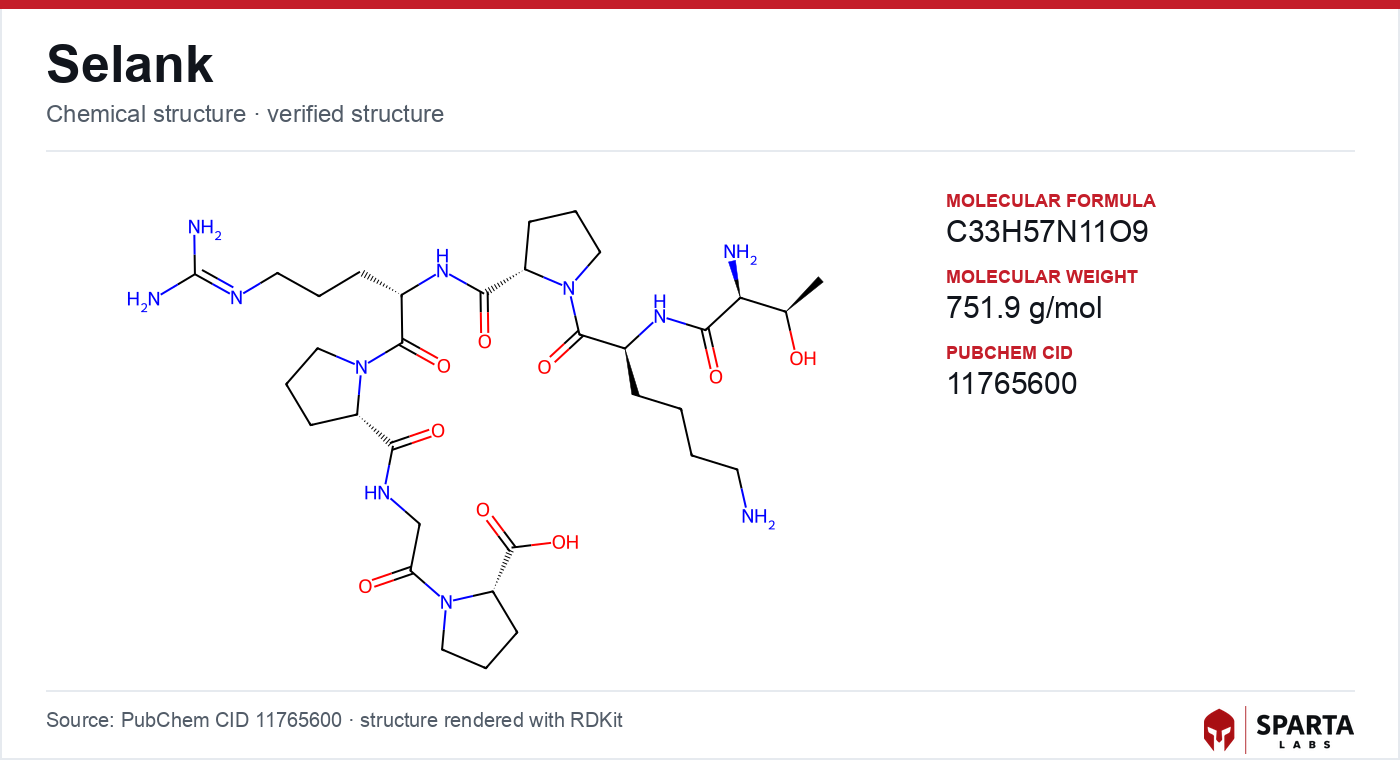
Figure: chemical structure of Selank.
The Tuftsin Core and the Pro-Gly-Pro Stabilizing Tail
Tuftsin was first described by Najjar and Nishioka in 1970 as a phagocytosis-stimulating tetrapeptide derived from the heavy chain of immunoglobulin G [1]. That parent peptide is short-lived in biological fluids, which historically limited its experimental utility. Selank's Pro-Gly-Pro extension is the medicinal-chemistry response to that limitation: proline-rich C-terminal sequences are comparatively resistant to aminopeptidase and carboxypeptidase cleavage, which lengthens the window during which the intact peptide can act.
This structural genealogy matters mechanistically for two reasons. First, the retained tuftsin core is the presumed basis for Selank's reported immunomodulatory activity, since tuftsin's own effects on immune cells were characterized before Selank existed [1]. Second, the extended half-life relative to tuftsin is what makes the peptide-availability hypotheses discussed below biologically plausible, because a rapidly degraded peptide would have little opportunity to influence enzyme systems or gene expression. The analogous stabilization logic underlies the closely related neuropeptide Semax and the amidated derivative N-Acetyl Selank Amidate, both engineered from short endogenous sequences for greater metabolic stability.
Enkephalin Peptidase Activity as a Proposed Axis
An early mechanistic hypothesis for Selank centers on the enzymes that degrade endogenous enkephalins. A review of the compound's mechanistic characterization in Zhurnal Nevrologii i Psikhiatrii imeni S.S. Korsakova discussed Selank in the context of enkephalin metabolism, describing altered enkephalin availability as a proposed contributor to its observed behavioral profile in model systems [2].
Findings from research models do not establish safety or efficacy in humans. Sparta Labs makes no claims about the use of this compound.
The proposed logic is indirect rather than receptor-mediated. Enkephalins are endogenous opioid peptides that act on mu and delta opioid receptors, including receptors expressed on interneurons that shape inhibitory tone in cortical and limbic circuits. If Selank slows enkephalin catabolism, the resulting change in enkephalin availability could alter opioid-receptor occupancy by endogenous ligands, and thereby influence downstream inhibitory neurotransmission without Selank itself binding any of those receptors. This connectivity was framed as a hypothesis rather than demonstrated end to end, and it remains a conceptual bridge between the enzyme observations and the behavioral data reported in anxiety models [2].
Modulation of GABAergic Transcription, Not Receptor Binding
A distinct body of work asks whether Selank influences the GABAergic system, the brain's principal inhibitory signaling network. The published answer is nuanced: the evidence points to effects on gene expression rather than direct receptor occupancy of the kind produced by benzodiazepines.
A 2016 study in Frontiers in Pharmacology by Volkova and colleagues used quantitative PCR to assess GABAergic-pathway gene expression in rat brain tissue after Selank administration [3]. The authors reported altered expression of several genes associated with GABAergic neurotransmission, including transcripts linked to GABA-A receptor subunits and GABA transport, and interpreted the pattern as an indirect transcriptional influence rather than direct receptor-level action.
A companion 2017 investigation in the same journal by Filatova and colleagues tested Selank alongside GABA and olanzapine in IMR-32 human neuroblastoma cells using a targeted GABAergic gene-expression panel [4]. In that isolated monoculture, Selank did not produce statistically significant expression changes. The authors treated the null result as informative: the in vivo transcriptional effects observed in rat cortex may depend on intact neural-circuit architecture or cell-type interactions absent from a single-cell-line model. Read together, references [3] and [4] frame Selank's GABAergic influence as context-dependent and circuit-level rather than intrinsic to any single neuron.
Interaction With a Benzodiazepine in a Stress Model
Because Selank does not appear to bind the benzodiazepine site directly, the question of how it behaves alongside a benzodiazepine is mechanistically informative. A 2017 study in Behavioural Neurology by Kasian and colleagues examined Selank together with diazepam in rats subjected to unpredictable chronic mild stress, using the elevated plus maze as the readout [5]. Combined administration produced anxiety-indicator values closer to pre-stress baseline than either compound produced alone.
The authors described the pattern as additive and noted that the mechanistic basis of the interaction was unresolved. An additive rather than redundant profile is consistent with the broader picture in which Selank acts through pathways that do not simply duplicate direct GABA-A modulation. Whether the two agents converge on shared downstream circuitry or act through complementary routes was flagged as an open question [5].
BDNF Content in Preclinical Models
A separate line of research examines brain-derived neurotrophic factor (BDNF), a neurotrophin involved in synaptic plasticity in rodent systems. A 2008 report in Doklady Biological Sciences by Semenova and colleagues described altered hippocampal BDNF messenger RNA and protein levels in rats following Selank administration, with the anatomical distribution of the changes leading the authors to propose locally stimulated neurotrophin expression rather than transport from distant regions [6].
A 2019 study in the Bulletin of Experimental Biology and Medicine by Laukova and colleagues extended this question to a chronic ethanol-exposure model in rats [7]. Selank-treated, ethanol-exposed animals showed BDNF content in the hippocampus and prefrontal cortex that differed directionally from ethanol-exposed controls. The authors interpreted the finding as consistent with a neurotrophin-associated component of the compound's activity in that model, while stopping short of any claim about mechanism in intact humans.
What the Mechanistic Record Does Not Yet Establish
Several gaps define the current understanding. No radioligand-displacement data at defined GABA-A subunit combinations or opioid-receptor subtypes have been published in accessible English-language literature, so a primary molecular target remains unassigned. The three reported axes, peptidase activity, GABAergic transcription, and BDNF content, have not been integrated into a single causal pathway within one study, and their proposed ordering is inferential.
A substantial fraction of Selank's characterization exists in Russian-language sources originating from the Institute of Molecular Genetics, some of which are not fully indexed in PubMed, which complicates independent English-language verification. The same caveats apply to structurally related regulatory peptides; readers can compare the parallel evidence base in the Semax mechanism of action reference. These are open questions in an active research program rather than settled conclusions. Selank as a research material is catalogued on the corresponding Selank product page for laboratory reference.
References
-
Najjar VA, Nishioka K. "Tuftsin": a natural phagocytosis stimulating peptide. Nature. 1970;228(5272):672–673. PMID: 5473315
-
Zozulia AA, Neznamov GG, Siuniakov TS, et al. Efficacy and possible mechanisms of action of a new peptide anxiolytic Selank in the therapy of generalized anxiety disorders and neurasthenia. Zhurnal Nevrologii i Psikhiatrii imeni S.S. Korsakova. 2008;108(4):38–48. PMID: 18454096
-
Volkova A, Shadrina M, Kolomin T, Andreeva L, Limborska S, Myasoedov N, Slominsky P. Selank administration affects the expression of some genes involved in GABAergic neurotransmission. Frontiers in Pharmacology. 2016;7:31. PMID: 26941645
-
Filatova E, Kasian A, Kolomin T, Rybalkina E, Alieva A, Andreeva L, Limborska S, Myasoedov N, Pavlova G, Slominsky P, Shadrina M. GABA, Selank, and olanzapine affect the expression of genes involved in GABAergic neurotransmission in IMR-32 cells. Frontiers in Pharmacology. 2017;8:89. PMID: 28293190
-
Kasian A, Kolomin T, Andreeva L, Bondarenko O, Myasoedov N, Slominsky P, Shadrina M. Peptide Selank enhances the effect of diazepam in reducing anxiety in unpredictable chronic mild stress conditions in rats. Behavioural Neurology. 2017;2017:5091027. PMID: 28348452
-
Semenova TP, Kozlovskaya MM, Zakharova NM, Kozlovskii II. Effect of intranasal administration of Selank on BDNF expression in the rat hippocampus. Doklady Biological Sciences. 2008;421:241–243. PMID: 18825971
-
Laukova M, Alaluf LG, Serova LI, Arango V, Sabban EL. Selank, a peptide analog of tuftsin, and BDNF content in the hippocampus and prefrontal cortex of rats exposed to ethanol. Bulletin of Experimental Biology and Medicine. 2019;167(5):641–644. PMID: 31625071
Disclaimer. Statements in this article have not been evaluated by the Food and Drug Administration. This compound is not intended to diagnose, treat, cure, or prevent any disease. Sparta Labs sells research-use-only materials. Content is provided for educational and informational purposes only and does not constitute medical advice. Consult a qualified medical professional for any health concerns.
Frequently asked questions
Is Selank related to tuftsin?
Yes. Selank is a synthetic heptapeptide built on the tuftsin tetrapeptide core (Thr-Lys-Pro-Arg) with an added Pro-Gly-Pro tail. Tuftsin was first described by Najjar and Nishioka in 1970 as a naturally occurring immunomodulatory peptide. The Pro-Gly-Pro extension is a medicinal-chemistry modification intended to slow enzymatic breakdown relative to the parent peptide.
Does Selank bind directly to GABA-A receptors?
Published research has not documented direct GABA-A receptor binding by Selank in the manner of benzodiazepines. A 2016 study in Frontiers in Pharmacology reported altered expression of GABAergic-pathway genes in rat brain tissue, which the authors interpreted as an indirect transcriptional influence rather than direct receptor-level action. A companion 2017 cell-culture study found no significant expression changes in isolation, suggesting the effect is circuit-dependent.
What is the proposed role of enkephalin peptidases in Selank research?
One hypothesis holds that Selank alters the enzymatic degradation of endogenous enkephalins, potentially prolonging their availability. Because enkephalins act on opioid receptors that regulate inhibitory neurotransmission, changes in enkephalin availability could indirectly influence downstream signaling without Selank itself binding those receptors. This pathway was proposed rather than demonstrated end to end in the cited literature.
Why is a single molecular target hard to identify for Selank?
No radioligand-displacement studies at defined GABA-A subunit combinations or opioid-receptor subtypes have been published in accessible English-language literature. Selank's characterized activity spans enzyme kinetics, gene transcription, and BDNF content, and these axes have not been integrated into a single causal pathway. Much of the underlying work also exists in Russian-language sources that are not fully indexed in PubMed.