
Semax Mechanism of Action
A structure-first review of Semax's reported pharmacology: how the ACTH(4-7) melanocortin core and the appended Pro-Gly-Pro tripeptide relate to neurotrophin induction, monoaminergic effects, and copper coordination documented in primary literature. Educational reference.

For research use only. Not for human consumption. This article is educational reference material. It is not medical advice and is not a recommendation to use any substance.
Introduction
Semax (Met-Glu-His-Phe-Pro-Gly-Pro) is a synthetic heptapeptide constructed by grafting a proteolysis-resistant Pro-Gly-Pro tripeptide onto the ACTH(4-7) fragment of adrenocorticotropic hormone. It is classified as a noncorticotropic melanocortin analog: it retains the behaviorally active core of ACTH while lacking the steroidogenic activity of the full hormone. Because Semax was designed as a sequence, its reported pharmacology is most usefully read from its structure outward. The sections below trace each reported molecular axis back to the specific residues thought to drive it, attributing every observation to the cited primary source and treating those observations as reported experimental findings rather than established clinical facts.
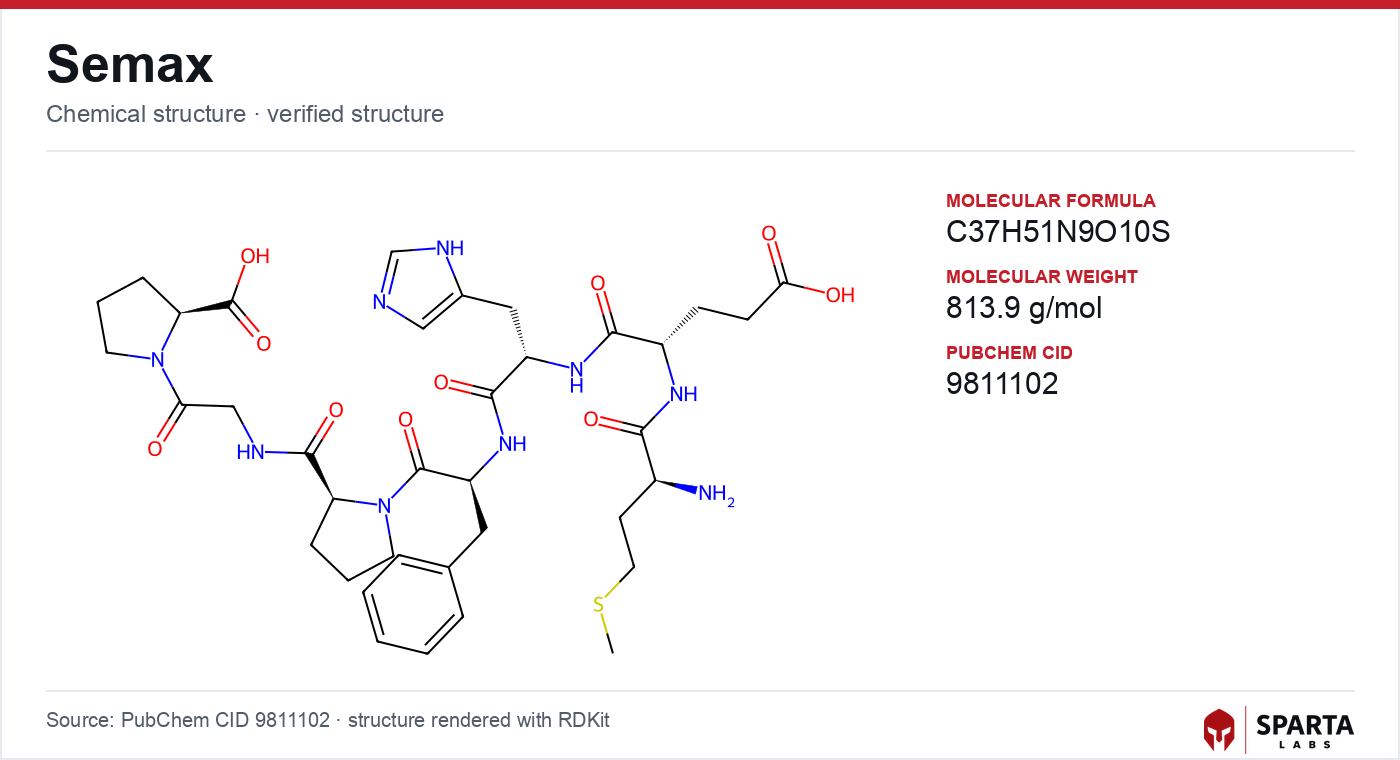
Figure: chemical structure of Semax.
From ACTH(4-10) to a Stabilized Heptapeptide
The design logic of Semax begins with the observation that the behavioral pharmacology historically attributed to ACTH resides not in the full 39-residue hormone but in a short internal fragment, ACTH(4-10) (Met-Glu-His-Phe-Arg-Trp-Gly). Within that fragment, the ACTH(4-7) tetrapeptide Met-Glu-His-Phe carries the melanocortin pharmacophore. Native ACTH(4-10) is rapidly hydrolyzed by peptidases, which limits its persistence in tissue.
Semax addresses that liability at the sequence level. The N-terminal Met-Glu-His-Phe is preserved as the pharmacophore, and a C-terminal Pro-Gly-Pro tripeptide is appended in place of the labile Arg-Trp-Gly tail. Proline residues flanking the C-terminus sterically hinder carboxypeptidase attack, and the whole construct is more resistant to enzymatic clearance than the parent fragment. This structure-stability relationship is the reason Semax is studied as a distinct entity rather than as an interchangeable ACTH surrogate, and it frames the recurring question in the literature of whether observed effects belong to the intact heptapeptide or to its fragments. The broader chemistry and classification are treated in the Semax research overview.
The Melanocortin Receptor Family as the Nominal Target
The ACTH(4-7) core engages the melanocortin receptor (MCR) system, a family of five G-protein-coupled receptors designated MC1R through MC5R that couple to adenylate cyclase and elevate intracellular cyclic AMP. Peripheral subtypes (MC1R, MC2R, MC5R) govern pigmentation, steroidogenesis, and exocrine function, while the central nervous system predominantly expresses MC3R and MC4R. Because Semax carries the melanocortin core but not the residues associated with adrenal steroidogenic signaling, it is grouped with the noncorticotropic melanocortin analogs.
Filippenkov and colleagues (2021), publishing in the International Journal of Molecular Sciences, examined hippocampal gene-expression patterns in male rats after acute stress and compared melanocortin derivatives in the ACTH(4-10) lineage [1]. The authors reported that these analogs modulated stress-response transcription in the hippocampus without reproducing the corticotropic hormonal activity of full-length ACTH, a pharmacological separation that operationally defines the noncorticotropic class to which Semax belongs.
Findings from research models do not establish safety or efficacy in humans. Sparta Labs makes no claims about the use of this compound.
A recurring open question in this literature is which central subtype predominates. Subtype-selective pharmacological tools have not resolved the relative contributions of MC3R and MC4R to the neurochemical effects attributed to Semax, and this remains an explicitly stated direction for further mechanistic work. The melanocortin framework also connects Semax to structurally distinct melanocortin agonists such as the MC4R-active compounds discussed in the Melanotan-2 mechanism of action article, which illustrate how different ligands engage the same receptor family through different pharmacophores.
Neurotrophin Induction: The Best-Characterized Axis
The most extensively documented molecular signature of Semax in published research is a reported change in the gene expression and protein levels of brain-derived neurotrophic factor (BDNF) and nerve growth factor (NGF).
Shadrina and colleagues (2001) provided the earliest English-language characterization in Neuroscience Letters, exposing primary rat glial cell cultures to Semax in vitro and measuring neurotrophin mRNA at 30 minutes post-treatment [2]. The authors reported an approximately eightfold elevation of BDNF mRNA and an approximately fivefold elevation of NGF mRNA relative to vehicle controls, in isolated glial cultures from neonatal rat basal forebrain. As an in vitro glial-culture measurement, it does not by itself establish in vivo or human equivalents. Additional bibliographic detail on these and later studies is collected in the Semax published research summary.
Dolotov and colleagues (2006), in Brain Research, reported that a single Semax administration in adult rats was associated with approximately 1.4-fold changes in BDNF protein, approximately threefold changes in exon III BDNF mRNA, and approximately twofold changes in trkB (the high-affinity BDNF receptor, NTRK2) mRNA in hippocampal tissue [3]. Tyrosine phosphorylation of trkB, an index of receptor activation state, was reported to be elevated approximately 1.6-fold, linking the transcriptional signal to a downstream receptor-activation readout. A companion report from the same group in the Journal of Neurochemistry described specific binding of Semax to basal forebrain tissue preparations, associated with measurable changes in BDNF protein in those tissues [4].
Two later studies bear directly on the intact-peptide-versus-metabolite question raised by the structure. Agapova and colleagues (2007), in Neuroscience Letters, examined neurotrophin gene expression across adult rat hippocampus, brainstem, cerebellum, and frontal cortex and reported a region-specific rather than uniform pattern of BDNF and NGF mRNA change [5]. Dmitrieva and colleagues (2009/2010), in Cellular and Molecular Neurobiology, compared intact Semax with its Pro-Gly-Pro metabolite in a rat model of experimental cerebral ischemia across 3-, 24-, and 72-hour time points [6]. They reported that intact Semax produced a selective pattern across neurotrophin targets (BDNF, NTRK2/trkB, NTRK3/trkC, NTRK1/trkA, NGF), whereas Pro-Gly-Pro alone showed a broader, less selective transcriptional profile. The authors interpreted this as evidence that the intact heptapeptide retains a molecular selectivity not fully reducible to its cleavage products, which reconnects the pharmacology to the design rationale for the Pro-Gly-Pro tail.
Downstream and Adjacent Reported Effects
Monoaminergic turnover
Eremin and colleagues (2005), in Neurochemical Research, reported microdialysis and neurochemical data indicating that Semax administration in rodents was associated with altered dopamine and serotonin turnover in the striatum, frontal cortex, and hippocampus [7]. The authors quantified monoamine metabolites (DOPAC and HVA for dopamine; 5-HIAA for serotonin) by HPLC with electrochemical detection and proposed that these monoaminergic changes were downstream of melanocortin receptor engagement rather than the result of direct binding at dopamine or serotonin receptors. This positions the monoaminergic signal as a secondary consequence of the melanocortin-neurotrophin axis rather than an independent primary target.
Transcriptome-level changes in ischemia models
Medvedeva and colleagues (2014), in BMC Genomics, performed a genome-wide transcriptional analysis in a rat model of permanent middle cerebral artery occlusion, examining differential cortical gene expression at 3 and 24 hours after Semax administration [8]. The study reported altered expression of gene sets related to immune response, vascular biology, and inflammatory signaling, with innate-immune pathways and genes associated with blood-brain-barrier function showing the most pronounced differential expression at 24 hours. This transcriptome-wide view broadens the reported footprint of Semax beyond neurotrophins alone, though the functional consequences remain a matter of ongoing study.
Copper coordination through the N-terminal motif
A distinct, chemistry-driven property arises from the N-terminal Met-Glu-His sequence, which supplies an amino-terminal copper- and nickel-binding (ATCUN) motif. Tabbì and colleagues (2015), in the Journal of Inorganic Biochemistry, reported that Semax forms a stable complex with copper(II) ions through this motif [9]. In experiments using SH-SY5Y neuroblastoma and RBE4 endothelial cell lines, the Semax-copper complex was reported to attenuate copper-induced cytotoxicity relative to copper alone, and the authors proposed potential relevance in contexts of metal-ion dysregulation. This axis is notable because it is dictated by primary sequence rather than by melanocortin-receptor pharmacology, and it distinguishes Semax's reported behavior from analogs whose N-termini are modified.
How N-Terminal Modification Changes the Picture
The dependence of both receptor engagement and copper binding on an intact N-terminus is illustrated by comparison with N-acetylated derivatives. Acetylation of the terminal amine and amidation of the C-terminus alter the pharmacophore presentation and abolish the free amino terminus required for the ATCUN copper interaction, changing the compound's reported interaction profile; those modifications are discussed in the N-Acetyl Semax Amidate mechanism of action article. A parallel design logic appears in the closely related regulatory peptide covered in the Selank mechanism of action article, which likewise pairs a short active core with a stabilizing tripeptide extension. Research-grade Semax from Sparta Labs is characterized by HPLC and mass spectrometry for use in preclinical investigations.
Limits of Current Understanding
Several load-bearing questions in the Semax mechanistic literature remain unresolved. The identity of the primary central melanocortin subtype responsible for the neurotrophin and monoaminergic effects has not been established with subtype-selective tools, so the causal chain from receptor to transcription is inferred rather than fully mapped. The pharmacokinetic relationship between administered Semax, central-nervous-system exposure, and receptor occupancy has not been rigorously quantified in any species, which leaves the exposure-response link underdetermined. Finally, the observation from Dmitrieva and colleagues that intact Semax and its Pro-Gly-Pro metabolite differ in transcriptional selectivity implies that any complete mechanistic account must track both species simultaneously [6]. These gaps are consistent with the compound's status as a research reagent whose pharmacology is still being characterized.
References
-
Filippenkov IB, Stavchansky VV, Glazova NYu, Sebentsova EA, Remizova JA, Valieva LV, Levitskaya NG, Myasoedov NF, Limborska SA, Dergunova LV. Antistress action of melanocortin derivatives associated with correction of gene expression patterns in the hippocampus of male rats following acute stress. Int J Mol Sci. 2021;22(18):10054. PMID: 34576218. DOI: 10.3390/ijms221810054. PubMed
-
Shadrina MI, Dolotov OV, Grivennikov IA, Slominsky PA, Andreeva LA, Inozemtseva LS, Limborska SA, Myasoedov NF. Rapid induction of neurotrophin mRNAs in rat glial cell cultures by Semax, an adrenocorticotropic hormone analog. Neurosci Lett. 2001;308(2):115–8. PMID: 11457573. DOI: 10.1016/S0304-3940(01)01994-2. PubMed
-
Dolotov OV, Karpenko EA, Seredenina TS, Inozemtseva LS, Levitskaya NG, Zolotarev YA, Kamensky AA, Grivennikov IA, Engele J, Myasoedov NF. Semax, an analog of ACTH(4-10) with cognitive effects, regulates BDNF and trkB expression in the rat hippocampus. Brain Res. 2006;1117(1):54–60. PMID: 16996037. DOI: 10.1016/j.brainres.2006.07.108. PubMed
-
Dolotov OV, Karpenko EA, Inozemtseva LS, Seredenina TS, Levitskaya NG, Zolotarev YA, Kamensky AA, Grivennikov IA, Engele J, Myasoedov NF. Semax, an analogue of adrenocorticotropin (4–10), binds specifically and increases levels of brain-derived neurotrophic factor protein in rat basal forebrain. J Neurochem. 2006;97 Suppl 1:82–6. PMID: 16635254. DOI: 10.1111/j.1471-4159.2006.03658.x. PubMed
-
Agapova TY, Agniullin YV, Shadrina MI, Shram SI, Kolomin TA, Myasoedov NF, Slominsky PA, Limborska SA. Neurotrophin gene expression in rat brain under the action of Semax, an analogue of ACTH 4-10. Neurosci Lett. 2007;417(2):201–5. PMID: 17353092. DOI: 10.1016/j.neulet.2007.02.042. PubMed
-
Dmitrieva VG, Povarova OV, Skvortsova VI, Limborska SA, Myasoedov NF, Dergunova LV. Semax and Pro-Gly-Pro activate the transcription of neurotrophins and their receptor genes after cerebral ischemia. Cell Mol Neurobiol. 2010;30(1):71–9. PMID: 19633950. DOI: 10.1007/s10571-009-9432-0. PubMed
-
Eremin KO, Kudrin VS, Saransaari P, Oja SS, Grivennikov IA, Myasoedov NF, Rayevsky KS. Semax, an ACTH(4-10) analogue with nootropic properties, activates dopaminergic and serotoninergic brain systems in rodents. Neurochem Res. 2005;30(12):1493–500. PMID: 16362768. DOI: 10.1007/s11064-005-8826-8. PubMed
-
Medvedeva EV, Dmitrieva VG, Povarova OV, Limborska SA, Skvortsova VI, Myasoedov NF, Dergunova LV. The peptide Semax affects the expression of genes related to the immune and vascular systems in rat brain focal ischemia: genome-wide transcriptional analysis. BMC Genomics. 2014;15:228. PMID: 24661604. DOI: 10.1186/1471-2164-15-228. PubMed
-
Tabbì G, Magrì A, Giuffrida A, Lanza V, Pappalardo G, Naletova I, Nicoletti VG, Attanasio F, Rizzarelli E. Semax, an ACTH4-10 peptide analog with high affinity for copper(II) ion and protective ability against metal induced cell toxicity. J Inorg Biochem. 2015;142:39–46. PMID: 25310602. DOI: 10.1016/j.jinorgbio.2014.09.014. PubMed
Disclaimer. Statements in this article have not been evaluated by the Food and Drug Administration. This compound is not intended to diagnose, treat, cure, or prevent any disease. Sparta Labs sells research-use-only materials. Content is provided for educational and informational purposes only and does not constitute medical advice. Consult a qualified medical professional for any health concerns.
Frequently asked questions
What is the pharmacophore of Semax?
Semax retains the ACTH(4-7) tetrapeptide Met-Glu-His-Phe as its melanocortin pharmacophore, the same core carried by the behaviorally active ACTH(4-10) fragment. A C-terminal Pro-Gly-Pro tripeptide is appended in place of the labile natural tail. The proline residues sterically hinder carboxypeptidase cleavage, giving the heptapeptide greater resistance to enzymatic clearance than the parent fragment.
Which receptors are associated with Semax in published research?
Semax is derived from the ACTH(4-7) melanocortin core, which engages the melanocortin receptor family of five G-protein-coupled subtypes (MC1R through MC5R). The central nervous system predominantly expresses MC3R and MC4R. Which of these subtypes predominates for Semax's reported neurochemical effects has not been resolved with subtype-selective tools in the published literature.
What has research reported about Semax and BDNF?
Shadrina and colleagues (2001) reported an approximately eightfold elevation of BDNF mRNA and fivefold elevation of NGF mRNA in rat glial cell cultures in vitro. Dolotov and colleagues (2006) reported, in adult rats, approximately 1.4-fold changes in hippocampal BDNF protein, threefold changes in exon III BDNF mRNA, and elevated trkB receptor phosphorylation. These are reported experimental observations in research models, not established human findings.
Why does Semax bind copper?
The N-terminal Met-Glu-His sequence of Semax supplies an amino-terminal copper- and nickel-binding (ATCUN) motif. Tabbì and colleagues (2015) reported that Semax forms a stable copper(II) complex through this motif, and that the complex attenuated copper-induced cytotoxicity relative to copper alone in two cell lines. This property is dictated by the peptide's primary sequence and depends on a free N-terminus, which is why N-acetylated derivatives behave differently.
How do intact Semax and its Pro-Gly-Pro metabolite differ?
Dmitrieva and colleagues (2009/2010) compared intact Semax with its Pro-Gly-Pro metabolite in a rat cerebral ischemia model across several time points. They reported that intact Semax produced a selective pattern across neurotrophin and receptor genes, whereas Pro-Gly-Pro alone showed a broader, less selective transcriptional profile. The authors interpreted this as evidence that the intact heptapeptide retains a molecular character not fully reducible to its cleavage products.