
Selank: A Research Overview
How a Pro-Gly-Pro extension turned the fleeting immunopeptide tuftsin into Selank, a metabolically stabilized heptapeptide studied across GABAergic and enkephalinergic pathways in Russian preclinical and clinical literature.

For research use only. Not for human consumption. This article is educational reference material. It is not medical advice and is not a recommendation to use any substance.
Selank: A Research Overview of a Tuftsin-Derived Heptapeptide
Introduction
Selank is a synthetic heptapeptide carrying the amino acid sequence Thr-Lys-Pro-Arg-Pro-Gly-Pro. It belongs to a small family of "regulatory peptide" drug candidates engineered in Moscow at the Institute of Molecular Genetics of the Russian Academy of Sciences, where the guiding idea was to take a short, biologically active fragment of an endogenous protein and re-engineer it into a molecule stable enough to survive in the bloodstream. In Selank's case the starting point was tuftsin, a four-residue immunopeptide. This overview traces that lineage: what tuftsin is, why it could not become a drug on its own, how a proline-rich tail changed the picture, and how the resulting heptapeptide is classified and regulated today.
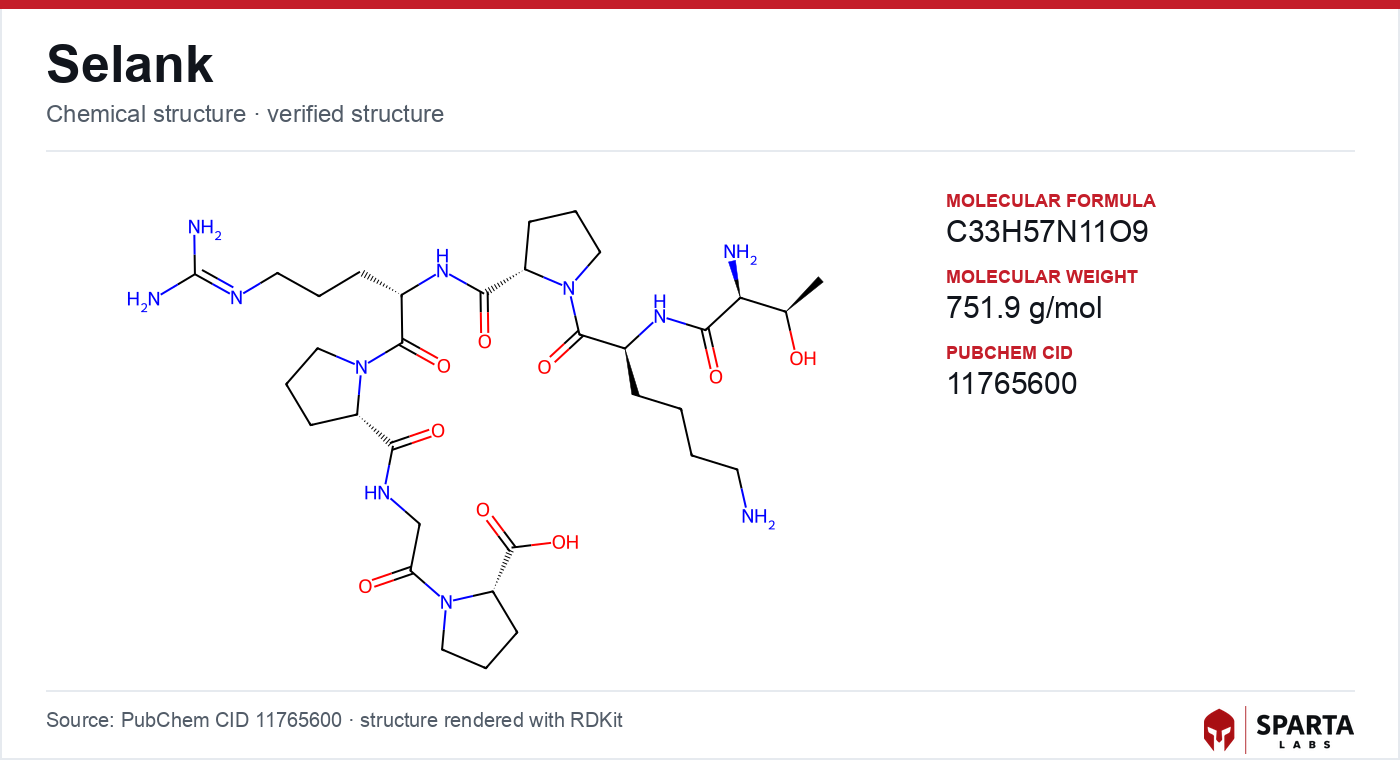
Figure: chemical structure of Selank.
The Tuftsin Starting Point
The story of Selank begins with a molecule that is not synthetic at all. In 1970, Najjar and Nishioka described tuftsin (Thr-Lys-Pro-Arg), a tetrapeptide released by enzymatic cleavage from the heavy chain of immunoglobulin G, and reported that it stimulated phagocytosis by leukocytes [1]. Findings from research models do not establish safety or efficacy in humans. Sparta Labs makes no claims about the use of this compound.
Tuftsin illustrated a recurring problem in peptide pharmacology. A fragment can be pharmacologically interesting yet clinically impractical, because circulating and membrane-bound peptidases cleave short peptides within minutes. Tuftsin's reported susceptibility to rapid enzymatic degradation constrained its translational usefulness and framed the design brief that eventually produced Selank: preserve the tuftsin core, but shield it from the enzymes that dismantle it.
Engineering Metabolic Stability
The design solution attributed to the Institute of Molecular Genetics group was to extend the tuftsin tetrapeptide at its C-terminus with a Pro-Gly-Pro tripeptide, yielding the heptapeptide Thr-Lys-Pro-Arg-Pro-Gly-Pro. Proline is a conformationally rigid, cyclic imino acid, and sequences rich in proline are characteristically poor substrates for many endopeptidases, because the peptide bonds adjacent to proline residues resist cleavage by numerous proteases.
This is not a coincidental choice. The Pro-Gly-Pro motif appears repeatedly in the design of stabilized neuropeptides from the same research program, and it recurs in the closely related N-acetyl Selank amidate, where additional N-terminal acetylation and C-terminal amidation are used to further blunt exopeptidase activity. The relationship between Selank and its parent peptide is therefore a compact case study in structure-guided stabilization: the pharmacophore is inherited from tuftsin, while the appended proline-rich segment is a metabolic protecting group in peptide form.
Chemistry and Physical Description
Selank is a linear heptapeptide. Its molecular formula is C33H57N11O9 with a molecular weight of approximately 751.9 Da, and all seven residues are in the L-configuration. The molecule is produced by solid-phase peptide synthesis (SPPS), the Merrifield-derived approach in which the growing chain is assembled residue-by-residue on an insoluble resin before cleavage and purification.
The sequence divides naturally into two functional halves. Positions one through four (Thr-Lys-Pro-Arg) reproduce tuftsin, including the basic lysine and arginine side chains that dominate the molecule's charge profile at physiological pH. Positions five through seven (Pro-Gly-Pro) form the stabilizing extension, in which two proline rings flank a single glycine. Readers interested in how these fragments have been dissected in receptor and signaling studies can consult the companion Selank mechanism of action article, which addresses the reported molecular interactions in more depth than an overview permits.
Pharmacological Classification
In the published pharmacology literature, Selank is described as a synthetic regulatory neuropeptide rather than a member of any classical small-molecule drug class. Russian clinical pharmacology sources categorize it among neuropeptide anxiolytics, a grouping defined by contrast: preclinical and clinical reports from the developing institution described an absence of the sedative, muscle-relaxant, and anticonvulsant effects associated with benzodiazepines at concentrations reported to be pharmacologically active [2].
At the molecular level, one of the better-characterized lines of investigation concerns GABAergic gene expression. Volkova and colleagues reported in Frontiers in Pharmacology that Selank administration altered the expression of several genes involved in GABAergic neurotransmission in a rodent model, situating the peptide's activity within that neurotransmitter system rather than at a single defined receptor [3]. Because Selank derives from an immunopeptide, parallel literature has also examined immunomodulatory characteristics; the overview treats these as distinct research threads rather than a unified therapeutic profile.
Regulatory Status
Selank received registration from the Russian Federation Ministry of Health in 2009 and has been distributed in Russia as a prescription intranasal solution, a status that reflects the regulatory framework of a single jurisdiction rather than international consensus [2].
Outside Russia the picture is different. Selank does not hold approval from the United States Food and Drug Administration, the European Medicines Agency, or comparable authorities, and it is not classified as an approved drug in those jurisdictions. It is handled as a research-use-only material, and regulatory obligations vary by locality; researchers are responsible for confirming the rules that apply to their own work. Research-grade Selank from Sparta Labs is verified by independent third-party analysis, and the associated verification standards are described in the Selank sourcing and quality article.
Position Within the Russian Neuropeptide Program
Selank did not emerge in isolation. It is one output of a broader Institute of Molecular Genetics effort to convert endogenous peptide fragments into stabilized therapeutic candidates, an approach that also produced the ACTH(4-10)-derived heptapeptide covered in the Semax research overview. Reading the two side by side highlights the shared engineering logic: identify a short endogenous sequence with reported central activity, then armor it against proteolysis with proline-rich or terminal-capping modifications.
Early behavioral characterization of Selank appeared in the English-language literature in 2003, when Kozlovskii and Danchev reported effects on a conditioned active-avoidance reflex in rats, and a companion paper examined tuftsin-family peptides in stress-related adaptive behavior [4,5]. The comparative clinical evaluation against a benzodiazepine reference compound in subjects with generalized anxiety and neurasthenia, published in 2008, preceded the 2009 registration [2]. For a structured summary of the individual studies rather than the narrative arc, the Selank published research article catalogs the primary literature with methodology notes.
References
-
Najjar VA, Nishioka K. "Tuftsin": a natural phagocytosis stimulating peptide. Nature. 1970;228(5272):672–673. Full text via DOI
-
Zozulia AA, Neznamov GG, Syunyakov TS, Kost NV, Gabaeva MV, Sokolov OIu, Sebentsova EA, Akhromeeva SA, Panchenko LF, Andriushenko AV, Teleshova ES, Shadrina MI, Slominsky PA, Miasoedov NF. Efficacy and possible mechanisms of action of a new peptide anxiolytic selank in the therapy of generalized anxiety disorders and neurasthenia. Zhurnal Nevrologii i Psikhiatrii Imeni S.S. Korsakova. 2008;108(4):38–48. PMID: 18454096
-
Volkova A, Shadrina M, Kolomin T, Andreeva L, Limborska S, Myasoedov N, Slominsky P. Selank administration affects the expression of some genes involved in GABAergic neurotransmission. Frontiers in Pharmacology. 2016;7:31. Full text via DOI
-
Kozlovskii II, Danchev ND. The optimizing action of the synthetic peptide Selank on a conditioned active avoidance reflex in rats. Neuroscience and Behavioral Physiology. 2003;33(7):639–643. PMID: 14552529
-
Semenova TP, Kozlovskaya MM, Zuikov AV, Kozlovskiy II, Myasoedov NF. Selank and short peptides of the tuftsin family in the regulation of adaptive behavior in stress. Neuroscience and Behavioral Physiology. 2003;33(9):853–860. PMID: 12154572
Disclaimer. Statements in this article have not been evaluated by the Food and Drug Administration. This compound is not intended to diagnose, treat, cure, or prevent any disease. Sparta Labs sells research-use-only materials. Content is provided for educational and informational purposes only and does not constitute medical advice. Consult a qualified medical professional for any health concerns.
Frequently asked questions
What is Selank and where does it come from?
Selank is a synthetic heptapeptide with the sequence Thr-Lys-Pro-Arg-Pro-Gly-Pro. It was developed at the Institute of Molecular Genetics of the Russian Academy of Sciences as a metabolically stabilized analog of tuftsin, a naturally occurring tetrapeptide fragment released from the heavy chain of immunoglobulin G.
How does Selank differ structurally from tuftsin?
Selank retains tuftsin's core Thr-Lys-Pro-Arg sequence and appends a C-terminal Pro-Gly-Pro tripeptide. This proline-rich extension is the feature that distinguishes the two molecules and is understood in the literature to underpin Selank's greater resistance to plasma peptidase cleavage relative to the parent peptide.
How is Selank classified in the pharmacological literature?
Published Russian pharmacology literature describes Selank as a synthetic regulatory neuropeptide with reported GABAergic and immunomodulatory activity. It is categorized separately from benzodiazepines, barbiturates, and azapirones, and preclinical reports have noted an absence of sedative and muscle-relaxant effects at active concentrations in animal models.
Is Selank an FDA-approved drug?
No. Selank does not hold approval from the United States Food and Drug Administration, the European Medicines Agency, or comparable authorities. It received registration from the Russian Federation Ministry of Health in 2009. Outside Russia it is not approved for any therapeutic indication and is handled as a research-use-only material.
Why was tuftsin an impractical drug candidate on its own?
Najjar and Nishioka first characterized tuftsin in 1970 as a phagocytosis-stimulating peptide cleaved from IgG. Although biologically active, tuftsin is degraded very rapidly by plasma enzymes, which limited its translational utility and motivated the design of stabilized analogs such as Selank.