
SS-31 (Elamipretide): A Research Overview
An overview of SS-31 (elamipretide / Bendavia): its aromatic-cationic tetrapeptide design, potential-independent cardiolipin targeting, place among mitochondrial pharmacology classes, and its 2025 FDA accelerated approval. Educational reference.

For research use only. Not for human consumption. This article is educational reference material. It is not medical advice and is not a recommendation to use any substance.
Introduction
SS-31, also designated elamipretide, MTP-131, and Bendavia, is a synthetic tetrapeptide belonging to the Szeto-Schiller (SS) peptide family. It is pharmacologically classified as a mitochondria-targeted inner-membrane peptide with selective affinity for cardiolipin, an anionic phospholipid concentrated at the inner mitochondrial membrane. What distinguishes SS-31 as a research subject is not a single reported effect but its design logic: a small, charge-directed molecule engineered to localize at one specific lipid interface rather than to inhibit a defined enzyme. This overview traces that design from its cardiolipin target outward through the peptide's chemistry, its place among mitochondrial-pharmacology classes, and its 2025 regulatory milestone. Research-grade SS-31 from Sparta Labs is verified by independent third-party analytical testing for sequence fidelity and purity.
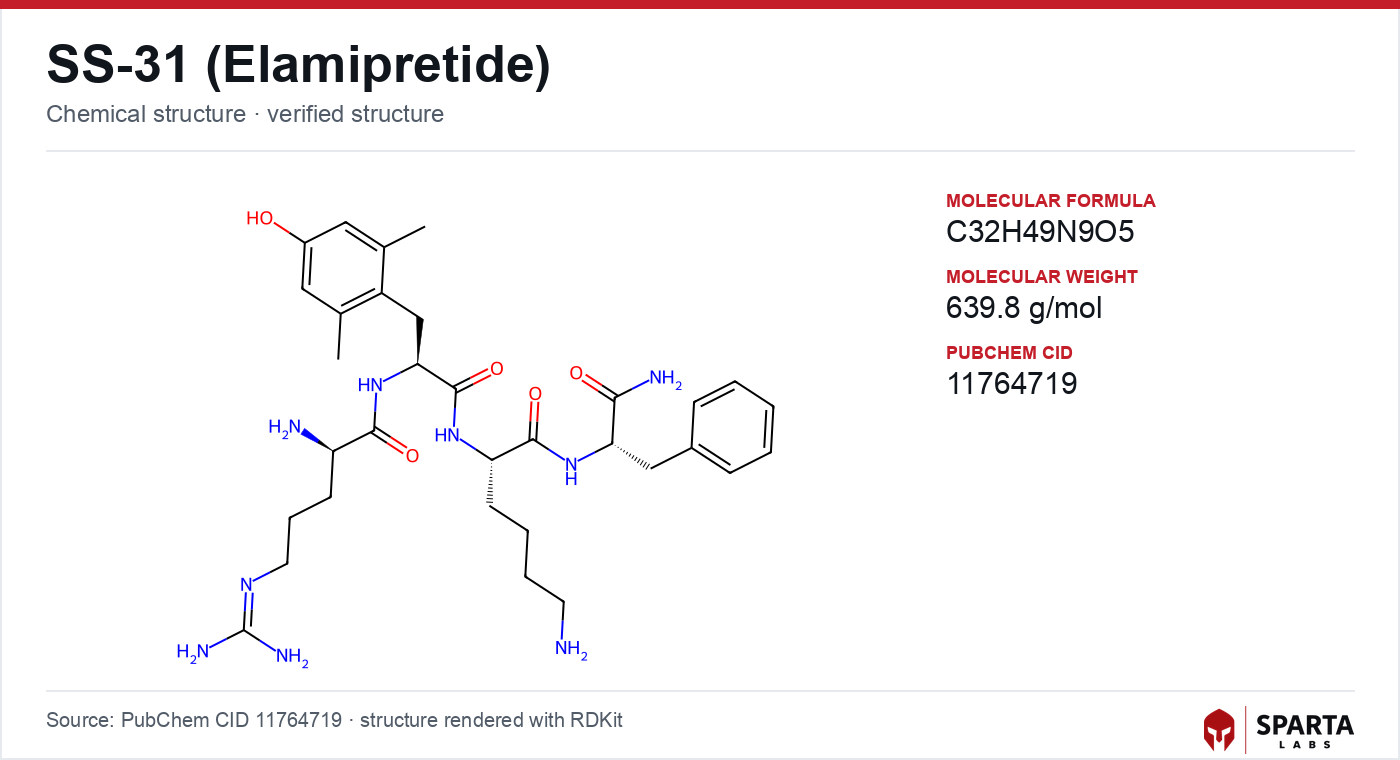
Figure: chemical structure of SS-31.
The cardiolipin problem SS-31 was built around
To understand SS-31, it helps to begin with its target rather than the molecule. Mitochondria are double-membrane organelles housing the electron transport chain (ETC), the principal site of ATP generation through oxidative phosphorylation. The inner mitochondrial membrane (IMM) is distinguished from every other cellular membrane by an unusually high content of cardiolipin, a bis-phosphatidyl glycerol lipid that accounts for roughly 20 percent of IMM phospholipid mass and is essential for the structural integrity of the cristae and for the supramolecular organization of the ETC complexes [1].
Cardiolipin performs a non-redundant role in anchoring cytochrome c at the IMM surface, where the heme protein shuttles electrons between Complex III and Complex IV. Birk and colleagues (2014) reported that under oxidative stress, peroxidation of cardiolipin can shift cytochrome c from its electron-carrier role to a peroxidase that amplifies lipid oxidation and can initiate apoptotic signaling [2]. This makes the cardiolipin/cytochrome c interaction a biochemical node of interest, and the ability to reach that specific interface with a defined chemical entity is the central motivation for research on SS-31.
Findings from research models do not establish safety or efficacy in humans. Sparta Labs makes no claims about the use of this compound.
Chemistry: an aromatic-cationic tetrapeptide
SS-31 is a water-soluble synthetic tetrapeptide with the sequence D-Arg-2',6'-dimethyltyrosine(Dmt)-Lys-Phe-NH2. Its molecular formula yields a compact mass of approximately 640 daltons, substantially smaller than most biologics and many conventional small-molecule drugs. The sequence alternates basic residues (D-arginine and lysine, conferring a formal charge of +3 at physiological pH) with aromatic residues (dimethyltyrosine and phenylalanine). Zhao, Schiller, Szeto and colleagues (2004) identified this alternating aromatic-cationic architecture as the structural basis for mitochondrial membrane targeting and antioxidant activity [1].
Three design features are worth isolating. The dimethyltyrosine (Dmt) substitution at position 2 confers greater aromatic electron density than unmodified tyrosine and is reported to matter for both free-radical scavenging and cardiolipin binding affinity. The C-terminal amide (NH2) contributes to membrane permeability. And the D-amino acid at the N-terminus (D-Arg) confers resistance to proteolytic cleavage, extending the molecule's biological half-life relative to an all-L-amino-acid analog. Together these choices describe a molecule optimized less for enzymatic potency than for durable, charge-driven localization.
How SS-31 finds its target: potential-independent accumulation
A distinctive property of the SS peptides as a class is their reported ability to accumulate at the IMM in a manner that is independent of mitochondrial membrane potential and non-saturable, a behavior attributed to electrostatic attraction between the molecule's positive charge and the anionic surface of cardiolipin-rich membranes [3]. Mitchell and colleagues (2020) characterized this using biophysical methods, reporting that SS-31 partitions into the interfacial region of cardiolipin-containing bilayers and modulates surface electrostatics in a charge-density-dependent manner, providing a physical-chemistry framework for the observed selectivity [3].
This surface-partitioning behavior is examined in greater mechanistic detail in the companion SS-31 mechanism of action article. The reported binding to cardiolipin at the IMM was characterized by Birk and colleagues (2014) as a mechanistic route by which the peptide is reported to modulate the cytochrome c/cardiolipin complex and, in turn, electron transport and ATP synthesis in the models studied [2].
Where SS-31 sits among mitochondrial pharmacology classes
SS-31 is classified within a category sometimes termed "mitochondria-targeted inner-membrane" compounds, or "aromatic-cationic mitochondrial peptides." A useful way to situate it is by contrast with an earlier approach. Triphenylphosphonium (TPP)-conjugated antioxidants such as MitoQ rely on the large negative mitochondrial membrane potential (approximately −180 mV) to drive electrophoretic accumulation of a lipophilic cation into the matrix. SS-31 carries no such lipophilic cationic moiety and does not depend on that potential; it targets the membrane surface through cardiolipin affinity. The practical consequence discussed in the literature is that potential-independent targeting may reach mitochondria whose membrane potential is already compromised, a population that potential-driven agents accumulate in less effectively [3].
SS-31 also differs from the mitochondria-derived signaling peptides. MOTS-c, for instance, is an endogenously encoded peptide reported to act through AMPK signaling rather than by localizing to a specific membrane lipid. Placing SS-31 alongside these classes clarifies that "mitochondria-targeted" is not one mechanism but several, distinguished by whether a molecule exploits charge, potential, or a signaling receptor.
Regulatory status and the Barth syndrome milestone
Elamipretide, marketed as FORZINITY, received accelerated approval from the United States Food and Drug Administration in September 2025 for the improvement of muscle strength in adult and pediatric patients with Barth syndrome weighing at least 30 kilograms. This was the first FDA approval for a compound directly targeting the mitochondrial inner membrane and the first approved pharmacological agent for Barth syndrome. Continued approval for the indication is contingent on verification of clinical benefit in confirmatory trials.
The path to that approval spanned more than a decade across several indication areas. Programs in heart failure with reduced ejection fraction and in primary mitochondrial myopathy generated a substantial body of safety and pharmacodynamic evidence that informed the Barth syndrome program. The MMPOWER-3 phase 3 trial in primary mitochondrial myopathy did not meet its co-primary endpoints at 24 weeks, while a pre-specified subgroup analysis reported numerical differences by genetic subtype that continue to inform research into patient selection [4]. The broader regulatory timeline, including the shift in indication focus over the program's history, is detailed in the SS-31 discovery and regulatory history article, and the underlying trial literature is summarized in the SS-31 published research summary. Outside the approved Barth syndrome indication, SS-31 is available as a research-use-only material.
Discovery lineage
The SS peptide family emerged from a research program conducted jointly by Hazel H. Szeto at Weill Cornell Medical College and Peter W. Schiller at the Institut de Recherches Cliniques de Montreal, initially focused on designing opioid-receptor-selective peptides with improved pharmacokinetic properties. The observation that certain members of this chemical class concentrated at mitochondrial membranes and exhibited antioxidant properties redirected the program toward mitochondrial pharmacology. Szeto and Birk described this trajectory in a 2014 review in Clinical Pharmacology & Therapeutics [5]. The foundational characterization of cell-permeable SS peptide antioxidants targeted to the IMM, including early evidence of the structural requirements for targeting and of protection against oxidative cell death in vitro, was reported by Zhao and colleagues in 2004 in the Journal of Biological Chemistry [1]. Subsequent work progressively defined cardiolipin as the specific molecular anchor, culminating in the preclinical and clinical development conducted under Stealth BioTherapeutics.
References
-
Zhao K, Zhao G-M, Wu D, Soong Y, Birk AV, Schiller PW, Szeto HH. Cell-permeable peptide antioxidants targeted to inner mitochondrial membrane inhibit mitochondrial swelling, oxidative cell death, and reperfusion injury. J Biol Chem. 2004;279(33):34682-34690. PMID: 15178689. DOI: 10.1074/jbc.M402999200. PubMed
-
Birk AV, Chao WM, Bracken C, Warren JD, Szeto HH. Targeting mitochondrial cardiolipin and the cytochrome c/cardiolipin complex to promote electron transport and optimize mitochondrial ATP synthesis. Br J Pharmacol. 2014;171(8):2017-2028. PMID: 24134698. DOI: 10.1111/bph.12468. PubMed
-
Mitchell W, Ng EA, Tamucci JD, Boyd KJ, Sathappa M, Coscia A, et al. The mitochondria-targeted peptide SS-31 binds lipid bilayers and modulates surface electrostatics as a key component of its mechanism of action. J Biol Chem. 2020;295(21):7452-7469. PMID: 32321821. PMC: PMC7247319. DOI: 10.1074/jbc.RA119.012094. PubMed
-
Karaa A, Bertini E, Carelli V, Cohen BH, Enns GM, Falk MJ, et al. Efficacy and safety of elamipretide in individuals with primary mitochondrial myopathy: the MMPOWER-3 randomized clinical trial. Neurology. 2023;101(1):e42-e54. PMC: PMC10382259. DOI: 10.1212/WNL.0000000000207402. PubMed
-
Szeto HH, Birk AV. Serendipity and the discovery of novel compounds that restore mitochondrial plasticity. Clin Pharmacol Ther. 2014;96(6):672-683. PMID: 25188726. PMC: PMC4267688. DOI: 10.1038/clpt.2014.174. PubMed
Disclaimer. Statements in this article have not been evaluated by the Food and Drug Administration. This compound is not intended to diagnose, treat, cure, or prevent any disease. Sparta Labs sells research-use-only materials. Content is provided for educational and informational purposes only and does not constitute medical advice. Consult a qualified medical professional for any health concerns.
Frequently asked questions
What is SS-31 (elamipretide)?
SS-31, also designated elamipretide, MTP-131, and Bendavia, is a synthetic tetrapeptide of the Szeto-Schiller family. It is pharmacologically classified as a mitochondria-targeted inner-membrane peptide with selective affinity for cardiolipin, an anionic phospholipid concentrated at the inner mitochondrial membrane.
Why does SS-31 concentrate at the inner mitochondrial membrane?
The peptide carries a net positive charge of about +3 at physiological pH. Published biophysical work attributes its accumulation to electrostatic attraction between that cationic charge and the anionic surface of cardiolipin-rich membranes, a mechanism reported to be independent of mitochondrial membrane potential and non-saturable.
How does SS-31 differ from other mitochondria-targeted compounds?
Earlier mitochondria-targeted antioxidants such as triphenylphosphonium-conjugated MitoQ rely on the large negative membrane potential to drive electrophoretic uptake. SS-31 lacks that lipophilic cationic moiety and instead targets the membrane surface through cardiolipin affinity, placing it in a distinct pharmacological class.
Is SS-31 (elamipretide) FDA approved?
Elamipretide received FDA accelerated approval in September 2025 for improvement of muscle strength in patients with Barth syndrome weighing at least 30 kilograms, marketed as FORZINITY. Outside that indication, SS-31 is offered as a research-use-only material. Continued approval is contingent on confirmatory trials.
Who discovered the SS peptide family?
The SS peptides emerged from a collaboration between Hazel H. Szeto at Weill Cornell Medical College and Peter W. Schiller at the Institut de Recherches Cliniques de Montreal, originally aimed at opioid-receptor-selective peptides. The observation that certain members concentrated at mitochondrial membranes redirected the program toward mitochondrial pharmacology.