
SS-31 (Elamipretide): Discovery and Regulatory History
How SS-31 (elamipretide) traveled from a Cornell opioid-analgesic program to a cardiolipin-targeting mitochondrial compound with a two-decade clinical development record. A sourced research-library timeline.

For research use only. Not for human consumption. This article is educational reference material. It is not medical advice and is not a recommendation to use any substance.
Introduction
SS-31, later developed as elamipretide, is a short synthetic tetrapeptide whose research history is unusual: it began inside an opioid-analgesic chemistry program and became one of the most studied inner-mitochondrial-membrane-targeting molecules in the pharmacological literature. Classified as a cell-permeable, mitochondria-associating peptide, SS-31 is of research interest because it concentrates at a specific subcellular compartment through a route that does not depend on membrane potential. This timeline traces the compound from its academic origins at Cornell through two decades of named clinical programs to its 2025 regulatory milestone, reporting what investigators and regulators have published rather than making any claim about its use.
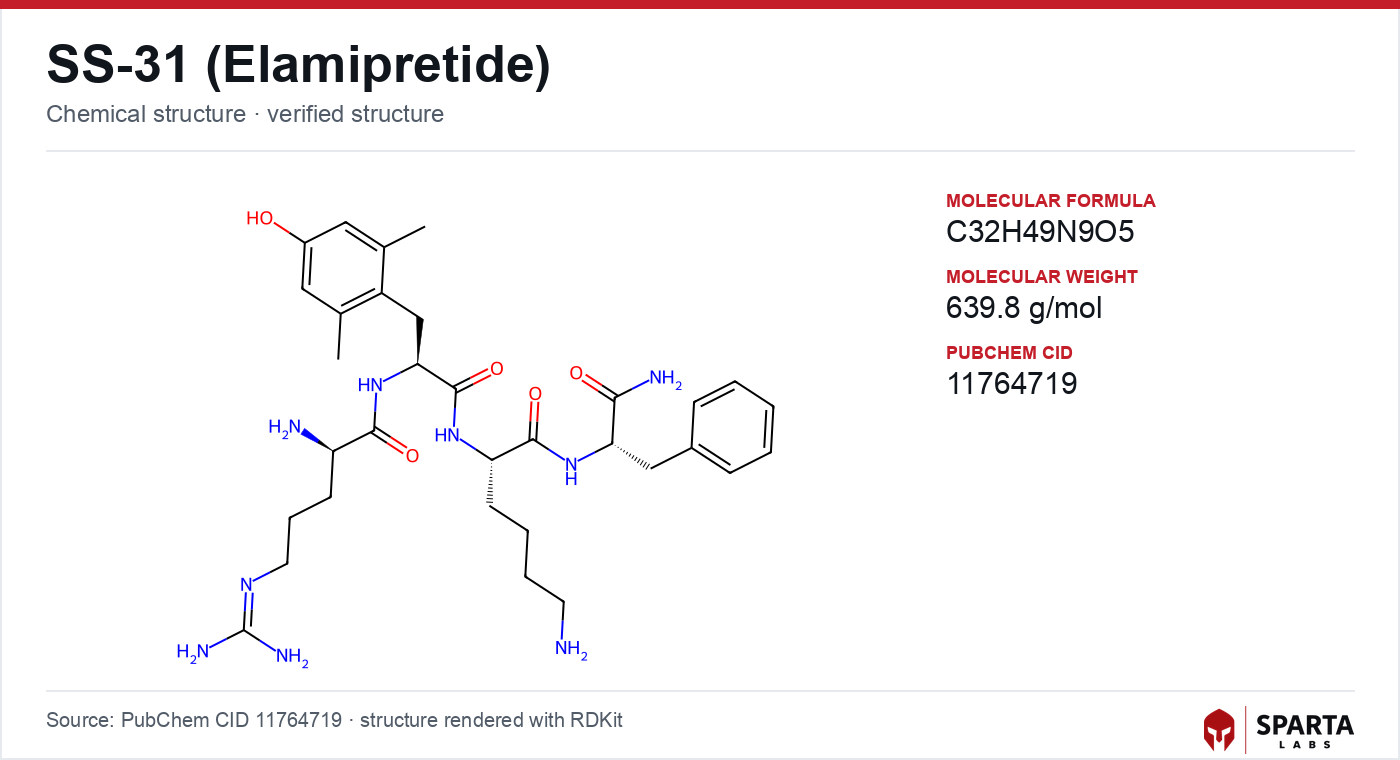
Figure: chemical structure of SS-31.
An Opioid Program That Pointed Toward Mitochondria
The SS (Szeto-Schiller) peptide family arose from a collaboration between Hazel H. Szeto, a pharmacologist and obstetrician at Weill Cornell Medical College, and Peter W. Schiller, a peptide chemist at the Institut de Recherches Cliniques de Montreal. The collaboration set out to design short, cell-permeable peptides with selective opioid-receptor activity for analgesic research. Two design features intended to tune opioid binding, an alternating aromatic-cationic residue motif and a non-natural D-amino acid at the N-terminus, produced molecules that incidentally accumulated inside mitochondria.
Szeto and Birk described this pathway in a 2014 review in Clinical Pharmacology & Therapeutics, characterizing the identification of mitochondrial targeting as a serendipitous departure from the original opioid research program [1].
Findings from research models do not establish safety or efficacy in humans. Sparta Labs makes no claims about the use of this compound.
The naming convention followed from the two investigators: the SS in the compound designations reflects the surnames Szeto and Schiller, and individual analogs were numbered within the series. SS-31 corresponds to the sequence H-D-Arg-Dmt-Lys-Phe-NH2, where Dmt denotes 2',6'-dimethyltyrosine, a modified aromatic residue central to the class.
The 2004 Characterization and the Aromatic-Cationic Architecture
The foundational peer-reviewed description of the SS peptide class appeared in 2004 in the Journal of Biological Chemistry, authored by Zhao, Zhao, Wu, Soong, Birk, Schiller, and Szeto. That paper reported the synthesis and evaluation of multiple SS analogs, described the structural requirements for inner-mitochondrial-membrane (IMM) targeting, and documented in vitro and ex vivo observations in oxidative and reperfusion-injury models [2]. Within the series, SS-31 was distinguished by a combination of high IMM accumulation and reduced opioid-receptor affinity relative to earlier analogs, which reoriented the class away from analgesia and toward mitochondrial pharmacology.
Szeto subsequently published review articles elaborating the rationale for IMM-targeted peptides, describing the class as "cell-permeable, mitochondrial-targeted, peptide antioxidants" and summarizing the preclinical literature across ischemia-reperfusion and related models [3]. A recurring observation across this body of work was that analogs lacking the specific aromatic residues showed diminished mitochondrial accumulation, implicating the aromatic-cationic architecture as mechanistically central. Readers tracing how these structural features are described in the receptor and signaling literature may consult the SS-31 mechanism of action article.
The Cardiolipin Insight That Redirected the Program
A pivotal conceptual shift came with the recognition that SS-31's mitochondrial association is better explained by interaction with cardiolipin, a phospholipid concentrated in the inner mitochondrial membrane, than by diffuse electrostatic attraction to the whole anionic membrane surface. Birk and colleagues reported in 2013, in the Journal of the American Society of Nephrology, evidence that SS-31 associates with cardiolipin and that this interaction was linked to altered cytochrome c behavior in a renal ischemia model [4].
This cardiolipin-centered framing became the canonical mechanistic description in the SS-31 literature, and it carried a direct strategic consequence. Because Barth syndrome is caused by tafazzin gene mutations that disrupt cardiolipin remodeling, the cardiolipin hypothesis pointed toward a genetic disorder whose molecular defect mapped onto the peptide's proposed site of action. The broader classification context for the compound is summarized in the SS-31 research overview.
The Corporate Lineage: MTP-131, Bendavia, and Elamipretide
As the academic program matured, the compound moved into commercial development under a succession of designations. It appeared in the translational literature as MTP-131 and under the development name Bendavia before adopting the international nonproprietary name elamipretide. The underlying intellectual property traced to the Cornell Research Foundation, with Hazel Szeto named as inventor on composition-of-matter and method-of-use filings covering the SS peptide series.
Stealth BioTherapeutics was organized to advance elamipretide through clinical development, consolidating the preclinical dataset into an investigational new drug program and first-in-human studies. This transition from academic characterization to sponsor-led trials is a common arc for peptide compounds; a longer-lineage counterpart in the antioxidant space is traced in the glutathione discovery and history article, which covers an endogenous system studied for far longer than the SS peptides.
Clinical Development and the Indication Pivots
Early clinical work concentrated on cardiovascular disease. A phase 1/2 study reported in 2017 in Circulation: Heart Failure evaluated a single intravenous infusion of elamipretide in participants with heart failure with reduced ejection fraction, reporting that the infusion was tolerated and describing exploratory pharmacodynamic observations at the doses studied [5]. Subsequent controlled evaluation in heart failure did not establish the efficacy signals the program had sought, and development attention shifted toward mitochondrial disease, where the cardiolipin rationale was most direct.
The pivotal mitochondrial-disease effort culminated in MMPOWER-3, a phase 3 trial in genetically confirmed primary mitochondrial myopathy reported in Neurology in 2023. As published, the co-primary endpoints of six-minute walk distance and fatigue were not statistically significantly different from placebo in the overall population at the primary timepoint. A pre-specified subgroup analysis reported a difference in walk distance among participants with nuclear-DNA mutations, an observation the authors framed as hypothesis-generating for future patient-selection research [6]. These indication pivots, from heart failure to broad mitochondrial myopathy to a genetically defined subset, define the arc of the program.
Regulatory Milestones
The regulatory record reflects the indication pivots described above:
- 2004 to 2013: Foundational academic characterization and mechanistic refinement established the scientific basis for an investigational program.
- 2017: First randomized clinical evidence published in the cardiovascular setting.
- Early 2020s: A submission for elamipretide in primary mitochondrial myopathy was not accepted for filing, prompting a strategy shift toward the Barth syndrome indication, whose tafazzin-related cardiolipin defect aligns most directly with the compound's proposed mechanism.
- 2025: The program advanced along an accelerated-approval pathway for the Barth syndrome indication, using a muscle-function measure as an intermediate clinical endpoint. Under accelerated approval, continued approval is contingent on verification of clinical benefit in confirmatory trials.
Current Research Landscape
The elamipretide development program established a documented regulatory precedent for a peptide whose proposed mechanism targets the inner mitochondrial membrane, and it has kept scientific attention on cardiolipin-directed strategies across the mitochondrial-disease spectrum. Post-hoc analyses of the MMPOWER-3 dataset, including genotype-stratified work distinguishing nuclear-DNA from mitochondrial-DNA cases, continue to inform prospective trial design. Analytical and handling standards for material used in ongoing laboratory research are described in the SS-31 sourcing and quality article.
For laboratories evaluating reference material, the SS-31 research peptide product page documents the specification and third-party verification associated with the catalog item.
References
-
Szeto HH, Birk AV. Serendipity and the discovery of novel compounds that restore mitochondrial plasticity. Clin Pharmacol Ther. 2014;96(6):672-683. PMID: 25188726. DOI: 10.1038/clpt.2014.174. PubMed
-
Zhao K, Zhao G-M, Wu D, Soong Y, Birk AV, Schiller PW, Szeto HH. Cell-permeable peptide antioxidants targeted to inner mitochondrial membrane inhibit mitochondrial swelling, oxidative cell death, and reperfusion injury. J Biol Chem. 2004;279(33):34682-34690. PMID: 15178689. DOI: 10.1074/jbc.M402999200. PubMed
-
Szeto HH. Cell-permeable, mitochondrial-targeted, peptide antioxidants. AAPS J. 2006;8(2):E277-E283. PMID: 16796378. DOI: 10.1007/BF02854898. PubMed
-
Birk AV, Liu S, Soong Y, Mills W, Singh P, Warren JD, et al. The mitochondrial-targeted compound SS-31 re-energizes ischemic mitochondria by interacting with cardiolipin. J Am Soc Nephrol. 2013;24(8):1250-1261. PMID: 23813215. DOI: 10.1681/ASN.2012121216. PubMed
-
Daubert MA, Yow E, Dunn G, et al. Novel mitochondria-targeting peptide in heart failure treatment: a randomized, placebo-controlled trial of elamipretide. Circ Heart Fail. 2017;10(12):e004389. PMID: 29217757. DOI: 10.1161/CIRCHEARTFAILURE.117.004389. PubMed
-
Karaa A, Bertini E, Carelli V, Cohen BH, Enns GM, Falk MJ, et al. Efficacy and safety of elamipretide in individuals with primary mitochondrial myopathy: the MMPOWER-3 randomized clinical trial. Neurology. 2023. DOI: 10.1212/WNL.0000000000207402. PubMed
Disclaimer. Statements in this article have not been evaluated by the Food and Drug Administration. This compound is not intended to diagnose, treat, cure, or prevent any disease. Sparta Labs sells research-use-only materials. Content is provided for educational and informational purposes only and does not constitute medical advice. Consult a qualified medical professional for any health concerns.
Frequently asked questions
How did SS-31 originate from opioid research?
The Szeto-Schiller (SS) peptide series was designed at Weill Cornell and the Institut de Recherches Cliniques de Montreal as short, cell-permeable peptides intended for opioid-receptor pharmacology. Certain members of the series, built on an alternating aromatic-cationic motif, were observed to concentrate at the inner mitochondrial membrane. Szeto and Birk later described this shift toward mitochondrial targeting as a serendipitous departure from the original analgesic aim.
What does the SS in SS-31 stand for?
The SS designation refers to the surnames of the two principal investigators, Hazel H. Szeto and Peter W. Schiller. SS-31 is one numbered analog within that broader peptide series, with the sequence H-D-Arg-Dmt-Lys-Phe-NH2.
Why did cardiolipin become central to the SS-31 research story?
Mechanistic work reported that SS-31 associates with cardiolipin, a phospholipid concentrated in the inner mitochondrial membrane, rather than binding diffusely across the membrane surface. Because Barth syndrome arises from tafazzin mutations that disrupt cardiolipin remodeling, this cardiolipin-centered framing helped direct later clinical development toward that genetic disorder.
What is elamipretide's regulatory status?
Elamipretide advanced through named clinical programs in heart failure and mitochondrial disease across roughly two decades. Regulatory milestones included a submission that was not accepted for filing in primary mitochondrial myopathy and, in 2025, an accelerated-approval pathway for the Barth syndrome indication. Continued approval under that pathway is contingent on verification of clinical benefit in confirmatory trials.