
SS-31 (Elamipretide) Mechanism of Action
A sequence-first account of the reported SS-31 (elamipretide) mechanism: why an aromatic-cationic tetrapeptide concentrates at cardiolipin, how it is reported to reverse the cytochrome c peroxidase switch, and what mitochondrial interactome mapping has added. Educational reference.

For research use only. Not for human consumption. This article is educational reference material. It is not medical advice and is not a recommendation to use any substance.
Introduction
SS-31 (elamipretide; D-Arg-Dmt-Lys-Phe-NH2) is a synthetic aromatic-cationic tetrapeptide whose reported mechanism of action is unusual among peptides: it centers not on a cell-surface receptor but on a phospholipid. Published research describes SS-31 concentrating at the inner mitochondrial membrane (IMM) through selective, reversible association with cardiolipin, and from that anchoring point influencing the cytochrome c/cardiolipin complex, electron transport chain (ETC) organization, and membrane surface electrostatics. This article follows the mechanism as the literature built it, beginning with the peptide sequence itself; broader chemistry and regulatory context appears in the SS-31 research overview.
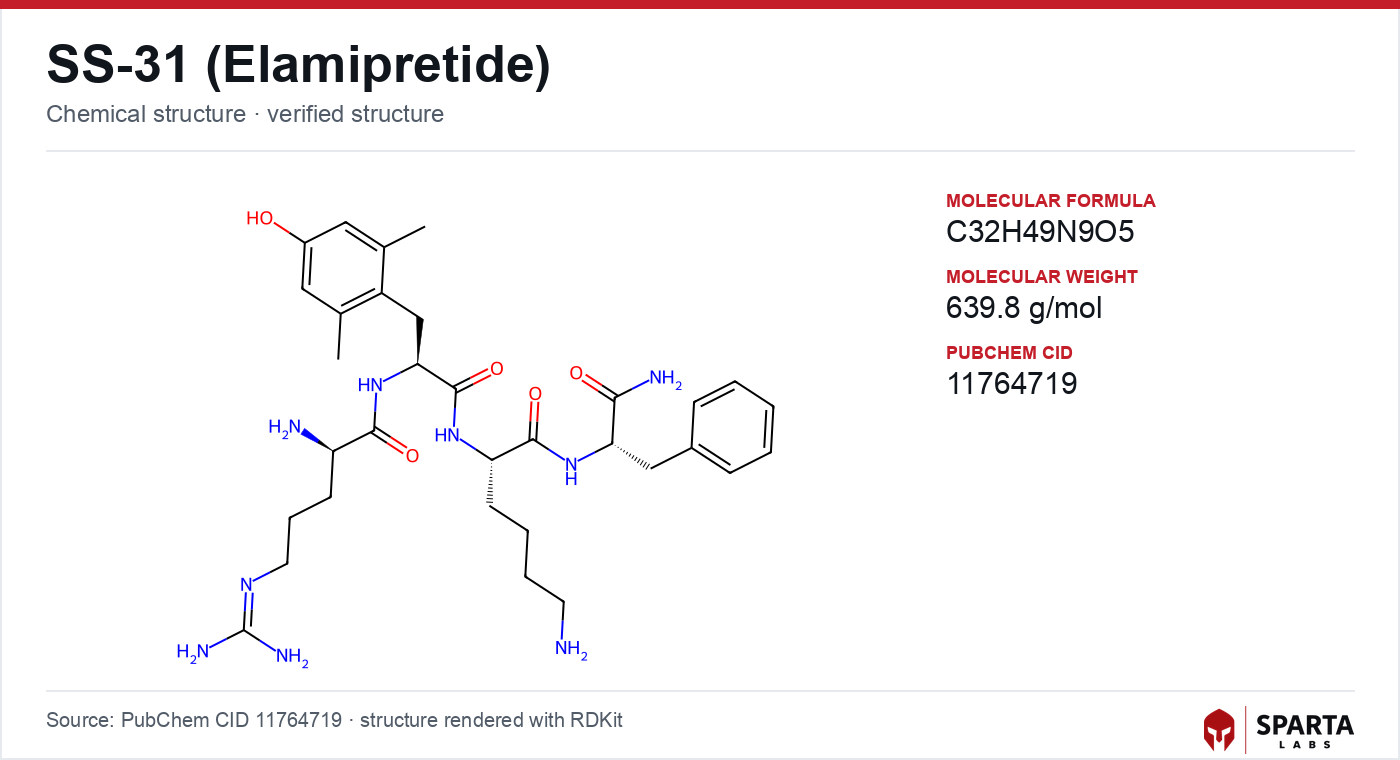
Figure: chemical structure of SS-31.
From Sequence to Target: Why an Aromatic-Cationic Peptide Finds Cardiolipin
The reported mechanism of SS-31 is best read out of its four-residue sequence rather than treated as a separate property. Zhao and colleagues, characterizing the SS family of peptides in 2004, reported that the alternating aromatic-cationic motif is the structural feature that directs these peptides to the IMM. The basic residues (D-arginine and lysine; formal charge +3) were reported to mediate electrostatic attraction to the negatively charged head groups of cardiolipin, while the aromatic residues (2',6'-dimethyltyrosine and phenylalanine) participate in hydrophobic and pi-electron contacts with the acyl-chain region of the bilayer [1].
Findings from research models do not establish safety or efficacy in humans. Sparta Labs makes no claims about the use of this compound.
Two consequences of this targeting logic recur throughout the later literature. First, accumulation at the IMM was reported to be largely independent of mitochondrial membrane potential, which distinguishes SS-31 from cationic lipophilic compounds such as triphenylphosphonium-conjugated antioxidants that rely on the membrane potential to accumulate [1]. Second, the target is a lipid that is itself scarce and compartment-specific: cardiolipin is a bis-phosphatidylglycerol phospholipid that constitutes roughly a fifth of IMM phospholipid mass and is effectively confined to that membrane, giving the peptide a naturally restricted distribution.
The Cardiolipin Interaction, Measured Biophysically
Biophysical work in 2020 tested the electrostatic model directly. Mitchell and colleagues used fluorescence spectroscopy and zeta-potential measurements and reported that SS-31 partitions into the interfacial region of cardiolipin-containing membranes, with the degree of association tracking membrane surface charge density [2]. The authors reported that SS-31 measurably altered the surface electrostatics of both model lipid bilayers and mitochondrial membranes isolated from cardiac tissue, consistent with the charge-driven mechanism proposed from the sequence.
This measurement matters mechanistically because it reframes the interaction as one with a membrane region rather than a single binding pocket. A peptide that redistributes at an interface can, in principle, influence any process sensitive to local charge at that interface, an idea that reappears when the interactome data are considered below.
The Cytochrome c Peroxidase Switch
The most developed node in the SS-31 mechanism literature is its reported effect on the cardiolipin-cytochrome c interaction. Cytochrome c is a small soluble heme protein that normally shuttles electrons between Complexes III and IV of the ETC. Under oxidative stress, cardiolipin peroxidation has been reported to reconfigure cytochrome c into a cardiolipin peroxidase, an activity linked to further reactive oxygen species (ROS) production, cardiolipin degradation, and, through cytochrome c release into the cytosol, initiation of apoptosis [3].
Birk, Chao, Bracken, Warren, and Szeto reported in 2014 that SS-31 binding to cardiolipin inhibited this peroxidase activity while preserving the electron-carrier function of cytochrome c [3]. The authors proposed that SS-31 occupies interaction sites on the cardiolipin acyl chains and thereby helps maintain the heme iron in an electron-carrier rather than peroxidase configuration. In the same models, SS-31 treatment was reported to be associated with preservation of cristae ultrastructure under stress, consistent with cardiolipin's structural role in shaping the IMM.
Szeto summarized this framework in a 2014 review, describing SS-31 as a cardiolipin-protective compound on the basis of its reported ability to stabilize cardiolipin against peroxidation without altering membrane potential or disrupting ETC function under non-stressed conditions [4]. This proposed selectivity, acting on the damaged state while leaving the resting state largely unchanged, is the mechanistic feature the review emphasized.
Reported Consequences for Electron Flux and ATP Synthesis
Downstream of the cardiolipin-cytochrome c node, several studies reported associations between SS-31 and ETC function. Birk and colleagues reported that, in isolated cardiac mitochondria under oxidative stress, SS-31 was associated with an observed optimization of electron flux through the cytochrome c/cardiolipin segment of the chain, including increased state 3 (ADP-stimulated) respiration and ATP production relative to untreated controls [3].
Chatfield and colleagues extended these observations to human tissue in 2019. In freshly explanted failing human ventricular myocardium, elamipretide treatment was reported to be associated with increases in mitochondrial oxygen flux and in Complex I and Complex IV enzymatic activities, including supercomplex-associated Complex IV activity, compared with vehicle-treated tissue from the same hearts [5]. The methodology is worth noting for how the mechanism is read: paired tissue from a single heart controls for donor variability, so the reported differences were attributed to the treatment rather than to differences between organs. The SS-31 published research summary collects the study-by-study detail behind these observations.
Interactome Mapping: A Membrane-Reorganization Model
A 2020 study in the Proceedings of the National Academy of Sciences approached the mechanism from the protein side. Chavez and colleagues applied chemical cross-linking combined with mass spectrometry to map the SS-31 interactome within intact mitochondria and reported that identified binding partners clustered around ATP synthase (Complex V) and proteins of the 2-oxoglutarate metabolic pathway, with cardiolipin proposed as the anchoring lipid mediating these associations [6]. The authors interpreted the pattern as consistent with a model in which cardiolipin binding reorganizes the local protein environment of the IMM to support ATP synthesis, rather than acting through one discrete protein.
Read together with the electrostatic measurements, the interactome data support a layered picture: a lipid-anchored peptide that alters interfacial charge and thereby the local arrangement of charge-sensitive membrane proteins. This distinguishes the proposed SS-31 mechanism from mitochondrial approaches that act on soluble cofactor pools, such as the sirtuin- and PARP-linked signaling discussed in the NAD+ mechanism of action article, and from mitochondrial-derived peptide signaling covered in the MOTS-c mechanism of action article. Batch-specific analytical documentation for laboratory reference use is listed on the SS-31 product page.
Open Mechanistic Questions
The mechanistic literature has grown considerably since the 2004 sequence characterization, and several questions remain open. The precise stoichiometry of the SS-31-cardiolipin interaction under physiological conditions in intact cells has not been definitively established. The relative contributions of peroxidase inhibition, protein-environment reorganization, and interfacial electrostatic modulation to any given experimental outcome remain under investigation in unified systems, and much of the interactome work was performed in isolated mitochondria that may not fully capture in-cell dynamics [6].
Clinical-model heterogeneity is a further prompt for mechanistic work. The MMPOWER-3 trial in primary mitochondrial myopathy reported, in a pre-specified subgroup analysis, a numerically greater response among participants with nuclear DNA mutations than among those with mitochondrial DNA mutations [7]. The molecular basis for such genotype-linked differences is among the hypotheses being examined and illustrates why a lipid-anchored mechanism may interact differently with distinct underlying mitochondrial defects. Regulatory and discovery context for these programs is summarized in the SS-31 discovery and regulatory history article.
References
-
Zhao K, Zhao G-M, Wu D, Soong Y, Birk AV, Schiller PW, Szeto HH. Cell-permeable peptide antioxidants targeted to inner mitochondrial membrane inhibit mitochondrial swelling, oxidative cell death, and reperfusion injury. J Biol Chem. 2004;279(33):34682-34690. PMID: 15178689. DOI: 10.1074/jbc.M402999200. PubMed
-
Mitchell W, Ng EA, Tamucci JD, Boyd KJ, Sathappa M, Coscia A, et al. The mitochondria-targeted peptide SS-31 binds lipid bilayers and modulates surface electrostatics as a key component of its mechanism of action. J Biol Chem. 2020;295(21):7452-7469. PMID: 32321821. PMCID: PMC7247319. DOI: 10.1074/jbc.RA119.012094. PubMed
-
Birk AV, Chao WM, Bracken C, Warren JD, Szeto HH. Targeting mitochondrial cardiolipin and the cytochrome c/cardiolipin complex to promote electron transport and optimize mitochondrial ATP synthesis. Br J Pharmacol. 2014;171(8):2017-2028. PMID: 24134698. DOI: 10.1111/bph.12468. PubMed
-
Szeto HH. First-in-class cardiolipin-protective compound as a therapeutic agent to restore mitochondrial bioenergetics. Br J Pharmacol. 2014;171(8):2029-2050. PMID: 24117165. DOI: 10.1111/bph.12461. PubMed
-
Chatfield KC, Sparagna GC, Chau S, Phillips EK, Ambardekar AV, Aftab M, et al. Elamipretide improves mitochondrial function in the failing human heart. JACC Basic Transl Sci. 2019;4(2):147-157. PMID: 31061916. PMCID: PMC6488757. DOI: 10.1016/j.jacbts.2018.12.005. PubMed
-
Chavez JD, Tang X, Campbell MD, Bhatt U, Grob MS, Sullivan BN, et al. Mitochondrial protein interaction landscape of SS-31. Proc Natl Acad Sci USA. 2020;117(26):15363-15373. PMCID: PMC7334473. DOI: 10.1073/pnas.2002250117. PubMed
-
Karaa A, Bertini E, Carelli V, Cohen BH, Enns GM, Falk MJ, et al. Efficacy and safety of elamipretide in individuals with primary mitochondrial myopathy: the MMPOWER-3 randomized clinical trial. Neurology. 2023;101(1):e42-e54. PMCID: PMC10382259. DOI: 10.1212/WNL.0000000000207402. PubMed
Disclaimer. Statements in this article have not been evaluated by the Food and Drug Administration. This compound is not intended to diagnose, treat, cure, or prevent any disease. Sparta Labs sells research-use-only materials. Content is provided for educational and informational purposes only and does not constitute medical advice. Consult a qualified medical professional for any health concerns.
Frequently asked questions
What is the reported primary target of SS-31 (elamipretide)?
Published research identifies cardiolipin at the inner mitochondrial membrane as the reported primary target of SS-31, rather than a conventional cell-surface receptor. Zhao and colleagues characterized the aromatic-cationic tetrapeptide as concentrating at this membrane through electrostatic and hydrophobic contacts. The interaction has been described as reversible and largely independent of mitochondrial membrane potential.
Why does the SS-31 amino acid sequence matter to its mechanism?
The reported mechanism follows directly from the D-Arg-Dmt-Lys-Phe-NH2 sequence, which alternates basic and aromatic residues. The basic residues (D-arginine, lysine) carry a formal +3 charge that is reported to draw the peptide toward negatively charged cardiolipin head groups, while the aromatic residues insert near the acyl chains. This aromatic-cationic pattern is the structural basis literature gives for cardiolipin selectivity.
What is the cytochrome c 'peroxidase switch' that SS-31 research describes?
Under oxidative stress, cardiolipin peroxidation is reported to reconfigure cytochrome c from an electron carrier into a cardiolipin peroxidase, an activity linked to reactive oxygen species amplification and apoptosis initiation. Birk and colleagues reported that SS-31 binding to cardiolipin inhibited this peroxidase activity while preserving the electron-carrier role. This proposed stabilization of the cardiolipin-cytochrome c complex is central to the published mechanistic model.
What has interactome mapping added to the SS-31 mechanism literature?
A 2020 study in the Proceedings of the National Academy of Sciences used chemical cross-linking with mass spectrometry to map SS-31 contacts inside intact mitochondria. The authors reported that identified binding partners clustered around ATP synthase and 2-oxoglutarate pathway proteins, with cardiolipin proposed as the anchoring lipid. The work reframed the mechanism as reorganization of the local protein environment of the membrane rather than a single-protein interaction.