
TB-500: Discovery and Regulatory History
TB-500's history is a case of mistaken identity: thymosin beta-4 was first characterized as a thymic hormone, then recharacterized as an intracellular actin buffer. This timeline traces that pivot, the mapping of the LKKTETQ fragment, RegeneRx clinical development, and WADA regulatory classification. Educational reference.

For research use only. Not for human consumption. This article is educational reference material. It is not medical advice and is not a recommendation to use any substance.
From Thymic Hormone to Actin Buffer: Why TB-500's History Is a Story of Mistaken Identity
The research compound marketed as TB-500 is the synthetic, N-terminally acetylated heptapeptide Ac-LKKTETQ, corresponding to residues 17 through 23 of thymosin beta-4 (Tβ4). Its documented history is unusual among research peptides because the parent molecule was characterized twice under two incompatible scientific frameworks: first as a secreted thymic hormone governing lymphocyte maturation, and later as an intracellular actin-sequestering protein present in nearly every cell type. TB-500 inherited its research identity from that second, revisionist understanding. This article traces the timeline chronologically, from the endocrine thymus program of the 1960s through the actin reinterpretation, the fragment-mapping that isolated LKKTETQ, the RegeneRx clinical divergence, and the anti-doping analytical work that fixed TB-500's regulatory status. It draws only on peer-reviewed and regulatory primary sources. The complementary TB-500 research overview summarizes the compound's contemporary classification, while a parallel discovery timeline for the gastric-origin peptide BPC-157 shows how two regenerative research peptides reached similar contexts along entirely separate scientific lineages.
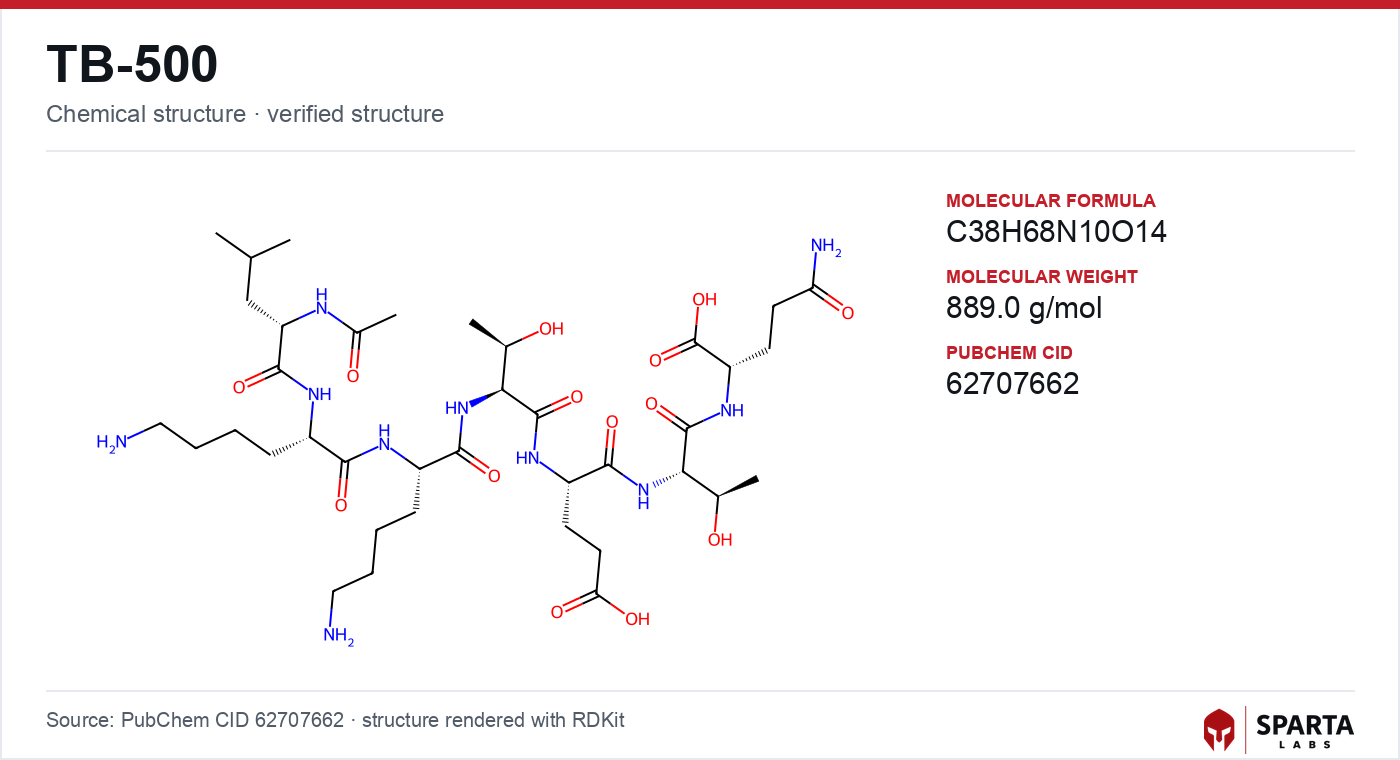
Figure: chemical structure of TB-500 (Ac-LKKTETQ).
The Endocrine Thymus Era and the First Framework (1960s–1981)
The scientific lineage of TB-500 begins with the effort to establish the thymus as an endocrine organ rather than a purely lymphoid tissue. Work in the early 1960s in the laboratory of Abraham White at the Albert Einstein College of Medicine in New York, later carried forward by Allan L. Goldstein at the University of Texas and then at the George Washington University School of Medicine, sought to identify soluble thymic factors. Goldstein's group characterized "thymosin" as a partially purified thymic fraction capable of inducing terminal deoxynucleotidyl transferase (TdT) activity in immature thymocyte populations, framing these peptides as developmental signals for immune cells [1].
This first framework was firmly endocrine: thymosin fractions were treated as circulating hormones analogous to other glandular secretions. Fractionation through the 1970s resolved the crude preparation into distinct polypeptides, and the individual molecules were named systematically by isoelectric point, producing the alpha and beta thymosin designations still used today.
The parent molecule of TB-500 entered the literature under its current name in 1981, when Low, Hu, and Goldstein published the complete amino acid sequence of thymosin beta-4 in the Proceedings of the National Academy of Sciences USA, describing a 43-residue peptide isolated from calf thymus [2]. That sequence report is the fixed reference point from which the LKKTETQ fragment was later numbered.
Findings from research models do not establish safety or efficacy in humans. Sparta Labs makes no claims about the use of this compound.
The Actin Reinterpretation: A Compound Recharacterized (1982–1993)
The endocrine interpretation of Tβ4 did not survive the following decade. The first pressure came from tissue-distribution data. In 1982, Hannappel, Xu, Morgan, Hempstead, and Horecker reported in the Proceedings of the National Academy of Sciences USA that Tβ4 was present not only in thymus but in spleen, brain, lung, liver, and heart muscle of rats and mice, with particularly high concentrations in peritoneal macrophages [3]. A molecule distributed that ubiquitously, and found at high intracellular concentration, was difficult to reconcile with a role as a secreted thymus-specific hormone.
The decisive reinterpretation was biochemical. In 1991, Safer, Elzinga, and Nachmias published in the Journal of Biological Chemistry the finding that Tβ4 was indistinguishable from "Fx," an actin-sequestering peptide that had been characterized independently in a separate cytoskeletal-biology research line [4]. Their work demonstrated 1:1 stoichiometric binding to monomeric G-actin that inhibited its polymerization, establishing Tβ4 as the principal cytoplasmic buffer for unpolymerized actin in human polymorphonuclear leukocytes. Two research programs that had proceeded in parallel under different names had, in fact, been studying the same molecule.
This convergence reframed the entire compound class. Tβ4 was no longer read primarily as an immune hormone but as an intracellular cytoskeletal regulator, and its ubiquitous tissue distribution now made sense. The mechanistic detail underlying this shift is developed further in the TB-500 mechanism of action article; for the purposes of history, the 1991 paper is the pivot on which the compound's identity turned.
Mapping LKKTETQ: The Birth of the Fragment (early–mid 1990s)
With actin binding established as the operative interpretive frame, attention turned to which portion of the 43-residue sequence was responsible for the sequestering activity. Safer and colleagues conducted systematic fragment-mapping using biochemical assays of actin binding. In work published in Cell Motility and the Cytoskeleton in 1993, the LKKTETQ motif spanning residues 17 through 23 was identified as the minimal sequence retaining substantial actin-sequestering activity in the DNase I inhibition assay [5].
That fragment is the intellectual origin of TB-500. The synthetic research compound is the acetylated form of exactly this seven-residue actin-binding motif rather than the intact 43-residue parent. Distinguishing the fragment from the full-length peptide is essential for reading the later literature correctly: clinical development programs used the intact Tβ4 molecule, whereas commercial research preparations of TB-500 correspond to the short LKKTETQ segment mapped in the early 1990s.
Clinical Development of the Parent Peptide: The RegeneRx Programs (2000s–2022)
Therapeutic interest in the intact Tβ4 molecule developed alongside the mechanistic work, and it proceeded through a formal corporate and regulatory pathway that TB-500 itself never entered. Early attention centered on the cornea. Studies by Sosne, Szliter, Kleinman, and colleagues published in 2001 and 2002 reported that topical Tβ4 was associated with wound closure in rabbit corneal injury models [6].
RegeneRx Biopharmaceuticals, Inc., a company established with scientific input from Allan Goldstein, advanced two intact-Tβ4 formulations through Investigational New Drug (IND) applications and clinical trials: RGN-259, an ophthalmic solution, and RGN-352, an injectable. The two programs produced markedly different translational outcomes, which is itself an instructive feature of this compound's history.
On the ophthalmic side, a Phase 2 trial of RGN-259 for dry eye disease reported by Sosne, Dunn, and Kim in Cornea in 2015 used a randomized, double-masked, placebo-controlled design and reported statistically significant differences on composite dry eye endpoints without serious adverse events attributed to the compound [7]. That result supported advancement to a Phase 3 trial in neurotrophic keratopathy, published by Bonini, Sheha, Hamrah, and colleagues in Clinical Ophthalmology in 2022, which reported greater proportional healing in the active arm versus placebo over four weeks [8]. As of publicly available records this is the most advanced clinical evaluation published for a Tβ4-derived compound, and neither formulation has received FDA marketing approval.
The injectable program tells the contrasting half of the story. A Phase 2 trial of RGN-352 in acute myocardial infarction patients (NCT01311518) was conducted by RegeneRx; the compound was reported as tolerated, but the cardiac functional outcomes observed in preclinical models were not replicated in that trial population. This preclinical-to-clinical gap is a recurring pattern in cardiac regeneration research generally, and it marks a clear boundary between what has been reported in animal models and what has been observed in human trials for this compound class.
Fixing the Regulatory Status: Anti-Doping Analysis (2012–present)
The synthetic Ac-LKKTETQ fragment entered the commercial research-peptide market independently of the RegeneRx clinical programs and is not associated with any IND application or controlled clinical development. Its regulatory identity was instead established largely through anti-doping analytical chemistry.
In 2012, Görgens, Guddat, Schänzer, and Thevis published the synthesis and structural characterization of the N-terminal acetylated 17–23 fragment of Tβ4 in Drug Testing and Analysis, explicitly identifying it as the compound found in commercial TB-500 preparations and confirming its molecular identity against a reference standard [9]. Weidemann and colleagues followed in 2013 with validated LC-MS/MS methods for detecting Ac-LKKTETQ in equine urine and plasma at sub-nanogram-per-milliliter concentrations [10], reflecting the compound's prominence in equine sport as well as human anti-doping contexts.
On the regulatory side, the World Anti-Doping Agency (WADA) lists thymosin beta-4 and its derivatives, including TB-500, on the Prohibited List under the S2 category (Peptide Hormones, Growth Factors, Growth Factor Mimetics, and Related Substances), classifying them as growth factor modulators; the prohibition applies both in-competition and out-of-competition [11]. Analytical documentation for verified research-grade material is discussed alongside the product listing, TB-500 offered by Sparta Labs, and the corresponding purity and verification standards are described in the TB-500 sourcing and quality reference.
The Contemporary Research Landscape
As of available published records, investigation of Tβ4 and its LKKTETQ fragment continues across the corneal, cardiac, and neurological domains that defined its earlier history. The RGN-259 program reached Phase 3 in 2022, and basic-science work on the Tβ4/actin axis remained active through the peer-reviewed literature of 2023 through 2025.
The trajectory has also moved beyond the intact parent sequence. A 2025 study on engineered tandem thymosin peptides published in Translational Vision Science and Technology illustrates how investigators have begun constructing modified variants with altered structural properties rather than working with the native molecule alone [12]. TB-500 itself remains a research-use-only compound with no approved therapeutic indication, and studies summarized in the TB-500 published research article place the fragment within that ongoing scientific record.
References
-
Goldstein AL, Guha A, Zatz MM, Hardy MA, White A. Purification and biological activity of thymosin, a hormone of the thymus gland. Proc Natl Acad Sci USA. 1972;69(7):1800–1803. PMID: 4624140. View on PubMed
-
Low TL, Hu SK, Goldstein AL. Complete amino acid sequence of bovine thymosin beta 4: a thymic hormone that induces terminal deoxynucleotidyl transferase activity in thymocyte populations. Proc Natl Acad Sci USA. 1981;78(2):1162–1166. PMID: 6940133. View on PubMed
-
Hannappel E, Xu S, Morgan J, Hempstead J, Horecker BL. Thymosin beta 4: a ubiquitous peptide in rat and mouse tissues. Proc Natl Acad Sci USA. 1982;79(7):2172–2175. PMC346152. Full text on PMC
-
Safer D, Elzinga M, Nachmias VT. Thymosin beta 4 and Fx, an actin-sequestering peptide, are indistinguishable. J Biol Chem. 1991;266(7):4029–4032. PMID: 1999398. View on PubMed
-
Safer D, Chowrashi PK. Actin-sequestering ability of thymosin beta 4, thymosin beta 4 fragments, and thymosin beta 4-like peptides as assessed by the DNase I inhibition assay. Cell Motil Cytoskeleton. 1993;25(4):329–335. PMID: 8471179. View on PubMed
-
Sosne G, Szliter EA, Barrett R, Kleinman HK, Bhattacharya B. Thymosin beta 4 promotes corneal wound healing and decreases inflammation in vivo following alkali injury. Exp Eye Res. 2002;74(2):293–299. PMID: 11950239. View on PubMed
-
Sosne G, Dunn SP, Kim C. Thymosin β4 significantly improves signs and symptoms of severe dry eye in a phase 2 randomized trial. Cornea. 2015;34(5):491–496. PMID: 25826322. View on PubMed
-
Bonini S, Sheha H, Hamrah P, et al. 0.1% RGN-259 (Thymosin ß4) Ophthalmic Solution promotes healing and improves comfort in neurotrophic keratopathy patients in a randomized, placebo-controlled, double-masked Phase III clinical trial. Clin Ophthalmol. 2022;16:4295–4310. PMC9820614. Full text on PMC
-
Görgens C, Guddat S, Schänzer W, Thevis M. Synthesis and characterization of the N-terminal acetylated 17-23 fragment of thymosin beta 4 identified in TB-500, a product suspected to possess doping potential. Drug Test Anal. 2012;4(11):871–876. PMID: 22962027. View on PubMed
-
Weidemann S, Görgens C, Dib J, Düe M, Guddat S, et al. Doping control analysis of TB-500, a synthetic version of an active region of thymosin β4, in equine urine and plasma by liquid chromatography-mass spectrometry. Drug Test Anal. 2013;5(6):441–449. PMID: 23084823. View on PubMed
-
World Anti-Doping Agency. The Prohibited List 2024. Montreal: WADA; 2024. Source: wada-ama.org
-
Wu H, Kim J, Kwon M, et al. Engineered tandem thymosin peptide promotes corneal wound healing. Transl Vis Sci Technol. 2025;14(1):16. PMID: 41235866. View on PubMed
Disclaimer. Statements in this article have not been evaluated by the Food and Drug Administration. This compound is not intended to diagnose, treat, cure, or prevent any disease. Sparta Labs sells research-use-only materials. Content is provided for educational and informational purposes only and does not constitute medical advice. Consult a qualified medical professional for any health concerns.
Frequently asked questions
What is TB-500 and how does it relate to thymosin beta-4?
TB-500 is the synthetic, N-terminally acetylated heptapeptide Ac-LKKTETQ, corresponding to residues 17 through 23 of thymosin beta-4 (Tβ4). Tβ4 is a 43-residue peptide whose complete sequence was published by Low, Hu, and Goldstein in 1981. TB-500 represents the short actin-binding fragment of that parent molecule rather than the intact protein.
Why was thymosin beta-4 recharacterized during its research history?
Thymosin beta-4 was first framed in the 1960s and 1970s as a secreted thymic hormone involved in lymphocyte development. In 1982 it was found distributed ubiquitously across many tissues, and in 1991 Safer, Elzinga, and Nachmias reported it was indistinguishable from the actin-sequestering peptide Fx. This reinterpreted Tβ4 as an intracellular cytoskeletal regulator rather than a circulating hormone.
How was the LKKTETQ fragment identified?
After actin binding was established as the operative framework, Safer and colleagues used biochemical fragment-mapping to locate the active region. Work published in Cell Motility and the Cytoskeleton in 1993 identified LKKTETQ (residues 17–23) as the minimal sequence retaining substantial actin-sequestering activity in the DNase I inhibition assay, which is the sequence used in the synthetic TB-500 research compound.
What clinical development involved thymosin beta-4?
RegeneRx Biopharmaceuticals advanced two intact-Tβ4 formulations. The ophthalmic RGN-259 reached a Phase 3 neurotrophic keratopathy trial published in Clinical Ophthalmology in 2022 reporting greater proportional healing than placebo. The injectable RGN-352 was evaluated in a Phase 2 acute myocardial infarction trial where preclinical cardiac outcomes were not replicated. Neither formulation has FDA marketing approval.
What is TB-500's status on the WADA Prohibited List?
The World Anti-Doping Agency lists thymosin beta-4 and its derivatives, including TB-500, under the S2 category as growth factor modulators, prohibited both in-competition and out-of-competition. Analytical work by Görgens et al. in 2012 and Weidemann et al. in 2013 established reference standards and LC-MS/MS detection methods that supported this classification.